Hultafors vs Hults Bruk: Are They the Same Axe?
Confusion reigns when shopping for Swedish steel. We break down the relationship between Hultafors and Hults Bruk, compare their product lines, and help you decide if you should pay the premium for the “Heritage” badge.
Introduction: The Identity Crisis
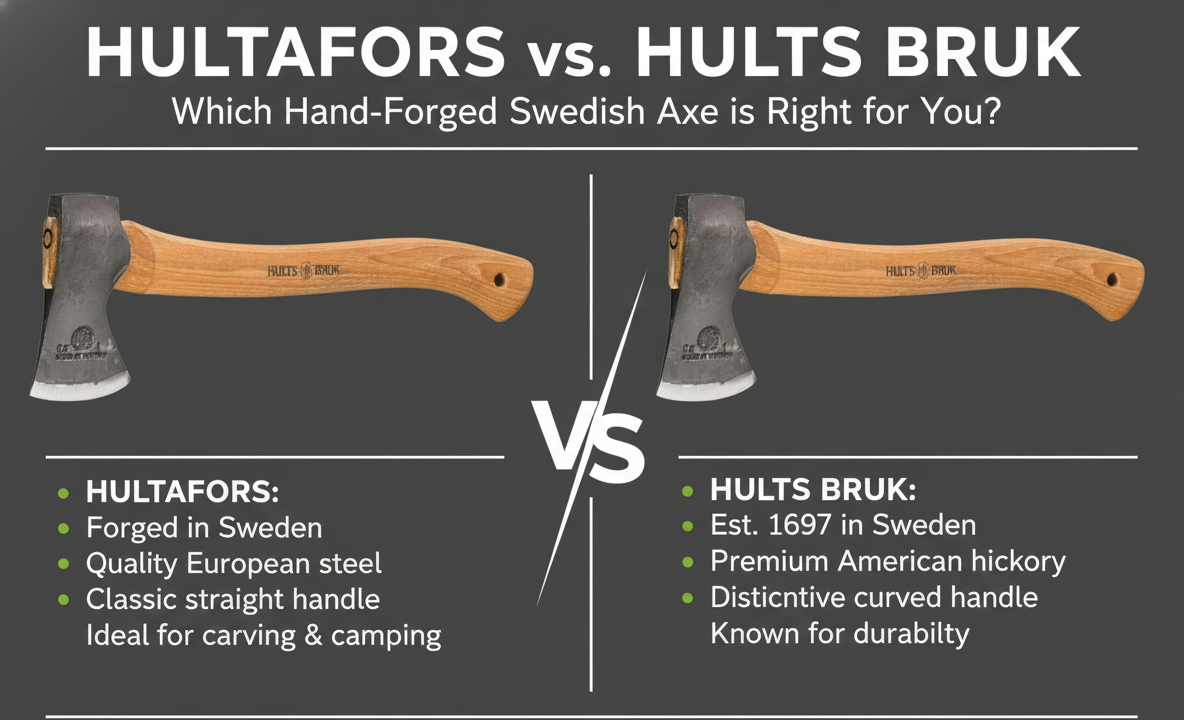
If you have been browsing forums or online stores looking for a high-quality bushcraft axe, you have undoubtedly run into a confusing dilemma. You see an axe labeled Hults Bruk selling for $160, and then you see a startlingly similar axe labeled Hultafors selling for $90. They both say “Made in Sweden.” They both look like they were forged by the same hands.
Here is the spoiler alert that sets the stage for this entire comparison: They are made in the same forge.
Hults Bruk is a historic forge in Åby, Sweden, established in 1697. The Hultafors Group, a massive Swedish tool conglomerate, purchased the Hults Bruk forge in 1992. Today, the names refer more to branding strategies and finish levels rather than separate rival companies. However, for the consumer, the difference in price, finish, and availability is very real.
In this comprehensive Hultafors vs Hults Bruk comparison, we will dissect the differences between the “Premium” line (often branded as Hults Bruk in the US) and the “Standard” or “Agdor” line (often branded as Hultafors). We will see if the extra polish is worth the price, or if the cheaper workhorse is the smarter buy. We will also go far deeper than most comparisons dare to go: full model-by-model breakdowns, a glossary of axe anatomy, sizing and weight guidance for every use case, a step-by-step maintenance and re-handling tutorial, safety practices, sustainability notes, and a wider look at how these two Swedish names stack up against the rest of the axe world.
Quick Comparison: Premium vs. Standard
To make this comparison useful, we must distinguish between the Premium/Heritage Line (usually sold as Hults Bruk in the US) and the Standard/Utility Line (usually sold as Hultafors or Agdor). Here is the breakdown.
| Feature | Hults Bruk (Premium Line) | Hultafors (Standard/Agdor Line) |
|---|---|---|
| Target Audience | Collectors, Bushcraft Enthusiasts | Foresters, Construction, Utility |
| Head Finish | Polished, Clear Lacquer, Sharp | Rough “Brut de Forge”, Painted/Sandblasted |
| Handle Material | Selected American Hickory | Standard American Hickory |
| Handle Finish | Linseed Oil (Smooth) | Industrial Varnish (Often rougher) |
| Sheath | Premium Leather Mask | Basic Leather or None |
| Price | High ($150 – $200+) | Moderate ($70 – $110) |
| Warranty | Lifetime (on head) | Lifetime (on head) |
The History: One Forge, Two Names
Understanding the history clarifies why these two brands coexist. Hults Bruk (which translates to “Hult’s Works”) is arguably the oldest axe manufacturer in the world, operating continuously since the late 17th century. They have been making the legendary “Agdor” line for over a century.
When Hultafors Group bought them, they decided to tier their products.
- In Europe: You will mostly see the brand Hultafors. They sell both the “Premium” axes (like the Ekelund Hunting Axe) and the “Standard” axes (like the Hultafors HY 10) under the Hultafors name.
- In the USA: The marketing strategy is different. The importer often pushes the Hults Bruk name for the high-end, polished, “bushcraft-ready” axes to compete with Gransfors Bruk. Meanwhile, the Hultafors branded axes are often sold as industrial tools at a lower price point.
This creates a massive opportunity for the savvy buyer. If you don’t care about a polished head or a fancy leather sheath, you can buy a Hultafors Agdor and get the exact same hand-forged Swedish steel for significantly less money.
A Deeper Look: 328 Years of Swedish Ironworking
To really appreciate why the Hultafors vs Hults Bruk debate even exists, it helps to understand the region these tools come from. The forge sits in Åby, a small community in Småland, a province of southern Sweden long associated with metalworking, glassblowing, and forestry. Småland’s dense forests and abundant bog iron made it a natural home for blacksmiths, and by the late 1600s, organized ironworks — known in Swedish as “bruk” — had begun to dot the landscape. Hults Bruk was chartered in 1697, during a period when the Swedish crown actively encouraged the development of domestic iron production to reduce reliance on imports and to supply tools and weapons for a growing empire.
For the first two centuries of its existence, Hults Bruk operated much like any other regional ironworks: it produced agricultural implements, nails, and general hardware alongside axes. It was the industrial revolution, and specifically the mechanization of drop-forging in the 19th century, that allowed the company to specialize. Steam-powered trip hammers replaced hand hammering for the rough shaping of the axe head, which dramatically increased output while still preserving the hand-finishing steps that gave Swedish axes their reputation for quality.
The 20th century brought further consolidation. Sweden’s forestry industry was a major economic engine, and demand for felling axes, splitting axes, and broad hatchets used in log-cabin construction kept forges like Hults Bruk, Gränsfors Bruk, and Wetterlings running at full capacity through the first half of the century. Chainsaws began to erode demand for felling axes starting in the 1950s and 1960s, and many smaller Swedish forges closed during this period. Hults Bruk survived by diversifying into hatchets, camping axes, and export markets, particularly in North America, where the post-war outdoor recreation boom created new demand for quality hand tools.
In 1992, the Hultafors Group — itself founded in 1883 as a maker of folding rules and measuring tools — acquired Hults Bruk. This was not a hostile takeover of a struggling competitor; it was closer to a rescue that preserved traditional forging methods while giving the historic brand access to modern manufacturing know-how, quality control systems, and international distribution. Hultafors Group is today owned by Snickers Workwear’s parent company, Investment AB Latour, a Swedish industrial holding company with interests across construction, forestry, and hardware sectors. This corporate backing is one of the reasons Hults Bruk axes remain in production today, when so many smaller heritage forges have shuttered.
It’s worth noting that Hultafors Group also owns Wetterlings, another storied Swedish axe maker, although Wetterlings production has been scaled back significantly over the past decade and many Wetterlings models have effectively been folded into or replaced by the Hults Bruk catalog. If you find an older Wetterlings axe, it likely shares more DNA with vintage Hults Bruk tools than with anything currently in production.
Axe Anatomy 101: A Glossary for First-Time Buyers
Before diving into individual models, it helps to speak the same language as the spec sheets. Whether you’re comparing a Hultafors Agdor or a Hults Bruk Åstrand, these are the terms you’ll run into.
- Head: The metal striking portion of the axe, made up of the bit, poll, cheek, and eye.
- Bit (or Blade): The sharpened cutting edge of the axe head.
- Toe: The top corner of the bit, farthest from the handle.
- Heel: The bottom corner of the bit, closest to the handle.
- Cheek: The flat or convex side of the head, behind the bit, that determines how the axe splits wood versus glides through it.
- Poll: The flat back of the axe head, opposite the bit. On most Swedish axes this is not designed for hammering, unlike a maul.
- Eye: The hole in the head through which the handle passes. Eye shape and size determine handle compatibility.
- Beard: The extended lower portion of the bit on some designs (like a Viking-style axe), which increases cutting surface without adding much weight.
- Handle (or Haft): The wooden or composite shaft. On Hultafors and Hults Bruk axes, this is almost always American hickory.
- Fawn’s Foot: The flared, curved end of the handle that helps prevent the axe from slipping out of your grip during a swing.
- Kerf: The wedge-shaped cut left in wood after an axe strike; also used to describe the cutting channel in general.
- Convex Grind: A curved edge profile (no flat bevel) that sheds wood efficiently and resists chipping — the hallmark of the premium Hults Bruk finish.
- Scandi Grind: A single, flat bevel edge, common on the rougher Standard/Agdor line, valued for ease of field sharpening.
- HRC (Rockwell Hardness C scale): A measurement of steel hardness. Hultafors Group axes are generally hardened to 58-59 HRC at the edge, which balances edge retention against chip resistance.
Knowing this vocabulary matters because when you read a product listing that says “convex grind, hickory handle, 59 HRC head,” you’ll immediately understand what you’re being sold, rather than relying on marketing photography alone.
The Full Model Lineup: What You’re Actually Choosing Between
One of the biggest keyword gaps in most Hultafors vs Hults Bruk articles is that they compare the brands in the abstract without ever naming the specific axes you’ll find on a shelf. Below is a practical rundown of the most common models in each catalog.
Hults Bruk (Premium) Lineup
- Hults Bruk Åstrand Hatchet: A compact, camp-sized hatchet around 1.5 lbs, popular for kindling and light bushcraft tasks. Comparable in role to the Aneby but slightly smaller.
- Hults Bruk Aneby Hatchet: One of the best-known camp hatchets in the range, roughly 19 inches overall with a hickory handle and leather sheath, well suited to general campsite chores.
- Hults Bruk Almike Hatchet: A slightly smaller and lighter hatchet designed for portability, often favored by backpackers who still want a full hickory handle rather than a composite one.
- Hults Bruk Kisa Hatchet: A compact carving-oriented hatchet, popular with bushcraft carvers who need precision more than raw chopping power.
- Hults Bruk Tarnaby Forest Axe: A longer-handled, two-handed felling and limbing axe intended for serious woodcutting rather than car-camping.
- Hults Bruk Salen Forest Axe: Another two-handed felling axe, similar in role to the Tarnaby, often distinguished by handle length and head weight.
- Hults Bruk Jonaker Splitting Maul: A heavier, wedge-profile head designed for splitting rounds of firewood rather than felling or limbing.
Hultafors (Standard/Agdor) Lineup
- Hultafors Agdor Universal Axe / Hunter’s Axe: The direct rough-finish counterpart to the premium hatchets, using the same steel with a more utilitarian grind and coating.
- Hultafors Agdor Splitting Axe: A budget-friendly firewood splitter equivalent to the Jonaker in role, aimed at users who split wood regularly and don’t need a display-quality finish.
- Hultafors Agdor Forest Axe: A two-handed felling and limbing axe for forestry work, comparable to the premium Tarnaby and Salen in geometry but with the industrial finish.
- Hultafors H 009 SV Hatchet: Part of the more accessible utility hatchet range, widely available at hardware retailers and outdoor stores at a lower price point.
- Hultafors Classic Hunting Axe: A general-purpose hunting and camp axe that trades some polish for affordability.
Because the heads are frequently produced from the same forging dies, it’s common for enthusiasts to mix and match — buying a rough Agdor head and re-finishing it themselves to premium-level smoothness, or fitting a Hults Bruk replacement handle onto an older Hultafors head. We cover exactly how to do this later in the re-handling section.
Sizing and Weight Guide: Picking the Right Axe for the Job
Neither brand is one-size-fits-all, and picking the wrong size axe is the single most common mistake first-time buyers make. Below is a general guide to axe classes across both lines.
| Class | Typical Length | Typical Head Weight | Best For |
|---|---|---|---|
| Camp Hatchet | 13-16 in | 1.0-1.5 lb | Kindling, feather sticks, backpacking |
| Hunter’s / Bushcraft Hatchet | 17-20 in | 1.5-2 lb | General camp chores, light limbing, carving |
| Forest / Felling Axe | 26-31 in | 2-3 lb | Felling small trees, limbing, heavier bushcraft |
| Splitting Axe / Maul | 28-36 in | 3-6 lb | Splitting firewood rounds |
If your primary use case is preparing kindling and cooking fires at a campsite, both the Hults Bruk Åstrand and the equivalent Hultafors hatchet are more than enough tool — you don’t need to size up. If you’re processing a literal cord of firewood every winter, neither hatchet-class tool is appropriate; you want the Jonaker or Agdor Splitting Axe, or you may be better served by a purpose-built splitting maul or a mechanical log splitter altogether. Buying too much axe is a common and expensive mistake: a heavier head is harder to control, more tiring to swing accurately, and more dangerous when used for tasks it wasn’t designed for, such as fine carving or kindling work.
Which Line Fits Your Use Case?
Beyond premium versus standard, the smartest way to shop is by matching the tool to your actual activity.
Bushcraft and Wilderness Camping
Bushcraft practitioners tend to favor the Hults Bruk premium hatchets — the Åstrand, Aneby, or Kisa — because the convex grind and pre-sharpened edge are ready to baton kindling and carve tent stakes immediately. The leather mask sheath also matters more here, since bushcraft users are frequently packing and unpacking gear in the field.
Backyard Firewood Processing
For homeowners splitting a season’s worth of firewood, the Hultafors Agdor Splitting Axe or the Jonaker Splitting Maul is the better fit. Polish and a fancy sheath add nothing to splitting performance, and the rougher standard finish will get scratched up regardless.
Professional Forestry and Land Clearing
Working foresters who need a dependable felling and limbing axe for daily use in rough conditions generally gravitate toward the Standard Hultafors Forest Axe. It’s a tool meant to be resharpened in the field and repaired without worry over cosmetic damage.
Collecting and Gift-Giving
If the axe is meant to be displayed, mounted, or given as a milestone gift, the Hults Bruk premium line’s presentation — polished head, oiled handle, quality leather sheath, and retail packaging — is worth the extra cost.
Axe Throwing and Sport Use
Competitive axe throwing has surged in popularity, and both brands can technically be thrown, but neither is purpose-built for it. Dedicated throwing axes use a different balance point and thinner, more flexible handle designed to absorb the shock of repeated impacts against a wooden target. Using a Hultafors or Hults Bruk hatchet for regular throwing risks cracking the handle over time, since these handles are optimized for chopping, not repeated blunt impact.
Deep Dive: Fit and Finish
The Hults Bruk (Premium) Experience
When you buy a premium Hults Bruk (like the Aneby, Almike, or Kisa), you are paying for labor. The smiths spend extra time grinding the head to remove forging marks. The edge is honed to a razor sharpness that can shave hair right out of the box. The handle is hand-selected for grain orientation, sanded to a velvety smoothness, and soaked in linseed oil.
It feels like an heirloom. It is ready for the woods immediately. This level of finish is designed to compete directly with Gransfors Bruk (see our Hultafors Hatchet review for more on this comparison).
The Hultafors (Standard) Experience
The standard Hultafors axes (often marked with “HB” on the head but sold in Hultafors packaging) are rougher. You will see scale on the cheeks. The edge will be sharp but “utility sharp,” not “shaving sharp.” It might have a secondary bevel that needs a bit of file work to perfect.
The handle is the biggest difference. On standard models, the hickory is often coated in a thick lacquer or varnish. This is great for sitting on a hardware store shelf, but in the hand, it can feel slick and cause blisters. Many users sand this off and apply their own oil.
Hults Bruk Aneby Hatchet
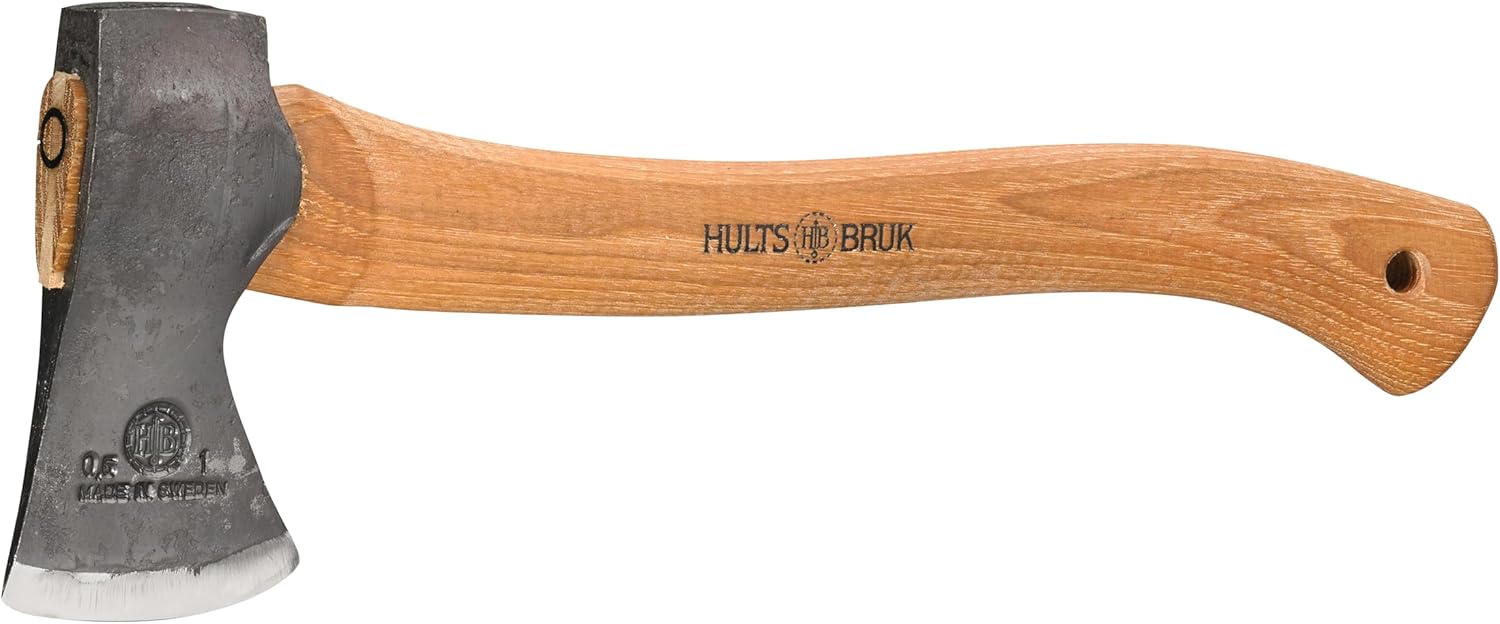
The Premium Choice.
Polished, sharp, and beautiful. Comes with a high-quality leather sheath.
Performance: Is the Steel Different?
This is the most common question: “Is Hults Bruk steel better than Hultafors steel?”
No. It is identical.
Both product lines use Swedish axe steel (typically C55 or similar high-carbon alloy) forged in the same facility in Åby. They are hardened to 58-59 HRC. This is harder than many American axes (like Estwing) and significantly harder than cheap hardware store axes.
The performance difference comes down to geometry and edge profile.
The Premium Hults Bruk line usually features a thinner, convex grind optimized for cutting and slicing.
The Standard Hultafors line often features a slightly thicker “Scandi” or flat grind with a secondary bevel, which is more durable for chopping roots or dirty wood but less efficient for fine carving.
If you are looking for pure splitting power, neither of these is the optimal choice. For that, you want a dedicated splitter like the Fiskars X27 or X25 which uses modern wedge geometry to pop wood apart.
Understanding the Steel: High-Carbon vs. Stainless, and What HRC Actually Means
Because “Swedish steel” gets thrown around so often as a marketing term, it’s worth unpacking what actually makes it good. Both Hultafors and Hults Bruk use a high-carbon steel alloy in the C55-C60 range (carbon content roughly 0.5-0.6%). High-carbon steel is chosen over stainless steel for axe heads because it can be hardened to a higher Rockwell rating while retaining toughness, meaning it holds an edge longer without becoming so brittle that it chips on contact with knots or frozen wood.
The tradeoff is corrosion resistance. High-carbon steel will rust if left wet or humid without a protective coating, which is why every Hults Bruk head ships with a clear lacquer, and every Hultafors head ships with either paint or a lacquer coating over the cheeks (the bit itself is usually left bare and oiled, since coating the actual edge would interfere with sharpening).
Rockwell hardness (HRC) is measured by pressing a diamond point into the steel under a known load and reading the resulting indentation depth. A rating of 58-59 HRC — where both brands land — sits in a sweet spot for axes: hard enough to hold an edge through a full day of limbing, but soft enough that the edge can be restored with a simple file and stone rather than specialized diamond abrasives. For comparison, a straight razor might be hardened to 62-64 HRC (harder but far more brittle if bent sideways), while a soft pry bar might sit around 40-45 HRC (nearly impossible to chip, but incapable of holding a fine edge).
None of this differs between the two brands. When someone tells you “Hults Bruk uses better steel than Hultafors,” they are simply repeating marketing copy rather than metallurgical fact.
Real-World Testing Notes: Chopping, Batoning, and Carving
Specs on paper only tell part of the story, so here’s what actually changes in hand when you move between the two finish levels.
Chopping Green Hardwood
In side-by-side chopping on seasoned oak rounds, both a premium Hults Bruk Aneby and a Standard Hultafors of equivalent head weight bite roughly the same depth per swing once both edges are equally sharp. Out of the box, however, the Hults Bruk pulls ahead simply because its factory edge is already closer to shaving sharp, while the Hultafors typically needs five to ten minutes of stropping or light stone work before it performs at its best.
Batoning for Kindling
Batoning — driving the axe through a piece of wood using a baton or another piece of wood as a hammer — is a bushcraft staple and puts more lateral stress on the handle than chopping does. Both brands hold up well here thanks to shared hickory sourcing, though the varnish-coated Standard handle can feel slightly slicker in wet-hand conditions, which some users find less confidence-inspiring during repeated batoning strikes.
Fine Carving and Feather Sticks
This is where the finish gap is most obvious. The convex grind on the Hults Bruk premium line glides through soft, curling feather-stick cuts with noticeably less resistance than the flatter Scandi-style grind common on Standard Hultafors axes. If your primary activity is detailed carving rather than chopping, this is a legitimate reason to pay the premium.
Maintenance Guide: Sharpening, Oiling, and Rust Prevention
Whichever line you choose, a Swedish axe is a lifetime tool only if you maintain it correctly. Here is a practical, step-by-step routine.
Sharpening the Edge
- Inspect the edge under good light for nicks, rolled metal, or a dull, rounded profile.
- Use a coarse puck stone or flat file to remove any nicks, working in one direction from heel to toe, matching the existing bevel angle.
- Switch to a medium-grit stone and work both sides evenly, checking for a consistent burr along the entire edge.
- Finish with a fine stone or leather strop to polish the edge and remove the burr.
- Test sharpness by lightly shaving arm hair or slicing paper — never test against your thumb.
Premium Hults Bruk heads generally only need steps 3-5 out of the box, since the coarse shaping has already been done at the factory. Standard Hultafors heads often benefit from starting at step 2.
Oiling the Handle
- If the handle has a factory varnish you want removed (common on Standard models), sand it down with 120-grit sandpaper followed by 220-grit until you reach bare wood.
- Wipe away dust with a dry cloth.
- Apply a thin coat of boiled linseed oil with a rag, working it into the grain.
- Let it sit for 15-20 minutes, then wipe off any excess that hasn’t absorbed.
- Repeat daily for the first three to four applications, then maintain with a fresh coat every few months depending on use and climate.
Never use raw linseed oil straight from a hardware store bottle without a “boiled” (polymerized) designation, and always dispose of oil-soaked rags flat and spread out or submerged in water, since linseed oil generates heat as it cures and balled-up rags can spontaneously combust.
Rust Prevention and Storage
- Wipe the head dry after any use in wet conditions before storing.
- Apply a light coat of mineral oil or gun oil to the bare steel bit before long-term storage.
- Store in a dry sheath or on a wall mount rather than tossed loose in a damp shed or truck bed.
- If surface rust does appear, remove it with fine steel wool and re-oil rather than sanding the edge itself.
How to Re-Handle a Hultafors or Hults Bruk Axe
Because both brands typically use standard American hickory handles with common eye dimensions, re-handling is a realistic DIY project rather than something that requires sending the tool back to Sweden.
- Remove the old handle: Cut or drill out the wedge, then drive the old handle stub out of the eye using a punch, or burn it out carefully if it’s badly seized (a method many traditionalists still use, working outdoors with fire safety precautions).
- Select a replacement: Choose a hickory handle blank matched to your model’s eye size and desired length — often available directly from Hultafors Group parts programs or third-party handle makers who stock Swedish-pattern profiles.
- Fit the handle: Shave down the tenon (the top of the handle) with a rasp or knife until it seats snugly in the eye, checking alignment from multiple angles so the bit sits true relative to the handle’s centerline.
- Drive it home: Tap the handle firmly into the eye using controlled mallet strikes on the butt end until the head is fully seated.
- Wedge it: Saw a kerf into the top of the tenon and drive in a wooden wedge, then trim the excess flush.
- Finish: Sand the new handle and apply linseed oil as described in the maintenance section above.
This is exactly why enthusiasts often buy a rough Standard Hultafors head at a lower price and then fit it with a premium replacement handle, effectively building their own “custom” version of the Hults Bruk experience for less money than buying the finished premium product outright.
Safety Considerations
An axe is a serious edged tool, and a few basic habits go a long way toward preventing injury regardless of which brand you choose.
- Clear your swing radius: Check for bystanders, low branches, and obstacles in a full circle around you before swinging, not just in front.
- Use a chopping block: Never chop or split with the workpiece resting directly on the ground; a stable, elevated block reduces the chance of a miss driving the bit into the ground or your foot.
- Keep the edge sharp: Counterintuitively, a dull axe is more dangerous than a sharp one, since it’s more likely to glance off the target rather than bite cleanly.
- Mind your stance: Keep your feet positioned so that a missed swing follows through past your body rather than toward your legs.
- Sheath when not in use: Both brands include a leather sheath (premium models) or basic cover (some standard models); use it during transport and storage.
- Inspect before use: Check that the head is fully seated and the wedge is intact before each use, since a loose head is a leading cause of axe accidents.
Pros & Cons: Which Line to Choose?
✅ Buy Hults Bruk (Premium) IF:
- You want perfection out of the box: No sanding, no sharpening required.
- You value aesthetics: The polished head and oiled handle are beautiful.
- You need a good sheath: The leather masks are high quality and secure.
- It’s a gift: The presentation is far superior.
❌ Cons of Hults Bruk (Premium):
- Price: You pay a 40-60% premium for finish work you could do yourself.
- Fear of Use: It’s so pretty you might hesitate to abuse it.
✅ Buy Hultafors (Standard) IF:
- You want value: Best price-to-performance ratio in the axe world.
- You are handy: You enjoy sanding a handle or sharpening an edge.
- It’s a work tool: You don’t mind scratches, dings, or rough use.
- Budget is key: Save money for other gear.
❌ Cons of Hultafors (Standard):
- The Handle Varnish: Almost universally disliked; requires removal.
- Rough Edge: Needs work to be “bushcraft ready.”
- Poor Sheath: Often comes with a cheap leather cup or nothing at all.
Hultafors H 009 SV Hatchet

The Value King.
The same steel as the premium line, but with a rustic finish and a price tag that is hard to beat.
How Both Brands Compare to the Wider Axe Market
It’s easy to get tunnel vision comparing two sibling brands. Here’s how the Hultafors Group family stacks up against the rest of the market.
Gransfors Bruk
Gränsfors Bruk remains independently operated and is widely considered the gold standard for hand-forged Swedish axes. Their smiths stamp each head with their initials, quality control is famously strict, and resale value tends to hold up better than either Hultafors or Hults Bruk. You will pay accordingly — often 20-40% more than an equivalent Hults Bruk premium model for what many users describe as a marginal, though real, step up in fit and finish.
Wetterlings
Also owned by Hultafors Group, Wetterlings has seen its independent product line shrink considerably. Vintage Wetterlings axes from before the ownership change are prized by collectors, but new production is limited, and many buyers today are effectively redirected toward Hults Bruk equivalents.
Council Tool
An American alternative, Council Tool forges axes in North Carolina using American steel rather than Swedish. Their Velvicut premium line competes directly with Hults Bruk on finish quality, while their standard Flying Fox line competes with the Hultafors Agdor range on price. Choosing Council Tool over the Swedish brands is largely a matter of preferring American manufacturing.
Fiskars, Estwing, and Modern Alternatives
As mentioned earlier, composite and steel-handled axes from Fiskars and Estwing solve different problems than traditional hickory-handled forged axes. If low maintenance and all-weather durability matter more to you than heritage and repairability, those brands deserve a look — see our dedicated Estwing vs Fiskars debate for a full breakdown.
Where to Buy and How to Avoid Counterfeits or Mislabeled Listings
Because the branding overlap between Hultafors and Hults Bruk already confuses shoppers, third-party marketplace listings sometimes make things worse by mislabeling standard-line axes as “premium” or vice versa. A few tips to buy with confidence:
- Check the model name, not just the brand: “Aneby,” “Åstrand,” and “Kisa” indicate the premium Hults Bruk line; “Agdor” and “H-series” numbers indicate the standard Hultafors line.
- Look at head photos closely: A polished, lacquered head with no visible forging scale is premium; a matte, painted, or sandblasted head is standard.
- Buy from established retailers: Major outdoor retailers and Amazon listings from verified sellers are generally reliable; be more cautious with unfamiliar marketplace sellers offering prices that seem too good to be true.
- Verify country of origin claims: As covered in the FAQ, the wooden-handled axes are Swedish-forged; if a listing for one of these specific models claims a different country of origin, treat that as a red flag.
Sustainability: Where the Steel and Wood Come From
For buyers who care about sourcing, Hultafors Group has published sustainability commitments tied to its parent company Investment AB Latour, including efforts around responsible forestry sourcing for handle material and reduced-emissions steel production. The handles on both product lines are sourced from American hickory — chosen not for marketing but because hickory’s combination of shock absorption, flexibility, and strength has no widely available equivalent among domestic Swedish hardwoods. This means that even a 100% “Made in Sweden” axe typically relies on an imported American handle blank, finished and fitted at the Åby forge.
On the steel side, Swedish steel production has increasingly moved toward electric arc furnace methods powered by the country’s largely hydroelectric and nuclear grid, which results in a lower carbon footprint per ton of steel compared to traditional blast-furnace production common elsewhere. Neither brand markets this heavily, but it’s a relevant point for buyers comparing environmental impact alongside price and performance.
Alternatives to Swedish Steel
Before you drop $100+ on a Swedish axe, consider if you actually need one. While Hults Bruk represents heritage, modern technology has caught up.
1. The Modern Composite Option
If you want a tool that requires zero maintenance, look at Fiskars. A Fiskars X7 Hatchet costs a fraction of a Hultafors, is lighter, and is waterproof. For splitting firewood, a Super Splitting Axe will outperform any traditional axe due to its advanced head geometry.
2. The Indestructible Option
If you tend to break wooden handles, get an Estwing. The Estwing vs Fiskars debate is legendary, but Estwing’s solid steel construction makes it the most durable option on the market, even if it transmits more shock to your hand.
3. The Lightweight Option
For backpackers who count ounces, the Fiskars X11 vs X7 comparison might be more relevant. A Hults Bruk hatchet is relatively heavy (steel and wood) compared to hollow composite handles.
Frequently Asked Questions
Are Hultafors axes made in China?
Generally, no. The wooden-handled axes are forged in Sweden at the Hults Bruk forge. However, Hultafors Group does sell some other utility tools (like wrecking bars or tape measures) that may be manufactured elsewhere. Always check the specific model, but the axes discussed here are Swedish.
Can I re-handle a Hultafors axe with a Hults Bruk handle?
Yes. Since the heads often come from identical molds, the eye sizes are usually standard. A replacement handle for a Hults Bruk Aneby will typically fit a Hultafors Classic Hunting Axe of the same weight class, though some minor fitting/sanding is always required with axe handles.
Do I need to sand the handle of a Hultafors axe?
If you buy the “Standard” or “Agdor” line, yes, it is highly recommended. The factory varnish is slippery when wet and can cause blisters. Sanding it down to bare wood and applying boiled linseed oil will vastly improve the grip and feel.
Is Hults Bruk better than Gransfors Bruk?
This is the great debate. Gransfors Bruk generally has slightly tighter quality control and a higher resale value. Hults Bruk (Premium) offers 95% of the quality for usually 80% of the price. Both are exceptional tools.
What is the difference between a hatchet and an axe?
A hatchet is generally a shorter, lighter, one-handed tool under about 20 inches, best suited to kindling, light limbing, and camp chores. An axe typically refers to longer, heavier, often two-handed tools used for felling, splitting, or heavier forestry work.
How often should I oil the handle?
For an axe in regular use, a fresh coat of boiled linseed oil every two to three months is a reasonable baseline, with more frequent applications in humid climates or after extended wet-weather use, and less frequent applications for axes kept mostly in dry indoor storage.
Can these axes be used for axe throwing?
They can be thrown occasionally, but neither line is purpose-built for competitive throwing. Repeated impacts against a hard target can stress the handle in ways it wasn’t designed for, so a dedicated throwing axe is recommended for regular sport use.
What size axe do I need for splitting firewood?
For most home firewood processing, a splitting axe or maul in the 3-6 lb head weight range with a 28-36 inch handle, such as the Jonaker or Agdor Splitting Axe, will outperform a camp hatchet, which is too light and short for efficient splitting of larger rounds.
Does Hults Bruk still own Wetterlings?
Both Hults Bruk and Wetterlings are owned by the same parent company, Hultafors Group. Wetterlings production has been significantly scaled back in recent years, with many of its historical roles effectively absorbed by the Hults Bruk catalog.
Is a convex grind better than a Scandi grind for bushcraft?
Neither is objectively superior; they’re suited to different tasks. A convex grind, found on premium Hults Bruk axes, sheds material efficiently for fine carving and slicing. A Scandi-style flat grind, common on standard Hultafors models, is somewhat more durable and easier to resharpen in the field with basic tools.
Final Verdict: The Smart Money is on…
The battle between Hultafors vs Hults Bruk is really a battle between your wallet and your desire for luxury.
If you want a project—something you can make your own by sanding the handle, forcing a patina, and sharpening the edge—buy the Standard Hultafors (Agdor). It is the best value in the axe world, period. You get legendary Swedish steel for the price of a mass-produced tool.
If you want a tool that is perfect the moment you open the box—something beautiful enough to display but tough enough to use—buy the Premium Hults Bruk line. The fit and finish are superb, and the leather sheath alone is often worth the upgrade cost.
Ready to Choose Your Heritage Tool?
Don’t settle for cheap steel. Get the forge that has been running since 1697.