Cleaver vs. Butcher Knife: The Heavyweights of the Kitchen
When it comes to breaking down large cuts of meat, standard kitchen tools simply don’t cut it. You need power, leverage, and specialized geometry. If you are browsing knifeindex.com/ looking to upgrade your butchery game, you have likely encountered two intimidating blades: the Cleaver and the Butcher Knife.
While movies often treat them as interchangeable props, in the culinary world, they serve vastly different purposes. Using a butcher knife to hack a bone will ruin the edge. Using a cleaver to trim silver skin is an exercise in frustration.
In this comprehensive guide, we will break down the anatomy of these beasts, compare heavy-duty options from Dalstrong vs Wusthof, and help you decide which one belongs in your knife bag.
1. The Meat Cleaver: The Axe of the Kitchen
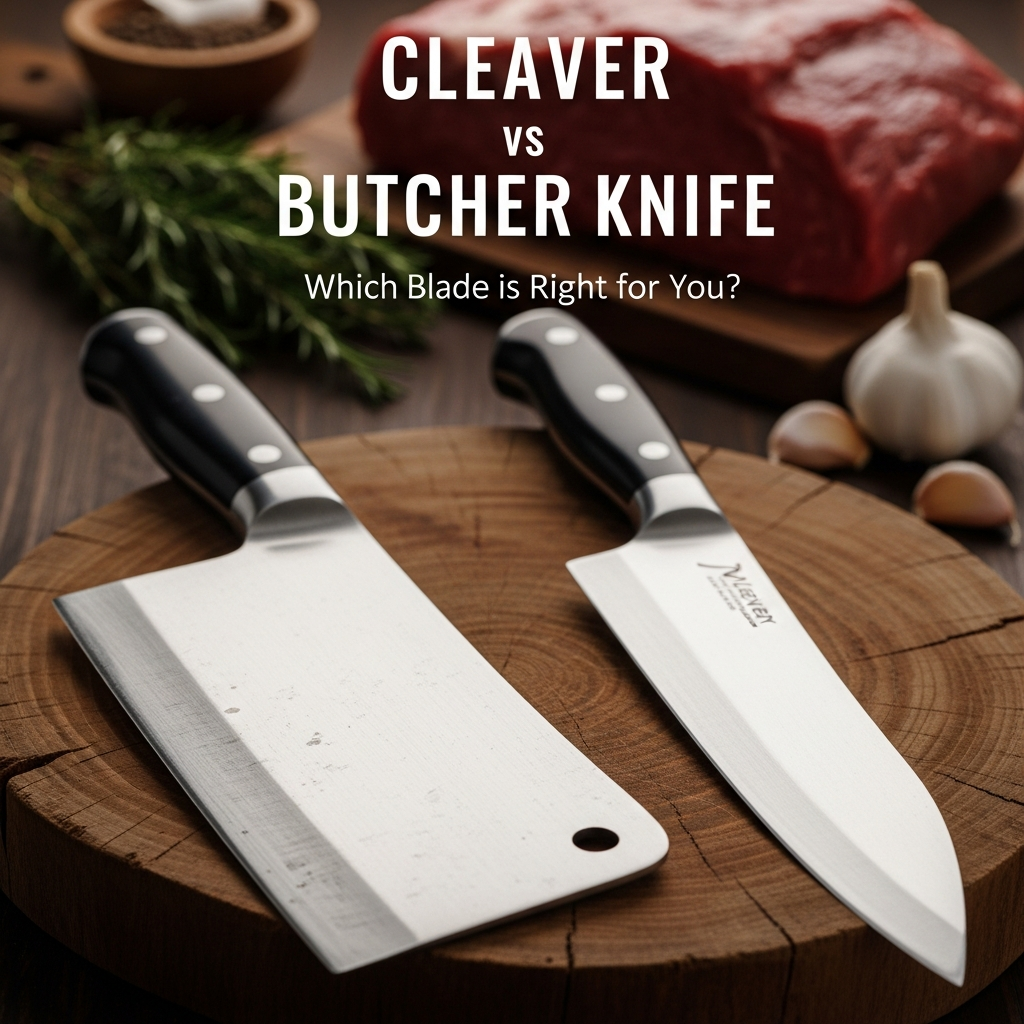
The Meat Cleaver is designed for one thing: force. It features a heavy, rectangular blade that looks like a hatchet. The spine is thick, adding weight to the swing.
Primary Use: Impact
The cleaver acts as a wedge. You swing it to generate momentum to chop through:
- Chicken bones and joints.
- Lobster shells.
- Pork ribs.
- Dense squash (like pumpkins).
⚠️ Important Distinction: Meat vs. Vegetable Cleaver
Not all rectangular knives are meat cleavers! The Chinese Cleaver (Cai Dao) is thin and sharp, designed for vegetables. If you try to hack a bone with a Chinese Cleaver, you will destroy it. Read our guide on What is a Nakiri Knife Used For? to understand the vegetable-specific versions.
2. The Butcher Knife: The Scimitar
The Butcher Knife (often called a Cimeter or Breaking Knife) features a long blade (8 to 12 inches) that curves upward at the tip. It looks like a sword.
Primary Use: Slicing and Portioning
Unlike the cleaver, the butcher knife never “chops.” It slices. The curved belly allows for long, drawing cuts that separate meat from bone or portion large primal cuts into steaks. It is the big brother to the boning knife.
Professional butchers use this to:
- Slice brisket or large roasts (see Carving vs Slicing).
- Trim fat caps from steaks.
- Break down whole deer or large game.
Video Demonstration
To see the mechanics of breaking down meat with these tools, watch this expert breakdown.
3. Head-to-Head: The Specs Breakdown
| Feature | Meat Cleaver | Butcher Knife |
|---|---|---|
| Blade Shape | Rectangular / Boxy | Curved / Scimitar |
| Motion | Chopping / Swinging | Slicing / Drawing |
| Weight | Heavy (Forward Balanced) | Medium to Heavy |
| Edge Angle | Obtuse (20-25°) for durability | Acute (15-20°) for sharpness |
| Primary Target | Bones, Cartilage, Frozen Food | Raw Meat, Large Roasts, Skinning |
4. Top Product Recommendations
We have tested the best brands to find the most durable heavy-duty tools.
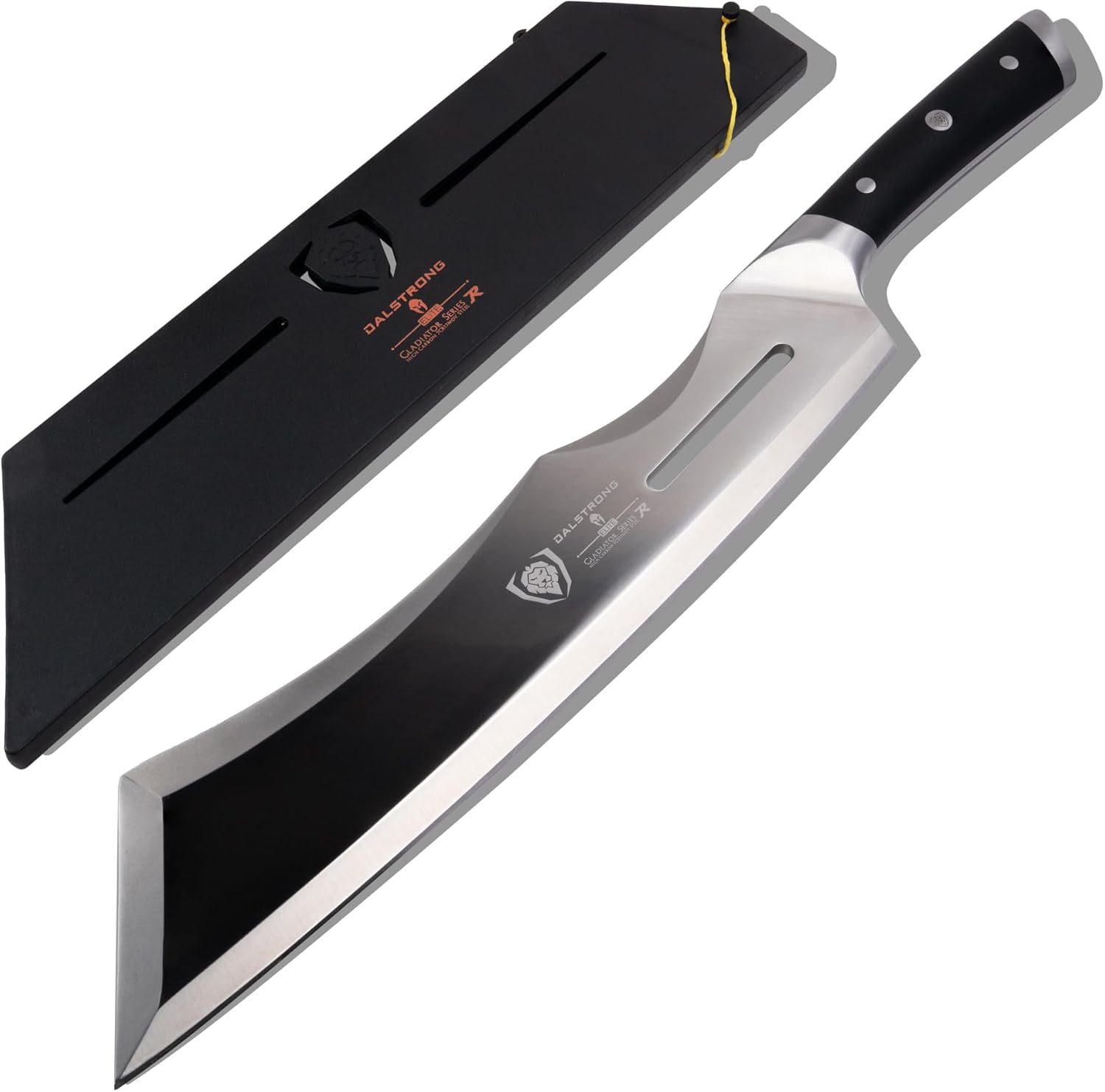 Dalstrong Gladiator Series “The Ravager”
A beast of a cleaver. Forged from high-carbon German steel with a G10 handle. It is heavy enough to go through bone but balanced enough for control. See Dalstrong vs Wusthof.
Check Price on Amazon Victorinox Fibrox Pro 10″ Cimeter
The industry standard. If you walk into a butcher shop, this is what they use. Non-slip handle, stamped steel, and razor sharp. Read our Victorinox reviews.
Check Price on Amazon5. Brand Comparisons: Who Makes the Best Heavy Blades?
Dalstrong vs. Wusthof
Dalstrong leans into the “Warrior” aesthetic. Their cleavers (like the Shadow Black series) look aggressive and are often heavier.
Wusthof makes classic, forged German cleavers. They are virtually indestructible but expensive. (See Dalstrong vs Wusthof).
Mercer vs. Victorinox (Budget Kings)
For butchery, you don’t need fancy Damascus steel. You need grip and toughness.
Victorinox: The Fibrox handle is the best for wet/bloody hands.
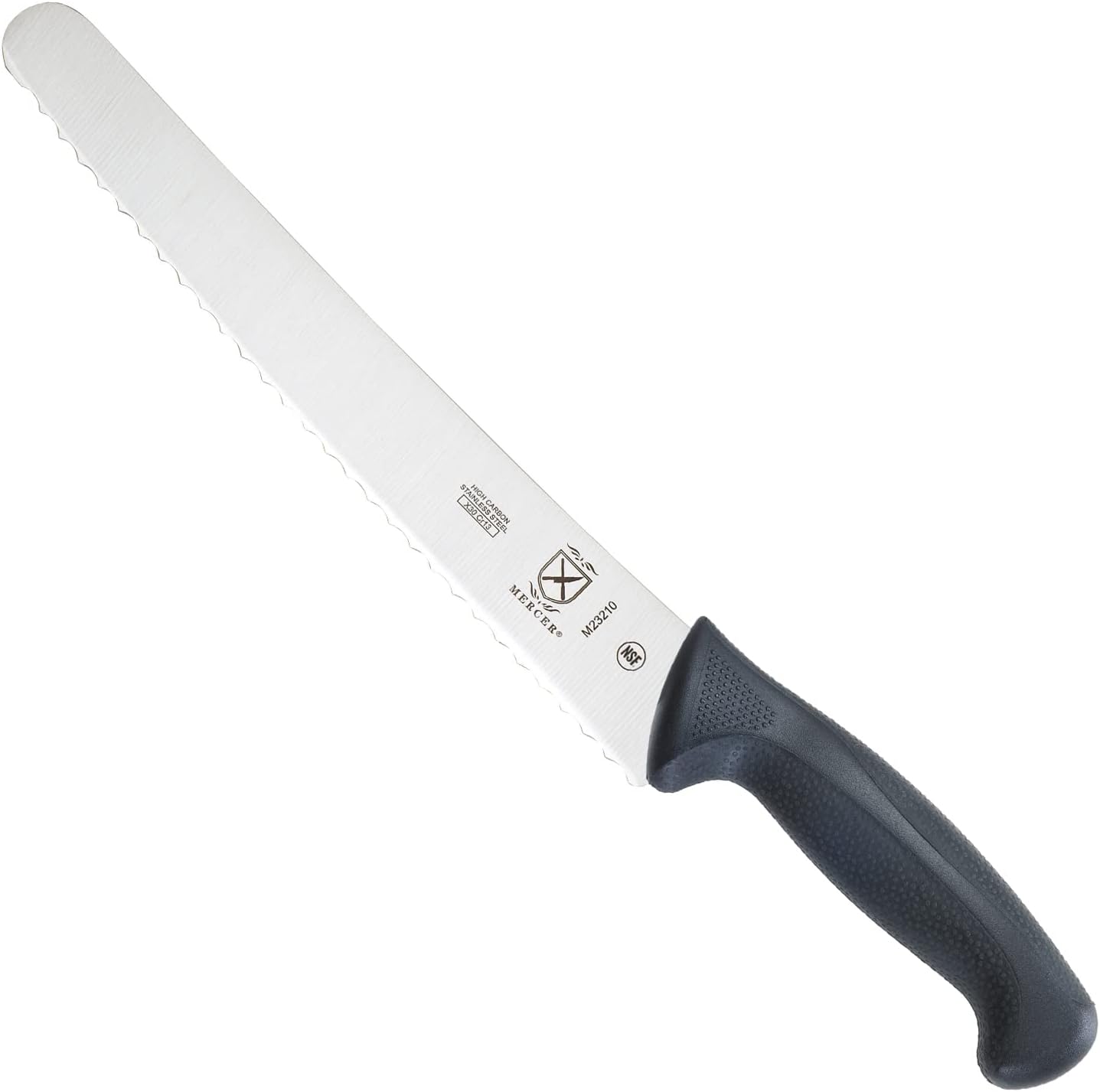
Mercer: The Millennia line is the budget alternative, very popular in culinary schools. (See Mercer vs Victorinox).
Japanese Options (Shun, Global, Tojiro)
Japanese brands typically focus on slicing.
Tojiro: Makes excellent high-carbon butcher knives. (See Tojiro vs Shun).
Global: Their heavyweight cleaver (G-12) is iconic but metal handles can be slippery with animal fat. (See Global vs Wusthof).
6. Maintenance: Handling Heavy Steel
These knives take abuse, so they need care.
- Sharpening: Cleavers generally need a wider angle (20-25 degrees) to prevent chipping on bones. Butcher knives need a finer angle (15-20 degrees) for slicing. Check our electric sharpeners guide for tools that handle both.
- Honing: Essential for the butcher knife to keep the long blade aligned.
- Rust: Blood is corrosive. Wash and dry immediately. If you use carbon steel, learn how to remove rust.
- Storage: These are big knives. They won’t fit in standard blocks. Use a drawer organizer or a magnetic bar.
- Dishwasher: NEVER. See our dishwasher safe guide for why heat destroys handles.
7. Where These Blades Came From: A Short History
Heavy chopping blades are almost as old as metallurgy itself. Long before stainless steel existed, butchers and cooks needed a way to break through bone, and the answer was always the same: add mass, add momentum, and let the tool do the work instead of the wrist.
The Cleaver’s Ancient Roots
Rectangular chopping blades show up independently in multiple food cultures. Chinese cooks have used the wide, thin cai dao for centuries as an all-purpose vegetable and prep tool, while European butchers developed thicker, heavier rectangular cleavers specifically for splitting carcasses in the back rooms of meat markets. The two tools look almost identical at a glance, which is exactly why so many home cooks confuse them today. The European butcher’s cleaver borrowed its silhouette from earlier hand axes and hatchets used in slaughterhouses, where a single downward blow needed to separate a rib section or split a spine without the user having to reposition the tool.
The Scimitar-Style Butcher Knife
The curved butcher knife, sometimes called a cimeter, cimitar, or breaking knife, takes its name and shape from curved swords used across the Middle East and Central Asia. Butchers adopted the curve because it lets the blade “roll” through a cut rather than pushing straight down, which reduces drag when separating large muscle groups from connective tissue. As commercial meatpacking scaled up in the 19th and 20th centuries, the curved breaking knife became the default tool on processing lines because a single long stroke could portion far more meat per minute than a straight blade.
Understanding this history matters because it explains why the two tools are built so differently even though they are often sold side by side. One evolved from an axe. The other evolved from a sword. That lineage still shapes how each performs today, and it’s part of why brands like Dalstrong and Wusthof design their heavy-blade lines so differently — a distinction covered in more depth in our Dalstrong vs Wusthof comparison.
8. Blade Steel Science: Why Metal Choice Changes Everything
Most buyers compare cleavers and butcher knives on shape alone, but the steel underneath the edge is arguably more important. A cleaver and a butcher knife can look similar on a spec sheet and still behave completely differently depending on how the steel was hardened.
High-Carbon Steel
High-carbon steel takes an extremely sharp edge and holds it longer between sharpenings, which is why many premium butcher knives use it for long slicing strokes. The tradeoff is reactivity: high-carbon blades can rust or discolor if left wet, and they are more brittle under lateral shock, which is exactly the kind of stress a cleaver experiences when it hits bone at speed. This is why you rarely see a full high-carbon cleaver marketed for heavy bone work without some kind of softer core or spine.
Stainless Steel
Stainless steel resists rust and is easier to maintain, which is why so many budget-friendly butcher knives use it. It generally cannot hold as fine an edge as high-carbon steel, but it tolerates the wet, high-humidity, high-blood-contact environment of a butcher shop far better. For a cleaver, a tougher stainless alloy is often preferable because it resists chipping better than a harder, more brittle carbon steel would.
High-Carbon Stainless (The Modern Compromise)
Most modern heavy-duty kitchen blades, including the products featured above, use high-carbon stainless steel. This blends the edge retention of carbon steel with the rust resistance of stainless. Hardness is usually measured on the Rockwell C scale (HRC). Cleavers are frequently tempered slightly softer, often in the low-to-mid 50s HRC, specifically so the edge deforms slightly under bone impact instead of chipping outright — a soft edge can be re-honed, but a chipped edge often needs a full regrind. Butcher knives are frequently tempered a few points harder, since they are not absorbing repeated shock and benefit more from edge retention during long slicing sessions.
Why This Matters When Buying
If a listing doesn’t mention hardness or steel type, that’s often a signal the manufacturer is using a generic stamped alloy rather than a purpose-forged one. Compare listings the way we do in our Wusthof vs Victorinox breakdown, where steel sourcing is a major differentiator between price tiers.
9. Cleaver vs. Butcher Knife vs. Chef’s Knife vs. Boning Knife
New buyers frequently lump all “big kitchen knives” into one mental category. In a working butcher shop, however, each of these four tools has a distinct job, and using the wrong one costs time and ruins cuts of meat.
| Tool | Best For | Should Never Be Used For |
|---|---|---|
| Meat Cleaver | Chopping through bone, joints, cartilage, frozen food | Fine slicing, delicate trim work |
| Butcher Knife | Long slicing strokes, portioning primals, trimming fat caps | Chopping bone, prying, twisting |
| Chef’s Knife | General prep, vegetables, boneless proteins | Any bone contact whatsoever |
| Boning Knife | Working close to bone, tight curves, joints | Heavy chopping or long slicing strokes |
The boning knife deserves special mention here because it is often mistaken for a small butcher knife. It isn’t. A boning knife has a short, narrow, flexible or semi-flexible blade built to navigate tight curves around joints and cartilage, whereas a butcher knife is longer, stiffer, and built for straight or sweeping strokes through large sections of meat. If you only own one heavy knife and add a second, the boning knife is usually the smarter second purchase over a second cleaver, since it fills a gap neither the cleaver nor the butcher knife can cover well.
The chef’s knife, meanwhile, is the tool most home cooks already own, and it’s worth reiterating why it should never touch bone: a chef’s knife edge is ground thin and acute for push-cuts through vegetables and boneless meat, and any lateral impact against bone can chip or roll that edge almost immediately. If you’re building out a full knife roll, our Chef’s Knife guide and Santoku guide explain where those tools fit alongside the heavier blades discussed here.
10. Choosing the Right Blade by Animal and Cut
The “correct” tool often depends less on brand and more on what you’re actually breaking down. Here’s how the choice shifts by protein.
Poultry (Chicken, Turkey, Duck)
Poultry bones are relatively soft and hollow, which means a mid-weight cleaver is usually enough — you don’t need the heaviest option on the market. A cleaver quickly separates leg quarters, splits a chicken down the spine (spatchcocking), and portions wings at the joint. A butcher knife is useful here too, but mainly for slicing a cooked bird rather than breaking down a raw one.
Pork
Pork ribs and pork shoulder bones are denser than poultry but still softer than beef. This is the classic cleaver use case: chopping a slab of spare ribs into individual bones, or splitting a ham hock. A butcher knife earns its keep trimming the fat cap off a pork butt before a low-and-slow cook.
Beef
Beef bones, especially from the leg and shoulder, are dense and often require the heaviest cleaver you own, sometimes paired with a mallet for controlled tapping rather than a full swing. For beef, the butcher knife becomes indispensable for portioning primals like brisket, chuck, or round into steaks and roasts, since these are almost entirely about slicing through muscle rather than chopping bone.
Game and Whole Animal Processing
Hunters processing deer, elk, or wild hog at home typically need both tools: a cleaver for joints and pelvis work, and a long butcher knife for skinning and breaking the carcass into primal sections. This is one of the few scenarios where owning both a Dalstrong-style heavy cleaver and a Victorinox-style cimeter genuinely pays for itself in the first season of use.
Fish and Shellfish
Neither tool is ideal for fish fillets — that’s a job for a proper fillet knife — but a cleaver is still the right call for splitting lobster and crab shells, and for removing the head from larger fish like salmon before filleting.
Quick Rule of Thumb
If you’re separating bone from bone (a joint), reach for the cleaver. If you’re separating meat from bone or meat from meat, reach for the butcher knife. When in doubt, the Carving vs Slicing comparison covers the finer distinctions once the primal is already broken down.
11. Ergonomics: Weight, Grip, and Handle Design
Because both of these tools are heavier than a standard chef’s knife, ergonomics matter more here than almost anywhere else in the kitchen. A poorly balanced cleaver isn’t just uncomfortable — it’s a genuine safety risk when swung repeatedly.
Cleaver Balance
Most cleavers are forward-weighted, meaning the center of mass sits closer to the blade than the handle. This is intentional — it’s what generates chopping force without requiring you to swing harder. However, a cleaver that is too forward-heavy for your hand size will fatigue your wrist quickly and reduce control on the downswing. Larger hands generally tolerate a more forward-weighted cleaver well; smaller hands often do better with a slightly lighter, more balanced option like the ones compared in our Wusthof vs Victorinox guide.
Butcher Knife Balance
Butcher knives are typically balanced closer to neutral or slightly handle-heavy, since the motion is a controlled draw rather than a swing. A handle-heavy butcher knife is easier to control across a long slicing stroke and reduces arm fatigue during extended butchery sessions.
Handle Materials
- Fibrox / textured polymer (like Victorinox): Excellent grip when wet or bloody, easy to clean, budget-friendly.
- G10 composite (like Dalstrong): Extremely durable, water resistant, often more aggressively shaped for grip.
- Wood: Comfortable and traditional, but requires more maintenance and can absorb moisture over time if not sealed properly.
- Full metal / stainless handle (like Global): Sleek and easy to sanitize, but can become slippery when coated in fat unless textured.
Proper Grip Technique
For a cleaver, a “hammer grip” with the thumb wrapped around the handle (rather than pinched on the blade like a chef’s knife) gives the most control during a swing. For a butcher knife, a pinch grip closer to the bolster, similar to how you’d hold a chef’s knife, gives better precision during long slicing strokes. Mixing up these grips is one of the most common mistakes new home butchers make, and it’s a major contributor to fatigue and slipping.
12. Home Cook vs. Professional Butcher: Do You Really Need Both?
Not everyone needs a full butcher’s toolkit, and it’s worth being honest about who actually benefits from owning both a cleaver and a dedicated butcher knife.
The Occasional Home Cook
If you buy pre-portioned meat from the grocery store and only occasionally break down a whole chicken, a single mid-weight cleaver covers almost everything you’ll need. You likely don’t need a 10-inch cimeter sitting in a drawer for the two times a year you handle a whole bird.
The Serious Home Butcher / Hunter
If you buy whole animals, process your own deer, or regularly break down primal cuts from a butcher co-op or wholesale club, both tools earn their place. The cleaver handles the joints and bones; the butcher knife handles portioning and trimming. This is the buyer profile the product picks above are aimed at.
The Professional or Aspiring Butcher
Working butchers typically own multiple cleavers of varying weights (light for poultry, heavy for beef primals) along with several breaking knives of different lengths. If you’re heading in this direction, it’s worth reading our best knife brands roundup to understand which manufacturers build tools rated for daily commercial use versus occasional home use, since the wear tolerances are very different.
13. Buying Guide by Budget
Price tiers in heavy kitchen blades tend to track steel quality, handle materials, and manufacturing method (forged vs. stamped) rather than brand name alone.
Budget Tier
Entry-level cleavers and butcher knives are usually stamped (cut from a steel sheet) rather than forged, with simpler stainless alloys and polymer handles. They’re perfectly serviceable for occasional home use, and brands like Mercer dominate this tier — see our Mercer vs Victorinox comparison for specifics.
Mid Tier
This is where Victorinox’s Fibrox line and many Dalstrong models sit. You start seeing better steel, improved heat treatment, and ergonomic handle shaping. For most home cooks and hobbyist butchers, this tier offers the best balance of durability and cost.
Premium Tier
Forged German cleavers from Wusthof, and premium Japanese butcher knives from brands like Tojiro or Shun, live in this tier. You’re paying for tighter tolerances, better edge geometry, and often a lifetime of durability if properly maintained. Our Tojiro vs Shun and Global vs Wusthof guides go deeper on this tier for buyers who process meat regularly enough to justify the investment.
Budget Tip
Don’t over-invest in your first cleaver if you’re not sure how often you’ll use it. A solid mid-tier option, paired with proper sharpening using tools from our electric sharpeners guide, will outperform a premium blade that’s never been maintained.
14. Safety Tips for Heavy Blade Work
Because these tools involve more force than typical kitchen knives, safety habits matter more here than with a standard paring or chef’s knife.
- Stable cutting surface: Always chop on a thick, stable cutting board. Thin or lightweight boards can shift or crack under a cleaver’s impact.
- Clear your swing path: Before chopping bone, make sure nothing (fingers, utensils, loose clothing) is in the arc of the blade.
- Let the weight do the work: Don’t muscle a cleaver through bone with brute force alone — over-swinging increases the chance of the blade skidding off a rounded bone surface.
- Dry your grip: Wet or greasy hands are the leading cause of slips with heavy blades. Textured Fibrox-style handles help, but drying your hands periodically still matters.
- Never catch a falling cleaver: If a heavy blade slips off a counter, step back and let it fall. This applies to every kitchen knife, but it’s especially critical with a tool this heavy.
- Store point-down or sheathed: Given their size, these blades often don’t fit standard blocks. A drawer organizer or magnetic strip keeps the edge protected and away from curious hands.
15. Common Myths About Cleavers and Butcher Knives
Myth: “A cleaver is just a bigger chef’s knife.”
Not true. The steel, edge angle, and balance are all tuned differently. A chef’s knife is ground thin for push-cuts; a cleaver is ground thicker and softer to absorb impact.
Myth: “Heavier is always better for a cleaver.”
Not for every user. A cleaver that’s too heavy for your hand and forearm strength will actually reduce accuracy and increase fatigue-related mistakes, especially on repeated cuts like portioning a whole case of chicken.
Myth: “You can use a Chinese vegetable cleaver on bones if you’re careful.”
Also not true, and one of the fastest ways to chip an otherwise great vegetable knife. As covered earlier, the vegetable-style cleaver and the meat cleaver may look alike, but the steel thickness and hardness are built for completely different jobs — see What is a Nakiri Knife Used For? for the vegetable-specific version of this tool.
Myth: “A butcher knife and a slicing knife are the same thing.”
They’re related but not identical. A butcher knife (cimeter) is built specifically for breaking down raw meat, while a slicing knife is typically used on cooked roasts at the table. Our Carving vs Slicing guide breaks down exactly where each one belongs.
16. Reading Manufacturer Specs Like a Pro
Product listings for heavy kitchen blades are often dense with numbers that don’t mean much to a first-time buyer. Once you know what to look for, though, a spec sheet tells you almost everything about how a cleaver or butcher knife will actually perform before it ever arrives at your door.
Blade Length
For cleavers, blade length usually refers to the width of the rectangular blade rather than a front-to-back measurement, typically ranging from about 6 to 8 inches. A wider blade gives you more flat surface for crushing garlic or transferring chopped food to a pan, but it also adds weight further from the handle, which changes the swing. For butcher knives, length is measured tip to heel and directly determines how much of a primal cut you can slice in a single stroke — a 10 to 12 inch blade lets you portion a large roast without repositioning mid-cut, while an 8 inch blade is easier to control in tighter spaces.
Blade Thickness (Spine Thickness)
This is the single most overlooked spec and the one that separates a true meat cleaver from a vegetable cleaver at a glance. Meat cleavers typically run 3 to 5mm thick at the spine to survive repeated bone impact, while vegetable cleavers are often under 2mm. If a listing doesn’t state spine thickness, treat that as a red flag, especially for anything marketed as a “multi-purpose” cleaver.
Full Tang vs. Partial Tang
A full tang means the steel extends the entire length of the handle, which is essential for any tool absorbing repeated impact. Partial tang cleavers exist and are cheaper, but they are far more prone to snapping at the bolster under heavy use. For a butcher knife, tang construction matters less for shock absorption but still affects overall balance and durability during long slicing sessions.
Weight Distribution
Manufacturers occasionally list total weight but rarely explain balance point, which is more useful information. As a rule, if a listing says “forward balanced” or “blade heavy,” expect a tool built for chopping. “Handle balanced” or “neutral balance” signals a tool built for control and precision, which is what you want in a butcher knife used for long slicing strokes.
Reading Between the Lines
Listings that emphasize “razor sharp out of the box” for a cleaver are sometimes describing a thinner, more delicate edge than true bone-chopping work requires. Compare this against dedicated bone-cleaver listings like the Dalstrong option above, where durability under impact is emphasized over initial sharpness — a distinction also explored in our Dalstrong vs Wusthof guide.
17. Setting Up a Butchery Station at Home
Owning the right blades is only part of the equation. A proper setup makes the difference between an efficient breakdown and a frustrating, messy one.
Cutting Surface
A dedicated end-grain wood or heavy-duty poly cutting board reserved for raw meat is essential, both for food safety and to protect your blade edges. Thin plastic boards can crack under repeated cleaver impact, and glass or stone surfaces will dull an edge almost instantly. Many serious home butchers keep a separate, thicker “block” style board specifically for cleaver work, distinct from the everyday board used for a chef’s knife.
Stabilizing the Work Area
A non-slip mat underneath your cutting board prevents shifting during forceful cleaver strokes. This sounds like a minor detail, but a board that slides even an inch during a downward chop is a common cause of near-miss accidents.
Waste and Trim Management
Keep a dedicated container for bones, trim, and connective tissue nearby so you’re not reaching across your cutting surface mid-task. This keeps your workspace clear and reduces the temptation to rush a cut because the surface is getting crowded.
Sanitation Between Tasks
Raw meat, especially poultry, requires thorough sanitation of both your board and blades between different proteins. A quick rinse is not enough — a proper hot water and soap wash, or a diluted sanitizing solution, should be used on both the cleaver and butcher knife before switching from, say, raw chicken to raw beef, to avoid cross-contamination.
Lighting
Good overhead lighting matters more for heavy blade work than for general prep, since you need to clearly see bone position, joints, and fat lines before committing to a swing or a long slicing stroke. Working in dim light with a cleaver is a genuinely avoidable risk.
18. Step-by-Step: Breaking Down a Whole Chicken With Both Tools
This walkthrough illustrates exactly where each tool takes over from the other, which is often the fastest way to understand the cleaver vs. butcher knife divide in practice.
- Remove the legs: Use a boning knife or the tip of a butcher knife to score around the leg joint, then pop the joint and finish the cut through soft tissue. No cleaver needed yet — this is entirely a slicing task.
- Separate thigh from drumstick: Locate the joint by feel, then use the butcher knife to cut through the connective tissue at the joint line. Again, no bone chopping required if you find the joint correctly.
- Remove the backbone: This is where the cleaver enters. Position the spine of the cleaver along the rib line beside the backbone and use controlled, firm strokes (not wild swings) to cut through the ribs on both sides.
- Split the breast: With the backbone removed, a firm downward cleaver strike through the center of the breastbone (or a mallet-assisted tap for more control) separates the two breast halves cleanly.
- Portion the wings: Back to the butcher knife or boning knife — cut through the wing joint where cartilage is soft, avoiding bone contact entirely.
- Trim and clean: Use the butcher knife to trim excess skin, fat, and any ragged edges left from the breakdown, giving you clean, presentation-ready pieces.
Notice that even in a single whole-chicken breakdown, the cleaver is only needed for two of six steps — the two steps that involve cutting directly through bone. This is the clearest illustration of why owning both tools, rather than trying to force one to do the other’s job, saves time and produces cleaner cuts.
19. Environmental and Sourcing Considerations for Home Butchers
For buyers who process a significant amount of meat at home, whether from a backyard flock, a hunting trip, or bulk-buying from a local farm, tool choice intersects with a broader set of practical concerns worth touching on briefly.
Reducing Waste
A properly sharpened cleaver reduces bone splintering compared to a dull one, which means cleaner stock-making bones afterward rather than fragments that need to be strained out. Dull tools don’t just slow you down — they create more waste at every stage of a breakdown.
Efficient Use of the Whole Animal
Home butchers processing a whole animal, whether poultry, pork, or game, get more usable cuts per carcass when they have the right tool for each cut rather than forcing a single knife to do everything. This is part of why hunters in particular tend to invest in both a cleaver and a dedicated butcher knife rather than making do with a single chef’s knife.
Tool Longevity as a Practical Choice
A well-made forged cleaver or butcher knife, properly maintained using the sharpening and storage guidance above, can realistically last decades. Buying a durable mid-to-premium tier tool once, rather than replacing a cheap stamped blade every year or two, is arguably the more sensible long-term choice even before considering performance differences.
20. Regional Cleaver and Butcher Knife Styles Around the World
While this guide focuses on the Western-style meat cleaver and cimeter-style butcher knife most common in American kitchens, it’s worth knowing that nearly every food culture with a butchery tradition developed its own version of these tools, and understanding the variations helps explain why some products marketed as “cleavers” behave so differently from one another.
The Chinese Cai Dao Family
Beyond the vegetable-focused Cai Dao already mentioned, there is also a heavier “bone chopper” variant within the same family, thicker and more substantial than the vegetable version but still visually similar to the untrained eye. This is part of why so many buyers accidentally purchase a thin vegetable cleaver expecting it to handle bones, then are surprised when the edge chips on the first use.
The German Beil
German cleavers, the style most associated with brands like Wusthof, tend to be heavier and more axe-like than their Chinese counterparts, with a pronounced bolster and a full bolster-to-heel transition designed for repeated, forceful chopping in commercial meatpacking settings. This is the lineage the Dalstrong “Ravager” style cleaver draws from, favoring mass and durability over refinement.
The Filipino Sinampalukan and Southeast Asian Chopping Knives
Various Southeast Asian food cultures use wide, moderately thick chopping blades for both produce and light bone work, occupying a middle ground between the thin Chinese vegetable cleaver and the heavy German bone cleaver. These are less common in Western retail but occasionally appear under generic “multi-purpose cleaver” listings, which is another reason to check spine thickness rather than trusting the product name alone.
The Middle Eastern and Central Asian Curved Blade Tradition
The curved butcher knife’s ancestry traces back to curved swords and long single-edged blades used across the Middle East, Persia, and Central Asia for both combat and food preparation. That heritage is why the curve on a modern cimeter-style butcher knife is so pronounced compared to, say, a straight-backed slicing knife — the geometry is inherited from a design meant to draw through material in a single long stroke rather than push straight down.
Recognizing these regional lineages is useful mostly as a buying filter: when a listing photo shows a blade that looks like a hybrid of these styles, it’s worth reading the full description carefully rather than assuming it fits neatly into the “cleaver” or “butcher knife” categories described throughout this guide.
21. Cost of Ownership Over Time
Sticker price is only part of the real cost of owning a heavy kitchen blade. A full picture of ownership cost includes sharpening, replacement frequency, and the value of time saved (or lost) by using the right tool for the job.
Upfront Cost
Budget cleavers and butcher knives typically run in the low tier, mid-tier options sit in a moderate range, and premium forged options from brands compared in our Global vs Wusthof guide occupy the top end. A cleaver and a butcher knife purchased together at the mid tier generally represent the best value for most home butchers.
Sharpening Costs Over the Tool’s Life
A cleaver used regularly for bone work will need periodic professional sharpening or a quality home system, particularly if it chips rather than simply dulling. Budget stamped steel dulls faster and may require more frequent sharpening sessions than a forged, properly heat-treated blade, which can mean the “cheaper” option costs more in sharpening fees over a few years of regular use.
Replacement Frequency
A well-forged cleaver or butcher knife maintained with proper drying, hand-washing, and appropriate storage can last well over a decade, sometimes multiple decades, without needing replacement. A poorly made stamped blade used for heavy bone work, on the other hand, may chip, warp, or have its handle fail within a year or two of regular use, effectively requiring a full repurchase.
The Time-Value Argument
Perhaps the least visible cost is time. Using the wrong tool, say, trying to portion a whole beef primal with only a chef’s knife, or attempting to chop through chicken bones with a butcher knife, takes meaningfully longer and produces messier results than using the purpose-built tool. For anyone processing meat regularly, whether from a hunting trip, a bulk meat purchase, or routine home cooking, the time saved by owning both a proper cleaver and a proper butcher knife adds up quickly and is arguably the strongest argument for investing in both tools rather than trying to make one do double duty.
22. Troubleshooting Common Problems
Even with the right tool, technique problems can make a cleaver or butcher knife feel underwhelming. Here are the most common issues home users run into, and what’s usually actually causing them.
“My cleaver keeps getting stuck in bone.”
This is almost always a technique issue rather than a tool problem. A cleaver should be used with a controlled, vertical strike directly through the target, not an angled or glancing blow. If the blade repeatedly wedges and sticks, try rocking it gently side to side to release it rather than yanking straight up, which can bend a thinner blade or strain your wrist. If sticking happens on nearly every strike, the edge may also be too dull to complete the cut cleanly, in which case a touch-up on a sharpening system is worth trying before assuming the tool itself is at fault.
“My butcher knife tears the meat instead of slicing cleanly.”
Tearing usually indicates either a dull edge or incorrect technique. A butcher knife should be drawn through the meat in one long, continuous stroke using the full length of the curved belly, not sawed back and forth in short strokes. Short sawing motions compress and tear muscle fiber rather than cutting cleanly through it. If the blade is properly sharp and the tearing persists, check that you’re using the curve of the blade rather than just the tip or the heel for the entire stroke.
“The cleaver feels unbalanced and tiring after a few chops.”
This usually points to a mismatch between the tool’s weight and the user’s hand size or strength, as discussed in the ergonomics section above. If a cleaver consistently feels front-heavy and hard to control, a lighter mid-weight option is often the better long-term choice over “toughing it out” with a heavier blade, since fatigue directly increases the risk of a missed or glancing strike.
“My blade is discoloring even though it’s stainless steel.”
Even “stainless” steel is not entirely rust-proof — it’s rust-resistant. Prolonged contact with acidic marinades, salt, or blood, especially if the blade isn’t dried promptly, can cause spotting or discoloration over time. This is a maintenance issue, not a defect, and is resolved by drying blades immediately after washing rather than letting them air-dry in a rack, as covered in the maintenance section earlier in this guide.
“I can’t get a consistent edge angle when sharpening at home.”
This is one of the most common complaints among home butchers trying to freehand sharpen a cleaver’s wider, more obtuse edge angle. A guided sharpening system, rather than a freehand stone, removes the guesswork and is generally the better investment for anyone maintaining both a cleaver’s wider edge and a butcher knife’s finer edge, since the two blades require noticeably different angles and freehand consistency across both takes real practice. Our electric sharpeners guide covers options built to handle both angle ranges reliably.
“My cleaver’s handle feels loose after a few months of use.”
A loosening handle is a serious warning sign on any tool that absorbs repeated impact, and it typically indicates either a partial tang construction under stress or handle scales that were poorly fitted at the factory. This is one of the clearest arguments for buying a full-tang, forged cleaver from an established brand rather than the cheapest stamped option available, since a handle failure mid-swing is a genuine safety hazard rather than a minor inconvenience.
23. Can You Use Them for Other Things?
Cleaver: The flat side is amazing for crushing garlic and ginger. The spine can tenderize meat. But do not use it for fine slicing—it’s too thick.
Butcher Knife: It makes a fantastic watermelon knife due to its length. It can also double as a slicer for brisket if you don’t own a slicing knife.
However, for general prep, stick to a Chef’s Knife or Santoku.
Frequently Asked Questions (FAQ)
It is for hanging the knife on a meat hook or wall. Because cleavers are heavy and large, they often don’t fit in knife rolls or blocks, so butchers hang them up.
No! A Chinese Cleaver (Cai Dao) is a vegetable knife (equivalent to a Nakiri). The blade is thin. Hitting a bone will crack the blade instantly. Always check the spine thickness—meat cleavers are thick; vegetable cleavers are thin.
If you are trimming briskets or pork butts before cooking, yes. The curved blade allows you to trim fat caps in one smooth motion without gouging the meat. For serving, you might prefer a straight Slicing knife.
A mid-weight cleaver, roughly 1.5 to 2 pounds, is the best starting point for most home cooks. It’s light enough to control confidently but still has enough mass to get through poultry and pork bones without excessive effort. Save the heaviest beef-grade cleavers for once you’re comfortable with the motion.
Cleavers dull less from cutting and more from chipping, so they need less frequent full sharpening but should be inspected for nicks after heavy bone work. Butcher knives lose their edge gradually from long slicing strokes and benefit from honing before every session and a full sharpening every few weeks with regular use.
Neither is strictly required — a boning knife can handle most of a chicken breakdown — but if you plan to split the bird through the spine or separate leg quarters at the joint, a mid-weight cleaver makes that single step much easier and safer than trying to saw through bone with a thin blade.
Not really. A butcher knife’s curved belly and length are built for long draws through meat, not the rocking chop motion used for dicing vegetables. It can technically slice some produce in a pinch, but a proper chef’s knife will always be more precise and comfortable for everyday prep.
Yes, almost universally. In a working meat department or processing facility, a butcher typically has both a cleaver and one or more breaking knives within arm’s reach at all times, switching between them dozens of times per shift depending on whether the current cut involves bone or pure muscle and connective tissue. This constant switching is exactly why the two tools are sold as complementary pieces rather than substitutes for one another.
Not necessarily, and this is a common misconception covered in the myths section above. Beyond a certain point, added weight without added control simply increases fatigue and the chance of a mis-struck blow. Edge geometry, spine thickness, and technique matter as much as raw weight, which is why a well-designed mid-weight cleaver from a reputable brand often outperforms an oversized, poorly balanced one from a generic listing.
Conclusion: The Verdict
The Cleaver vs. Butcher Knife choice is about what you are cutting.
Choose a Cleaver If: You buy whole chickens, chop ribs, or deal with hard vegetables like pumpkin. You need weight and impact power.
Choose a Butcher Knife If: You buy large sub-primal cuts (whole loins, briskets) and need to trim fat and portion steaks. You need length and slicing precision.
For the complete home butcher shop, grab one of each. Check out our affordable knife guide to find budget-friendly versions like Victorinox that perform at a pro level.