
The History of Japanese Knife Making: From Samurai Swords to Sushi Blades
1. Where It All Began
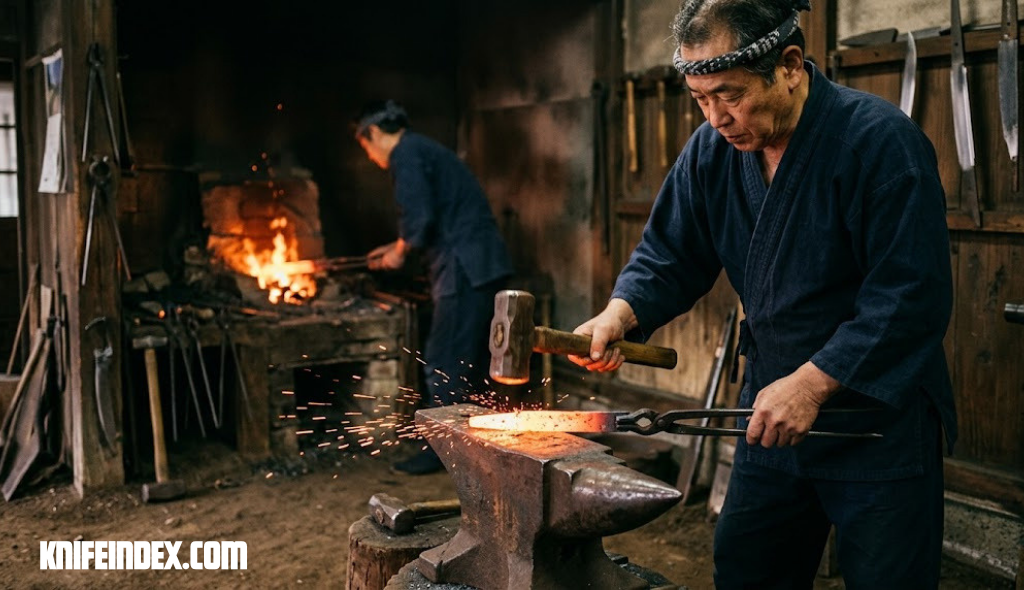
Long before anyone plated a piece of tuna on rice, Japan’s bladesmiths were solving a much older problem: how to turn crude iron sand into something sharp enough to trust with a life. The story of the Japanese knife doesn’t start in a kitchen at all. It starts in the mountains, the river valleys, and the smoke-filled forges of a country that treated bladed steel as something closer to a spiritual object than a tool.
Iron working reached the Japanese archipelago from the Asian mainland, arriving through trade and migration routes that connected Japan to Korea and China. Early blacksmiths worked with whatever ore they could find, and the results were serviceable rather than remarkable. What set Japan apart wasn’t a head start in metallurgy — it was geography. The country’s iron sand, known as satetsu, combined with abundant charcoal from its forested mountains, gave smiths a unique local material to experiment with over centuries. That experimentation eventually produced a steel-making process unlike anything else in the world.
By the time organized smithing guilds began to form, a blade had already become more than a weapon. It was a marker of rank, a diplomatic gift, and in many stories, an object with something like a soul. That reverence for the blade is the thread that runs through every century covered in this article, whether the object in question is a katana meant for the battlefield or a yanagiba meant for slicing sashimi paper-thin.
Geography as a Silent Craftsman
It’s easy to overlook how much of Japan’s metallurgical identity was shaped by things nobody in a forge actually controlled: rainfall patterns, mountain mineral deposits, and the availability of specific types of hardwood for charcoal. The Chugoku region in particular became known for its iron sand deposits, and the surrounding forests supplied the enormous quantities of charcoal a tatara furnace demands. A single smelting run could consume the equivalent of an entire small forest’s worth of fuel, which meant early bladesmithing was inseparable from forestry management long before anyone used that term.
This resource dependency also explains why smithing clusters formed where they did. Access to satetsu iron sand, clean river water for quenching, and reliable charcoal supply chains created natural hubs, and those hubs eventually became the regional schools of smithing that later gave individual cities like Sakai and Seki their distinct reputations, long before either city had anything to do with kitchen knives specifically.
The Smith as a Social Figure
Unlike many trades of the era, a skilled smith occupied a somewhat unusual social position. They weren’t nobility, but their skill granted them proximity to nobility that most craftspeople never had. A famous smith’s work might be commissioned directly by a warlord, displayed as a diplomatic gift, or passed down as a family heirloom weighted with more meaning than land or currency. That elevated status created strong incentive for smiths to guard techniques carefully, which is part of why so much of early Japanese metallurgy was transmitted orally within family lines rather than written down for outsiders to study.
This secrecy had a curious side effect for historians: much of what’s understood today about early forging methods has been reconstructed through metallurgical analysis of surviving blades rather than through contemporary written instruction. Modern smiths and researchers have essentially had to reverse-engineer techniques that were never meant to leave the workshop, which is part of why debates about “true” traditional methods versus modern reconstructions still surface among enthusiasts and collectors today.
2. The Age of the Swordsmith
The medieval period in Japan turned bladesmithing into one of the most respected professions in the country. As regional warlords competed for territory, demand for reliable swords exploded, and smiths who could produce a blade that held an edge, resisted shattering, and looked beautiful doing it became enormously valuable. Entire lineages of smiths formed, each guarding proprietary methods for folding, quenching, and tempering steel.
These smiths didn’t think of themselves as tradespeople in the way a modern manufacturer might. Sword forging carried ritual weight. Smiths would often purify themselves before beginning a new blade, wear ceremonial clothing during the forging process, and treat the workshop as something close to sacred space. This wasn’t superstition for its own sake — it reflected a belief that the smith’s focus and intention were physically transferred into the metal.
The practical genius of these smiths, though, is what actually matters for the knives on your counter today. They discovered that a blade needed two different qualities that steel doesn’t naturally offer at the same time: a hard, sharp edge and a flexible, shock-absorbing spine. Solving that contradiction is the single most important technical achievement in the entire history of Japanese blademaking, and it’s the direct ancestor of the hard-core, soft-cladding construction used in many premium kitchen knives sold today.
Why Sword Culture Shaped Kitchen Culture
When Japan eventually moved away from sword production, the smiths didn’t lose their knowledge — they redirected it. The same hardening curves, the same steel-folding logic, and the same obsessive quality standards were carried directly into agricultural tools, carpentry blades, and eventually kitchen knives. A modern gyuto owes far more to a 16th-century katana than most home cooks realize.
Regional Schools and Competing Philosophies
Sword production in feudal Japan wasn’t a single unified tradition — it was a patchwork of regional schools, each with its own signature approach to grain pattern, curvature, and temper line shape. Smiths in one province might favor a straighter hamon and a more conservative curve, while a rival school a few valleys over pursued a dramatically flared temper line meant to signal both technical mastery and artistic flair. These stylistic rivalries weren’t purely aesthetic disagreements; they often reflected genuine differences in fighting doctrine, since blade geometry affects handling characteristics in ways that mattered enormously to the warriors who depended on them.
This same instinct toward regional specialization is exactly what later produced the split between cutlery centers like Sakai and Seki. Centuries before either city became known for kitchen knives, the underlying cultural pattern of small, fiercely competitive smithing communities each defending a distinct technical identity was already fully established. Kitchen cutlery inherited that competitive, regionally distinct structure wholesale.
Apprenticeship and the Transmission of Skill
Becoming a recognized swordsmith required years, often a decade or more, of apprenticeship under an established master before a smith was permitted to sign their own work. Apprentices typically began with menial tasks — maintaining the forge fire, preparing charcoal, and hauling water — long before they were allowed to touch a hammer to a blade billet. This slow, hierarchical training model is the direct ancestor of the apprenticeship systems still used in traditional cutlery workshops in Sakai and Seki today, where a new worker might spend years on a single stage of production, such as rough forging or blade polishing, before advancing to more delicate work.

See the Craft in a Modern Blade
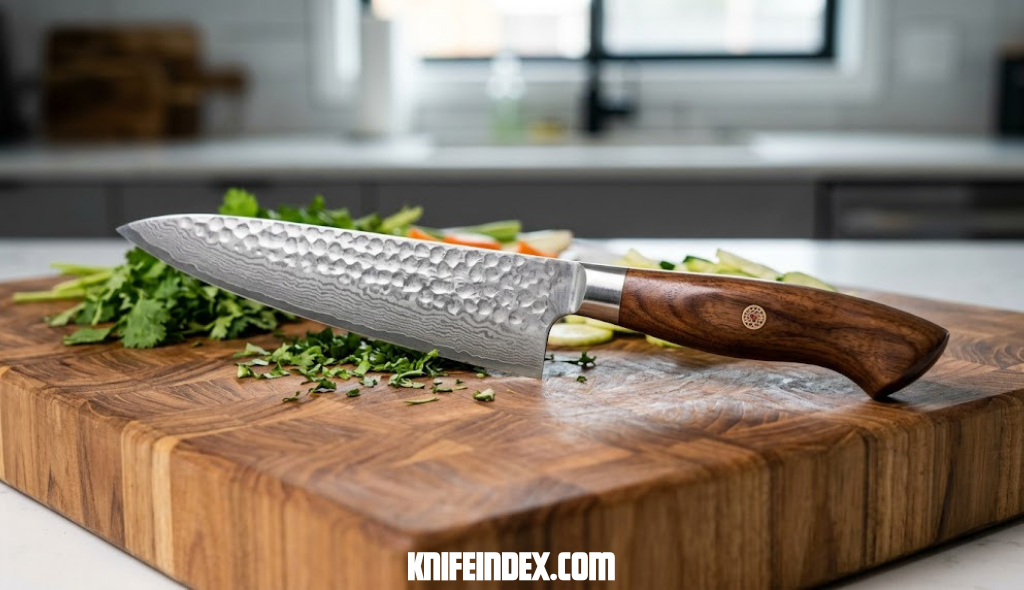
Traditionally forged Japanese chef knives still use techniques descended from sword smithing. Check current pricing and availability on Amazon.
View on Amazon3. Tamahagane and the Tatara Furnace
No conversation about Japanese blades gets far without the word tamahagane. This is the raw steel produced in a tatara, a clay-walled furnace that smelts iron sand and charcoal together over several days of continuous, carefully monitored burning. The process is closer to a slow-cooked recipe than a modern industrial pour: temperature, airflow, and timing all have to be managed by feel, developed over years of apprenticeship.
What comes out of a tatara isn’t uniform. A single smelt produces steel with varying carbon content throughout the bloom, the raw lump of iron and slag pulled from the furnace. Smiths would break the bloom apart and sort pieces by their carbon content — higher-carbon steel for the cutting edge, lower-carbon and more ductile steel for the body and spine. This sorting step is the real origin of Japan’s obsession with layered, composite blade construction.
Tamahagane production nearly disappeared during the 20th century as industrial steel became cheap and widely available, but a small number of traditional furnaces have been kept alive specifically to supply sword restoration projects and highly traditional cutlery makers. It’s slow, expensive, and inefficient compared to modern steelmaking — and that’s exactly the point for smiths who value the material’s character over convenience.
| Material | Carbon Content | Typical Use |
|---|---|---|
| Tamahagane (high-carbon selection) | ~1.0–1.5% | Cutting edge / hagane core |
| Tamahagane (low-carbon selection) | ~0.2–0.6% | Spine and body / jigane cladding |
| Modern mono-steel (e.g., blue or white steel) | ~1.0–1.4% | Full blade or laminated core in kitchen knives |
Inside a Tatara Smelt
Running a tatara furnace is closer to conducting an orchestra than operating a machine. A team of smelters works in continuous shifts across several days, feeding alternating layers of iron sand and charcoal into the furnace while manually operating bellows to control airflow. Too much air and the smelt burns too hot, producing brittle, high-carbon iron in the wrong places. Too little, and the reaction stalls, leaving unusable raw ore. The entire process depends on smelters reading flame color, smoke behavior, and the sound of the furnace to make constant micro-adjustments, none of which can be reduced to a simple written formula.
At the end of the smelt, the furnace is broken open and the bloom, a rough, irregular mass called a kera, is extracted and cooled. Skilled sorters then break the kera apart with hammers, separating pieces by appearance and sound into rough carbon-content categories. This sorting step is arguably as skilled a job as the smelting itself, since misjudging a piece’s carbon content can ruin an entire subsequent blade.
Why Modern Smiths Still Reference Tamahagane
Even though most working cutlery today is made from consistent, industrially produced steel, tamahagane remains an important reference point because it defines the aesthetic and structural goals traditional Japanese blades are still measured against — a fine, tight grain, a visible hardening line, and a blade that feels alive in a way smiths describe as difficult to fully put into words. Modern steels like the carbon steels discussed later in this article were specifically engineered to approximate tamahagane’s performance characteristics without requiring a multi-day furnace smelt for every batch.
4. Folding Steel: Myth and Method
Folded steel gets romanticized to the point of confusion. The popular image is that folding makes a blade infinitely strong, layer upon magical layer. The real reason smiths folded tamahagane is more practical: it homogenizes the material. Tatara-smelted steel isn’t perfectly consistent, and folding distributes carbon more evenly while squeezing out slag and trapped impurities that would otherwise weaken the blade or cause it to crack during quenching.
A smith folds a billet of steel, hammers it flat, folds it again, and repeats the process a set number of times depending on the desired result. Each fold theoretically doubles the layer count, though in practice welds fail and layers merge, so the true layer count is more art than arithmetic. What folding does reliably deliver is a finer, more even grain structure — which shows up visually as the wavy hada pattern you can see on traditionally forged blades and on damascus-style kitchen knives that mimic the same aesthetic today.
It’s worth separating two related but distinct technique families here: folding (repeatedly hammering and doubling a single billet) and lamination (sandwiching a hard core steel between softer outer layers, sometimes called san-mai construction). Most premium Japanese kitchen knives today use lamination for performance and folding-derived damascus patterns mostly for appearance, since modern industrial steel doesn’t need folding to be homogeneous the way tamahagane did.
What Folding Actually Achieves
- Removes trapped slag from bloomery steel
- Evens out inconsistent carbon distribution
- Produces the visible hada/damascus grain pattern
- Improves toughness in low-quality starting material
What Folding Does Not Do
- Does not make modern clean steel meaningfully stronger
- Does not create “millions of layers” in any functional sense
- Is not required for edge retention in modern alloys
- Is largely decorative on knives forged from clean, modern bar stock
San-Mai and the Rise of Laminated Construction
While folding solved the problem of inconsistent raw steel, lamination solved a completely different problem: how to give a blade a hard, sharp edge without making the entire blade brittle and prone to snapping. The san-mai method, meaning “three layers,” sandwiches a hard, high-carbon core between two softer, more shock-absorbent outer layers, usually of iron or low-carbon steel. The result is a blade that sharpens like a much harder, more brittle steel would, but flexes and resists chipping like a softer one.
This construction method is why many traditional Japanese kitchen knives show a visible line running along the blade face, marking the boundary between the hard core and the softer cladding. That line isn’t decorative — it’s a direct visual record of the blade’s internal engineering, and it’s one of the clearest ways to distinguish a genuinely laminated blade from a mono-steel knife finished to merely look laminated.
Some workshops extend this concept further with a five-layer or even multi-layer cladding structure, primarily for visual effect and marketing differentiation rather than meaningful performance gains beyond what a well-executed three-layer san-mai blade already delivers. Buyers evaluating premium knives should treat extremely high layer counts as an aesthetic feature first and a performance feature a distant second.
5. Peacetime and the Sword Ban
Japan’s long stretch of internal peace during the Edo period changed the economics of bladesmithing dramatically. With far fewer wars to supply, demand for combat swords dropped, and many smiths shifted toward producing tools for farming, carpentry, and food preparation. This is one of the quieter but more important turning points in the story — it’s when sword-grade craftsmanship first started showing up in everyday cutting tools used by ordinary households.
The more dramatic break came later, during the Meiji era, when sweeping modernization reforms included a ban on the public carrying of swords. Practically overnight, an entire class of highly skilled smiths lost their primary market. Some smiths left the trade entirely. Many others adapted, applying sword-grade heat treatment and lamination techniques to kitchen cutlery, farming implements, and craft tools, effectively rescuing centuries of forging knowledge by giving it a new commercial home.
This shift is the direct historical bridge between “swordsmith” and “knife maker” as professions. Without it, the specific hardening philosophy, edge geometry, and steel-selection instincts that define Japanese kitchen knives today might have been lost entirely, surviving only in museum pieces rather than daily-use tools.
Swordsmithing dominates; regional schools of smiths compete on quality and reputation.
Extended peace reduces sword demand; smiths diversify into farm tools and kitchen blades.
Sword-carrying restrictions force a wholesale pivot toward civilian cutlery production.
Regional forging towns formalize into recognized cutlery manufacturing centers.
Export demand grows; Japanese knives begin reaching Western professional kitchens.
The Human Cost of an Industry Shift
It’s worth pausing on how disruptive the sword-carrying restrictions actually were for the people living through them. For generations, a smith’s entire family identity might be built around forging swords for a specific regional lord or clan. When that market disappeared, some family lines ended their smithing tradition entirely rather than adapt, while others made the difficult decision to essentially start over, retraining in tool-making or kitchen cutlery despite decades of specialized sword-focused experience.
The smiths who successfully made this transition often did so by leaning into markets that valued precision over prestige. A farmer buying a sickle or a cook buying a kitchen knife didn’t care about a smith’s aristocratic connections — they cared whether the tool held an edge through a full day’s work. This shift arguably democratized access to master-level forging skill in a way that sword production never had, since ordinary households could now afford tools built by smiths whose techniques had previously been reserved almost exclusively for the ruling class.
Guild Formalization and Regional Branding
As former sword-focused smithing communities settled into their new civilian markets, many formalized into guilds or cooperative associations that standardized quality benchmarks and, in some cases, began using regional stamps or marks to certify a blade’s origin. This early form of regional branding is a direct ancestor of the geographic reputation that cities like Sakai and Seki still carry today — a stamp indicating a blade was forged in one of these historically significant centers still carries real weight with knowledgeable buyers, in much the same way a wine’s designated region of origin signals something about expected quality and style.
6. Sakai: The City That Became a Knife Capital
If you own a Japanese chef knife, there’s a reasonable chance its lineage traces back to Sakai, a port city near Osaka. Sakai’s rise as a cutlery center wasn’t an accident of culture alone — it was geography and trade again doing the heavy lifting. The city had access to good raw materials, established merchant trade routes, and eventually specialized in producing tobacco-cutting knives during a period when tobacco was a major cash crop.
That tobacco-knife specialization mattered more than it sounds. It required extremely precise, thin, and sharp blades, and the guild structure that grew around producing them created a rigorous, segmented production system: one craftsman forges, another sharpens, another handles the handle fitting, and so on. This division-of-labor model became a defining feature of Sakai cutlery and is still used by many workshops there today, unlike the single-smith model common in some other forging traditions.
Sakai eventually became closely associated with single-bevel knives used in professional Japanese cuisine, including the yanagiba used for slicing raw fish. The city’s reputation for razor-thin, exacting edge geometry is a direct descendant of that early tobacco-knife precision work.
For readers comparing single-bevel blade types used in professional sushi prep, this yanagiba vs. sujihiki breakdown is a useful next stop, and the best sushi knives for beginners guide is worth bookmarking if you’re shopping on a budget.
The Division-of-Labor Workshop Model
One detail that surprises a lot of newcomers to Japanese knife history is that a single Sakai knife is rarely, if ever, the product of one craftsman working start to finish. Instead, the traditional Sakai workshop model splits production into distinct specialized roles: a forger shapes the raw billet and performs the initial heat treatment, a sharpener handles the extremely delicate final edge geometry, and a separate handle craftsman fits and finishes the wooden handle, often using a specific wood species chosen for balance and grip feel. Each of these roles can take years to master independently, and a single blade may pass through the hands of three or four specialists before it’s considered finished.
This segmented model exists for a good practical reason: single-bevel sharpening in particular is an extraordinarily demanding skill that benefits enormously from total specialization, since a sharpener who does nothing else develops a level of muscle memory and consistency that’s difficult to match with a generalist approach. It also means that when you buy an authentic Sakai-forged blade, you’re really buying the combined output of a small, tightly coordinated team rather than the work of a single individual, however the marketing around a “master craftsman” might frame it.
Certification and the Sakai Legacy Today
Given the city’s reputation, some regional and trade associations have worked to formally certify traditionally produced Sakai cutlery, helping buyers distinguish workshop-forged blades that follow historic methods from mass-produced knives that borrow the Sakai name for marketing purposes without the underlying craftsmanship. This certification effort mirrors a broader trend across many traditional craft industries worldwide, where growing consumer interest in authenticity has pushed historic production centers to formalize standards that were previously maintained only through informal reputation and word of mouth.
7. Seki: The Other Great Forging Town
While Sakai built its reputation on single-bevel precision cutlery, the inland city of Seki grew up around sword production for samurai clans, thanks to access to quality raw materials and river transport for trade. When the sword-carrying ban reshaped the industry, Seki’s smiths pivoted with the same discipline Sakai’s had, redirecting their sword-grade forging skill into pocketknives, kitchen cutlery, and eventually razors and scissors.
Seki today is closely associated with double-bevel Western-style Japanese knives — the gyuto, santoku, and similar blades that have become popular internationally because they’re more approachable for cooks trained on European knife techniques. Many well-known modern cutlery brands still manufacture or subcontract production through Seki-based workshops, blending traditional forging know-how with more standardized modern manufacturing.
The Sakai-versus-Seki distinction is a useful mental model for understanding Japanese knives broadly: Sakai tends toward single-bevel, traditionally shaped blades built for specific Japanese culinary techniques, while Seki tends toward double-bevel, internationally familiar shapes designed to compete directly with German and French chef knives on the global market.
Seki’s Broader Cutlery Diversification
Seki’s post-sword pivot wasn’t limited to kitchen knives. The same forging and heat-treatment expertise that had gone into katana blades was redirected into a surprisingly wide range of civilian cutting products, including folding pocketknives, straight razors, scissors, and later, surgical and industrial blades. This diversification gave Seki-based manufacturers a broader commercial base than cities that specialized more narrowly, and it’s part of why Seki emerged as a genuine manufacturing hub rather than remaining a collection of small individual workshops.
This broader manufacturing base also made Seki more receptive to industrialization earlier than more tradition-focused centers like Sakai. Factory-style production lines, standardized quality control processes, and eventually large-scale export operations took root in Seki well before similar changes reached the more traditionally organized single-bevel sushi-knife workshops elsewhere in the country, positioning the city well for the international cutlery boom that followed in later decades.

Explore Seki-Style Gyuto Knives
Double-bevel gyutos combine sword-forging heritage with an edge geometry familiar to Western cooks.
Check Current Prices8. From Battlefield to Sushi Counter
It’s tempting to imagine a straight line from katana to sushi knife, but the real path runs through centuries of civilian tool-making first. What did carry over directly, though, is the underlying philosophy: a blade should be built around a single clear purpose, and its geometry should be uncompromising in service of that purpose.
That philosophy is why traditional Japanese kitchen knives are so specialized compared to a typical Western knife roll. Rather than one general-purpose chef knife handling everything, Japanese kitchens historically developed distinct blades for distinct tasks: the deba for breaking down fish, the usuba for precise vegetable cuts, and the yanagiba for slicing raw fish into clean, single-pull cuts that don’t tear delicate flesh. Each shape reflects a swordsmith’s instinct that form should follow function without compromise.
The rise of sushi as a refined culinary art form during the Edo period accelerated demand for extremely sharp, extremely thin single-bevel blades. A single-bevel edge, ground flat on one side, allows for cuts so clean they barely disturb the cell structure of the fish — something a symmetrical double-bevel edge struggles to replicate at the same level of precision. This is why sushi chefs still train for years specifically to master single-bevel technique, and why a yanagiba remains one of the most respected and demanding knives in professional kitchens today.
Single-Bevel vs. Double-Bevel: Why It Matters
Understanding this distinction is arguably the single most useful thing a home cook can take from Japanese knife history. It explains why some Japanese knives feel completely different from a German chef knife, and why they aren’t necessarily better or worse — just built for a different job.
| Feature | Single-Bevel (e.g., Yanagiba) | Double-Bevel (e.g., Gyuto) |
|---|---|---|
| Edge Grind | Flat on one side only | Symmetrical, both sides ground |
| Best For | Precision slicing, sashimi | General prep, chopping, slicing |
| Learning Curve | Steep, requires dedicated training | Approachable for most cooks |
| Origin City | Sakai tradition | Seki tradition |
Readers wanting to go deeper on this distinction may enjoy the single-bevel vs. double-bevel explainer and the nakiri vs. usuba comparison for two vegetable-focused blade shapes that illustrate the same principle.
The Cultural Weight of the Sushi Chef’s Blade
In traditional Japanese kitchen hierarchies, the right to use certain knives, particularly the yanagiba, was historically reserved for senior chefs who had earned that privilege through years of apprenticeship. Junior kitchen staff might spend years handling only vegetable prep or basic knife maintenance before being permitted to touch fish at all, let alone slice it with the kitchen’s finest single-bevel blade. This hierarchy reflects the same underlying respect for bladed tools inherited from the swordsmithing era — a blade wasn’t simply handed to whoever wanted it, it was earned.
That cultural weight persists today in high-end sushi restaurants around the world, where chefs often maintain and sharpen their own personal knives rather than sharing communal kitchen equipment, treating blade maintenance as an extension of professional identity rather than a chore to delegate. It’s a direct echo of how individual samurai were expected to personally maintain their own swords rather than relying entirely on outside armorers.
How Fish Cutting Technique Shaped Blade Geometry
The specific demands of raw fish preparation drove several distinct geometric choices in traditional Japanese blade design that might otherwise seem unusual to a Western-trained cook. A yanagiba’s exceptional length relative to its width allows a chef to complete a single cut through a fillet in one continuous pulling motion rather than a shorter sawing motion, which matters enormously for preserving the delicate texture of raw fish. Similarly, the flat, unclad single-bevel grind lets the blade glide through flesh with minimal friction on one side, reducing the microscopic tearing that a symmetrical edge would otherwise introduce.
9. The Steel Evolution: Carbon to Powder Metallurgy
Traditional tamahagane is a beautiful material, but it’s slow and expensive to produce at any real scale, which is exactly why Japanese knife makers eventually adopted more consistent industrial steels while keeping the forging and heat-treating philosophy intact. Two of the most iconic modern carbon steels in this lineage are known informally as white steel and blue steel, both produced by a Japanese steelmaker specifically for traditional bladesmithing rather than general industrial use.
White steel is prized for its purity and its ability to take an extremely refined edge, making it a favorite among traditionalist sushi knife makers. Blue steel adds a small amount of chromium and tungsten to the same base formula, improving edge retention and toughness at a slight cost to sharpenability. Both are high-maintenance carbon steels that will rust if neglected, which is part of why traditional Japanese knife care rituals emphasize drying blades immediately after use.
The most recent chapter in this evolution is powder metallurgy steel, produced by atomizing molten steel into fine powder and then compressing it under heat and pressure into an extremely fine, uniform grain structure. Modern super-steels used in premium Japanese and Western knives alike often rely on this process to achieve edge retention and toughness combinations that traditional forging alone can’t match. It’s a genuinely different manufacturing philosophy from tamahagane, but the design goals it serves — a hard, stable edge paired with a resilient body — are exactly the same ones swordsmiths were chasing centuries ago.
For readers comparing specific modern steels, these deep-dive comparisons are useful: MagnaCut vs. M390, S35VN vs. S45VN, and high-carbon vs. stainless steel.
Reading a Blade’s Hamon
One visible legacy of differential heat treatment, whether on an antique sword or a modern carbon-steel kitchen knife, is the hamon: a wavy or textured line visible along the blade where the hardened edge meets the softer spine. This line isn’t painted or etched on for decoration in traditionally made blades — it’s a direct physical record of how the clay coating during quenching controlled which parts of the blade cooled and hardened at different rates. A wider, more dramatic hamon typically indicates a more aggressive clay application pattern, while a subtler, straighter hamon suggests a more conservative, uniform approach.
Modern manufacturers sometimes apply acid-etched patterns designed to visually mimic a hamon on blades that weren’t actually differentially hardened, purely for aesthetic appeal. Collectors and serious cooks generally consider this a meaningful distinction worth understanding before paying a premium for what’s marketed as a traditionally hardened blade, since an etched pattern carries none of the performance implications of a genuine differential hardening line.

Traditional Carbon Steel Blades
White and blue steel knives deliver the sharpness traditional Japanese smiths are famous for. See current listings on Amazon.
Shop Carbon Steel Knives10. Anatomy of Traditional Japanese Knife Types
Japanese kitchen cutlery developed as a family of highly specialized shapes rather than one do-everything blade, and understanding that family makes the whole history click into place. Below is a practical rundown of the shapes most directly descended from the traditions covered above.
Deba
A thick, heavy single-bevel knife designed for breaking down whole fish, including cutting through small bones. Its weight and edge angle borrow directly from tool-cutting knives developed in the post-sword-ban diversification era.
Yanagiba
The classic sashimi slicer: long, thin, single-bevel, designed for a single smooth pulling stroke through raw fish. This is the shape most associated with Sakai’s tobacco-knife precision lineage.
Usuba and Nakiri
Vegetable-focused blades with a flat edge profile suited to precise push cuts rather than the rocking motion common with Western chef knives. The usuba is traditionally single-bevel and used by professionals; the nakiri is its double-bevel, home-kitchen-friendly counterpart.
Santoku and Gyuto
Both double-bevel, general-purpose blades that emerged largely from Seki’s post-sword-ban production shift and later adaptation for Western-style cooking. The gyuto in particular was designed explicitly to compete with the German and French chef knife shape while keeping Japanese steel and grind philosophy.
Kiritsuke
A hybrid shape historically reserved for head chefs in professional Japanese kitchens, combining the slicing capability of a yanagiba with the versatility of a usuba. It carries strong ceremonial weight in traditional kitchen hierarchies.
| Knife Type | Bevel | Primary Task | Origin Lineage |
|---|---|---|---|
| Deba | Single | Breaking down fish | Sakai |
| Yanagiba | Single | Sashimi slicing | Sakai |
| Usuba | Single | Precision vegetable cuts | Sakai |
| Nakiri | Double | Everyday vegetable prep | Seki-influenced |
| Santoku | Double | General-purpose prep | Seki |
| Gyuto | Double | Western-style all-purpose | Seki |
| Kiritsuke | Single or Double | Slicing and vegetable hybrid | Sakai/ceremonial |
To go deeper on specific comparisons within this family, see santoku vs. nakiri, kiritsuke knife uses, and bunka vs. santoku geometry.
Handle Design as Part of the Tradition
Traditional Japanese knife handles, known as wa handles, are almost always lighter, simpler, and more octagonal or oval in cross-section than the heavier bolstered handles common on Western-style knives. This isn’t a cost-saving shortcut — it reflects a deliberate design philosophy prioritizing blade-forward balance and a lighter overall feel, letting the cutting edge do the work rather than relying on handle weight for momentum. Traditional handles are typically friction-fit onto a tang rather than riveted, which makes them easier to replace when worn but does require periodic re-seating as the wood dries and shrinks slightly over time.
Wood choice for these handles carries its own small tradition. Magnolia (ho wood) is a common traditional choice for its light weight and resistance to warping, while more premium handles might use denser, more decorative woods for chef knives intended as showpieces or gifts. This attention to handle material mirrors the same “form serving function first” philosophy that shaped blade geometry throughout this article.
Maintenance Traditions Inherited From Swordcare
Traditional Japanese knife maintenance practices, particularly for carbon steel blades, borrow heavily from historic sword-care rituals. Drying a blade immediately after washing, applying a light coating of oil before storage, and periodically re-sharpening on natural whetstones rather than mechanical sharpeners are all practices with direct roots in how samurai were expected to care for their swords. Whetstone sharpening in particular remains the preferred method among traditionalists, since it allows far more control over bevel angle and surface finish than a pull-through or electric sharpener can offer.
For readers wanting practical guidance translating this historic maintenance philosophy into modern kitchen routines, see how to prevent rust on knives and whetstone vs. electric sharpener for a closer look at why traditionalists remain skeptical of powered sharpening tools.
11. Going Global: Japanese Knives in Western Kitchens
Japanese knives didn’t reach Western professional kitchens in earnest until relatively recently in the broader arc of this history, arriving alongside growing international interest in Japanese cuisine and a wave of chefs training abroad and bringing tools home with them. What Western chefs noticed first was the edge angle: traditional Japanese knives are typically ground to a noticeably more acute angle than classic German cutlery, producing a thinner, sharper edge at the cost of some durability against heavy bone-chopping work.
This tradeoff sparked one of the more enduring debates in professional kitchens: German-style knives built for heavier-duty, more forgiving edge maintenance, versus Japanese-style knives built for precision and finesse but demanding more careful sharpening and handling. Neither approach is objectively superior — they reflect two different culinary traditions solving for different priorities, in much the same way single-bevel and double-bevel blades solve for different priorities within Japan itself.
As Western demand grew, Japanese manufacturers increasingly produced double-bevel versions of traditional shapes specifically for export, along with hybrid designs blending Japanese steel and grind angles with Western-style handles and bolsters. This export-focused hybridization is a major reason gyuto and santoku knives are now common in home kitchens well outside Japan, while more specialized shapes like the deba and usuba remain comparatively niche outside professional Japanese cooking.
Readers comparing the two broader traditions may find this German steel vs. Japanese steel comparison useful, along with forged vs. stamped knives for understanding how manufacturing method affects both traditions.
Japanese-Style Edge: Strengths
- Exceptional sharpness and slicing precision
- Thinner stock reduces food drag during cuts
- Ideal for fish, produce, and fine knife work
Japanese-Style Edge: Tradeoffs
- More prone to chipping on bone or frozen food
- Requires more frequent, careful sharpening
- Carbon steel versions need active rust prevention
The Role of Culinary Media and Chef Culture
Beyond direct professional training exchanges, television, cookbooks, and later online video played an enormous role in normalizing Japanese knives for home cooks outside Japan. Watching a knife glide through a tomato with almost no downward pressure, or seeing a chef break down a whole fish with textbook-clean deba cuts, did more to sell the idea of Japanese cutlery to a broad audience than any trade catalog could. This exposure created consumer demand for accessible entry points into the category, which is a big part of why mid-range gyuto and santoku knives became such a common recommendation for home cooks looking to upgrade from a basic Western knife set.
Retailers and manufacturers responded by developing clearer educational materials explaining bevel differences, steel types, and maintenance needs specifically for a Western audience unfamiliar with these concepts, effectively translating centuries of specialized Japanese kitchen knowledge into approachable buying guides. That educational effort continues today and is part of why detailed knife-comparison content remains genuinely useful for buyers trying to make sense of an unfamiliar category.
Hybrid Manufacturing for a Global Market
Many manufacturers now produce knives explicitly designed to bridge both traditions: Japanese steel and edge geometry paired with a Western-style bolstered handle, or a double-bevel grind applied to a traditionally Japanese blade shape purely to make it easier for cooks trained on European technique to pick up without a steep learning curve. This hybridization isn’t a compromise so much as a genuinely new category that didn’t exist before Japanese and Western culinary traditions began influencing each other at scale, and it represents one of the more interesting recent chapters in the broader story this article has been tracing.
12. Modern Craftsmen and the Future of the Trade
Traditional forging is a genuinely difficult trade to keep alive. It requires years of apprenticeship, physically demanding daily work, and a market willing to pay a premium for hand-forged goods when mass-produced alternatives are cheaper and more consistent. Even so, a dedicated community of smiths across Sakai, Seki, and other regional centers continues to train new apprentices and hand-forge blades using techniques that trace back, link by link, to the sword-forging tradition described earlier in this article.
What’s kept the trade alive commercially is a combination of cultural pride, tourism, and a genuine global market of professional chefs and enthusiasts who specifically seek out hand-forged Japanese cutlery rather than machine-made alternatives. Some workshops have modernized parts of their process, using powder-metallurgy steels or CNC-assisted grinding for consistency, while preserving hand-hammering and traditional heat-treatment for the parts of the process that most affect a blade’s character.
Recognizing genuine hand-forged craftsmanship versus marketing language that borrows traditional terms without the substance behind them is an increasingly useful skill for buyers. Understanding a few reliable signals — hand-finished bevels, visible hamon lines from differential hardening, and maker-specific stamps — can help separate authentic traditional work from knives that simply use “Japanese-style” as a marketing term.
For more on evaluating authenticity and forging quality, see what makes a knife hand-forged and the difference between forging and stamping.
The Apprenticeship Bottleneck
Perhaps the single biggest threat to the continued survival of traditional Japanese bladesmithing isn’t competition from cheaper factory knives — it’s the simple demographic challenge of finding enough young people willing to commit a decade or more to learning a physically demanding trade with a long, low-paid apprenticeship period before reaching full earning potential. Workshops in both Sakai and Seki have reported ongoing difficulty recruiting new apprentices, a challenge shared by many traditional craft industries in Japan facing an aging population and shifting career expectations among younger generations.
Some workshops have responded by shortening certain aspects of training, focusing new apprentices more narrowly on a single specialized production stage rather than requiring mastery of the entire process before earning a living wage. Others have leaned into international demand, marketing directly to overseas chefs and enthusiasts willing to pay a premium specifically for hand-forged authenticity, which has helped some smaller workshops remain commercially viable even as domestic demand for hand-forged blades has softened relative to mass-produced alternatives.
Documentation, Museums, and Preserving Technique
Recognizing the risk of losing centuries of accumulated technique, cultural preservation efforts in Japan have increasingly focused on formally documenting traditional forging methods, sometimes designating especially skilled smiths as bearers of intangible cultural heritage, a formal recognition intended to support and encourage the continuation of otherwise commercially difficult traditional crafts. Museums dedicated to blade history, alongside demonstration workshops open to the public, have also played a growing role in keeping these techniques visible to a broader audience rather than confined entirely to closed professional workshops.
This documentation effort matters beyond simple nostalgia. Every technique lost to a retiring smith without a trained successor represents a genuine, permanent gap in accumulated craft knowledge, since so much of traditional forging skill depends on physical feel and experience that resists being fully captured in written instructions or video demonstration alone.

Own a Piece of This Tradition
Hand-forged Japanese knives carry centuries of technique in every blade. Compare current options on Amazon.
Browse Hand-Forged KnivesFrequently Asked Questions
Did samurai actually use kitchen knives made by the same smiths as their swords?
Not directly during the height of the samurai era, but the same forging lineages that produced swords later diversified into kitchen cutlery once demand for combat swords declined, carrying identical heat-treatment and lamination techniques with them.
What is tamahagane and is it still used today?
Tamahagane is traditional steel smelted from iron sand in a clay furnace called a tatara. It’s rarely used commercially today because it’s slow and expensive to produce, but a small number of traditional furnaces still operate for sword restoration and highly traditional cutlery projects.
Why do some Japanese knives only have a bevel on one side?
Single-bevel grinding allows for extremely precise, clean cuts favored in traditional Japanese cuisine, particularly for slicing raw fish. It requires more skill to sharpen and use correctly than a standard double-bevel edge.
What’s the difference between Sakai-style and Seki-style knives?
Sakai is historically associated with single-bevel, traditionally shaped Japanese knives used in professional Japanese cuisine, while Seki is associated with double-bevel, internationally familiar shapes designed to compete with Western chef knives.
Are Japanese knives sharper than German knives?
Japanese knives are typically ground to a thinner, more acute edge angle, which produces a sharper-feeling edge, while German knives use a slightly thicker edge angle prioritizing durability over outright sharpness.
Why do carbon steel Japanese knives rust so easily?
Traditional carbon steels like white steel and blue steel contain little to no chromium, the element primarily responsible for corrosion resistance in stainless alloys, which is why they require diligent drying and oiling after use.
What happened to swordsmiths when sword carrying was restricted?
Many smiths pivoted to producing farming tools, carpentry blades, and kitchen cutlery, applying the same sword-grade forging and heat-treatment knowledge to civilian goods rather than abandoning the trade entirely.
Is folded steel actually stronger than unfolded steel?
Folding primarily helped homogenize inconsistent traditional bloomery steel and remove trapped impurities. On modern, already-clean industrial steel, folding is largely decorative rather than functionally necessary.
What is a kiritsuke knife used for?
The kiritsuke is a hybrid blade traditionally reserved for head chefs in Japanese kitchens, combining slicing capability similar to a yanagiba with vegetable-prep versatility similar to a usuba.
How can I tell if a Japanese knife is genuinely hand-forged?
Look for visible hamon lines from differential hardening, hand-finished bevel work, and identifiable maker stamps, since these details are difficult to fake convincingly on mass-produced blades.
What is powder metallurgy steel and how does it relate to traditional forging?
Powder metallurgy steel is produced by compressing atomized steel powder into an extremely fine, uniform grain structure, pursuing the same balance of hardness and toughness that traditional forging aimed for, using modern manufacturing instead of hand-hammering.
Why does sushi culture rely so heavily on single-bevel knives?
Single-bevel edges allow for extremely clean cuts through delicate raw fish in a single pulling stroke, minimizing damage to the flesh in a way that symmetrical double-bevel edges struggle to match.
Is a gyuto basically a Japanese chef knife?
Yes, the gyuto was developed specifically as a Japanese-made alternative to the Western chef knife, combining Japanese steel and grinding philosophy with a double-bevel shape familiar to cooks trained on French or German technique.
Why do traditional Japanese knife handles look so different from Western handles?
Traditional wa handles are lighter and simpler than bolstered Western handles because Japanese blade design prioritizes a light, blade-forward balance rather than handle weight, letting the edge do most of the work during a cut.
Bringing the Story Full Circle
The path from samurai swordsmith to sushi knife maker isn’t a metaphor — it’s a documented chain of technique, geography, and economic necessity spanning centuries. Every fold in a damascus pattern, every single-bevel yanagiba edge, and every carefully laminated gyuto carries a direct thread back to smiths who once built blades meant to decide battles. That heritage is exactly what makes a well-made Japanese kitchen knife feel different in the hand.
If you’re ready to bring some of that history into your own kitchen, browse current traditional and modern Japanese knife options below, and explore related guides on Japanese steel types and the best gyuto knives for home chefs to find the right blade for your own cooking style.
Whether you gravitate toward a traditional single-bevel yanagiba, a more approachable double-bevel gyuto, or a hand-forged carbon steel blade built the same way generations of Sakai and Seki craftsmen have built theirs, understanding where these tools came from changes how you use them. A knife stops being just a kitchen implement once you know it’s carrying forward a discipline that started with smiths purifying themselves before lighting a forge fire meant to shape a warrior’s blade.
Shop Authentic Japanese Kitchen Knives