Rolling Thunder: The Best Knife Bags for Chefs and Culinary Pros
For a chef, a set of knives is more than just a collection of tools; it’s a deeply personal extension of their craft. Each blade is an investment of money, time, and trust. So, when it’s time to move those precious tools from one kitchen to another, simply wrapping them in a dish towel is an act of culinary malpractice. A high-quality knife bag isn’t a luxury—it’s a suit of armor for your most essential gear, a mobile command center that protects, organizes, and showcases your professionalism.
The Towel Roll of Terror: My Culinary School Confession
I can still feel the pit in my stomach from my first day of culinary school. I arrived with my brand-new knife kit, which I had proudly, and foolishly, wrapped in a thick kitchen towel secured with rubber bands. I thought I was being clever. The supervising chef walked by, took one look at my lumpy, insecure bundle, and stopped dead. He didn’t yell. He just looked at me with an expression of profound disappointment and asked, “Would a surgeon carry his scalpels in a napkin?”
He then unrolled his own immaculate leather knife roll, revealing a perfectly ordered set of gleaming blades, each in its own protected slot. The message was clear: if you don’t respect your tools, you can’t respect the craft. I was embarrassed, but it was the most important lesson I learned that day. I bought my first real knife bag that afternoon. It was more than just a carrier; it was a commitment. This guide is born from that experience—to help every aspiring chef, culinary pro, and passionate home cook find a bag that reflects the respect their knives deserve.
Unpacking the Essentials: How We Tested and Rated Chef Knife Bags
A knife bag has to do more than just hold things; it has to protect, organize, and endure the brutal pace of a professional kitchen environment. We went beyond surface-level looks to evaluate each bag on the core functionalities that matter most to a working chef or a traveling culinary enthusiast.
Our Core Philosophy: The best knife bag provides uncompromising protection for your blades, intuitive organization for your workflow, and rugged durability to last for years, all while being comfortable to carry.
- Material & Durability: We prioritized bags made from proven, heavy-duty materials. This included thick waxed canvas, genuine leather, and high-denier ballistic nylon. We assessed stitching quality, reinforcement at stress points, and the quality of zippers, buckles, and clasps.
- Blade Protection & Capacity: How many knives can it hold, and how well are they protected? We looked for bags with deep, secure pockets, protective flaps to cover the blades, and features like blade guards or sheaths. We tested the capacity for common knife lengths, from paring knives to long slicing knives.
- Portability & Ergonomics: How does it feel to carry a fully loaded bag? We evaluated the comfort and quality of handles and shoulder straps. We considered the bag’s overall weight, balance, and how compactly it rolled or closed for transport.
- Organizational Features: A chef carries more than just knives. We gave high marks to bags with extra storage, such as zippered pockets for smaller tools (peelers, thermometers), dedicated slots for honing steels, and even compartments for notebooks or a tablet.
- Style & Professionalism: While function is key, appearance matters. A knife bag is part of a chef’s uniform. We considered the aesthetic appeal and the professional impression each bag makes when you walk into a kitchen.
Knife Bag Sizing Guide: How Many Slots Do You Actually Need?
One of the most common mistakes people make when shopping for a knife roll or case is buying based on price or looks alone, without first counting what they actually carry. A knife bag that’s too small leaves your best blades at home. One that’s too large becomes an awkward, half-empty burden that flops around and lets knives shift and knock against each other during transport. Before you buy, take an honest inventory of your kit and match it to a bag that fits with a little room to spare.
Culinary students typically carry a compact starter set: an 8-inch chef’s knife, a paring knife, a serrated knife, a boning knife, and a honing steel. For this kit, a 6-to-8 slot roll is plenty, and buying anything larger just adds unnecessary bulk to a backpack that’s already full of textbooks and uniforms. Line cooks and sous chefs tend to expand their kit over time, adding a slicer, a santoku, offset spatulas, fish tweezers, a thermometer, and a dedicated sharpening steel. That calls for a 10-to-14 slot roll or a mid-size case with a few extra zippered pockets. Executive chefs, butchers, and culinary instructors who carry specialty tools like boning hooks, cleavers, scaling knives, or a full Japanese honyaki set often outgrow a traditional roll entirely and move to a structured case or a knife backpack with 18 or more slots, since these give rigid separation between long, heavy blades that would otherwise bang against each other in a soft roll.
Slot width matters just as much as slot count. Many budget rolls are cut for slim European handles and struggle to fit thicker Japanese wa-handles, bulky ergonomic grips, or ambidextrous Western handles with substantial bolsters. If your kit includes knives with oversized handles, look specifically for a roll advertised with “extra-wide” or “adjustable” slots, or plan to leave a spare slot between wide-handled knives so they aren’t forced in at an angle that stresses the stitching.
Quick Rule of Thumb: Count your current knives and tools, add two spare slots for future purchases, then round up to the nearest common size (6, 8, 10, 12, 18, or 21 slots). A slightly larger roll with a couple of empty pockets is always more forgiving than a bag that’s stuffed to capacity on day one.
Matching Slot Length to Blade Length
Slot count is only part of the equation — slot length matters just as much. Most standard rolls are built around a maximum blade length of 10 to 12 inches, which comfortably covers an 8-inch chef’s knife, a paring knife, a boning knife, and a serrated bread knife. If your kit includes a long slicing knife, a cimeter, a full-size cleaver, or a Japanese sujihiki, you’ll need a roll specifically marketed for longer blades, typically rated to 15 or 18 inches. Trying to force an oversized knife into a slot that’s too short means the tip either pokes out unprotected past the edge of the flap, or the handle sits so low that it’s difficult to grip and pull free quickly during a busy prep shift. Always measure your longest blade from tip to the base of the handle before assuming a given roll’s slots will accommodate it.
Kit Composition by Kitchen Role
It also helps to think about slot needs in terms of what your specific role actually touches during a shift, rather than assuming every cook needs an identical kit. A pastry cook’s core kit often centers on an offset spatula, a bench scraper, a serrated knife, and a small paring knife, with far less need for a large chef’s knife slot but a real need for a flat pouch to protect piping tips and thermometers. A butcher or fabrication cook, by contrast, needs dedicated space for a boning knife, a breaking knife, a cleaver, and a steel, all of which are heavier and bulkier than a standard prep kit and benefit from a case with rigid dividers rather than a soft rolled pocket. A sushi chef’s kit is built almost entirely around a small number of very long, very thin single-bevel blades — a yanagiba, a deba, and an usuba — which require slots that are long but not necessarily wide, since these knives typically have slender wooden handles.
How to Properly Pack and Roll a Knife Bag (Step-by-Step)
Owning a great knife roll only solves half the problem. How you load and roll it determines whether your blades arrive sharp and unscratched or rattling around and dinging against each other. Professional kitchens move fast, and a few seconds of careless packing at the end of a shift can undo months of careful blade maintenance.
- Start with clean, completely dry knives. Never roll away a wet blade. Trapped moisture inside a zipped or rolled bag is the single fastest way to invite rust spots, especially on high-carbon steel.
- Load heaviest and longest knives toward the center first. This keeps the weight balanced when the roll is closed, rather than lopsided toward one end, which stresses the stitching over time and makes the roll harder to carry evenly.
- Sheath or guard every exposed edge before it goes in. Even inside a padded slot, a naked edge can work through fabric over months of use. Blade guards, edge sheaths, or even folded cardstock are cheap insurance.
- Insert points-down, spine-up whenever the slot design allows it. This orients the sharpest part of the blade away from your hand when you reach in during a rush.
- Fill zippered pockets with the tools you reach for most first, such as a peeler, thermometer, or kitchen shears, so you’re not digging past knives to find them mid-shift.
- Fold in the side flaps before rolling, if your bag has them, to keep handles from poking out the ends.
- Roll from the hinge side toward the ties or buckles, keeping tension even and snug but not so tight that you’re crushing the knives against one another.
- Secure the ties, snaps, or buckles fully before picking the roll up by its handle or strap; a partially secured roll is one of the leading causes of accidental knife drops.
If your bag is a structured case rather than a soft roll, the same principles of dry blades, guarded edges, and balanced weight distribution still apply — you’re simply zipping a rigid shell closed instead of rolling and tying canvas or leather.
Preventing Rust and Moisture Damage Inside a Closed Bag
A rolled or zipped knife bag is essentially a sealed, low-airflow environment, which is exactly the condition that encourages rust to form on carbon steel and even on some stainless blades if moisture gets trapped. Beyond simply drying knives before packing, many chefs drop a small silica gel packet or two into a zippered pocket to absorb residual humidity, particularly in humid climates or during the summer months. If a bag gets damp from rain, condensation, or a spilled water bottle, unroll it and lay every knife out to air dry completely before repacking — never leave a wet roll folded closed overnight, even if it seems minor, since rust can form on an exposed edge in a matter of hours under the wrong conditions. For chefs working in particularly humid kitchens, a light coat of food-safe mineral oil on carbon steel blades before rolling adds an extra layer of protection against moisture in the air inside the closed bag.
Organizing for Speed of Service
Beyond protection, how you pack a roll affects how quickly you can find what you need mid-shift. Many working cooks develop a consistent internal layout — for example, always placing the chef’s knife in the same slot, tools ordered from most-used to least-used left to right, and the honing steel in a fixed position near the opening flap — so that muscle memory takes over even when the kitchen is loud, hot, and moving fast. Consistency here reduces the chance of grabbing the wrong tool or fumbling for a knife by feel, both of which are genuine safety concerns in a fast-paced line.
Material Deep Dive: Waxed Canvas vs. Leather vs. Ballistic Nylon
The material a knife bag is built from affects everything from how it feels on day one to how it ages after years of daily abuse. Here’s a closer look at the tradeoffs behind the three materials that dominate this category, plus a note on newer alternatives.
Waxed Canvas
Waxed canvas is heavy cotton fabric impregnated with a wax or paraffin coating that makes it naturally water-resistant and remarkably tough. It resists tearing, shrugs off spills, and develops a handsome, worn-in patina with age rather than looking shabby. The tradeoff is that it can feel stiff out of the box and typically needs periodic re-waxing every year or two to maintain its water resistance, especially along heavily creased fold lines.
Genuine Leather
Leather is the classic choice for a reason: it’s extremely durable, ages beautifully, and projects a level of craftsmanship and professionalism that synthetic materials struggle to match. Full-grain leather in particular can last decades with proper care. The downsides are weight, cost, and maintenance — leather needs occasional conditioning to prevent it from drying out and cracking, and it’s more sensitive to prolonged moisture than waxed canvas or nylon.
Ballistic Nylon and Polyester
High-denier ballistic nylon and heavy polyester weaves are lightweight, highly resistant to abrasion and tearing, and simple to wipe clean or spot-wash. They’re the most budget-friendly option and are often the lightest to carry, which matters if you’re already hauling a chef’s coat, shoes, and a uniform bag to work. They don’t develop the same character as canvas or leather, and cheaper versions can show wear at the zippers and seams faster than premium materials.
Vegan Leather and Recycled Materials
A growing number of manufacturers now offer vegan leather (PU or cork-based) and recycled polyester options for cooks who want the aesthetic of leather or the durability of nylon without animal products or virgin plastic. These materials have improved significantly in recent years, though they generally don’t match the multi-decade lifespan of full-grain leather or heavyweight waxed canvas.
Reading Hardware and Stitching as Quality Signals
Regardless of the primary fabric, the small hardware details are often the clearest sign of how long a bag will actually last. Metal zippers with a smooth, sealed pull generally outlast plastic coil zippers, which tend to separate or jam once grit and food debris work their way into the teeth. Brass or stainless buckles resist corrosion far better than painted or plated metal, which can flake and rust with repeated exposure to water and heat. On the stitching itself, look for tight, even rows with a noticeably higher stitch count at pocket bases and strap attachment points — these are the areas under the most repeated tension, and a bag that reinforces them with a box stitch or bar tack is signaling that it was engineered for daily commercial use rather than occasional home use.
The Lineup: Top Knife Bags for Chefs
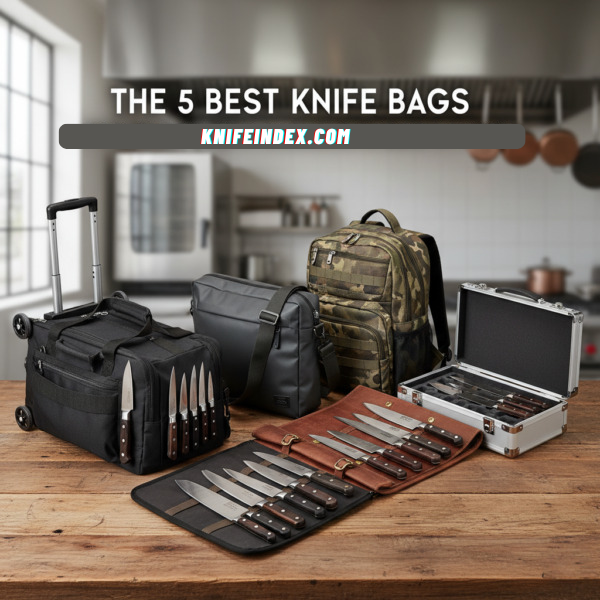
Need to make a fast decision before your next shift? Here are our top five picks, each a champion in its class.
| Knife Bag | Image | Material | Best For | Check on Amazon |
|---|---|---|---|---|
| Dalstrong Nomad Knife Roll |  |
Waxed Canvas | Best Overall Performance | View Price |
| Noble Home & Chef Roll Bag |  |
Canvas/Polyester | Best Value / For Students | View Price |
| Aaron Leather Goods Roll |  |
Genuine Leather | Best Premium Look | View Price |
| Chef Sac Knife Backpack |  |
Polyester | Best for Travel & Capacity | View Price |
| Messermeister Padded Bag |  |
Nylon/PVC | Best Compact Protection | View Price |
Best Knife Bags by Budget: What to Expect at Every Price Point
Knife bags span an enormous price range, and understanding what that money actually buys helps you avoid both overpaying and under-protecting your knives.
Under $50: Entry-Level and Student Budgets
At this price point, expect canvas/polyester blends, basic elasticized slots, and simple flap or roll closures. These bags are perfectly serviceable for a starter kit of 6-8 knives and are a smart choice for culinary students who are still building their collection and don’t want to over-invest before they know their long-term needs. Stitching quality and zipper durability are usually the first things to suffer at this tier, so handle the bag in person or read reviews carefully before buying.
$50-$100: The Sweet Spot for Working Cooks
This range is where most genuinely durable, working-kitchen knife rolls live. Expect heavier waxed canvas or ballistic nylon, reinforced stitching at stress points, metal hardware instead of plastic clips, and thoughtful extras like a honing steel slot or a padded laptop sleeve. For most line cooks and sous chefs, a bag in this range represents the best balance of durability, capacity, and price.
$100-$200: Premium Materials and Craftsmanship
Here you’ll find genuine leather rolls, thicker waxed canvas with leather accents, and cases with rigid, padded shells designed to survive drops and rough handling. These bags are built to last many years of daily use and often carry a more polished, professional look suited to fine-dining kitchens or chefs who present their tools in front of guests.
$200 and Up: Heirloom and Fully Custom Pieces
At the top end, you’re paying for full-grain leather, hand-stitching, monogramming, and sometimes fully custom slot configurations built to match a specific knife collection. These are less about raw function — a $70 roll will protect your knives just as well on a day-to-day basis — and more about owning a piece of gear that’s meant to be passed down or that reflects a significant investment in a professional identity.
The Full Inspection: In-Depth Reviews of the Best Chef Knife Bags
We loaded these bags with full knife kits, carried them around town, and put them through the rigors of a busy kitchen environment. Here’s the detailed report.
1. Dalstrong Nomad Knife Roll (Best Overall Performance)
The Dalstrong Nomad is a beast of a knife roll that perfectly balances rugged durability with intelligent design. It’s constructed from 12oz heavy-duty, water-resistant waxed canvas with genuine leather accents. It feels incredibly tough and built to withstand abuse. The roll features 10 knife slots for blades up to 15″ long, plus 2 large zippered pockets for storing everything from a honing steel to a notebook and phone. The slots are extra-wide, easily accommodating knives with thicker handles.
What sets it apart are the details: the heavy-duty zippers, the adjustable G-hook clasps, and the comfortable shoulder strap. It’s a thoughtfully designed bag for a working chef who needs to carry their core tools securely. It’s the perfect transport for the high-quality blades you’d find after researching the best chef knife brands.
Who is this best for?
The serious home cook, culinary professional, or student who wants a rugged, stylish, and highly functional roll that will last for years.
- Extremely durable waxed canvas and leather construction
- Ample storage with 10 knife slots and 2 large pockets
- High-quality zippers and buckles
- Water-resistant and easy to clean
- Looks and feels incredibly professional
Pros
- Can get heavy when fully loaded
- Canvas can feel a bit stiff when new
Cons
2. Noble Home & Chef Knife Roll Bag (Best Value / For Students)

For the culinary student or the cook on a budget, this knife roll from Noble Home & Chef offers incredible functionality for its price. It’s a no-nonsense bag made from a durable ballistic nylon/canvas blend that can hold 8 knives up to 18″ long, plus a slot for a honing steel. It also includes a zippered utility pouch for smaller items. The elasticized pockets hold knives securely, and a full flap covers the blades for protection.
While it doesn’t have the premium feel of waxed canvas or leather, it’s a tough, practical workhorse. It does the job of protecting and organizing your knives effectively without breaking the bank. It’s the perfect starter bag, ideal for transporting a reliable workhorse like a Victorinox, a brand whose value we explore in our Victorinox chef knife reviews.
Who is this best for?
Culinary students, aspiring chefs on a budget, or anyone who needs a simple, effective, and affordable knife transport solution.
- Excellent value for the price
- Holds 8 knives plus a honing steel
- Lightweight and durable material
- Includes a utility pouch and shoulder strap
Pros
- Lacks the premium feel of more expensive bags
- Velcro closures on the pouch are less durable than zippers
Cons
3. Aaron Leather Goods Premium Knife Roll (Best Premium Look)
This is more than a knife bag; it’s an heirloom piece. Handcrafted from 100% genuine buffalo leather, this roll makes a powerful statement of professionalism and style. The leather is thick, supple, and develops a beautiful, unique patina over time. It features 10 slots of varying widths to accommodate different knives, a durable leather flap for blade protection, and a zippered pocket for small essentials. It’s all secured with handsome brass buckles.
Carrying this bag feels special. It’s for the chef who has invested heavily in their craft and their tools, perhaps after agonizing over a Wüsthof vs. Zwilling vs. Shun debate, and wants a bag that reflects that level of quality. It’s a functional piece of art that offers excellent protection and unmatched aesthetic appeal.
Who is this best for?
The established professional, the dedicated enthusiast, or anyone who appreciates the timeless appeal and durability of genuine leather craftsmanship.
- Stunning, high-quality genuine leather construction
- Develops a beautiful, personal patina with age
- Excellent protection and secure storage
- Makes a strong professional statement
Pros
- Heavy, especially when fully loaded
- Requires occasional leather conditioning
- Higher price point
Cons
4. Chef Sac Knife Backpack (Best for Travel & Capacity)

For the modern chef on the move, a simple roll might not be enough. The Chef Sac Backpack is a complete mobile kitchen workstation. It features a dedicated, padded compartment with 21 slots for knives and tools. But the real advantage is everything else it offers: a separate large compartment for books, a uniform, or a laptop; multiple exterior pockets; and even a USB charging port. It’s designed for the chef who travels, commutes, or needs to carry more than just their blades.
The ergonomic, padded straps make it comfortable to carry even when fully loaded. It offers excellent organization and protection in a convenient backpack format. This is the ultimate solution for keeping your entire kit, from your best bread knife to your tablet, safe and organized. It’s a different approach from traditional knife holders, designed for total mobility.
Who is this best for?
The traveling chef, the culinary competitor, the student who bikes to class, or any professional who needs to carry their full toolkit and personal items in one bag.
- Massive capacity with 21+ slots and multiple compartments
- Comfortable and ergonomic backpack design
- Excellent organization for knives, tools, and personal items
- Durable construction with padded compartments
Pros
- Can become very heavy and bulky
- Less traditional aesthetic than a classic roll
Cons
5. Messermeister 8-Pocket Padded Bag (Best Compact Protection)
Messermeister is a trusted name in the culinary world, and this bag reflects their commitment to quality and function. Unlike a roll, this is a zippered case with a semi-rigid, padded exterior, offering superior protection against bumps and drops. Inside, it features 8 elasticized pockets for knives up to 18″ long. The interior is fully lined and has a commercial-grade zipper that can be locked.
This bag offers a step up in protection from a soft roll without the bulk of a backpack. It’s sleek, professional, and very durable, made from a tough, abrasion-resistant polyester fabric. It’s an ideal choice for safely carrying a core set of high-quality knives, like those from the German giants in the Zwilling vs. Henckels debate. It’s a professional-grade case for the discerning chef.
Who is this best for?
The chef who prioritizes blade protection above all else and wants a compact, secure, and highly durable case for their essential knives.
- Padded construction offers excellent protection
- Durable, abrasion-resistant material
- Lockable commercial-grade zipper
- Sleek and professional appearance
Pros
- Limited capacity of 8 knives
- No extra pockets for larger tools or personal items
Cons
Traveling with Knives: Airline, TSA, and Checked Bag Rules
Culinary competitors, traveling private chefs, and cooks relocating between jobs often need to fly with a full knife kit, and the rules here are strict and non-negotiable. In the United States, chef’s knives of any length are not permitted in carry-on luggage under TSA regulations, full stop — there is no exception for “small” or “dull” blades, and attempting to bring one through security checkpoint screening will result in confiscation at best and a civil penalty at worst.
Knives must be packed in checked luggage, and this is exactly where a quality knife bag earns its keep. A soft roll offers minimal protection against baggage handlers and conveyor systems, so if you’re flying, wrap each blade individually in a rigid blade guard, place the loaded roll inside a hard-sided suitcase or a padded knife case, and position it in the center of the case surrounded by clothing so it isn’t jostled against the shell. A semi-rigid case like the Messermeister padded bag offers meaningfully more protection than a soft canvas roll when it’s going to be tossed around a cargo hold.
International travel adds another layer of complexity, since knife-carry laws vary significantly by country and even by region within a country. Some destinations restrict blade length or classify certain knives as prohibited weapons regardless of intended culinary use. Always check the customs and import regulations of your destination country well before your trip, and consider shipping specialty knives ahead via an insured courier if local restrictions are unclear or particularly strict.
Travel Tip: Keep a printed or photographed inventory of your knife kit with approximate values in case a bag is lost or damaged in transit. Most airlines require documentation like this to process a claim for checked baggage damage.
Alternatives to Flying With Your Kit
For chefs relocating permanently, competing at a distant event, or simply uneasy about entrusting a valuable kit to a baggage handling system, shipping ahead via an insured courier is often a safer and less stressful option than checking knives on a flight. Ground shipping also sidesteps international customs uncertainty entirely for domestic moves, and a well-padded knife bag placed inside a sturdy outer shipping box with additional packing material offers excellent protection for a multi-day transit. If you do ship a kit, always purchase shipping insurance equal to the kit’s replacement value and photograph the packed contents before sealing the box.
Choosing a Knife Bag: Culinary Students vs. Working Professionals
The right knife bag looks different depending on where you are in your culinary career, and buying the wrong one for your stage can mean paying for capacity you don’t need or, worse, being under-equipped for daily kitchen life.
Culinary students are usually carrying a starter kit issued or recommended by their program, transporting it daily between classes, a part-time kitchen job, and home. Priorities here should be a comfortable strap or backpack format for walking or biking, a compact 6-to-10 slot capacity, and a price point that doesn’t compete with the cost of tuition and the knives themselves. Durability still matters, since a knife roll used daily for a two-year program takes real wear, but ultra-premium materials are rarely worth the investment at this stage.
Working line cooks and sous chefs typically carry an expanded kit and move between stations or even between restaurants more often. A mid-size roll or case with 10-14 slots, a dedicated honing steel slot, and a couple of zippered utility pockets for a thermometer, pens, and a notepad tends to fit this stage best. Because these bags see near-daily use in a hot, wet, high-friction environment, investing in genuinely tough materials — waxed canvas, ballistic nylon, or leather — pays off in years of service rather than months.
Executive chefs, instructors, and specialists (butchers, sushi chefs, pastry chefs with specialty tools) often have the most idiosyncratic needs, and a larger structured case or backpack with configurable or oversized slots is usually the better fit, since it can accommodate irregular tools like scaling knives, offset spatulas, piping tip sets, or a full Japanese knife set with oversized wa-handles.
Knife Safety and Etiquette Outside the Kitchen
Carrying blades through public spaces comes with responsibilities beyond just protecting the edges. Always keep knives fully sheathed or guarded and zipped inside your bag while in transit — never carry an exposed blade, even briefly, in a hallway, on public transit, or in a parking lot. Be aware that some cities and states have local ordinances regulating the transport of fixed-blade knives above a certain length, separate from the workplace exemptions that typically apply to chefs commuting directly to and from a culinary job; if you’re unsure of local rules, keep documentation of your culinary employment or enrollment with you.
When arriving at a new kitchen or a stage (a trial shift), it’s considered good etiquette to keep your roll closed and out of the way until you’re shown where to store it, rather than laying knives out on a shared station unprompted. Many kitchens have a designated knife storage area, locker, or magnetic strip specifically so personal knife bags aren’t left out during service.
DIY Knife Rolls and Long-Term Bag Maintenance
Some cooks with sewing experience choose to make their own knife roll, and it’s a genuinely rewarding project if you want a fully custom slot layout for an unusual knife collection. A basic DIY roll requires heavyweight canvas or denim, a lighter contrasting fabric for the pocket layer, sturdy thread rated for upholstery use, and either grommets and cord or a length of leather strap and a buckle for the closure. The key technical challenge is sizing each pocket about half an inch wider than the knife’s widest point (usually the bolster or handle) so blades slide in and out smoothly without straining the seams, and reinforcing the base of every pocket with a double or triple stitch, since that’s the point that takes the most repeated stress.
Whether store-bought or homemade, a knife bag lasts longest with a bit of routine care. Wipe down interior pockets after every use to remove food debris and moisture before it has a chance to sit against the fabric. Air out a rolled bag fully open for a few minutes after a shift rather than leaving it tightly rolled and damp in a locker overnight. Re-apply wax dressing to waxed canvas roughly once a year, and leather conditioner every few months for bags in regular use. Small tears or loose stitching should be repaired immediately with a heavy-duty needle and thread or taken to a cobbler, since a small failure at a seam quickly becomes a knife falling through an unsupported pocket.
Protecting Your Investment: Insurance, Warranties, and Gifting a Knife Bag
A fully loaded, high-end knife roll can easily represent a thousand dollars or more once you add up premium blades, a sharpening steel, and specialty tools, yet many cooks never consider insuring it. If you carry a serious kit, check whether your renter’s or homeowner’s insurance policy covers professional tools away from home, and consider a dedicated rider if it doesn’t — many standard policies cap personal property claims well below what a professional kit is worth. Keep receipts or at minimum photos of your knives and bag for any future claim.
A knife bag also makes an excellent, thoughtful gift for a culinary student graduating into their first kitchen job, a home cook who’s serious about their craft, or a chef starting a new position. For a student, a well-made mid-range roll in the $50-$100 range strikes the right balance of quality and practicality. For an established professional, a premium leather roll or a bag that can be monogrammed adds a personal touch that turns a practical gift into a keepsake they’ll carry for years.
Common Mistakes When Choosing a Knife Bag
After testing dozens of bags and talking to cooks across every stage of their careers, a handful of avoidable mistakes come up again and again.
Buying Based on Looks Alone
A beautiful leather roll photographed on a marble countertop can hide thin stitching, undersized slots, or hardware that won’t survive a single busy service. Always check stated slot dimensions and read reviews specifically mentioning long-term durability rather than just unboxing impressions.
Ignoring Handle Width
As covered above, many rolls are cut for slim handles and simply won’t accommodate thicker ergonomic grips or Japanese wa-handles. Measure your widest handle before buying, not just your longest blade.
Overbuying Capacity Too Early
A brand-new culinary student doesn’t need a 21-slot backpack built for an executive chef’s full kit. Oversized bags for a small kit end up half-empty, awkward to carry, and prone to letting knives shift and knock against each other during transport since nothing holds them snugly in place.
Skipping Blade Guards
Even the best-built pocket can wear through over months of repeated insertion and removal if the edge makes direct contact with the fabric. Individual blade guards are inexpensive and dramatically extend the life of both your knives’ edges and the bag’s interior lining.
Forgetting About Off-Season Storage
Culinary students on break, or cooks between jobs, sometimes leave a loaded roll sitting closed in a bag or car trunk for weeks. Extended storage in a closed, humid environment is a common and preventable cause of rust; always store a roll open, dry, and out of direct sunlight if it won’t be used for an extended stretch.
Not Matching the Bag to Your Actual Knife Set
Different knife sets have meaningfully different handle profiles and lengths, and it’s worth thinking about your specific set rather than a generic “chef knife” assumption. A traditional German-style set with substantial full-tang handles needs wider slots than a slim Japanese-style set, while a hybrid set that mixes both styles benefits from a roll with a few adjustable or extra-wide slots rather than uniform narrow ones throughout.
Your Knife Bag Questions, Answered
Do I really need a knife bag? Can’t I just use towels?
If you ever transport your knives, a dedicated bag is a non-negotiable piece of safety equipment. Wrapping knives in towels is incredibly dangerous—the blades can easily slice through the fabric, posing a risk to you and others. It also causes the blades to knock against each other, which leads to dulling and chipping. A proper knife bag is the only professional and safe way to transport your most important tools.
What’s better: a knife roll or a knife case/bag?
It comes down to personal preference and need. A knife roll (like the Dalstrong or Aaron Leather) is traditional, often more compact when rolled, and lays out flat for easy access to all your tools. A knife case or bag (like the Messermeister or Chef Sac) often provides more structured, padded protection and can include significantly more storage for items beyond just knives. If you carry a large kit or travel frequently, a bag might be better. For daily essentials, a roll is often preferred.
Should I use blade guards inside my knife bag?
Yes, it is highly recommended. While a good knife bag will protect your knives, adding individual plastic or felt-lined blade guards provides an extra layer of safety. They prevent the knife tip from poking through the material over time and stop the edge from making any contact with the bag’s interior stitching or other knives. It’s a small, inexpensive upgrade that offers maximum protection.
How do I clean my knife bag?
For waxed canvas or nylon/polyester bags, spot cleaning with a damp cloth and mild soap is usually sufficient. Avoid machine washing, as it can damage the fabric’s integrity and water-resistant coatings. For a genuine leather bag, you should use a dedicated leather cleaner and apply a leather conditioner periodically to keep it supple and prevent it from drying out and cracking.
Can you bring a chef’s knife on a plane?
No. Chef’s knives are not allowed in carry-on bags under TSA rules and must go in checked luggage. Pack them in a padded knife case or roll, guard every blade individually, and place the case in the center of your suitcase surrounded by clothing for extra protection during handling.
How many slots do I need in a knife roll?
Count your current knives and tools, then add two or three spare slots for future purchases. Culinary students with a starter kit are usually well-served by 6-8 slots, working line cooks and sous chefs typically need 10-14, and chefs with specialty tools or a full professional set often prefer 18 or more.
Can I make my own knife roll?
Yes, a DIY knife roll is a manageable sewing project using heavyweight canvas or denim, a lighter pocket fabric, upholstery-grade thread, and a strap or grommet-and-cord closure. Size each pocket about half an inch wider than the knife’s bolster or handle, and reinforce the base of every pocket with a double stitch since that’s the point under the most repeated stress.
Should I insure my knife kit?
If your kit represents a significant investment, it’s worth checking whether your renter’s or homeowner’s policy covers professional tools away from home, since many standard policies cap personal property claims below what a full professional kit is worth. A dedicated rider and photographic records of your knives can make a future claim much easier to process.
The Final Word: Choosing Your Culinary Armor
Your knife bag is more than just luggage; it’s a direct reflection of your commitment to the culinary craft. It’s the silent partner that ensures your most trusted tools arrive ready for service, day after day. Whether you’re a student just starting your journey or a seasoned executive chef, there is a perfect bag to suit your needs.
For the ultimate blend of modern durability, intelligent design, and rugged good looks, the Dalstrong Nomad Knife Roll is our top recommendation. It’s built to work as hard as you do.
If you’re a student or budget-conscious cook who needs reliable function without the frills, the Noble Home & Chef Knife Roll Bag provides unbeatable value. And for the professional who needs to carry their entire world on their back, the Chef Sac Knife Backpack offers unparalleled capacity and organization.
Invest in a quality bag, treat your knives with the respect they command, and carry your tools with the confidence of a true professional.