Few knives provoke as much legal confusion — and sheer fascination — as the butterfly knife. Known formally as the balisong, this distinctive folding blade with two counter-rotating handles has been romanticized in action films, practiced obsessively by EDC enthusiasts, and simultaneously banned in a surprising number of places around the world. If you’ve ever asked yourself why is a butterfly knife illegal, you’re not alone.
The answer is more nuanced than you might expect. It’s not purely about how sharp the blade is. It’s not even about blade length in most cases. It’s about how fast the knife can be deployed, how easily it can be concealed, and the fears — rational and irrational — that lawmakers held when they drafted knife legislation decades ago. Those original fears have been written into statute books across dozens of jurisdictions, and many of those laws have never been updated.
This guide covers everything you need to know: the history of the balisong, why legislators targeted it specifically, how the laws break down across US states and internationally, what the penalties look like, and what your legal options are if you want to carry or collect these knives without breaking the law.
1. What Is a Butterfly Knife?
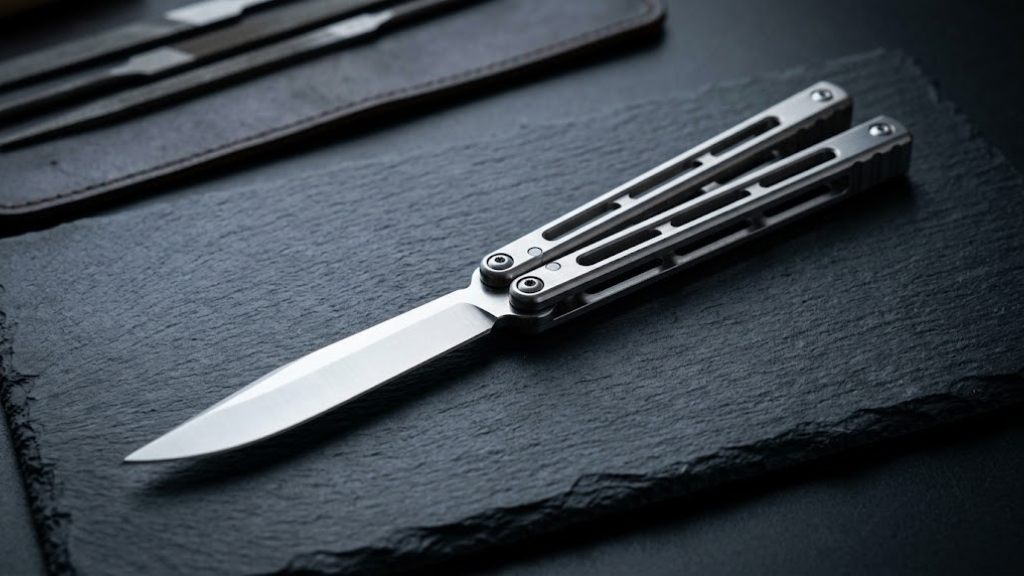
A butterfly knife — also called a balisong, fan knife, or Batangas knife — is a type of folding pocketknife with two handles that rotate around the blade’s pivot. When closed, both handles fold over the blade to protect it (and the user’s pocket). When opened, the handles fan out in opposite directions and lock into place, forming a single ergonomic grip.
The mechanical ingenuity of the design is what makes it so controversial. An experienced user can deploy a butterfly knife in a fraction of a second using a one-handed flipping technique that requires zero buttons, no thumb studs, and no assist mechanisms. To the untrained eye, it looks almost magical. To a legislator thinking about street violence in the 1950s, it looked terrifying.
Anatomy of a Balisong
Understanding what distinguishes a butterfly knife from a regular folding knife helps explain why it gets treated differently under the law:
- Bite handle: The handle that closes over the sharp edge of the blade. Usually marked with a pin or notch to help users identify it by touch.
- Safe handle: The handle that closes over the spine (dull back) of the blade.
- Latch: A small clip or latch that holds the handles together when the knife is closed, preventing accidental opening in a pocket.
- Pivot pins: The two pins around which both handles rotate independently.
- Blade: Typically between 3.5 and 4.5 inches, with clip-point or drop-point profiles being most common in classic Filipino designs.
The combination of these elements creates a knife that is, mechanically speaking, very different from a standard slip-joint or liner-lock folder. It has no locking mechanism in the traditional sense — the handles themselves form the lock when fully opened — and it requires a specific learned motion to deploy. That learned motion is the problem from a legal standpoint.
2. History and Cultural Origins of the Butterfly Knife
To understand why the butterfly knife became so legally fraught, you have to understand where it came from — and how it arrived in Western markets.
Filipino Roots
The balisong has deep roots in the Batangas province of the Philippines, where it functioned as both a utility tool and a self-defense weapon for centuries. Local craftsmen in Balisong (the town, which lent its name to the knife) produced these blades from as early as the 1700s, though some researchers argue earlier versions existed even before Spanish colonization.
In Philippine culture, the balisong was not a gangster’s weapon — it was a working man’s knife. Farmers used them to cut rope and harvest crops. Fishermen used them to gut fish and cut lines. Soldiers incorporated them into the martial art of Arnis (also known as Eskrima or Kali), where the rapid-deploy capability made the knife an effective combat tool in close-quarters situations.
The knife’s reputation as a pure weapon began when Filipino immigrants and American servicemen brought balisongs to the United States following World War II and the Korean War. Without the cultural context of Philippine village life, all the Western observer saw was a knife that could be produced and put into action with stunning speed.
Western Popularization and the Media Effect
In the 1950s and 1960s, butterfly knives began appearing in American urban settings, particularly in California and Hawaii — states with large Filipino-American communities. Their exotic appearance and rapid deployment made them attractive to street gangs and sensationalized in newspaper reports about youth violence.
Hollywood accelerated the moral panic. Films and TV shows consistently portrayed the butterfly knife as a villain’s weapon — the blade of choice for the cinematic thug who flips it open menacingly before a confrontation. By the time legislators began drafting knife regulations in earnest through the 1950s and into the 1980s, the butterfly knife had acquired a cultural association with criminal violence that was deeply embedded in the public imagination, even if the statistical reality was more complicated.
The Switchblade Panic Connection
The butterfly knife ban is historically linked to the broader “switchblade panic” of the 1950s. Following the release of juvenile delinquency films and a wave of newspaper reporting on gang violence, Congress passed the Federal Switchblade Knife Act in 1958, which banned the interstate commerce of switchblades and gravity knives. Many states followed with their own statutes, and some of those statutes were written broadly enough to include balisongs as well — even though the butterfly knife predates the switchblade and operates on a completely different mechanical principle.
3. Why Are Butterfly Knives Specifically Considered Illegal?
The core legal reasoning behind butterfly knife restrictions comes down to three primary concerns, all of which have been articulated in various court decisions and legislative histories.
Rapid One-Handed Deployment
The single biggest reason butterfly knives get banned is their ability to be deployed rapidly with one hand. Traditional folding knives — even those with thumb studs or flipper tabs — require a deliberate, recognizable opening motion. Someone reaching for a standard folder doesn’t look threatening until the blade is out. A balisong expert can produce a fully open, blade-forward knife in under a second from a closed, latched position, with the motion concealed in the flipping flourish.
Legislators and courts have consistently pointed to this deployment speed as functionally equivalent to a switchblade — and in some rulings, faster. The intent of the carrier becomes difficult to assess when the weapon can be ready before anyone recognizes a threat posture.
Concealability
A butterfly knife, when closed and latched, is no larger than many legal folding knives. It fits comfortably in a trouser pocket or jacket pocket. The compact, ambiguously shaped closed form means it doesn’t flag metal detectors much differently from a set of keys, and casual visual inspection often doesn’t identify it. The combination of easy concealability with extremely fast deployment is the exact profile that knife statutes were written to target.
Perceived Threat and Intimidation
There’s also a psychological element. The flipping motion of a balisong — even when performed purely as a skill demonstration — is widely perceived as threatening and intimidating. Courts have recognized that producing a butterfly knife and executing opening flourishes in a confrontational context constitutes a form of threatening behavior. Some jurisdictions have prosecuted individuals not for carrying the knife per se, but for the manner in which they displayed or manipulated it in front of others.
Classification by Association
Many states didn’t specifically legislate against balisongs — they were simply swept up in statutes written about “switchblades,” “gravity knives,” or “automatic knives.” Courts in different jurisdictions have reached different conclusions about whether a balisong technically fits those definitions. In some states, courts ruled that a balisong requires manual action and therefore isn’t “automatic.” In others, the deployment speed was deemed sufficient for the automatic or switchblade classification to apply. The result is a genuinely inconsistent patchwork of legal interpretations.
4. US State-by-State Butterfly Knife Laws
There is no single federal law that bans butterfly knives for civilians (more on federal law below). The legal landscape is entirely determined by state statutes, and sometimes by city or county ordinances within those states. What’s perfectly legal in one state can land you in handcuffs across the border.
Here is a breakdown of the current legal status across key US states as of 2026. Note that laws change — always verify with current local statutes or legal counsel before carrying.
| State | Status | Key Restriction | Notes |
|---|---|---|---|
| California | Illegal | Possession & carry banned | Penal Code §17235 classifies balisongs as switchblades if blade ≥2 inches. Effectively banned. |
| Hawaii | Illegal | Outright ban on possession | Hawaii law explicitly bans balisongs by name. One of the strictest state laws. |
| New York | Illegal | Gravity knife statutes apply | Courts have classified balisongs as gravity knives. Carry and sale prohibited. |
| New Mexico | Illegal | Banned as switchblade | State statute covers butterfly knives explicitly under switchblade prohibition. |
| Texas | Legal (with limits) | Location restrictions apply | Legal to own and openly carry. Cannot carry in schools, courthouses, bars, or polling places. |
| Arizona | Legal | Minimal restrictions | Arizona has broad preemption laws. Most knives legal; standard deadly weapon rules apply. |
| Montana | Legal | Age restrictions | Legal for adults. Minors restricted. Concealed carry allowed for legal adults. |
| Alaska | Legal | Standard knife laws apply | No specific balisong ban. Carry restrictions apply for certain locations. |
| Oregon | Restricted | Concealed carry banned | Open carry legal; concealed carry of a balisong may be charged as a switchblade violation. |
| Washington | Restricted | Intent & context-based | Ownership generally legal; carrying with intent to harm illegal. Gray area for public carry. |
| Illinois | Illegal | Included in switchblade ban | State law broadly covers automatic opening knives. Butterfly knives caught in sweep. |
| Florida | Restricted | Concealed carry restrictions | Ownership legal; concealed carry of knives with blades over 4 inches restricted. |
| Colorado | Restricted | Local ordinances vary | State law doesn’t specifically ban balisongs, but Denver and other cities have ordinances. |
| Nevada | Restricted | Concealed carry banned | Possessing in vehicle or concealed on person is prohibited. Open carry rules ambiguous. |
The pattern here reflects a broader national divide in knife law philosophy. Western and Southern states that follow a “knife rights” or “constitutional carry” model tend to have more permissive laws. Coastal states with more urban populations and historical associations between knife crime and street gangs tend to have stricter statutes, many of which date to the 1950s and 1960s and haven’t been substantially revised since.
For broader context on knife carry laws for minors, the restrictions become even more pronounced — essentially every state imposes additional restrictions on anyone under 18, regardless of knife type.
The Local Ordinance Problem
Even in states where butterfly knives are technically legal, city and county ordinances can override state permissiveness. This is especially true in major metropolitan areas. A balisong that’s perfectly legal to carry in rural Arizona might violate a Tucson city ordinance. The same knife legal in unincorporated Texas could be prohibited in Houston. Always check at the municipality level, not just the state level.
5. Federal Law and the Butterfly Knife
Many people are surprised to learn that there is no broad federal law banning butterfly knives for civilians. The federal statutes that exist around knives are narrower than most people assume.
The Federal Switchblade Knife Act (1958)
The primary federal knife statute is the Federal Switchblade Knife Act of 1958, which prohibits the manufacture, sale, or transport in interstate commerce of switchblade knives. The critical legal question has always been: does a butterfly knife qualify as a switchblade under this act?
The act defines a switchblade as any knife with a blade that opens “automatically” by hand pressure applied to a button or other device on the handle, or by the operation of inertia, gravity, or both. Butterfly knives require deliberate manual manipulation — not a button or gravity release. Federal courts have generally not classified balisongs as switchblades under the federal act, though the question has been litigated in various contexts.
Carrying on Federal Property
Where federal law does come into direct play is in carrying knives on federal property. Under 18 U.S.C. § 930, carrying a dangerous weapon in a federal facility (federal buildings, courthouses, military installations) is prohibited. A butterfly knife, even if legal in the state where the federal facility is located, would likely be classified as a dangerous weapon under this statute.
Federal Employees and Government Contractors
Federal employees, military personnel, and government contractors face additional workplace restrictions that may prohibit butterfly knives on government premises regardless of what state law says. These aren’t criminal statutes — they’re employment regulations — but the consequences for violation can include termination and security clearance revocation.
6. International Regulations: A Global Picture
The legal status of butterfly knives internationally is even more fragmented than the US state picture, with some countries imposing total bans and others placing no specific restrictions at all.
| Country | Status | Legal Basis |
|---|---|---|
| United Kingdom | Banned | Criminal Justice Act 1988, Section 141 — explicit nationwide prohibition |
| Germany | Banned | Weapons Act (Waffengesetz) — balisongs classified as forbidden weapons |
| Canada | Banned | Criminal Code Section 84 — prohibited weapon classification |
| Australia | Banned | Most states classify as prohibited weapons; some allow for collection with license |
| Philippines | Legal | Native cultural implement; no general prohibition on balisongs |
| Japan | Effectively Banned | Swords and Firearms Control Law restricts blades over 6cm; carrying restricted |
| France | Restricted | Category D weapon — ownership allowed, carry requires justification |
| Spain | Restricted | Legal to own; concealed carry regulated under Arms Regulations |
| New Zealand | Banned | Arms Act 1983 — prohibited offensive weapon |
| Netherlands | Banned | Weapons and Ammunition Act — balisongs specifically prohibited |
The international picture reveals an interesting anomaly: the Philippines — the knife’s homeland — is one of the few countries that imposes no general prohibition on balisongs, recognizing their deep cultural significance. Meanwhile, every major Western nation with strict weapons laws has banned them outright.
7. Butterfly Knife vs. Other Knives: Why Single Out the Balisong?
One of the most common arguments made by knife rights advocates is that the butterfly knife is singled out unfairly while other knives with similar or greater capabilities remain legal. It’s a fair question that deserves a careful answer.
| Knife Type | Deployment Speed | Concealability | Blade Length (typical) | Legal Status (typical) |
|---|---|---|---|---|
| Butterfly Knife (Balisong) | Very Fast (with practice) | High | 3–4.5 inches | Often Restricted |
| Automatic / Switchblade | Fastest (button press) | High | 2–4 inches | Widely Restricted |
| Assisted-Opening Folder | Fast (thumb stud + assist) | High | 3–4 inches | Generally Legal |
| Standard Folding Knife | Moderate | High | 2.5–4 inches | Generally Legal |
| Fixed Blade Knife | Instant (no deployment) | Low (requires sheath) | 3–12+ inches | Varies widely |
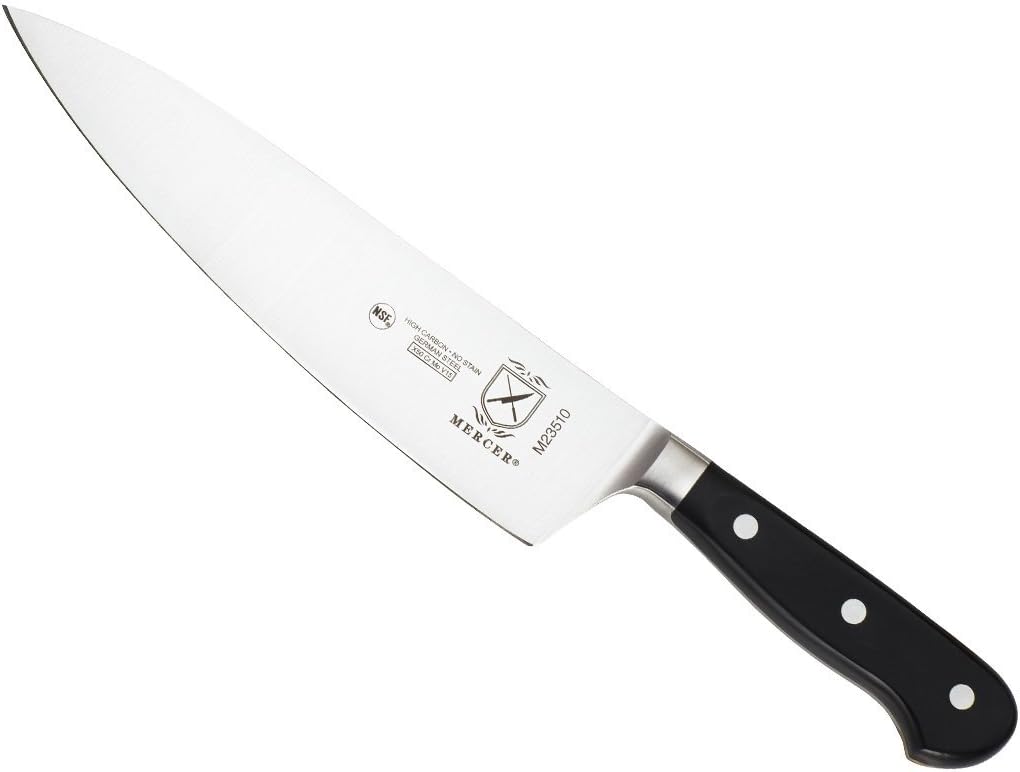
| Chef’s Knife / Kitchen Knife | Instant | Low | 6–12 inches | Unregulated |
The table above illustrates a real inconsistency in knife law. A large kitchen knife — which has a longer blade, can cause at least as much harm, and is already deployed the moment someone picks it up — faces zero legal restriction. An assisted-opening folder can be deployed nearly as fast as a balisong with much less practice. Yet neither of these faces the same legal scrutiny as a butterfly knife.
The answer lies entirely in cultural history and the optics of intimidation. The butterfly knife looks threatening when being flipped, which created a media-driven moral panic that a kitchen knife in a drawer never generated. Laws respond to perceived threats, and the butterfly knife’s perceived threat was high relative to its actual danger compared to other edged tools.
This is the same dynamic that affects broader discussions about law enforcement knife selection — where the legal and functional characteristics of a blade must be carefully balanced, and where perceptions of a knife’s “look” can influence how it’s received by the public and the legal system.
8. Butterfly Knife Trainers and the Legal Gray Area
The rise of butterfly knife trainers — balisongs with a completely unsharpened, rounded “blade” designed purely for practicing flipping techniques — has created a fascinating legal gray area that courts and legislators have only partially addressed.
What Is a Butterfly Knife Trainer?
A trainer balisong is mechanically identical to a live balisong. It has the same two-handle design, the same pivot mechanism, the same weight and balance feel. The only difference is that the “blade” is a blunt, unsharpened piece of metal — often with a channel cut into it so it can never be sharpened. You cannot cut anything with a trainer. It is, essentially, a skill toy.
Are Trainers Legal?
The answer depends entirely on how your jurisdiction defines a prohibited knife. There are two schools of thought in the law:
Mechanism-based bans: States like California and Hawaii that define the balisong primarily by its mechanical design (two rotating handles, specific pivot mechanism) will often include trainers in the prohibition, because the mechanism is what makes the knife threatening regardless of whether the blade is sharp. California courts have specifically addressed this, noting that a dull-bladed balisong is still a balisong under the statute.
Blade-based restrictions: Some states and countries define prohibited weapons based on blade sharpness or lethality. Under these frameworks, a trainer might be considered a toy or sporting implement rather than a weapon, because it cannot actually cut. This interpretation tends to be more permissive of trainers.
The safest general rule: if a live balisong is illegal in your jurisdiction, treat the trainer as equally restricted unless you have specific legal confirmation otherwise. “It’s not sharp” is not a reliable legal defense in most jurisdictions.
The Comb Loophole
Perhaps the most legally bulletproof alternative is the butterfly comb — a product that uses the exact handle mechanism of a balisong but holds a hair comb instead of any kind of blade. Because there is literally no blade or sharpened edge, butterfly combs are generally legal everywhere and widely sold in retail stores. They’re popular with beginners who want to learn the basic flipping motions without any legal risk and without the danger of a sharp blade.
9. What Are the Penalties for Carrying a Butterfly Knife Illegally?
The consequences of carrying a butterfly knife in a jurisdiction where it’s illegal can range from a minor fine to serious criminal charges, depending on the specific state, the circumstances of the encounter, your prior record, and whether any aggravating factors (such as proximity to a school or intent to harm) apply.
Misdemeanor vs. Felony Classification
In most jurisdictions, simple possession or concealed carry of a banned knife is treated as a misdemeanor on first offense. This typically carries:
- Fines ranging from $100 to $1,000 depending on jurisdiction
- Possible jail time of up to 1 year in county jail
- Mandatory knife confiscation and destruction
- A criminal record entry, which can affect employment and professional licensing
The charge escalates to a felony in several circumstances:
- Prior record: Many states elevate a second offense on a weapons charge to a felony
- School zones: Carrying any weapon near a school typically triggers enhanced penalties under both state and federal law (Gun-Free School Zones Act applies to knives in some interpretations)
- Intent to harm: If there’s evidence of intent to use the knife as a weapon — threats, confrontational behavior, documented targeting — the charge can become aggravated assault with a deadly weapon, a felony in every state
- Combined with another crime: Carrying an illegal knife while committing another crime adds weapons charges that compound the sentencing
Real-World Enforcement
It’s worth being honest about enforcement reality. Police encounters involving butterfly knives outside of criminal context are relatively uncommon in most jurisdictions. Officers generally exercise discretion, and a casual encounter that reveals a butterfly knife — a traffic stop, for example — may result in confiscation without formal charges if the officer determines there’s no criminal intent and your record is clean.
That said, enforcement is highly contextual. In urban areas with heightened police attention to knife crime, or in jurisdictions running active anti-weapons campaigns, the same encounter might produce very different outcomes. The legal risk is real, even if the practical enforcement risk varies.
10. Legal Alternatives to Butterfly Knives
If you’re drawn to the butterfly knife for its aesthetic, its flipping skill element, or its EDC utility but you live in a jurisdiction where it’s restricted, there are several legal alternatives worth considering.
For the Flipper: Assisted-Opening Folders
If you love the fast, satisfying snap of a blade deploying, a quality assisted-opening folding knife delivers an experience that’s surprisingly close to a balisong in everyday carry terms. Knives with strong spring-assist mechanisms deploy with a single thumb-stud press and lock open crisply. They’re legal in the vast majority of US jurisdictions (though not all — always check) and carry no associated stigma.
For EDC knife enthusiasts interested in high-performance folders across all price points, our detailed breakdown of top blade brands for 2026 covers some of the best options in the current market, including assisted-opening designs from established manufacturers.
For the Collector: Seek Legal Jurisdiction Purchases
If you want to own and collect balisongs, consider whether your state actually prohibits possession at home versus just carry in public. Many states that restrict carrying butterfly knives do not prohibit home ownership. You can legally own and admire a quality balisong collection in states like Florida without carrying it in public.
Purchase from established knife retailers who are familiar with state-specific shipping restrictions, and always have your balisongs stored and transported in compliance with your state’s specific rules about transport of restricted knives (typically in a locked case, separate from ammunition if relevant, not within reach of the driver in a vehicle).
For the Martial Artist: Licensed Training Programs
Filipino martial arts schools (teaching Arnis, Eskrima, or Kali) in restricted jurisdictions often have specific arrangements for using balisongs in a licensed training context. Training with a licensed instructor in an official martial arts setting may provide a legal use exception in some jurisdictions, though this varies enormously. Contact your local FMA school for guidance on how they navigate local knife laws.
For the Skill Hobbyist: Quality Trainers and Combs
If your primary interest is the flipping and manipulation skill itself — learning the zen of two-handed balisong choreography — high-quality trainers exist specifically for this purpose. Manufacturers like Squid Industries, Benchmade, and BRS produce trainer balisongs that are weighted and balanced like high-end live balisongs. Pair this with a butterfly comb for absolute legal safety and you have a complete skill-building toolkit that carries essentially zero legal risk anywhere in the world.
✓ Advantages of Trainers
- Zero risk of cutting yourself while learning
- Legal in many more jurisdictions than live blades
- Same skill development as live balisong
- Usually less expensive than quality live balisongs
✗ Limitations of Trainers
- Still illegal in some strict-ban jurisdictions
- No utility value — cannot be used as an actual tool
- Feel slightly different from live blades in some designs
- Legal status can still be challenged by authorities
11. Butterfly Knife Collectors and the Sport Flipping Community
What often gets lost in the legal discussion is the fact that butterfly knives have a legitimate and thriving collector culture and competitive sport flipping community that treats these knives with the same seriousness that a competitive archer brings to a recurve bow.
The Balisong Collecting Hobby
Quality balisongs — particularly vintage Filipino-made pieces and modern production knives from premium manufacturers — command significant prices from collectors. A vintage Batangas-province balisong in good condition can fetch hundreds of dollars. High-end production balisongs from makers like Benchmade (whose 87 Titanium Balisong remains highly sought after despite being discontinued), BRS (Barebones and Alpha Beast models), and custom Filipino makers trade at prices from $200 to well over $1,000 for exceptional pieces.
The collecting community is deeply knowledgeable about metallurgy, handle materials, pivot tolerances, and historical provenance — the same criteria that serious collectors in any knife category use to evaluate pieces. The same way that knife enthusiasts carefully evaluate blade hardness and edge retention in kitchen knives, balisong collectors scrutinize handle geometry, pivot play, blade steel, and aesthetic finish with equal rigor.
Competitive Sport Flipping
Sport balisong flipping is a growing competitive community with its own vocabulary, skill hierarchy, and online presence. Competitors develop and perform complex sequences of flips, transfers, and aerial tricks using either trainer balisongs or live blades (in appropriate legal contexts). Online communities on YouTube, Reddit’s r/balisong, and dedicated Discord servers have built up detailed educational resources for aspiring flippers at every skill level.
Competitions typically use trainer balisongs for safety and legal reasons, even when held in jurisdictions where live blades would be legal. The sport has pushed manufacturers to build trainers with precisely calibrated weight, handle-to-blade balance, and latch tension that mirrors the best live balisongs as closely as possible.
How the Legal Environment Affects the Community
The patchwork of laws creates real difficulties for the collecting and sport flipping communities. Enthusiasts living in California, Hawaii, and New York find themselves unable to participate in aspects of the hobby that require live blades. Collectors in those states must navigate complex questions about what they can legally own, display, and store. Many in the community advocate for knife law reform, arguing that the existing laws were drafted on the basis of outdated fears and bear no rational relationship to actual crime statistics.
Organizations like Knife Rights and the American Knife and Tool Institute (AKTI) actively lobby for knife law reform at the state level, and have achieved meaningful legislative wins in states like Texas, Arizona, and Georgia in recent years. The movement argues — with reasonable evidence — that most knife crime is committed with ordinary kitchen knives and cheap fixed blades, not with expensive, technically sophisticated balisongs that cost the same as a decent chef’s knife.
12. The Future of Butterfly Knife Laws in the United States
The legal landscape for butterfly knives is slowly but genuinely shifting. The knife rights movement has achieved meaningful legislative victories over the past decade, and there’s reason for cautious optimism among those who believe the current laws are disproportionate, outdated, or inconsistently applied.
Recent Legislative Trends
A wave of knife law reform has swept through several states since 2010. Texas’s landmark 2017 law legalized most “illegal knives” including bowies, dirks, spears, and swords for adults, cleaning up a statutory mess that had dated to the 1950s. In 2021, New Hampshire repealed its switchblade ban. Kansas and Missouri have similarly broadened their knife statutes in recent years.
The general trend is toward preemption (eliminating confusing city-by-city patchworks), narrowing of the definitions used to classify prohibited knives, and recognizing that criminal behavior — not knife type — should be the trigger for legal intervention.
Constitutional Challenges
Following the US Supreme Court’s 2022 Bruen decision (which established a new historical test for Second Amendment regulations), some knife rights advocates have argued that existing knife laws should be subjected to the same heightened scrutiny. If a butterfly knife was not historically regulated as a dangerous weapon in the early republic, the argument goes, then modern categorical bans may not survive constitutional challenge under the Bruen framework. This legal theory has not yet produced a successful court victory on balisong-specific laws, but it’s an active area of litigation.
The Role of Education and Cultural Shift
Perhaps the most significant long-term driver of legal change is the simple fact that younger legislators — and younger voters — don’t share the same cultural associations between butterfly knives and street gang violence that drove 1950s legislation. To a millennial lawmaker, a balisong is more likely to evoke a YouTube skill video than a West Side Story rumble. That cultural shift is gradual, but it’s real, and it tends to manifest in less moral-panic-driven approach to knife regulation over time.
For those who want to stay current with knife law developments, the broader conversation about blade design and material quality — including comparisons like edge retention tests across different steels — often overlaps with policy discussions about what makes a knife genuinely “dangerous” under the law versus what’s simply an aesthetic or mechanical design feature.
What Advocates Are Pushing For
The reform agenda for butterfly knife laws generally includes:
- Reclassification: Removing balisongs from switchblade/automatic knife categories and treating them like other manual-opening folding knives
- Preemption laws: Eliminating city/county variations so that a single clear state standard applies
- Intent-based enforcement: Focusing criminal penalties on threatening behavior and demonstrated criminal intent rather than mere possession of a particular knife type
- Collector and sport exemptions: Carving out explicit legal protections for collectors, martial artists, and competitive flippers similar to the antique firearms exemptions in federal gun law
Whether these reforms will spread to historically restrictive states like California, New York, and Hawaii remains to be seen. Those states have shown little appetite for loosening weapons restrictions in any category, and the political dynamics make legislative progress on knife laws very difficult in the near term.
In the meantime, the best approach for anyone interested in butterfly knives is to become thoroughly informed about the specific laws in their jurisdiction — just as thoughtful knife owners research the right blade for their actual needs before making any purchase decision.
Frequently Asked Questions
Conclusion: Know Your Laws Before You Flip
The question of why a butterfly knife is illegal doesn’t have a single clean answer — it has a historical answer, a legal answer, a cultural answer, and arguably a political answer. The balisong arrived in Western culture at a moment of intense moral panic about youth violence, got swept up in legislation that was drafted quickly and written broadly, and has been living under those laws ever since even as the cultural context has entirely changed.
Today, most people who are interested in butterfly knives are hobbyists, collectors, martial arts practitioners, or EDC enthusiasts who find the design mechanically fascinating and the flipping skill rewarding to develop. They’re not gang members. They’re not planning violence. But the laws don’t know that, and in most jurisdictions, the laws haven’t been updated to reflect the actual user population.
The practical bottom line is straightforward:
- Know your jurisdiction. Don’t assume what’s legal in one state is legal in yours. Check both state law and local ordinances specifically.
- When in doubt, use a trainer or comb. If you want to develop flipping skills and you’re not certain about local law, start with a trainer — especially a butterfly comb, which faces essentially zero legal risk anywhere.
- Storage and transport matter. Even in states where ownership is legal, transporting a butterfly knife carelessly (loose in a car’s center console, for example) can create legal complications.
- The law is changing. Stay informed. The knife rights movement is active and has achieved real legislative wins. Your state’s laws today may not be the same in two years.
If you’re new to the broader world of blade culture and want to build your knowledge base — from kitchen knives to EDC folders — there’s a rich community of enthusiasts and detailed resources to help you navigate it intelligently, legally, and safely.
Explore More from KnifeIndex
Whether you’re new to knives or a seasoned collector, we cover everything from kitchen knife comparisons to EDC reviews, knife law guides, and blade steel deep dives.
Browse All Knife Guides →