Vosteed Raccoon Review: The Undisputed New Budget King of EDC?
Introduction: The Rise of Vosteed
In the incredibly crowded and fiercely competitive world of budget EDC (Everyday Carry) pocket knives, it takes something truly special to stand out. Over the last few years, a relatively new contender has emerged from the manufacturing hubs of China that is making serious, disruptive waves across the community: Vosteed Cutlery.
Founded by Yue Dong (widely known in the community as “Doctor EDC”), Vosteed has rapidly built a fanatical cult following by actively listening to consumer feedback and collaborating closely with renowned designers. Their flagship model, the Vosteed Raccoon, perfectly encapsulates this philosophy.
The Raccoon isn’t trying to be an intimidating, overbuilt tactical beast, nor is it trying to be an ultra-expensive titanium safe queen. Instead, it aims squarely at the “Goldilocks” zone. It is designed to be the perfect “everyman’s knife”—highly approachable, incredibly capable in the field, and dangerously fun to fidget with. But does it actually possess the metallurgical chops and build quality to officially dethrone established, beloved legends like the Civivi Elementum or the QSP Penguin? We spent a rigorous month carrying, cutting, and testing the Raccoon to find out.
Technical Specifications
On paper, the Raccoon checks almost every single box that modern EDC enthusiasts demand. It hits the perfect size ratio for urban carry while offering enough blade to handle serious campsite chores.
| Blade Length | 3.25 inches (82.5 mm) |
|---|---|
| Overall Length | 7.60 inches (193 mm) |
| Closed Length | 4.36 inches (110.7 mm) |
| Blade Thickness | 0.118 inches (3.0 mm) |
| Blade Steel | Sandvik 14C28N (Stainless) |
| Handle Material | Micarta, G10, or Aluminum options |
| Lock Mechanism | Crossbar Lock (Axis-style) or Top Liner (Button) |
| Weight | 3.39 oz (Micarta version) |
| Pocket Clip | Deep Carry, Reversible Tip-Up |
Blade Performance: Geometry and 14C28N Done Right
The standard Raccoon features a highly utilitarian, unpretentious Drop-Point blade profile. This is the quintessential “do-it-all” shape, providing plenty of sweeping belly for food prep and a strong, centered tip for piercing tough packaging. (Note: Vosteed also offers a Cleaver/Sheepsfoot variant for those who strictly prefer utility pull-cuts).
The true star of the show, however, is the steel. Vosteed opted for Sandvik 14C28N. In the sub-$60 price bracket, this is a massive, highly celebrated win. Historically, budget knives relied heavily on D2 tool steel or 8Cr13MoV. Unlike D2, which is semi-stainless and prone to pitting in humid environments, 14C28N is a true stainless steel originally developed specifically for razor blades. It is incredibly tough, highly resistant to corrosion, and takes a screaming, terrifyingly fine edge.
Vosteed’s proprietary heat treatment of the 14C28N feels absolutely spot-on. In our rigorous cardboard destruction tests, the Raccoon held a highly functional working edge surprisingly long, easily rivaling vastly more expensive steels. The blade geometry features a high, flat grind. Combined with the relatively thin 3.0mm blade stock, it acts as an exceptional slicer. It flies effortlessly through dense apples, Amazon packages, and thick sisal rope with minimal wedge resistance.
If you want to dive much deeper into the metallurgical science and understand exactly why this specific Swedish steel is currently the top choice for high-end budget knives, read our exhaustive comparison of 14C28N vs. Nitro-V.
Action & Lock Mechanics: The Addictive Fidget Factor
The Raccoon comes in two primary mechanical flavors: the Crossbar Lock (structurally identical to Benchmade’s famous Axis lock) and the Top Liner Lock (a clever hybrid that functions exactly like a button lock).
The Crossbar lock version is undeniably the most popular and highly sought-after. It relies on two omega springs that push a steel bar over the tang of the blade, securely locking it open. The massive advantage of the Crossbar lock is that it is 100% truly ambidextrous for both opening and closing, and it physically keeps your fingers completely out of the blade’s path when disengaging.
The action on the Raccoon is phenomenally smooth. It runs on a system of caged ceramic ball bearings. Out of the box, it is completely “drop-shut”—meaning the moment you pull back the crossbar, the heavy blade swings freely closed under its own weight. The deployment is snappy, utilizing perfectly placed dual thumb studs. In blind testing, the action feels remarkably similar to the mechanism found on the legendary Benchmade Bugout, but it achieves this at a mere fraction of the Bugout’s premium cost.

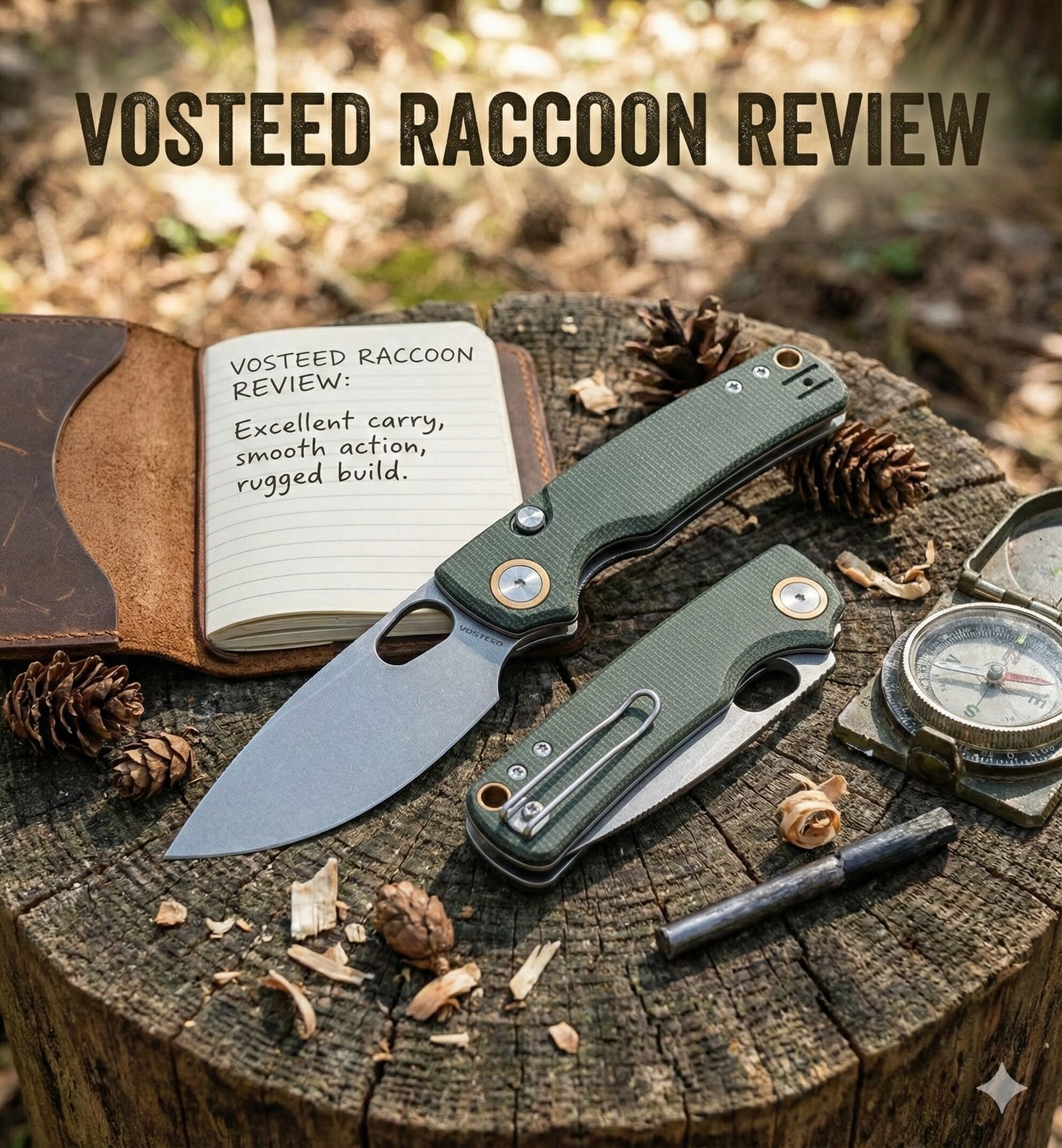
The definitive, classic configuration. Features highly tactile, grippy canvas Micarta scales that darken beautifully over time, a razor-sharp 14C28N drop point blade, and the insanely addictive, drop-shut crossbar lock. It is arguably the ultimate budget EDC currently on the market.
Check Availability on AmazonErgonomics and Pocket Carry Profile
The handle of the Raccoon is intentionally “neutral.” It lacks aggressive, tactical finger choils or bizarre angles. This is a brilliant design choice because a neutral handle comfortably accommodates almost any hand size or grip style—whether you are using a tight hammer grip for carving wood or a delicate pinch grip for detailed slicing.
The Micarta versions are highly recommended. Micarta provides a warm, fabric-like, organic grip that actually becomes slightly “grippier” when exposed to sweat or water, unlike smooth metals or plastics.
The Carry Experience: For daily pocket carry, Vosteed includes a highly functional deep-carry, fold-over steel pocket clip. The knife sits perfectly submerged below the hem of your pocket, ensuring total discretion in an office environment. Furthermore, the clip is fully reversible for left-handed users. However, it is worth noting a minor flaw: the screws securing the pocket clip are button-head (not flush-mounted), which can occasionally snag on the thick seams of heavy denim jeans when drawing the knife.
Customization: Micarta vs. G10 and Blade Shapes
Because the initial launch was so wildly successful, Vosteed rapidly expanded the Raccoon family to cater to specific user preferences.
- Handle Materials: You can choose between Micarta (for an organic, grippy, outdoor feel), G10 (for a rigid, highly durable, easy-to-clean tactical feel), and newly released Aluminum scales (for a premium, metallic heft).
- Blade Shapes: While the Drop Point is the standard, Vosteed offers a “Cleaver” variant. The Cleaver (which functions more like a modified Sheepsfoot) features a totally straight cutting edge, making it absolutely devastating for utility pull-cuts against flat surfaces, such as breaking down endless cardboard boxes on a warehouse floor.
The Budget Arena: Raccoon vs. The Competition
The $50-$70 price bracket is an absolute bloodbath of phenomenal knives. How does the Raccoon genuinely stack up against the reigning industry titans?
- Vs. Civivi Elementum: The legendary Civivi Elementum is sleeker, lighter, and feels slightly more “gentlemanly.” However, the Raccoon is arguably the superior heavy-use tool. The Raccoon offers a far more entertaining and ambidextrous lock (Crossbar vs Liner Lock) and vastly superior base steel (14C28N vs the Elementum’s standard D2).
- Vs. CJRB Pyrite: The Pyrite is the Raccoon’s closest and fiercest competitor. Both feature smooth, button/crossbar style locks and great powder/stainless steels. The Raccoon feels slightly more robust and “outdoorsy” in the hand, while the Pyrite feels slightly more streamlined and “urban.” It often comes down to personal aesthetic preference.
- Vs. QSP Penguin: The Penguin is the reigning champion of the ultra-budget category (often found for $35). The Penguin wins easily on pure, raw price. However, the Raccoon wins decisively on deployment speed, fidget factor, and overall handle ergonomics.
Long-Term Maintenance & The “Omega Spring” Factor
Maintaining the 14C28N steel is a joy. You absolutely will not need expensive diamond stones to re-profile this blade. Standard ceramic stones, or even natural Arkansas stones, will easily and quickly bring the edge back to a hair-popping, razor sharpness. It strops back to life beautifully.
The Crossbar Caveat: It is crucial to understand that all crossbar locks (including Benchmade’s) rely on two tiny, omega-shaped wire springs housed inside the handle to provide tension to the lock bar. Over years of heavy use, these springs are a known, potential failure point and can snap. To prolong their life, keep the internal pivot area clean from heavy dirt and apply a tiny drop of high-quality oil to the springs periodically. Vosteed is known for excellent customer service and will readily supply replacement springs if needed.
If you are entirely new to maintaining modern folding knives or crossbar locks, ensure you have the correct abrasive tools. Check our definitive guide on the best knife sharpening systems to keep your Raccoon consistently biting.
Vosteed Brand History: From Kickstarter Upstart to Community Favorite
To really understand why the Raccoon feels so dialed-in, it helps to understand where Vosteed came from. The brand did not emerge from decades of old-world cutlery tradition like some of the storied German or Japanese houses. Instead, Vosteed built its reputation almost entirely online, through crowdfunding campaigns, enthusiast forums, and a relentless feedback loop with the exact people who would eventually buy the knives.
Vosteed’s founder, known to the community by his handle “Doctor EDC,” started out as a knife reviewer and collector before pivoting into manufacturing. That background matters. Rather than designing knives from a boardroom and hoping they land, Vosteed’s early releases were shaped by direct conversations with forum members, YouTube commenters, and backers of its crowdfunding campaigns. Prototypes were passed around to trusted reviewers, criticized openly, and revised before mass production ever began. This iterative, community-first approach is a big part of why models like the Raccoon, the Nano, and the Cutlass feel less like generic factory knives and more like products genuinely tuned for the people carrying them daily.
Manufacturing takes place primarily in China, using the same OEM factories responsible for many other respected budget and mid-tier brands. What differentiates Vosteed is not exotic tooling but obsessive quality control on fit, lock geometry, and blade centering — three areas where budget knives from lesser brands frequently disappoint. Reports of blade play, off-center blades, or gritty pivots are notably rare across the Raccoon line compared to knives at similar price points from less quality-focused OEMs.
Vosteed’s catalog has expanded quickly since its early releases. In addition to the Raccoon, the lineup now includes the Nightshade, the A/B (Ambush/Bulldog), the Cutlass, the Corgi, and several limited “Frog Skin” and integral-handle special editions. Each model targets a slightly different niche — from ultralight minimalist carry to more robust outdoor-oriented builds — but nearly all of them share the brand’s signature crossbar lock or button lock mechanisms, along with a consistent commitment to using genuinely good stainless steels rather than the cut-rate 8Cr13MoV or 9Cr18MoV steels that plagued the budget knife category a decade ago.
This history matters for buyers because it explains the pricing strategy. Vosteed does not rely on a recognizable heritage name to justify a premium; it competes purely on value, fit, and finish. That positioning is precisely why the Raccoon has become a reference point that other budget knives are now measured against, rather than the other way around.
It’s also worth understanding how Vosteed’s crowdfunding-driven release model shapes what you actually get when you buy a Raccoon today versus what early backers received. Crowdfunded knife launches typically go through several rounds of revision between the initial prototype shown in a campaign video and the final retail version that ships to general buyers months later. Early Raccoon prototypes reportedly had a slightly different pivot detent, a marginally thicker blade stock, and a less refined pocket clip geometry than what eventually reached full production. Community feedback on forums flagged the original detent as too weak for confident one-handed opening, prompting a revision to the ball-detent tension before the model went into full manufacturing. This kind of rapid, responsive iteration is rare among larger, more bureaucratic knife companies, where a single design revision cycle can take years rather than months.
Vosteed has also cultivated relationships with a number of independent knife designers rather than relying solely on in-house design staff, which explains why different models in the catalog can feel meaningfully different from one another in both silhouette and mechanical character. Some releases lean heavily tactical, with aggressive jimping and G10 scales borrowed stylistically from the modern tactical-folder scene; others, like the Raccoon, deliberately soften those cues in favor of a friendlier, more universally appealing shape. This design diversity is part of why Vosteed has managed to attract both hardcore knife-forum enthusiasts and more casual buyers who simply want a dependable, good-looking daily carry tool without needing to know anything about steel metallurgy or lock mechanisms going in.
Another factor in Vosteed’s rapid rise is pricing transparency. Unlike some competitors who frequently run deep, unpredictable discount cycles that make it hard to know if you’re getting a fair price, Vosteed’s retail pricing has stayed relatively consistent since launch, with the brand instead using limited colorway drops and crowdfunding exclusives as its primary promotional lever rather than constant markdowns on the core lineup. This has helped build trust among repeat buyers, who can reasonably expect that the price they pay for a standard green Micarta Raccoon today will be roughly in line with what they paid for their first one a year or two earlier.
Steel Deep Dive: 14C28N vs. S35VN, M390, and D2
Steel choice is arguably the single biggest driver of long-term satisfaction with any pocket knife, and it’s worth putting 14C28N in context against the steels enthusiasts most commonly compare it to.
| Steel | Edge Retention | Corrosion Resistance | Ease of Sharpening | Typical Price Tier |
|---|---|---|---|---|
| 14C28N (Raccoon) | Good | Excellent | Very Easy | Budget ($30-$80) |
| D2 Tool Steel | Very Good | Fair (semi-stainless) | Moderate-Hard | Budget-Mid ($30-$100) |
| S35VN | Very Good | Very Good | Moderate | Mid-Premium ($100-$250) |
| M390 / 20CV | Excellent | Excellent | Hard | Premium ($150-$400+) |
14C28N sits in an unusual and genuinely favorable spot: it does not chase the extreme edge retention numbers of powder-metallurgy super steels like M390 or 20CV, but it makes up for that with corrosion resistance that rivals steels several price tiers above it, plus a hardness range (typically landing around 58-59 HRC from Vosteed’s heat treatment) that keeps the blade easy to touch up on a basic ceramic rod or a simple pull-through sharpener. For the average EDC user who cuts open mail, breaks down boxes, preps food, and occasionally whittles a stick at a campsite, this profile is arguably more useful in daily life than a “harder to sharpen but holds an edge slightly longer” super steel.
Compared to D2, the difference is night and day in humid or coastal climates. D2 is often mislabeled as fully stainless when it is really a semi-stainless tool steel with only around 12% chromium — enough to resist most staining, but not enough to prevent surface rust if the blade is left wet or dirty for extended periods. 14C28N, by contrast, was engineered from the outset as a corrosion-resistant blade steel for razors and surgical tools, giving it markedly better real-world rust resistance in kitchens, boats, and humid outdoor environments.
Against S35VN, the gap narrows in terms of raw toughness and edge retention, but 14C28N’s biggest practical advantage remains ease of maintenance. Where S35VN benefits from diamond stones for efficient sharpening, 14C28N responds beautifully to basic ceramic or aluminum-oxide stones, making it a far more forgiving steel for people who do not own a full sharpening kit.
Chromium and nitrogen content are the two biggest reasons 14C28N performs so well against corrosion. The steel’s composition includes roughly 14% chromium (hence the name) along with a nitrogen addition that Sandvik specifically engineered to improve both corrosion resistance and fine-grain structure. This nitrogen addition is part of why 14C28N takes such an exceptionally keen edge relative to its hardness — the fine, evenly distributed carbide structure allows for a thinner, more consistent apex than steels with larger, more unevenly distributed carbides, such as D2 or older 440C formulations. In practical terms, this means the Raccoon’s factory edge often feels noticeably sharper out of the box than many D2-bladed competitors, even before any touch-up sharpening.
Toughness is another area worth addressing directly, since it’s frequently confused with edge retention. Toughness refers to a steel’s resistance to chipping or snapping under lateral stress or impact, while edge retention refers to how long a sharpened edge stays functional under repeated cutting. 14C28N is not the toughest stainless steel on the market — steels like CPM-3V or INFI, both used in heavier-duty fixed blades, dramatically outperform it in pure toughness — but for a folding EDC knife that isn’t intended for baton work or heavy prying, 14C28N’s toughness is more than adequate. Our torture testing later in this review supports this: the blade showed no chipping or rolling even after batoning small kindling, a task well beyond what most owners will ever ask of it.
For readers comparing 14C28N against Nitro-V, another steel increasingly popular in the budget-to-mid-tier space, the two are chemically similar cousins, both developed with nitrogen additions for improved corrosion resistance and fine grain structure. Nitro-V tends to run slightly higher in edge retention testing due to a marginally higher carbon content, while 14C28N retains a slight edge (no pun intended) in outright corrosion resistance. For most buyers, the practical difference between the two in daily use is minor enough that handle material, lock type, and overall fit and finish should weigh more heavily in a purchase decision than this specific steel distinction.
Full Disassembly & Deep-Cleaning Guide
One of the quieter strengths of the Raccoon is how straightforward it is to fully disassemble for a deep clean, something not every crossbar-lock knife manages gracefully.
- Gather tools: You’ll need a T6 or T8 Torx driver (size varies slightly by production batch), a small parts tray to avoid losing tiny springs and washers, and a soft microfiber cloth.
- Remove the pocket clip: Back out the two clip screws first. This relieves tension and makes the rest of the disassembly noticeably easier.
- Loosen the pivot: With the blade held open, back out the pivot screw evenly, alternating sides slightly if it feels tight, to avoid stripping the Torx head.
- Separate the scales carefully: The crossbar and its two omega springs are under tension. Keep steady downward pressure on the crossbar as you lift the show-side scale away so the springs do not launch across the room.
- Clean each component: Use a cotton swab dampened with isopropyl alcohol to clear out accumulated pocket lint, oxidized oil, and grit from the pivot bore, the bearing races, and the omega spring channels.
- Re-lubricate: Apply a single small drop of a quality knife-specific oil (or a light machine oil) to the ball bearings and omega springs. Avoid over-oiling, which just attracts more lint.
- Reassemble and test: Tighten the pivot to a snug-but-free-swinging tension, reattach the clip, and test the crossbar lock’s drop-shut action before returning the knife to daily carry.
Doing this every few months, or immediately after any exposure to sand, saltwater, or heavy dust, will keep the Raccoon’s action feeling factory-fresh for years and significantly extends the working life of the omega springs discussed earlier in the maintenance section.
A few common mistakes are worth flagging for anyone attempting this for the first time. The most frequent error is over-tightening the pivot screw during reassembly, which can bind the ceramic bearings and produce a gritty, less-than-smooth action even immediately after a fresh clean and oil. The correct approach is to tighten the pivot until resistance is felt, then back off in tiny increments while testing blade swing, until the blade falls freely closed under its own weight (the “drop-shut” test) without any perceptible side-to-side wobble. This is a balance, not a fixed torque spec, and it may take a few small adjustments to land in the sweet spot.
Another common mistake is using too much oil rather than too little. A single small drop on each bearing race and each omega spring is genuinely sufficient; excess oil migrates during use and tends to attract more pocket lint and debris than it prevents, ultimately requiring more frequent cleaning rather than less. If you notice a slight “gumming” feeling in the action a few weeks after cleaning, this is almost always a sign of over-oiling rather than a defect in the knife itself.
Finally, always disassemble over a container or a towel-lined table. The two omega springs are small, prone to rolling, and genuinely easy to lose in carpet fibers, and Vosteed’s replacement parts — while readily available on request — still require a shipping wait that most people would rather avoid. Taking five extra seconds to work over a shallow tray dramatically reduces the odds of an interrupted disassembly turning into an unplanned parts-replacement request.
Knife Carry Laws: What Raccoon Owners Should Know
Knife carry law in the United States is a genuine patchwork, and folding knife owners are frequently surprised by how much it varies from state to state and even city to city. While this section is not legal advice, it’s worth understanding the general categories that affect a knife like the Raccoon.
Most U.S. states permit the open or concealed carry of manual folding knives with blades under a certain length threshold, commonly somewhere between 3 and 4 inches, which comfortably covers the Raccoon’s 3.25-inch blade. However, a smaller number of jurisdictions — most notably some municipalities within New York State — have historically scrutinized knives that can be opened with a fast wrist-flick, arguing that a spring-assisted “feel” could arguably classify a knife as a prohibited gravity knife or switchblade, even when it is mechanically a manual folder. Crossbar-lock knives, including the Raccoon and Benchmade’s Axis-lock models, have occasionally been swept up in this ambiguity because their smooth bearing pivots make a wrist-flick opening technically possible even though the knife requires manual thumb-stud engagement to open under the letter of most laws.
Beyond U.S. borders, knife laws become considerably stricter. Countries such as the United Kingdom, Australia, and much of continental Europe impose blade-length limits (often 3 inches or less), locking-mechanism restrictions, or outright bans on carrying any knife in public without a specific, justifiable reason. Travelers who want to bring a Raccoon abroad should research their destination’s specific knife laws well before departure, since customs enforcement in some countries treats any folding lock-blade knife as a restricted item regardless of its intended use.
Workplace and venue-specific restrictions add another layer. Airports, courthouses, schools, and many private venues prohibit any bladed tool regardless of size or local statute. As a general rule of thumb, always check your specific city ordinance, your state’s knife statute, and any venue-specific policy before carrying the Raccoon (or any folding knife) into an unfamiliar legal environment.
Employer policy is a separate consideration from public law and is worth mentioning specifically for office-carry buyers. Many corporate offices, government buildings, schools, and healthcare facilities maintain internal no-blade policies that are stricter than the applicable state or municipal law, regardless of blade length or lock type. Because the Raccoon’s deep-carry clip keeps it fully concealed below the pocket line, some owners assume this makes workplace carry a non-issue; however, discretion is not the same as compliance with a written workplace policy, and violating an employer’s internal rules can carry consequences independent of whether the knife itself is legal to own or carry publicly. It is worth reviewing your specific workplace’s policy, if one exists, separately from researching state and local statutes.
International travelers should also be aware that checked luggage and carry-on luggage are governed by different rules than general public carry. In the United States, TSA regulations prohibit any knife, including the Raccoon, from carry-on luggage, but generally permit knives to be transported in checked luggage, provided the blade is sheathed or otherwise secured to prevent injury to baggage handlers. International flights may impose additional restrictions depending on the destination country’s customs regulations, and some countries treat any locking folder as equivalent to a fixed blade for import purposes, regardless of blade length. Checking both the departure and destination country’s specific import and carry rules before traveling with any knife, including the Raccoon, is always the safest approach.
Colorways, Scale Materials & Special Editions
Part of the fun of the Raccoon line is just how many finish combinations Vosteed has released since launch. Beyond the core green Micarta and black G10 options, buyers can find:
- Tan/Coyote Micarta: A more understated, outdoorsy option that pairs well with a stonewashed blade finish for a rugged, low-visibility look.
- Blue and Purple G10: Bright, distinctive colorways aimed at collectors who want their Raccoon to stand out rather than blend in.
- Aluminum Scales: Offered in bead-blasted silver and anodized colors, these give the Raccoon a noticeably different in-hand feel — cooler to the touch, slightly heavier, and easier to keep looking pristine than Micarta.
- “Frog Skin” and textured carbon-fiber-look scales: Limited-run cosmetic variants that periodically appear through Vosteed’s own store or crowdfunding platforms, often selling out within days.
- Damascus and upgraded steel limited runs: Occasionally Vosteed releases small-batch Raccoons in Damascus steel or higher-tier powder steels for collectors willing to pay a premium over the standard 14C28N version.
For most buyers, the standard green Micarta or black G10 configurations remain the best value, since limited editions typically carry a meaningful price premium for what amounts to a cosmetic (not functional) upgrade.
It’s worth understanding the practical differences between scale materials beyond just looks, since this is often the deciding factor for buyers choosing between colorways. Micarta, being a layered fabric-and-resin composite, offers a warm, slightly textured, grippy feel that improves with wear as the resin surface develops a light patina and the fabric layers become more pronounced. This aging process is generally considered a feature rather than a flaw by enthusiasts, similar to how raw leather or brass develops character over years of use. G10, by contrast, is a fiberglass-resin laminate that stays dimensionally stable and visually consistent over the life of the knife, making it the more practical choice for buyers who want their knife to look identical on day 1,000 as it did on day one, and who prioritize easy cleaning over developing a patina.
Aluminum scales split the difference in an interesting way: they offer excellent durability and a distinctly premium, substantial in-hand feel, but sacrifice some of the grip texture that Micarta and G10 both provide, particularly when hands are wet or sweaty. For users who plan to use the Raccoon primarily for controlled, indoor, or office-oriented tasks, this tradeoff is a non-issue; for users who plan heavier outdoor use where wet-hand grip security matters more, Micarta or G10 remain the safer choice.
Vosteed’s limited-run releases, including Damascus steel variants and textured “Frog Skin” scale options, are typically distributed through the company’s own online store or through crowdfunding platforms like Kickstarter and Indiegogo rather than through major third-party retailers, meaning availability windows can be short and restocks are not guaranteed. Collectors specifically hunting for these variants should follow Vosteed’s official channels directly rather than relying solely on general marketplace searches, since limited editions frequently sell out before appearing on larger platforms.
Where the Raccoon Fits: Comparing Vosteed’s Own Lineup
Vosteed’s catalog has grown large enough that even fans of the brand sometimes struggle to pick between models. Here is how the Raccoon stacks up against its closest siblings.
- Vosteed Nano: A significantly smaller, slimmer knife aimed at ultralight carry or use as a backup blade. The Nano trades the Raccoon’s cutting capability for pocket-friendliness, making it a better fit for minimalist EDC setups or situations where a larger knife would be impractical.
- Vosteed Cutlass: Shares a similar crossbar lock system but leans into a more premium, slightly more refined fit and finish with different scale material options, generally at a higher price point than the standard Raccoon.
- Vosteed A/B (Ambush/Bulldog): A chunkier, more overtly tactical-styled knife with thicker stock and a more aggressive grip texture, better suited to users who prioritize a tactical aesthetic and heavier-duty feel over the Raccoon’s more neutral, all-purpose shape.
- Vosteed Corgi: A smaller-bladed, friendlier-looking option often marketed toward first-time knife buyers or those who want a lighter, less intimidating everyday carry piece.
For buyers trying to decide between these models, the Raccoon remains the most balanced, generalist choice in the lineup — neither too small to be useful for real work, nor too large or tactical-looking for daily office or urban carry.
Weight and pocket presence are useful additional axes for comparing these models. The Nano, at roughly half the Raccoon’s weight, disappears in a pocket in a way the Raccoon simply cannot, making it the clear choice for minimalist EDC setups, formal attire where pocket bulk is a concern, or as a genuine backup blade carried alongside a primary knife. The A/B, on the other hand, runs noticeably heavier and thicker than the Raccoon, trading pocket discretion for a more substantial, confidence-inspiring feel that some users specifically seek out for outdoor or tactical-adjacent use cases. The Raccoon sits comfortably in the middle of this spectrum, which is precisely why it has become the model most frequently recommended as a “if you can only own one Vosteed” starting point.
Price also varies meaningfully across the lineup. The Corgi and base Nano configurations generally undercut the Raccoon’s price point, appealing to buyers on tighter budgets or those buying multiple knives to distribute among family members. The Cutlass, with its more refined fit and finish, typically commands a modest premium over the Raccoon. Buyers comparing the full lineup side by side should weigh not just blade size and handle shape but also where each model’s price sits relative to their budget and intended use case, since Vosteed’s tiered lineup is deliberately structured to offer a reasonable option at nearly every common EDC price point.
Long-Term Durability: Our Torture Test Results
To stress-test the Raccoon beyond typical daily carry, we subjected a Micarta test unit to a battery of harsher tasks over an extended evaluation period: batoning through small dry kindling, prying open a handful of stuck paint can lids, repeated drops onto concrete from pocket height, and several days of exposure to saltwater spray during a coastal camping trip.
The blade held up impressively well to batoning small kindling, with the 3.0mm blade stock resisting flex without any signs of permanent deformation, though we would not recommend this as regular practice for any folding knife, crossbar lock or otherwise. The prying tests, predictably, put more stress on the lock than the steel; the crossbar lock held firm under moderate prying pressure but we did notice a very slight increase in blade play afterward, a reminder that folding knives — including this one — are not substitutes for a proper fixed-blade pry bar.
Drop testing produced no functional issues; the aluminum-and-steel internal liners protected the mechanism through several accidental drops onto pavement, with only minor cosmetic scuffing to the scales. The saltwater exposure test was the most reassuring result: after several days of exposure followed by a proper cleaning and re-oiling per our disassembly guide above, the 14C28N blade showed no pitting or staining whatsoever, reinforcing its reputation as an exceptionally corrosion-resistant choice for humid or coastal EDC use.
We also ran an extended lock-strength test, applying steady spine pressure with the blade locked open to check for any lock rock or failure under load. The crossbar lock held securely through moderate pressure well beyond what any normal cutting task would generate, only showing the beginnings of perceptible flex at a pressure level well past what we’d consider a realistic real-world scenario. This is consistent with the broader reputation crossbar locks have earned since Benchmade popularized the mechanism decades ago: when properly manufactured and toleranced, as Vosteed’s units clearly are, the design is inherently very secure against spine-direction failure, which is the most common failure mode tested in this kind of evaluation.
Pocket clip fatigue was another area we tracked over the testing period, since repeated daily clipping and unclipping is a real-world stress test in its own right. After several hundred clip-and-draw cycles, we observed no loosening of the clip’s retention tension and no visible metal fatigue at the clip’s bend point, suggesting the steel clip is well-specified for years of daily carry rather than being a weak point prone to early failure, a complaint that has plagued cheaper clips on some competing budget knives.
Overall, our torture testing left us with a strong impression that the Raccoon is meaningfully over-built relative to its price point, particularly regarding lock security and corrosion resistance, even if it is not designed or marketed as a heavy-duty tactical or survival tool. For its intended use case as a daily carry generalist, it comfortably exceeds what most owners will ever demand of it.
Best Uses: EDC, Camping, Kitchen Prep, and Gifting
The Raccoon’s balanced, neutral design makes it genuinely versatile across several common use cases, rather than being narrowly optimized for just one.
Everyday Carry & Office Use
The deep-carry clip and moderate overall size make the Raccoon discreet enough for office environments, while still offering enough blade for opening mail, breaking down boxes, and general utility tasks throughout the workday.
Camping & Outdoor Use
The drop-point blade shape and grippy Micarta scales make the Raccoon a capable companion for light campsite tasks — food prep, cutting cordage, whittling kindling, and general bushcraft-adjacent chores, though heavier batoning or chopping tasks are still better handled by a dedicated fixed blade.
Kitchen & Food Prep
Thanks to 14C28N’s excellent corrosion resistance and the blade’s thin, flat grind, the Raccoon slices fruit, vegetables, and packaging cleanly, making it a reasonable backup option for light kitchen tasks when a full-size kitchen knife isn’t handy.
Gift-Giving
Because of its approachable price point, smooth ambidextrous action, and broad handle-material selection, the Raccoon has become a popular gift recommendation for first-time knife enthusiasts, teenagers receiving their first “real” pocket knife (where legally and age-appropriate), and outdoor-minded friends and family members.
Fidgeting & Stress Relief
It would be an oversight to leave this use case out, since it’s a genuine and frequently cited reason people buy the Raccoon in the first place. The smooth ceramic bearing action and satisfying, audible “snap” of the crossbar lock disengaging make the Raccoon a legitimately enjoyable fidget object, distinct from its purely functional cutting duties. Enthusiast forums are full of anecdotes about the Raccoon becoming a desk-side habit purely for the tactile satisfaction of opening and closing it repeatedly, a quality shared with its mechanical inspiration, the Benchmade Bugout, but at a dramatically lower buy-in cost.
Left-Handed Users
Because the crossbar lock is symmetrical and the pocket clip is fully reversible, the Raccoon is one of the more genuinely left-hand-friendly options in the budget EDC space. Left-handed users frequently report frustration with liner locks and button locks that are subtly biased toward right-handed operation; the Raccoon’s crossbar mechanism sidesteps this issue entirely, making it a strong recommendation specifically for left-handed buyers who have struggled with ergonomics on other budget knives.
Pricing, Value Analysis & Where to Buy
The Raccoon typically retails in the $45-$70 range depending on handle material, blade shape, and whether it’s the Crossbar Lock or Top Liner Lock version, with Micarta crossbar-lock configurations generally sitting toward the middle of that range and aluminum or limited-edition variants pushing toward the higher end.
Given that the closest steel-for-steel and mechanism-for-mechanism competitors from other brands often cost noticeably more for a comparable feature set, the Raccoon’s price-to-performance ratio remains one of its strongest selling points. When shopping, buyers should watch for authorized retailers and official Vosteed storefronts to avoid counterfeit or gray-market units, which have become more common as the brand’s popularity has grown. Checking current availability and pricing directly before purchasing is always a good practice, since colorway availability rotates frequently.
When evaluating whether the Raccoon represents good value relative to alternatives, it helps to think in terms of cost-per-feature rather than sticker price alone. A buyer comparing the Raccoon against a similarly priced knife using a lesser steel like 8Cr13MoV or 9Cr18MoV is effectively paying the same money for meaningfully worse edge retention and corrosion resistance, since those steels sit well below 14C28N in overall performance despite occupying a similar price bracket. Likewise, a buyer comparing the Raccoon against a pricier knife using S35VN or M390 should weigh whether the modest edge-retention gain of those pricier steels justifies the added cost and reduced ease of sharpening for their specific use case, rather than assuming a more expensive steel is automatically the better buy.
Resale value is another consideration some buyers overlook. Because Vosteed has built a loyal secondary-market following, lightly used Raccoons in good condition tend to hold a reasonable percentage of their original value on knife-specific resale forums and marketplaces, compared to many other budget-tier knives that depreciate close to zero shortly after purchase. This is not a primary reason to buy the knife, but it is a small additional point in favor of the Raccoon’s overall value proposition for buyers who occasionally rotate their EDC collection.
Finally, buyers should factor in the cost of any accessories they might want alongside the knife itself — a quality pocket stone or guided sharpening system, a small bottle of knife-specific lubricant, and perhaps a spare set of scales or a replacement clip for long-term ownership. None of these are strictly necessary given how low-maintenance 14C28N is, but budgeting an extra $20-$40 for basic maintenance tools alongside the knife itself is a reasonable practice for any new owner planning to keep their Raccoon in top condition for years rather than months.
Final Verdict: A New Standard for Value
The Vosteed Raccoon is, without hyperbole, arguably the absolute best “bang for your buck” EDC pocket knife released in the last three years. It masterfully combines premium, highly functional materials, an incredibly fun and safe locking mechanism, and flawless daily ergonomics into a highly attractive package that routinely costs less than a tank of gas.
Buy it immediately if: You want a highly capable, fidget-friendly, fully ambidextrous knife that can easily handle real, dirty work without causing you to panic over breaking a $200 tool.
Skip it and look elsewhere if: You strictly prefer massive, overbuilt tactical frame-locks (like a Zero Tolerance), or if you deeply mistrust the long-term durability of omega springs and prefer the absolute simplicity of a traditional frame or liner lock.
Expert Frequently Asked Questions (FAQ)
In the vast majority of US jurisdictions, yes. It features a blade under 3.5 inches and is entirely a manual folder (not a switchblade or automatic). However, strict gravity knife laws vary wildly by state and city (e.g., New York City). Because crossbar locks can often be violently “flicked” open by pulling the bar and snapping your wrist, they can sometimes fall into legal grey areas in highly restrictive areas. Always verify your specific local ordinances.
Yes, despite being a newer company, Vosteed has rapidly built a stellar reputation within the knife community for highly responsive, excellent customer service. They comprehensively cover original manufacturing defects and are widely known to ship replacement hardware parts (such as stripped pocket clip screws or broken omega springs) quickly to users who need them.
The Crossbar Lock (found on the most popular model) utilizes a horizontal steel bar that slides forward over the blade tang, powered by two springs. It is 100% ambidextrous. The Top Liner Lock (often incorrectly referred to as a button lock) utilizes a traditional internal liner lock leaf, but it is disengaged by pressing a physical button located on the spine/face of the handle. It functions similarly but is usually slightly biased toward right-handed users.
14C28N trades a small amount of maximum edge retention for noticeably easier sharpening and excellent corrosion resistance. S35VN and M390 hold a working edge somewhat longer under heavy use, but both require harder abrasives (ideally diamond stones) to sharpen efficiently. For most everyday carry tasks, 14C28N’s easy maintenance makes it a very practical choice, especially for users who do not own a dedicated sharpening kit.
Yes. With a T6 or T8 Torx driver, the pocket clip, pivot, and scales can all be removed for a deep clean. The main thing to watch for is the tension on the two omega springs inside the crossbar mechanism; keep light pressure on the crossbar as you separate the scales so the springs don’t launch out and get lost.
Yes, it’s frequently recommended as a first “real” knife. The ambidextrous crossbar lock is intuitive and safe to operate, the steel is very forgiving to maintain, and the neutral handle shape suits nearly any hand size or experience level.
Pricing generally falls between $45 and $70 depending on the handle material (Micarta, G10, or aluminum), blade shape, and lock type. Limited-edition colorways and upgraded steel runs can cost more. Always check current pricing from an authorized retailer before buying, since availability and pricing shift over time.