
Why This Comparison Actually Matters
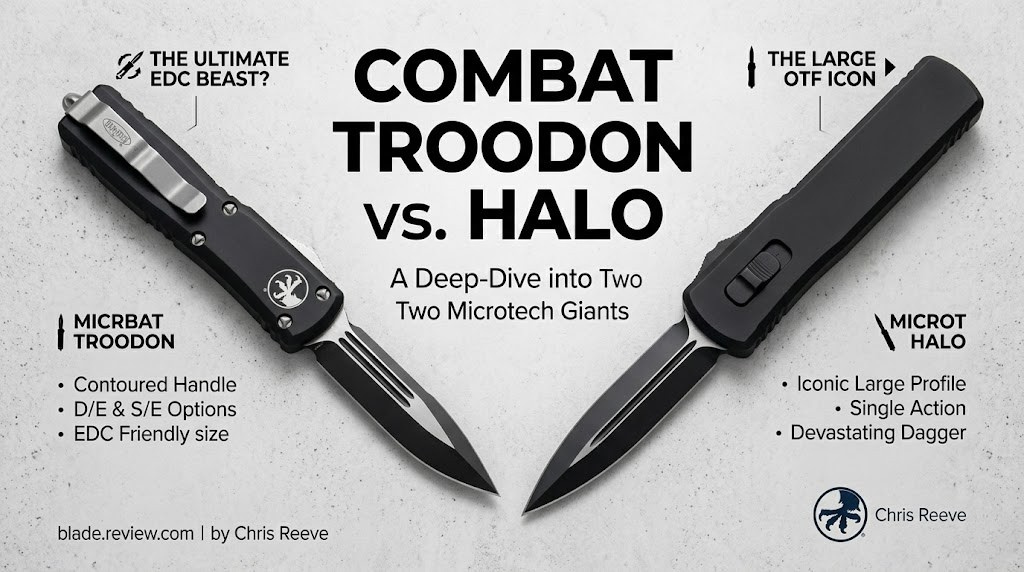
Microtech Knives occupies a specific stratum in the OTF market: above the budget Chinese OTFs that flood Amazon, and operating in the same tier as the finest American automatic knife production. Within Microtech’s own lineup, the Combat Troodon and the Halo represent two fundamentally different design philosophies — the CT is a double-action deployment system optimized for everyday carry versatility, while the Halo is a massive single-action automatic purpose-built for tasks where “understated” is not in the vocabulary.
Both knives carry significant price tags. Both are legal only in jurisdictions where automatic knives are permitted (laws vary significantly — always verify your local regulations before purchasing). And both deserve honest scrutiny rather than the breathless promotional copy that too often substitutes for real analysis in the OTF space.
This comparison examines every dimension of both knives: blade geometry, steel, mechanism reliability, ergonomics, carry characteristics, and real-world performance against the tasks each knife was designed for. It also examines the variants available for each model, because Microtech’s configuration options are extensive enough to meaningfully affect the buying decision. Readers interested in the broader Microtech catalog can also check our reviews of the Microtech UTX-85 and the Ultratech blade options for additional context on where these two knives fit in the lineup.
Quick Overview: What You’re Choosing Between
- Double-action OTF (opens AND closes automatically)
- 3.8″ blade — compact enough for genuine EDC
- Blade: M390, M4, or standard stainless options
- Aluminum handle — lightweight, textured
- MSRP: ~$350–$500 depending on configuration
- Use case: Serious EDC, tactical carry, utility
- Single-action OTF (opens automatically, closes manually)
- 4.5″ blade — large format, high presence
- Blade: 154CM standard; premium variants available
- Stainless steel handle — substantial, authoritative
- MSRP: ~$480–$600+ depending on configuration
- Use case: Tactical, collection, hard use, presence
At their cores, the Combat Troodon and Halo VI represent Microtech’s two different answers to the question of what an OTF should prioritize. The CT maximizes practical utility through its double-action mechanism and more manageable size. The Halo VI maximizes force of personality through sheer scale, a single-action mechanism optimized for raw deployment speed, and a stainless steel construction that communicates permanence rather than lightness. Deciding between them begins with being honest about which of those priorities matches your own.
Full Specs Side by Side
| Specification | Combat Troodon | Halo VI |
|---|---|---|
| Blade Length | 3.8″ | 4.5″ |
| Overall Length (open) | 8.9″ | 10.75″ |
| Overall Length (closed) | 5.0″ | 6.12″ |
| Blade Thickness | 0.145″ | 0.180″ |
| Handle Thickness | 0.58″ | 0.65″ |
| Weight | 4.1 oz (116 g) | 6.8 oz (193 g) |
| Blade Steel (standard) | M390 / 154CM / D2 | 154CM |
| Blade Hardness | 60–62 HRC (M390) | 57–59 HRC (154CM) |
| Action Type | Double-action OTF | Single-action OTF |
| Blade Profiles | Tanto, Dagger, Drop, Spear | Tanto, Dagger, Spear Point |
| Handle Material | 6061 Aluminum (T6) | 303/304 Stainless Steel |
| Handle Finish | Anodized (multiple colors) | Stonewash / Satin |
| Deployment Mechanism | Top-mounted thumb slide | Top-mounted thumb slide |
| Country of Origin | USA (Bradford, PA) | USA (Bradford, PA) |
| Warranty | Lifetime (Microtech) | Lifetime (Microtech) |
| MSRP (standard) | ~$350–$430 | ~$480–$560 |
Blade Geometry & Steel Analysis
Both knives offer multiple blade profile options, but the geometry and steel choices available for each tell a revealing story about their intended applications. This is where the Combat Troodon and Halo begin to diverge most meaningfully from each other.
Combat Troodon Blade Options
The CT is available in four primary blade profiles: tanto, dagger (double-edged), drop point, and spear point. The tanto is the most popular — its reinforced tip geometry makes it Microtech’s answer to users who want penetration capability without sacrificing tip integrity. The drop point broadens the CT’s appeal to utility-focused carriers who prioritize cutting efficiency over tactical capability.
The geometry on the CT blades is executed with Microtech’s characteristic precision. The tanto profile features a secondary bevel that transitions cleanly without the muddled geometry that plagues cheaper OTF tantos. The drop point has a clean hollow grind that provides excellent cutting performance relative to the blade’s thickness. Both profiles work, and neither is a marketing-first compromise.
What makes the Combat Troodon genuinely special in the blade department is the steel selection. Microtech offers the CT in M390 — a premium Austrian powder metallurgy stainless that competes directly with the finest production steels available. M390’s carbide distribution and chromium content produce edge retention that substantially outperforms conventional stainless steels like 154CM or AUS-8, while maintaining enough toughness to survive the cyclical stresses of OTF deployment. For those evaluating blade steel performance tiers, the MagnaCut vs M390 comparison provides excellent context on where M390 fits in the current premium landscape.
Halo VI Blade Options
The Halo VI’s blade options center on profiles appropriate for a knife of its scale: tanto, dagger, and spear point are the primary configurations. The tanto profile dominates sales — the Halo is a knife that communicates tactical intent clearly, and the tanto geometry underlines that communication.
At 4.5″ with a blade thickness of 0.180″, the Halo VI blade is a substantial piece of steel. The geometrically simple grind lines are appropriate for a knife this size — the Halo isn’t trying to be a slicer, it’s trying to be a presence. The factory edge on 154CM is functional but not exceptional — 154CM at 57–59 HRC is a workhorse steel rather than an edge-retention champion, and it sharpens readily with conventional stones or a quality diamond rod.
The dagger configuration on the Halo VI is worth specific discussion: a 4.5″ double-edged blade is a significant piece of hardware, and in many jurisdictions dagger configurations carry additional legal restrictions beyond the automatic action itself. Always verify local law before selecting the dagger profile.
Steel Comparison: M390 vs 154CM
| Property | M390 (Combat Troodon) | 154CM (Halo VI) |
|---|---|---|
| Carbon Content | 1.90% | 1.05% |
| Chromium | 20% | 14% |
| Vanadium | 4% | — |
| Typical HRC | 60–62 | 57–59 |
| Edge Retention | Outstanding | Good |
| Toughness | Good (for the hardness) | Very good |
| Corrosion Resistance | Excellent | Good |
| Ease of Sharpening | Moderate (needs diamonds) | Easy |
| Steel Advantage | CT WINNER | — |
The steel advantage belongs decisively to the Combat Troodon’s M390 option. 154CM is not a bad steel — it’s proven, corrosion-resistant, and easy to touch up in the field. But M390 at the same price point is a genuinely better material for an OTF that sees daily use, and Microtech’s access to premium steels at this price is part of what makes the Combat Troodon compelling. Those curious about how these steels relate to the broader conversation of premium vs. value knife steels may find our coverage of S35VN vs S45VN useful for establishing the performance continuum context.
OTF Action & Mechanism Deep Dive
The single most important technical distinction between the Combat Troodon and the Halo VI is the action type. This is not a minor design variation — it represents fundamentally different engineering philosophies and produces fundamentally different user experiences. Understanding this difference is the most important step in choosing between the two knives.
Double-Action OTF: The Combat Troodon’s Approach
The Combat Troodon is a double-action OTF. This means the thumb slide both opens AND closes the blade automatically. Push the slide forward: the blade deploys. Pull the slide rearward: the blade retracts. The entire cycle is powered by the spring mechanism — you never touch the blade to close the knife, and you never need to manually push the blade back into the handle.
The engineering challenge of double-action OTFs is significant. The mechanism must reliably power the blade in both directions, maintain consistent lockup in the deployed position, and resist unintentional deployment while still allowing deliberate deployment with a single directional thumb input. Microtech has been refining their DA OTF mechanism for decades, and the Combat Troodon’s action reflects that accumulated experience. The deployment is crisp, the lockup is solid, and the retraction is smooth without the drag that plagues cheaper DA OTFs.
The practical advantage of double-action for everyday carry is significant: one-handed operation is complete and unambiguous. Open with one motion, close with the reverse motion, and your other hand is free throughout. For users who carry in gloves, or who need to manage the knife while handling other materials, this capability is genuinely useful rather than merely impressive.
Single-Action OTF: The Halo VI’s Approach
The Halo VI is a single-action OTF. The thumb slide deploys the blade automatically; retracting it requires manually pushing the blade back into the handle until the mechanism re-cocks. This is a significant operational difference from the DA mechanism and shapes every aspect of how the Halo is used.
The advantage of single-action mechanisms is spring force efficiency. Because the spring only needs to power deployment (not retraction), SA OTF springs can be designed for maximum deployment power. The Halo VI’s deployment is noticeably more forceful and authoritative than the CT’s — the blade throws forward with a snap that is viscerally satisfying and mechanically impressive given the blade’s mass. For a 4.5″ blade, that deployment authority matters; a weak spring on a heavy blade produces a slow, mushy deployment that defeats the purpose of the mechanism.
The manual retraction requirement is the trade-off. Closing the Halo VI requires pushing the blade straight back into the handle while the mechanism re-cocks — a process that works but requires more deliberate attention than the CT’s thumb-slide retraction. In gloves or under stress, this distinction becomes more significant.
Spring Replacement and Long-Term Maintenance
OTF springs are wear items. Both the Combat Troodon and the Halo VI will eventually require spring replacement — typically after tens of thousands of deployment cycles, but the exact lifespan varies by use pattern. Microtech’s service program handles spring replacement at a reasonable cost, and their customer service is generally well-regarded. The Combat Troodon’s double-action spring is a slightly more complex assembly than the Halo’s single-action spring and may require professional service more readily; the Halo’s simpler mechanism is arguably more accessible for users comfortable with basic maintenance.
Handle Design & Ergonomics
The materials and form factor differences between the Combat Troodon and Halo VI handles are significant enough to constitute a meaningful buying criterion independent of the action type or blade geometry differences.
Combat Troodon: Aluminum Architecture
The Combat Troodon’s handle is machined from 6061-T6 aluminum — the same material used in aerospace structural components, aircraft fuselage panels, and high-end bicycle frames. 6061-T6 is not a compromise material; it is strong, light, corrosion-resistant, and machines to excellent tolerances. Microtech anodizes the aluminum in their distinctive style, producing a surface finish that is both durable and available in a wide range of colors (OD green, flat dark earth, blue, red, black, and more).
The handle geometry is designed for a four-finger grip on a knife of this scale, with subtle contouring that provides hand position feedback during operation. The texture is restrained — not aggressively grippy, but sufficient for wet-hand retention under normal use. The milled window on the handle allows visual inspection of the spring and blade channel without disassembly — a practical feature that Microtech includes across most of their OTF lineup.
At 4.1 oz, the CT’s aluminum handle contributes meaningfully to the knife’s all-day carry viability. Four ounces is not ultralight, but it’s comfortable for front-pocket carry in most trouser cuts.
Halo VI: Stainless Steel Statement
The Halo VI’s handle is stainless steel — machined 303/304 stainless, polished or stonewashed depending on configuration. This is the most immediately striking physical difference between the two knives. Stainless handles communicate weight, permanence, and intent in a way that aluminum — however well-executed — does not. Hold a Halo VI and the 6.8 oz of stainless steel tells you immediately that this is not a knife that apologizes for itself.
The ergonomic trade-off is real: 6.8 oz is heavy for pocket carry, and the 6.12″ closed length means the Halo VI exceeds the practical size limit for most standard trouser pockets. It is most naturally carried in a belt pouch, sheath, or duty rig rather than a pants pocket. For users in those carry contexts, the stainless handle’s weight is simply part of the package. For EDC-oriented buyers who need the knife in a front pocket, it’s a genuine limitation.
The handle texture on the Halo VI uses a distinctive pattern of machined grooves and stepped geometry that provides grip feedback at the cost of some slip resistance in very wet conditions. Stainless is less inherently grippy than anodized aluminum, and Microtech’s texture work on the Halo, while attractive, does not fully compensate. Gloves help significantly.
✓ Combat Troodon Handle Wins
- 4.1 oz — genuinely pocketable weight
- Anodized finish available in multiple colors
- Better grip traction in wet conditions
- 5.0″ closed — actual EDC size
- Lighter on spring mechanism due to lower handle mass
✗ Combat Troodon Handle Drawbacks
- Aluminum lacks stainless steel’s visual gravitas
- Color finishes can wear with hard daily use
- Less authoritative feel than steel in the hand
✓ Halo VI Handle Wins
- Stainless construction — permanent, impervious
- Exceptional visual and tactile presence
- Stonewash finish hides carry wear indefinitely
- Withstands hard contact and rough environments
✗ Halo VI Handle Drawbacks
- 6.8 oz is heavy for sustained pocket carry
- 6.12″ closed — not truly pocket-sized
- Wet-hand grip traction is limited
- Premium carry adds significant cost
Carry Characteristics & Daily Integration
An OTF knife’s carry system shapes how it fits into daily life more than any specification on a data sheet. The Combat Troodon and Halo VI have radically different carry profiles, and this section addresses the practical reality of living with each knife.
The Combat Troodon’s EDC Viability
The Combat Troodon ships with a clip designed for tip-up carry — the standard configuration for an OTF of this form factor. The clip tension is calibrated for secure pocket retention without excessive resistance on the draw. At 5.0″ closed, the CT fits most front pockets with the handle protruding approximately 0.5–0.8″ above the pocket lip — normal for a knife of this class.
The aluminum handle’s modest weight means the CT doesn’t drag the pocket down noticeably. Over a full work day, most users report that the CT’s pocket presence becomes background awareness rather than active distraction. This is the carry profile that makes a knife a genuine everyday tool rather than a special-occasion carry piece.
One specific consideration: OTF mechanisms must be protected from debris ingress in pocket carry. Microtech designs their OTF channels with tolerances that minimize this risk, but carrying the CT in environments with significant dust, sand, or wood shavings may require more frequent cleaning than a conventional folding knife. A pocket with dedicated lint protection helps; dedicated OTF sheaths are available for users who work in particularly harsh environments.
The Halo VI’s Carry Reality
The Halo VI is not an EDC knife for most users. At 6.12″ closed and 6.8 oz, it exceeds the practical boundaries of comfortable pocket carry for extended periods. This is not a flaw — it’s a design choice that reflects the Halo’s intended use profile. Users who carry in duty rigs, tactical belts, or dedicated OTF sheaths will find the Halo’s size completely appropriate. Users who need a knife that disappears into a front pocket will be better served by the Combat Troodon or other smaller-format OTFs.
For those interested in understanding how premium OTF and fixed-blade carry systems compare in tactical contexts, the comparison of SOG TAC XR tactical geometry provides useful reference for thinking about size-to-capability ratios in the category.
Deployment Access
Both knives use a top-mounted thumb slide for deployment. The CT’s double-action slide is slightly shorter in travel than the Halo’s, which contributes to the crisp, deliberate feel of CT deployment. The Halo’s longer slide travel is appropriate for a mechanism this powerful — a shorter travel would compromise the cam geometry that generates deployment force for a 4.5″ blade.
Ambidextrous deployment is not fully supported by either knife’s stock configuration — the slide mechanism works from either thumb, but the clip is set up for right-hand carry on both standard models. Left-hand users should verify clip reversibility before purchasing.
Real-World Performance Testing
Specification comparisons and mechanism analysis only go so far. What does each knife actually do, day-to-day and under demanding conditions? This section addresses practical performance across the task categories that differentiate the two knives.
Cutting Performance: The Combat Troodon’s Edge
In controlled cutting tests — cardboard, rope, food, cord — the Combat Troodon with M390 steel is a notably better cutter than the Halo VI with standard 154CM. M390 at 60–62 HRC holds a working edge through sustained cutting tasks at a level that 154CM at 57–59 HRC cannot match. The CT’s thinner blade stock (0.145″) also gives it a cutting geometry advantage: it slices through materials with less wedging resistance than the Halo’s 0.180″ stock.
For utility tasks — the cutting that most OTF owners actually do with their knives rather than what they imagine they’ll do — the CT is the clearly superior performer. The combination of M390 steel, appropriate blade geometry, and a more refined secondary bevel produces a knife that cuts with the efficiency of a premium folding knife while deploying with the immediacy of an automatic.
Tactical Performance: The Halo’s Domain
For applications where deployment speed, blade mass, and overall presence matter more than edge retention or cutting refinement, the Halo VI establishes terms the Combat Troodon cannot match. The sheer authority of a 4.5″ blade deploying with single-action spring force is meaningfully different from the CT’s more measured deployment — not faster in terms of blade-to-deployed measurement, but more viscerally decisive. In simulated force-on-force training contexts, where psychological impact matters alongside physical capability, the Halo VI communicates differently than smaller alternatives.
The 0.180″ blade stock also provides greater resistance to lateral flex under hard contact — though it’s worth noting that any OTF mechanism involves engineering tradeoffs in tip rigidity compared to fixed blades, and neither knife should be used as a pry tool regardless of blade thickness.
Durability Testing
Both knives are durably constructed, but the Halo VI’s stainless steel handle is inherently more resistant to impact damage, chemical exposure, and physical abuse than the CT’s anodized aluminum. Aluminum handles can dent and show wear at exposed edges with hard use; stainless handles are practically impervious. For users who genuinely work their knives in harsh environments, the stainless construction of the Halo VI is a meaningful practical advantage independent of the size and weight trade-offs.
The OTF mechanisms on both knives are robust enough to withstand tens of thousands of deployment cycles under clean conditions. Both benefit from periodic lubrication of the blade channel with a light synthetic oil — over-lubrication can attract debris, so restraint is appropriate. Microtech’s service program is the recommended path for spring replacement when cycles accumulate, and their track record for service quality is generally positive among experienced OTF users.
Edge Maintenance Comparison
M390 on the Combat Troodon requires diamond stones or quality ceramic for efficient sharpening — conventional whetstones work slowly and wear quickly against this steel. For users already maintaining premium steels in their collection, this is not an issue; for users accustomed to simple kitchen-grade sharpeners, M390 demands a tool upgrade. The sharpening system guide for hard steels covers the right equipment approach for these situations.
154CM on the Halo VI sharpens readily on conventional stones and even basic pull-through systems at a pinch. Its lower edge retention is the cost of this accessibility — if you sharpen regularly, the tradeoff is entirely acceptable.
Variants, Configurations & Special Editions
Microtech’s approach to product configuration is unusually expansive — both the Combat Troodon and Halo VI are available in enough variants that the buying decision extends beyond “which knife” to “which version of which knife.” Understanding the variant landscape is essential for making an informed purchase.
Combat Troodon Configurations
The Combat Troodon’s configuration matrix includes blade profile (tanto, dagger, drop point, spear point), blade finish (stonewash, polish, satin), blade steel (M390, M4, D2, 154CM), handle color (black, OD, FDE, blue, red, and numerous special runs), and edge style (plain, partially serrated, full serrated). Multiplying these options produces a staggering number of SKUs — which is both a strength (you can configure precisely the knife you want) and a complexity (you can spend significant time researching before selecting).
The premium configuration — M390 blade in stonewash finish, tanto profile, with a matching handle color — represents what most informed buyers will select. M390 is simply the right steel for a knife at this price point, and the stonewash finish on both blade and handle provides the most practical appearance for sustained carry use. The tanto profile is the most structurally sound option for a knife that may see demanding tasks.
Microtech also produces limited run Combat Troodons with special hardware, inlays, and blade materials including Elmax, Bohler M390 variants, and others. These command premium pricing and are often collector-oriented rather than carry-focused.
Halo VI Configurations
The Halo VI configuration options parallel the CT’s in structure but reflect the knife’s different character. Blade profiles are limited to the more tactically oriented options (tanto, dagger, spear point — no drop point). Steel is typically 154CM standard, with M390 available on premium configurations. Handle finishes are fewer: stonewash and satin dominate, reflecting the knife’s serious-use orientation over aesthetic variety.
The Halo VI Signature Series represents special-edition configurations with unique handle machining, non-standard blade geometries, or premium steel upgrades. These versions occupy collector territory and carry prices to match — often $600–$800+ for limited run pieces. For buyers focused on a carry tool rather than a collection piece, the standard production Halo VI provides everything the knife is designed to deliver without the collector premium.
| Configuration Factor | Combat Troodon Options | Halo VI Options |
|---|---|---|
| Blade Profiles | 4 (Tanto, Dagger, Drop, Spear) | 3 (Tanto, Dagger, Spear) |
| Steel Options | M390, M4, D2, 154CM | 154CM (M390 on premium runs) |
| Handle Colors | 10+ standard; many special runs | 3–4; fewer color options |
| Edge Styles | Plain, partial, full serrated | Plain, partial serrated |
| Special Editions | Frequent limited runs | Signature Series; less frequent |
| Custom Shop | Available via Microtech CS | Available via Microtech CS |
One important note: Microtech production runs sell through quickly, and specific configurations (particularly M390 variants or popular color/profile combinations) may require searching secondary markets. The Microtech website and authorized dealers are the first stop; BladeHQ, KnifeArt, and similar premium knife retailers typically stock a reasonable selection of both models.

Microtech Knives
Combat Troodon — Double-Action OTF (Various Configurations) Check Combat Troodon →Round-by-Round Scorecard
Every major comparison criterion evaluated head-to-head. Scoring reflects the knife’s performance within its intended use context — the Combat Troodon is evaluated as an EDC-oriented OTF, the Halo VI as a tactical/hard-use platform.
Who Should Buy Which Knife
Choose the Combat Troodon If:
- EDC is the primary use case — the CT’s size, weight, and double-action mechanism make it the more practical daily carry tool by a wide margin
- Cutting performance matters — M390’s edge retention and the CT’s geometry make it a meaningfully better cutter for utility tasks
- You carry in standard trouser pockets — the CT’s 5.0″ closed length and 4.1 oz weight fit the EDC pocket carry profile
- Gloved or one-handed operation is important — the DA mechanism’s complete one-hand cycle is a genuine operational advantage
- Configuration customization matters — the CT’s broader variant matrix lets you dial in exactly the spec you want
- You’re working within a tighter budget — the CT’s lower MSRP makes the premium tier more accessible
Choose the Halo VI If:
- Maximum presence is a priority — no production OTF communicates intent more clearly than the Halo VI
- You carry in a duty rig or belt pouch — the Halo’s size is appropriate in carry systems designed for large tools
- Deployment force matters — the SA mechanism’s concentrated spring energy produces the most authoritative OTF deployment available in production
- You want the most durable handle construction — stainless steel is objectively harder to damage than aluminum
- Collecting is part of the motivation — the Halo VI’s limited edition presence and collector community are significant
- Raw blade length is important — there’s no substitute for 4.5″ of blade when task scale demands it
Overall Recommendation: Combat Troodon
For the broadest range of buyers — those who want a premium OTF for actual daily use — the Combat Troodon is the more practical, more versatile, and ultimately more satisfying choice. M390 steel, double-action convenience, and genuine EDC dimensions make it the knife that earns its place in the pocket. The Halo VI is exceptional on its own terms, but those terms are narrower — choose it deliberately for specific use cases rather than as a general-purpose premium OTF.

Microtech Knives
Halo VI — Single-Action OTF (Tanto / Dagger Configurations) Check Halo VI →Final Verdict: An Honest Conclusion
This comparison set out to give buyers the information they need to make the right choice between two excellent but genuinely different knives. The conclusion is not that one knife is objectively superior to the other — it’s that they serve different buyers with different priorities, and conflating those priorities leads to dissatisfied purchases at a price point where dissatisfaction is particularly painful.
The Combat Troodon is Microtech’s most practical OTF for most users. Its double-action mechanism eliminates the operational compromise of single-action OTFs, its M390 steel option puts it in the conversation with the finest production knife steel, and its 5.0″ closed / 4.1 oz profile makes it a genuine daily carry piece rather than an occasional use knife. At its price point, it competes with — and often surpasses — every other double-action OTF in production. The knife that readers familiar with our analysis of the best police knives would recognize as purpose-built for professional carry contexts.
The Halo VI is Microtech’s statement piece — a knife that prioritizes presence, deployment authority, and physical permanence over daily carry practicality. It is not for everyone, and it is not trying to be. In the right carry context and with realistic expectations about its limitations, the Halo VI delivers an experience that smaller OTFs simply cannot replicate.
Choose based on what you’ll actually do with the knife, not what you imagine you’ll do. If you’re honest about your use case, both knives reward that honesty with exceptional performance.
Combat Troodon: The more practical knife for more buyers. Best-in-class EDC OTF. M390 steel puts it in a different performance tier for actual cutting tasks. Rating: 9.2 / 10
Halo VI: Exceptional on its specific terms. The most physically authoritative production OTF available. Requires deliberate carry planning to use well. Rating: 8.4 / 10