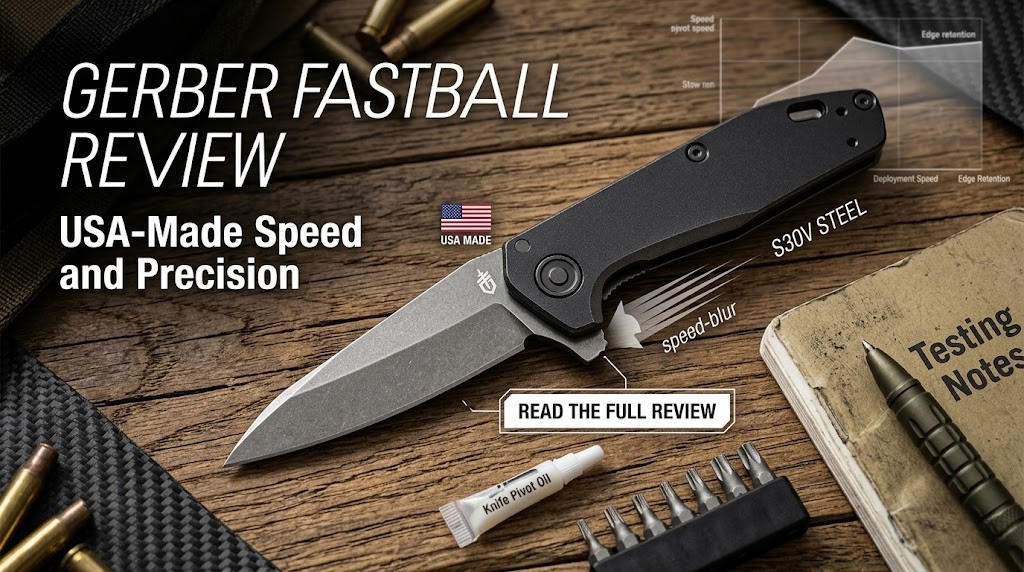

If you want a U.S.-made, slim everyday carry folder with clean lines and quick one-handed deployment, the Fastball is one of the most discussed options in the mid-price bracket. This review breaks down exactly where it shines, where it falls short, and whether it belongs in your pocket this year.
Quick Verdict: Is the Gerber Fastball Actually Worth Buying?
Short answer: yes—for the right user. The Gerber Fastball is a sharp, lightweight, cleanly designed EDC folder that prioritizes speed, carry comfort, and visual simplicity. It feels modern without being overbuilt, and it handles the vast majority of daily cutting tasks with confidence. If your EDC routine includes package breakdown, rope trimming, zip ties, plastic clamshells, and occasional food prep in a pinch, the Fastball checks a lot of important boxes.
Where people get split on this knife is not in whether it is usable (it absolutely is), but in whether its performance justifies its price compared with aggressive competition. That tension is real. You are paying for U.S. manufacturing, a refined slim profile, and a distinctly minimal form factor. You are not paying for maximum steel prestige, massive handle scales, or a tank-like hard-use lock geometry.
- Best for: urban EDC, office carry, travel-friendly pocket loadouts, users who like lighter knives.
- Not ideal for: heavy prying, extended hard utility cuts, users who prefer larger hands-filling handles.
- Carry impression: one of the easiest “forget it’s in your pocket” knives in its class Top Strength
- Bottom line: a refined everyday cutter with strong portability and good action, but value depends on what you expect at this price.
Who the Gerber Fastball Is For (and Who Should Skip It)
The biggest mistake shoppers make with this knife is treating all EDC folders like they are supposed to perform the same. They are not. Some are compact tanks. Some are refined slicers. Some are worksite beaters. The Fastball clearly sits in the refined, lightweight, easy-carry category. So instead of asking “Is it good?” the better question is “Is it right for my use profile?”
Buy it if your priorities look like this
- You value low pocket footprint and light carry weight over brute-force toughness.
- You want quick, predictable one-handed opening from a flipper tab.
- You like clean design language with understated branding.
- You want a knife that transitions well between jeans, slacks, and business-casual environments.
Pass on it if your needs look like this
- You regularly do hard utility cuts in thick, abrasive materials for long sessions.
- You need a broader, more aggressive handle with deeply textured grip scales.
- You place top priority on premium steel choices in this price class.
- You want a knife with a more oversized, confidence-inspiring lockup feel for gloved use.
Think of the Fastball less as a mini pry bar and more as a performance-focused daily cutter with excellent carry manners. If that sounds like your style, the knife becomes much easier to appreciate.
Gerber Fastball Specs and Real-World Interpretation
Factory specifications matter, but context matters more. A lot of buyers read a spec sheet and still end up disappointed because they do not translate the numbers into actual handling expectations. Here’s what the critical specs tell you in real use.
| Category | Gerber Fastball | What It Means in Use |
|---|---|---|
| Blade Length | Approx. 3.0 in class | Strong general-purpose size for legal friendliness and precise control. |
| Blade Steel | S30V | Good edge retention and corrosion resistance for mainstream EDC expectations. |
| Opening | Flipper + bearing system | Fast deployment with light finger effort and satisfying action. |
| Lock Type | Liner lock | Simple, proven, easy to maintain; not the most overbuilt lock style. |
| Weight | Lightweight profile | Comfortable all-day pocket carry with minimal sagging. |
| Clip | Deep carry orientation | Keeps the knife discreet and reduces visual printing. |
The headline here is balance. Gerber did not chase extreme numbers. Instead, the Fastball is tuned around practical carry and quick, repeatable deployment. For many users, that balanced profile is more useful than a knife that dominates one category and compromises three others.
If you have been researching kitchen steel behavior recently, you have probably noticed how people obsess over hardness numbers while ignoring geometry and use case. That same habit appears in pocket knives too. The same principle discussed in blade retention comparisons applies here: steel matters, but it is only one part of the cutting system, not the whole story. For a deeper steel-performance mindset, this breakdown on edge retention methodology is useful reading: edge retention testing framework.
Blade Geometry, Grind, and Cutting Feel
In day-to-day carry, what you notice first is not steel chemistry; it is cutting sensation. Does the blade glide through corrugated cardboard, or wedge? Does it track predictably in drawn cuts? Can it make controlled shallow slices in plastic without hopping or tearing? The Fastball’s blade geometry leans toward practical slicing, and that shows up quickly in regular household and office tasks.
What the blade profile gets right
The blade shape is versatile enough to handle both utility and detail cuts. You can open packages, trim loose threads, or break down produce with controlled tip placement. This “do many things well” approach is exactly what an EDC blade should prioritize.
How it performs on common materials
- Cardboard: consistent bite, reasonably low drag, good edge feel during long cuts.
- Plastic packaging: tip control is solid; less tendency to skid than thicker utility-oriented blades.
- Cord and light rope: effective with proper draw angle; not a rescue-hook style specialist, but competent.
- Food prep in a pinch: acceptable for fruit, sandwiches, and quick camp-style snack prep after cleaning.
One useful way to evaluate this is to look at your own weekly cutting log. If your real tasks are mostly medium-resistance materials, the Fastball’s slicing-oriented behavior makes sense. If your tasks are heavy abrasion all day, you may want something thicker and more aggressively textured in hand.
Performance takeaway: the Fastball is a precision-minded everyday cutter first, and a hard-use workhorse second.
Opening Action, Lockup Confidence, and Fidget Quality
Action is where the Fastball earns much of its fan base. The flipper deployment is quick and intuitive, and it feels tuned for repeatability. That matters more than one dramatic showroom flip. A good EDC knife should open reliably from awkward grip positions, with cold fingers, or while multitasking in low-attention moments. The Fastball generally does that well.
Deployment characteristics
Finger pressure on the flipper tab engages smoothly, and the blade tends to snap into lock with reassuring speed. There is a nice cadence: press, detent break, blade rotation, lockup. Users who enjoy mechanical feedback will likely appreciate this rhythm.
Liner lock behavior in practice
Liner locks can vary widely across brands and production runs, but the Fastball’s format is familiar and easy to operate. Unlocking is straightforward with moderate thumb pressure, and closure control is predictable once you establish your finger placement routine. For many users, that simplicity beats more complex lock systems that require adaptation.
Fidget factor vs utility factor
Yes, the Fastball is fun to flip. But the better news is that its action is not just entertainment value—it supports practical speed when you actually need the knife quickly for short tasks. A lot of knives are either fun but inconsistent, or consistent but dull in feel. The Fastball lands in a healthy middle zone.
Handle Ergonomics, Grip Security, and Comfort Over Time
Ergonomics on this knife are intentionally slim. That creates excellent pocket comfort, but it also means your hand interface is more minimalist than chunky tactical-style handles. Whether that is good or bad depends on how long and how hard you cut in one session.
What feels good immediately
- The profile disappears in pocket better than many similarly priced folders.
- The contouring is clean and neutral, so it works for multiple grip styles.
- There are no major hot spots during short utility jobs.
Where limitations appear
- Extended hard cutting can make the slimness feel less supportive in larger hands.
- If your hands are wet, oily, or gloved, you may want more aggressive tactile grip texture.
- Users who power-cut dense materials repeatedly may prefer thicker scales and fuller palm fill.
In plain language: for normal EDC cycles, comfort is solid. For prolonged heavy-duty sessions, the design priorities shift away from what this knife is built to do.
Pocket Carry, Clip Performance, and Day-to-Day Practicality
Carry experience is one of the Fastball’s biggest wins. This is where many users become loyal to it, because comfort and discretion matter every single day, not just when you are admiring blade finish under bright light.
Deep-carry behavior
The clip keeps the knife tucked low enough for discreet carry while preserving enough access for reliable draw. In jeans, chinos, and lighter technical pants, the balance between retention and draw force is generally practical.
Seated comfort and movement
Because the profile is slim and light, it tends to interfere less with seated posture than blockier folders. If you spend long stretches driving, desk working, or moving in and out of vehicles, this difference is noticeable over a week.
Use rhythm in real life
The Fastball excels in repeated short tasks: open package, close; trim material, close; cut zip tie, close. If your routine looks like that, this knife feels efficient. If your routine is continuous cutting for 45 minutes, it still works, but you may feel why heavier-duty formats exist.
For readers building a complete EDC system around compactness and practical task coverage, it can help to pair this review mindset with broader role-based blade planning, like in this practical overview of minimal blade setups: streamlined blade-kit strategy.
Durability, Edge Retention, and Maintenance Strategy
Let’s separate durability into the parts that matter most for owners: edge life, pivot consistency, hardware resilience, finish wear, and ease of touch-up. In this class, the Fastball performs credibly when maintained with realistic expectations.
Edge retention expectations
S30V in this context offers good retention for mainstream EDC. You should not expect infinite cardboard runs without touch-up, but you also should not expect constant sharpening. A periodic strop and occasional proper sharpening cycle will keep performance stable for most users.
Corrosion and environment
For normal urban or suburban carry, corrosion risk is manageable with basic wipe-down habits. If you are in humid, salty, or sweaty environments daily, a little extra maintenance discipline goes a long way.
Cleaning and pivot care
The bearing-based action rewards cleanliness. Pocket lint, adhesive residue, and fine debris can dull the opening feel over time. A simple periodic cleaning routine—compressed air, careful wipe, and appropriate lubrication—usually restores the action without drama.
If you are newer to maintaining knife edges and are comparing methods, this guide offers a practical framework for choosing sharpening tools based on edge geometry and angle goals: knife sharpening approach by angle style.
Gerber Fastball vs Popular Alternatives in the Same Buying Window
Most buyers do not ask “Should I buy this knife?” in isolation. They ask, “Should I buy this one instead of those three?” That comparative lens is crucial for value-based decisions.
| Comparison Factor | Gerber Fastball | Typical Rival Folder | Who Wins |
|---|---|---|---|
| Pocket comfort | Excellent slim carry | Often bulkier profile | Fastball for daily comfort |
| Perceived toughness | Moderate, balanced | Some feel more overbuilt | Rival if hard-use priority |
| Action feel | Quick, smooth flipper cadence | Varies from snappy to stiff | Fastball for consistent speed |
| Aesthetic style | Modern, restrained | Ranges tactical to flashy | Subjective; Fastball for minimalists |
| Steel/price optics | Solid but debated value | Some rivals offer more on paper | Depends on buyer priorities |
Fastball Pros
- Very carry-friendly form factor.
- Pleasant, repeatable flipper action.
- Clean and mature design language.
- Good all-around slicing utility for EDC.
Fastball Cons
- Not the most confidence-inspiring for sustained heavy abuse.
- Value debates persist in a crowded segment.
- Slim handle may not suit all hand sizes under prolonged load.
- Requires basic maintenance discipline to keep action feeling crisp.
Gerber Fastball Value in 2026: Price-to-Performance Reality
Value is emotional and practical at the same time. On paper, buyers compare steel and lock type. In the pocket, they judge convenience, confidence, and satisfaction. The Fastball often scores high in the second category, which is why owners who actually carry it daily tend to defend it strongly.
Where the value is strongest
- Users who prioritize slim carry and quick deployment.
- Buyers who appreciate U.S.-made branding and identity.
- People who want one knife that looks appropriate in multiple environments.
Where value may feel weaker
- Spec-sheet-first buyers chasing maximum steel/lock output per dollar.
- Users expecting hard-use workknife ergonomics from a minimalist handle.
- Shoppers comparing strictly by internet hype without use-case matching.
For practical shoppers, the best move is simple: match tool profile to actual task profile. If your day is mostly quick, controlled utility cuts with high carry time, the Fastball can feel like money well spent. If your day is rough utility nonstop, there are stronger value candidates built for that lane.
Pre-Buy Checklist: 9 Questions to Ask Before You Hit Checkout
Before buying any folder in this class, run this checklist. It saves returns and buyer’s remorse.
- What percentage of my cuts are light vs heavy? If 80% are light-to-medium tasks, Fastball profile fits.
- Do I care more about pocket comfort or overbuilt feel? Be honest here.
- Am I okay with regular maintenance? Bearings reward cleanliness.
- How important is discreet carry? Deep carry users often prefer this format.
- Do I use gloves often? Slim handles can be less ideal with thick gloves.
- How sensitive am I to lock style preferences? Some buyers strongly prefer axis/frame/button formats.
- Do I keep knives for years? Long-term owners should plan a maintenance kit early.
- Am I buying for function or collecting variety? Different answer, different decision.
- Would I still like this knife if it had no online hype? If yes, that is a strong signal.
Where to Buy the Gerber Fastball
If the Fastball matches your carry style, use a reputable seller and verify the exact configuration (blade finish, handle color, and clip setup) before checkout.

Check Current Fastball Price and Options
See the latest listing details, available finishes, and shipping availability. Use this link to review current buyer feedback before purchasing.
View Gerber Fastball on AmazonDeep-Dive Use Cases: How the Fastball Behaves Across 30 Days of Real Carry
To make this review practical instead of theoretical, imagine a full month of realistic ownership. Not a one-day desk test, not a staged social-media clip, but recurring daily tasks in mixed environments: home, car, office, errands, light outdoor work, and weekend cleanup. This is where the Gerber Fastball’s personality becomes clear. It is not simply “good” or “bad.” It has a pattern of strengths that repeatedly appear when cuts are short, frequent, and varied.
On weekday mornings, the knife tends to be used for package tape, shipping labels, produce netting, and occasional stubborn plastic wraps. In these tasks, the Fastball feels efficient. It deploys quickly, tracks cleanly through thin material, and closes just as quickly without feeling clumsy. That rapid open-cut-close loop matters if you use a knife in short bursts fifteen times per day. It creates less friction in your routine and encourages you to use the tool as intended instead of wrestling with it.
By lunch or afternoon, many users encounter mixed-density tasks: trimming cardboard inserts, shaving labels from bins, cutting twine, and opening blister packs that punish weak edge geometry. Here, the knife’s practical grind profile stays predictable. It may not be the absolute king of prolonged cardboard destruction, but it avoids the “stuck and wedgey” feeling that frustrates users of thicker blades. If your workday includes repeated medium-resistance cuts, this predictability can matter more than flashy lock gimmicks.
Evening routines reveal another advantage: comfort over carry duration. A knife that performs nicely for five minutes can still become annoying if it drags your pocket all day. The Fastball’s lightweight format keeps annoyance low, especially when seated for long periods. If you drive often, this can be the difference between carrying daily and leaving the knife at home half the week.
Weekend use adds a different set of demands. Yard bags, fertilizer sacks, plastic wrap around gardening tools, rope ends, and occasional workshop cleanup all stress a knife differently than office supplies do. The Fastball handles these jobs with competence, but this is where its intended role boundary appears. If the task transitions into repeated forceful cutting through dense material, you begin to notice that this is a refined daily cutter, not a chunky hard-use platform. That is not a flaw—it is honest design focus.
What many owners appreciate most over a 30-day cycle is consistency. Some knives feel amazing on day one and gradually become fiddly as pivot debris accumulates or edge behavior drops quickly. The Fastball typically rewards simple maintenance with stable feel. Wipe the blade, keep the pivot reasonably clean, touch up the edge when performance dips, and it remains a reliable part of daily rhythm.
Another practical observation from month-long carry is social usability. There are knives that perform well mechanically but look too aggressive in mixed settings. The Fastball’s restrained visual design is easier to deploy in front of coworkers or at community spaces without drawing unnecessary attention. For many users, that social subtlety increases actual utility because they are comfortable carrying and using it consistently.
In short, extended real-life carry reinforces the same conclusion: the Fastball is a knife that rewards normal people with normal tasks. It is not a “look what I can baton through” tool. It is an “I need a fast, controlled, discreet cutter ten times today” tool. If that description sounds like your life, this knife is built for you.
Long-Term Ownership Experience: What Happens After the Honeymoon Phase
The first week of ownership is easy to love. The action feels snappy, the edge is fresh, the hardware is clean, and the knife still has novelty. The real question is what happens at month three, month six, and beyond. Long-term value depends less on day-one excitement and more on whether a knife remains dependable without becoming high-maintenance or irritating.
Month 1: Familiarization and carry habit formation
Most new owners quickly build confidence with deployment and closure. The flipper action becomes muscle memory, and draw angle from pocket clip settles into a repeatable pattern. During this phase, owners often discover whether the handle profile matches their hand shape for repetitive utility cuts. For many, it does—especially in short tasks.
Month 2 to 3: Edge reality and maintenance discipline
This period is where honest assessment begins. Factory sharpness fades, and you start seeing the true edge-retention pattern under your materials and habits. Users who cut a lot of cardboard or abrasive packaging will need touch-ups sooner than casual users. The good news is that routine maintenance keeps the knife feeling lively. The bad news, if you dislike maintenance, is that neglect eventually reduces the action quality and perceived performance.
Month 4 to 6: Mechanical confidence and wear character
By this stage, your opinion of a knife usually stabilizes. You either trust it instinctively, or you start leaving it at home. With the Fastball, owners who match the design intent generally continue carrying it because the convenience remains high. Surface wear becomes part of ownership character, and minor cosmetic marks typically do not interfere with core performance.
Beyond 6 months: Is it still chosen over newer purchases?
This is the true test. Plenty of knives are fun for a few weeks and then fade into drawer status. The Fastball tends to stay in rotation for users who prioritize slimness and speed over tactical bulk. It may not be the “most exciting” knife in a large collection, but it often remains the “most used” because it fits everyday life with low friction.
Long-term ownership also highlights the importance of system thinking. Your knife is only one part of your cutting workflow. Carrying a compact microfiber cloth, doing occasional edge maintenance, and respecting task limits dramatically improve satisfaction. Users who approach ownership this way usually report better results than users who expect any single knife to perform like three different tools.
Financially, long-term value depends on two things: frequency of real use and frequency of regret. If the knife is in your pocket five to seven days per week and keeps tasks smooth, its cost amortizes quickly. If it sits unused because it does not match your habits, even a cheaper knife can feel expensive. On this metric, the Fastball performs well for carry-first users.
The most honest conclusion after the honeymoon phase is simple: the Fastball does not rely on novelty to stay relevant. It remains useful because it is convenient, quick, and easy to live with. That is exactly what many people need from a true everyday carry tool.
12-Point Expert Breakdown for Serious Buyers
For readers who want a structured, audit-style view before purchase, here is a condensed twelve-point framework you can apply not just to the Fastball, but to any mid-tier EDC folder.
1) Task Match Accuracy
Does the knife’s geometry match your most frequent tasks? The Fastball scores high for mixed daily cuts and medium materials, moderate for sustained hard-use workloads.
2) Carry Compliance
Will you actually carry it daily? Fastball scores high due to slim profile and low pocket burden.
3) Deployment Reliability
Can you open it confidently under imperfect conditions? It performs strongly with repeatable flipper cadence.
4) Ergonomic Endurance
How does it feel after repeated cuts? Good in short bursts; moderate in prolonged, force-heavy sessions.
5) Lock Practicality
Is lock operation intuitive and safe in your grip style? Liner lock keeps operation simple for most users.
6) Edge Behavior
Does the edge hold and recover well with maintenance? S30V gives balanced real-life performance.
7) Serviceability
Can the knife be cleaned and maintained without specialized complexity? Yes, with basic owner discipline.
8) Visual Context Fit
Does the knife look appropriate in your social/professional environments? Fastball’s design is discreet and versatile.
9) Price Confidence
Do you feel satisfied after comparing alternatives? This depends on whether you value carry comfort as much as spec-sheet metrics.
10) Rotation Stickiness
Will this remain in your pocket after the excitement fades? For many users, yes, because convenience remains excellent.
11) Resale and Perception
How does market perception influence confidence? Brand familiarity and model recognition support buyer confidence, even when debates about value continue.
12) Ownership Enjoyment
Does using the knife feel good in routine tasks? Fastball usually scores high here thanks to smooth action and clean handling cadence.
If you run those twelve points honestly against your habits, your purchase decision becomes much clearer than any one-line recommendation can provide.
Advanced Analysis: Steel, Geometry, User Behavior, and Why Reviews Often Conflict
If you have read ten different opinions on the Gerber Fastball and felt confused by contradictory conclusions, you are not alone. One reviewer says it is a brilliant minimalist EDC. Another says it is overpriced. Another praises action but questions long-session comfort. These statements can all be true at the same time because each reviewer may be measuring a different success condition. Understanding this helps you decode knife reviews far more effectively.
At the center of this confusion is a simple mismatch between tool identity and user identity. The Fastball is designed as a quick-access, carry-friendly, everyday utility folder. If the user behaves like a high-volume industrial cutter, they may perceive weakness where the design intended efficiency. If the user behaves like an office-and-errand EDC carrier, they may perceive elegance where others see compromise. The product did not change. The context changed.
Why steel discussions become misleading without workload context
S30V remains a well-rounded EDC steel, but discussions around it are often framed as if all users cut the same materials at the same frequency. They do not. Edge retention in recycled cardboard with embedded abrasives differs significantly from edge retention in tape, food packaging, and light rope. A reviewer who spends weekends processing heavy corrugated stock will report a different maintenance cycle than a reviewer who opens parcels and trims straps occasionally.
This does not mean one person is right and the other is wrong. It means each report is workload-specific. Serious buyers should ask not “Which review is correct?” but “Which reviewer’s task profile matches mine?” Once you do that, review clarity improves immediately.
Geometry explains more cutting feel than people expect
Users frequently attribute cutting sensation only to steel, but edge geometry and blade thickness behind the edge influence perceived performance just as much in many day-to-day tasks. A knife can have respected steel and still feel mediocre in slicing if geometry is not tuned for low drag. Likewise, a knife with less trendy steel can feel excellent if geometry supports the target tasks.
The Fastball generally delivers a practical slicing behavior that supports common EDC materials well. This is why some owners remain loyal despite spec-sheet debates: the knife simply behaves predictably in their real tasks. Predictability is underrated. In daily carry tools, consistent behavior often matters more than theoretical peak performance under niche testing conditions.
The role of ergonomics in perceived quality
Ergonomics are highly personal, yet buyers often treat them as objective absolutes. Slim handles divide opinions quickly. For users who prioritize pocket comfort and compactness, slimness is a premium feature. For users with large hands doing prolonged high-force cuts, slimness can feel like reduced support. Both experiences are valid. The question is not whether the handle is universally perfect; the question is whether it is suitable for your hand, grip style, and task duration.
This is why “five-minute handling impressions” in stores can be misleading. A handle that feels great in a quick in-hand test may reveal hot spots during 20 minutes of repetitive cutting. Conversely, a handle that feels modest in-store may prove outstanding once you carry it daily and appreciate how unobtrusive it is in pocket. Longitudinal experience beats first impressions.
Action quality and user confidence loops
Knife action is not only about fun—it influences safety and efficiency through confidence loops. When deployment is reliable and repeatable, users engage with the tool decisively and reduce awkward half-open corrections. The Fastball’s action often supports this confidence loop. Over time, this can improve user rhythm: draw, deploy, cut, close, re-pocket with less cognitive overhead.
Confidence loops are a practical ownership advantage rarely captured by static spec comparisons. This is also why some users keep carrying a knife that looks average on paper—it performs smoothly in real motion, not just in a spreadsheet.
Durability vs survivability: two different standards
Online discourse frequently blends durability and survivability into one concept. Durability means maintaining intended performance in intended tasks over time. Survivability means tolerating misuse, abuse, and extreme loads outside intended scope. The Fastball aims for durability in everyday cutting, not maximum survivability under abusive use. Evaluating it against the wrong standard creates unfair conclusions.
If your personal use includes light-to-medium daily utility with occasional tougher cuts, durability should be your priority. If your use includes repetitive heavy force, torque, and unpredictable jobsite abuse, survivability features deserve more weight. Matching evaluation criteria to use reality prevents expensive mistakes.
Ownership economics: purchase price vs use frequency
A practical way to judge value is cost-per-use over time. Suppose you carry and use the Fastball most days for two years. Even if initial price feels moderate-to-high compared with some competitors, frequent utility can make ownership economics favorable. By contrast, a cheaper knife that feels bulky or awkward may be left at home, resulting in poor real value despite lower upfront cost.
This is the hidden value equation many buyers miss: a tool you enjoy carrying tends to be a tool you actually use. Actual use is where value is created.
How to perform your own objective mini-review in one week
If you are still undecided, run a simple seven-day trial framework after purchase (or with a borrowed unit):
- Track carry hours: note whether the knife remains comfortable through full-day wear.
- Track task variety: list materials cut each day (cardboard, plastic, cord, food prep, etc.).
- Track deployment confidence: note any failed flips or awkward grip moments.
- Track hand comfort: identify any emerging hotspots during longer sessions.
- Track edge feel: use one repeat task daily to assess performance consistency.
- Track maintenance burden: note whether cleaning/touch-up effort feels acceptable.
- Track preference drift: compare how often you choose this knife over alternatives.
At the end of seven days, your data will outperform internet arguments. You will know whether the knife supports your routine, not someone else’s.
Psychology of satisfaction: why some owners love the Fastball
User satisfaction in EDC knives often comes from friction reduction. A knife that deploys quickly, cuts predictably, carries comfortably, and looks socially neutral reduces friction in small daily moments. Over weeks, those moments accumulate into trust. The Fastball tends to earn that trust for users in its intended lane.
Owners who dislike it usually have a different lane: higher-force tasks, larger handle preference, more aggressive grip demand, or stronger emphasis on maximizing paper specs per dollar. Their negative verdict is useful too—it clarifies boundaries.
The most honest and expert conclusion is that the Fastball is a targeted solution, not a universal answer. That is exactly what mature product design should be.
Final Field Notes: Practical Tips to Get the Best Performance from Your Fastball
Even a strong EDC knife can underperform if ownership habits are inconsistent. The Fastball is no exception. The good news is that a few low-effort habits can significantly improve long-term experience without turning maintenance into a chore.
Tip 1: Match edge angle to your actual materials
Many users blindly copy sharpening angles from forums. A better strategy is matching edge angle to your dominant tasks. If you mostly cut tape, packaging, and light cord, a keen edge profile can feel fantastic. If you cut rough cardboard daily, a slightly more stable edge can improve durability. The point is intentionality: tune the edge for your life, not internet bragging rights.
Tip 2: Treat the pivot like a performance system
Bearing-driven knives respond quickly to contamination. Pocket lint, fine dust, and adhesive residue can reduce the crisp action that makes this model enjoyable. A simple schedule helps: quick wipe weekly, deeper pivot cleaning periodically, and minimal appropriate lubricant. Over-lubing attracts debris; under-lubing increases friction. Keep it balanced.
Tip 3: Use task boundaries, not ego boundaries
One major reason users become disappointed is trying to force a precision EDC folder into heavy-duty tasks better suited to thicker tools. Respecting boundaries is not weakness; it is smart tool management. Use the Fastball for what it does best, and keep a separate hard-use option when needed. This dual-tool mindset often saves both money and frustration.
Tip 4: Build a 60-second post-use routine
After messy cuts—adhesive packaging, wet materials, dusty debris—take one minute to wipe blade faces, inspect pivot area, and confirm clean closure path. This tiny routine prevents gradual buildup that makes action feel rough over time. Most long-term owners who report stable satisfaction do some version of this.
Tip 5: Evaluate comfort by session length, not first impression
Grip comfort changes with duration. A knife that feels fine for two cuts may feel different after 50 repetitive motions. If possible, test comfort in realistic sessions: cardboard breakdown, rope trimming, and repetitive package work. This will tell you whether the slim profile remains comfortable for your hand shape and cutting style.
Tip 6: Keep a realistic expectation model
The Fastball is a refined carry-first cutter. Expecting it to outperform oversized hard-use folders in abuse scenarios sets the knife up for unfair failure. Expecting fast deployment, reliable daily utility, and discreet portability aligns with its true strengths and usually produces high satisfaction.
When these habits are followed, the knife tends to retain the qualities that made it appealing in the first place: quick action, practical edge behavior, and effortless carry. For many owners, that combination is exactly why the Fastball remains in rotation long after newer models come and go.
Frequently Asked Questions About the Gerber Fastball
1) Is the Gerber Fastball good for first-time EDC buyers?
Yes, especially if you want a straightforward flipper knife with a lightweight carry profile and no overly complicated lock mechanics. New users usually adapt quickly to its opening rhythm.
2) Is S30V still a good steel choice in 2026?
Absolutely. While newer steels get attention, S30V remains a capable real-world performer with a good balance of wear resistance, corrosion resistance, and practical sharpenability for most users.
3) Does the Fastball feel too small for large hands?
It can during long, forceful cutting sessions. For short and medium utility tasks, many large-hand users still find it manageable thanks to neutral handle shaping.
4) How often should I sharpen a Fastball used daily?
That depends on material type and volume, but many owners do light touch-ups as needed and full sharpening only when slicing performance noticeably drops.
5) Is the Fastball legal to carry everywhere?
No knife is universally legal. Always verify your local and state knife laws regarding blade length, locking mechanisms, and carry method before purchasing or carrying.
6) Can I use the Fastball for food prep?
For occasional quick food tasks, yes—after proper cleaning. It is not a dedicated kitchen knife, but it can handle simple snack prep in a pinch.
7) Is this knife better than heavier tactical folders?
Not in hard-use durability, but often better in comfort and discreet carry. Which is “better” depends entirely on your daily cut profile.
8) Does the deep-carry clip work well on jeans and slacks?
Generally yes. It usually strikes a solid balance between secure retention and easy draw across common pant materials.
9) Is the action still smooth after months of carry?
It can remain smooth if you perform basic maintenance and keep lint/grit out of the pivot area. Neglect eventually makes any bearing action feel sluggish.
10) Who should avoid buying the Gerber Fastball?
Users who demand a hard-abuse workknife with oversized grip texture and maximum lock confidence under heavy force should look at more robust alternatives.
Final Recommendation: Should You Buy the Gerber Fastball?
The Gerber Fastball succeeds when evaluated for what it is designed to be: a slim, fast, modern EDC folder built for frequent real-life utility cuts and easy all-day carry. It is not trying to be a giant tactical hard-use blade, and buyers who understand that usually walk away satisfied.
If your goal is a knife that feels quick in hand, clean in pocket, and practical in daily rotations, the Fastball remains a legitimate contender. If your workload is consistently harsh and high-force, you should move toward a heavier platform. But for the majority of everyday users, this knife delivers a well-rounded and genuinely enjoyable ownership experience.
My verdict: recommended for carry-first EDC users who value balance, speed, and discreet practicality over brute overbuild aesthetics.