Fiskars X11 vs X7: Chopper vs. Splitter Showdown
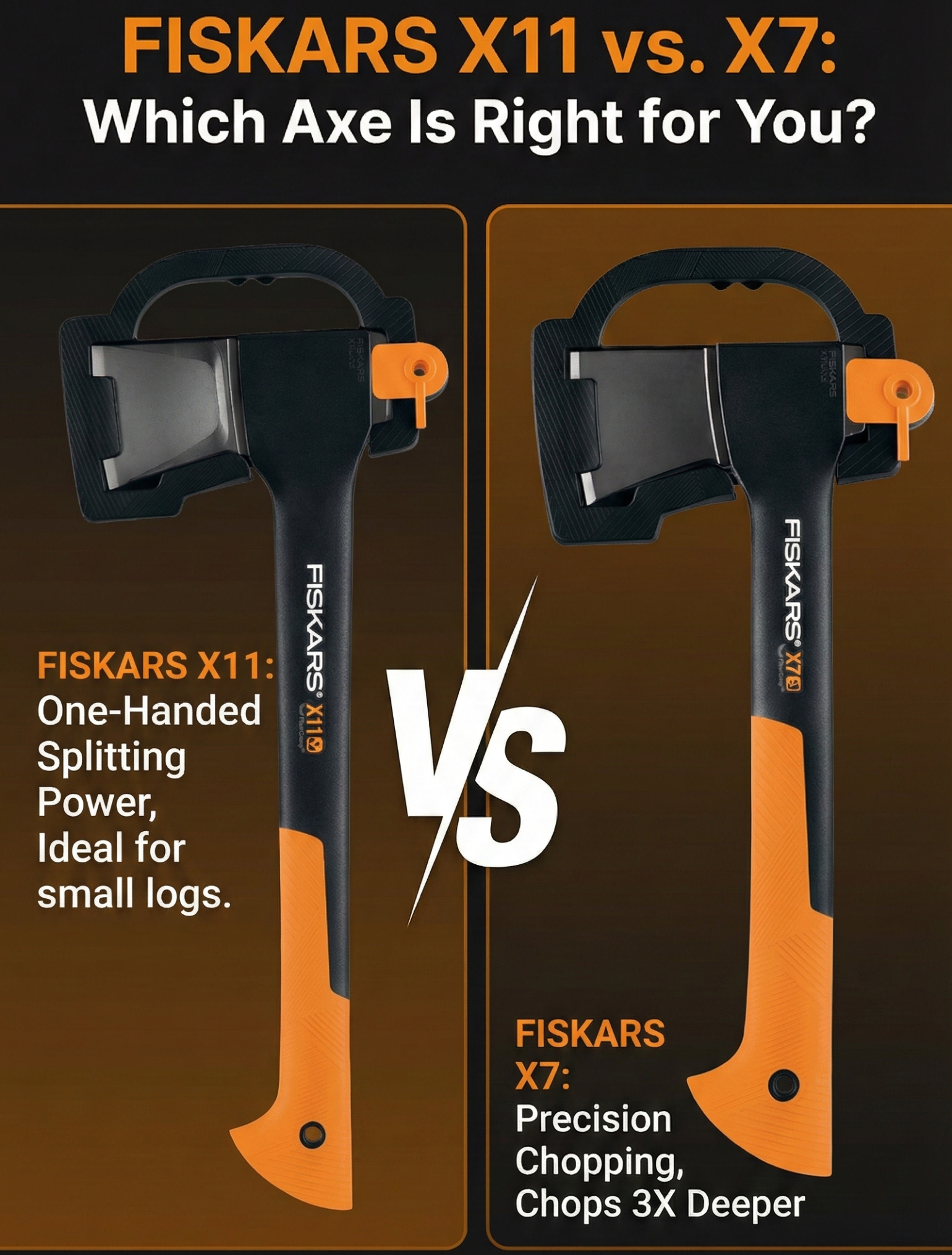
Two orange handles, nearly identical lengths, but completely different purposes. We break down the physics, performance, and best use cases for the Fiskars X7 Hatchet and the X11 Splitting Axe.
Introduction: The Identity Crisis
If you are standing in the hardware store aisle or scrolling through Amazon, looking at the iconic orange-and-black handles of Fiskars axes, you might be confused. The Fiskars X7 and the Fiskars X11 look almost exactly the same at first glance. They are both compact, lightweight, and built with Fiskars’ practically indestructible FiberComp handles.
However, buying the wrong one can lead to immense frustration in the field. Why? because one is a scalpel, and the other is a wedge.
In this detailed Fiskars X11 vs X7 comparison, we are going to dissect the nuances of head geometry, weight distribution, and cutting physics. Whether you are a bushcrafter needing to carve tent pegs or a homeowner needing to pop apart seasoned oak for the woodstove, understanding these differences is critical.
We will also touch upon how these compare to other market leaders like the Estwing Fireside Friend and traditional options from Swedish forges.
Quick Comparison: At A Glance
Before we dive into the deep review, here are the raw specs. Notice the weight difference despite the similar length.
| Feature | Fiskars X7 Hatchet | Fiskars X11 Splitting Axe |
|---|---|---|
| Primary Role | Chopping, Carving, Limbing | Splitting small logs & kindling |
| Total Length | 14 inches (355 mm) | 17 inches (431 mm) |
| Total Weight | 1.4 lbs (640 g) | 2.43 lbs (1100 g) |
| Head Weight | 1.03 lbs (470 g) | 1.85 lbs (840 g) |
| Blade Geometry | Thin, sharp cutting edge | Thick, convex splitting wedge |
| Balance Point | Near the head (agile) | Very head-heavy (momentum) |
| Best For | Hiking, Bushcraft, Backpacking | Car Camping, Wood Stoves, RVs |
The Challenger: Fiskars X7 Hatchet

The Fiskars X7 is arguably the most popular camping hatchet in the modern world. It is designed for cutting fibers. The blade is thin, allowing it to bite deep into wood. It is lightweight enough to carry on a belt or in a pack all day without fatigue.
If you want a detailed breakdown of its bushcraft capabilities, check out our full Fiskars X7 Hatchet Review.
See Fiskars X7 on AmazonThe Challenger: Fiskars X11 Splitting Axe

The Fiskars X11 is the smallest member of Fiskars’ splitting series (which ranges up to the massive X27). It is designed to push fibers apart. The head is heavier and features a distinct wedge shape. It is essentially a handheld splitting maul. It is not meant for felling trees; it is meant for processing rounds into firewood.
For those interested in larger splitting tools, see how the X-series scales up in our Fiskars X27 vs X25 comparison.
See Fiskars X11 on AmazonDeep Dive: Head-to-Head Comparison
1. Blade Geometry: The “Bite” vs. The “Pop”
The single most important difference between the X7 and X11 is the shape of the head (the cheek geometry). This dictates the physics of the tool.
The X7 Hatchet has a thin, flat profile. When you swing it at a tree branch or a small log, it slices. This makes it excellent for limbing (cutting branches off a fallen tree) or carving feather sticks for a fire. However, if you strike a thick log vertically, the thin blade tends to bite deep and get stuck, acting like a nail rather than a wedge.
The X11 Splitting Axe has a head that flares out rapidly immediately behind the cutting edge. It looks almost bulbous from the top. When this head strikes a log, it doesn’t want to cut; it wants to force the wood apart. The kinetic energy is transferred laterally, “popping” the wood open. It rarely gets stuck because the wedge shape forces the wood away from the steel.
2. Weight and Swing Dynamics
The X11 is significantly heavier than the X7—about a pound heavier. In the world of hand tools, a pound is massive.
- X7 (1.4 lbs): You can swing this with wrist action. It feels like an extension of your arm. You can use it for hours without your shoulder burning. It is precise.
- X11 (2.4 lbs): This requires more arm and shoulder engagement. It is top-heavy. When you swing it, the head “pulls” the handle down, generating more momentum. This is great for splitting because gravity helps you, but it is terrible for tasks that require finesse, like making tent stakes or carving.
3. Handle Length and Safety
The X11 is slightly longer (17 inches vs 14 inches for the X7). This extra 3 inches gives you a longer lever arm, increasing the velocity of the head at impact. For splitting, velocity + mass = force. This makes the X11 far superior for stubborn, knotty wood.
However, 17 inches is an awkward size for packing. It doesn’t fit inside a standard daypack as easily as the 14-inch X7. If portability is your main concern, the X7 wins.
4. Durability and Materials
Both tools use Fiskars’ proprietary FiberComp handle—a carbon fiber reinforced polyamide. It is lighter than wood and stronger than steel in terms of shock absorption. You can overstrike (hit the handle against the log) without snapping it, a common failure point for wooden axes like those discussed in our Hultafors hatchet review.
Both heads are insert-molded, meaning the plastic is molded around the steel head. The head will never fly off. This makes both tools incredibly safe compared to traditional wedged axes.
Performance Scenarios: Which One Do You Need?
Let’s simulate some real-world situations to help you decide.
Scenario A: The Backpacker
You are hiking 10 miles into the backcountry. Every ounce counts. You need a tool to process fallen branches for a small campfire and maybe hammer in a tent stake.
Winner: Fiskars X7. The X11 is dead weight here. The X7 can split small branches (up to 3 inches) just fine and is light enough to carry.
Scenario B: The Car Camper / RV Owner
You are driving to a campsite. You bought a bundle of firewood from the camp host, but the logs are huge quarters that won’t catch fire easily. You need to break them down into kindling.
Winner: Fiskars X11. The X7 will struggle with seasoned hardwood logs. It will get stuck. The X11 will pop those logs apart with a single strike. Since you aren’t carrying it on your back, the extra weight is a benefit, not a burden.
Scenario C: The Bushcrafter
You want to build a shelter, carve a spoon, and process game. You value control over brute force.
Winner: Fiskars X7. The X11 is too clumsy for carving. You cannot choke up on the head effectively for fine work because of the bulk. For bushcraft purists who prefer wood, you might look at Gransfors Bruk vs Hults Bruk, but in the Fiskars lineup, the X7 is the bushcraft choice.
Scenario D: The Home Wood Stove
You have a wood stove and a pile of large rounds already split by a hydraulic splitter or a large maul (like a Super Splitting Axe). You need a tool by the hearth to make kindling every night.
Winner: Fiskars X11. Or potentially the Estwing Fireside Friend. The X11 is perfect for “one-hand” splitting of small rounds on a chopping block.
Pros and Cons
✅ Fiskars X7 Pros
- Extremely lightweight (1.4 lbs).
- Razor-sharp cutting edge for slicing/carving.
- Perfect balance for one-handed use.
- Fits in almost any backpack.
- Great for limbing green wood.
❌ Fiskars X7 Cons
- Gets stuck in thick logs (binding).
- Lacks the mass to split hardwoods easily.
- Not efficient for processing large volumes of firewood.
✅ Fiskars X11 Pros
- Superior splitting wedge geometry.
- Heavy head generates great kinetic energy.
- Rarely gets stuck in wood.
- Longer handle (17″) offers more leverage.
- Textured grip for better control with gloves.
❌ Fiskars X11 Cons
- Too heavy for long-distance hiking.
- Terrible for carving or fine bushcraft tasks.
- Utility edge is not as sharp as the X7 (by design).
Understanding the Full Fiskars X-Series Lineup
One of the biggest sources of confusion for shoppers is that the X7 and X11 do not exist in a vacuum. Fiskars builds an entire family of orange-handled tools around the same core technology, and knowing where each model sits in that lineup helps explain why the X7 and X11 diverge so sharply in design philosophy.
At the small end of the range sits the Fiskars X5, a compact hatchet even shorter than the X7, intended mainly for kindling and camp chores where pack space is at an absolute premium. Moving up, the X7 is the “do everything” hatchet most people default to, balancing chopping and carving in a package light enough for daily carry. The splitting side of the family starts with the X11, which we’re covering here, and continues upward through the X15 and X17, both intended for two-handed splitting of larger rounds, before culminating in full-length splitting mauls like the X25 and X27.
The naming convention is not arbitrary. Fiskars uses the number roughly to indicate the tool’s chopping or splitting energy class, a rating tied to head weight, handle length, and swing velocity. A higher number generally means more force delivered per swing, which is why the X27 can split a round in one blow that would take a dozen strikes with an X7. Understanding this scale is useful context for anyone comparing models beyond just the X7 and X11, and it explains why simply “buying the biggest one” isn’t always the right call — a X25 is overkill and dangerous for carving tent stakes, just as an X7 is underpowered for rounds a foot in diameter.
If your firewood needs grow beyond what the X11 can comfortably handle — for example, if you are processing multiple cords of oak or hickory per season — it is worth stepping up to the X15 or X17 rather than forcing the X11 to do a job it was never designed for. Repeatedly overworking a small splitting axe on oversized rounds accelerates handle fatigue and increases the risk of glancing blows.
Steel Quality, Edge Retention, and Sharpening Guide
Both the X7 and X11 use a forged, precision-ground steel head made from a proprietary high-carbon steel alloy that Fiskars hardens to a working range suitable for repeated impact rather than pure edge retention. This is an important distinction from kitchen or pocket knife steel: axe heads are optimized to resist chipping under lateral shock loads, which means they are tempered slightly softer than you’d expect from a fixed-blade knife of similar carbon content.
In practical terms, this means the X7’s edge will dull faster than a premium bushcraft knife but is far less likely to chip when it strikes a knot or embedded stone. The X11’s edge is intentionally left thicker and more obtuse, since a fine edge angle on a splitting wedge would roll or micro-chip almost immediately under the forces the tool generates.
How to Sharpen the Fiskars X7
- Secure the head in a vise or stabilize it firmly on a bench, taking care to protect the FiberComp handle from clamp pressure.
- Use a coarse puck stone or a flat file to establish a consistent bevel, working from the heel of the edge to the toe in smooth arcing strokes.
- Maintain the factory edge angle, generally in the 25-30 degree range per side for a cutting hatchet; going thinner increases the risk of edge damage on hard wood.
- Finish with a fine-grit puck or leather strop to remove the wire edge and polish the bevel.
- Wipe the head with a light coat of oil after sharpening to prevent surface rust, especially if you’re storing the tool for an extended period.
How to Sharpen the Fiskars X11
The X11 needs a noticeably steeper edge angle, often closer to 35-40 degrees per side, to preserve the wedge geometry that makes it split efficiently. Because the profile behind the edge is so much thicker, you typically only need to touch up the last few millimeters of the bevel rather than reprofiling the whole cheek. Over-sharpening the X11 to a thin, X7-like edge will actually hurt its splitting performance, since a thinner edge tends to bite and stick rather than wedge the wood apart.
As a rule of thumb, sharpen the X7 every few outings if you’re using it heavily for carving and limbing, and sharpen the X11 far less often — every season or two under normal use is usually sufficient, since a slightly duller splitting wedge still performs its job effectively.
Proper Technique: How to Chop and Split Safely
A tool is only as good as the technique behind it, and a large share of “this axe doesn’t work” complaints online actually trace back to poor form rather than a flawed product.
Chopping Technique with the X7
When limbing or chopping with the X7, always work with the branch or log supported so the blade has somewhere to travel if it passes through the material — never chop toward your body or a supporting hand. Let the weight of the head do the work rather than muscling the swing; a relaxed grip that tightens only at the moment of impact (“choking up and snapping”) generates more controlled power with less fatigue. For carving tasks like feather sticks or tent stakes, choke all the way up near the head and use short, controlled push cuts rather than full swings.
Splitting Technique with the X11
Splitting is a different motion entirely. Always split on a stable chopping block, never on the ground, both to protect the edge from dirt and rocks and to give the swing a defined stopping point below the target round. Stand the round on end, position your feet shoulder-width apart and outside the swing radius, and aim for a spot slightly off-center or along an existing crack rather than dead center on a knotty round. Let the X11’s head-heavy design do the work — a full, committed swing that uses gravity and momentum will outperform a tentative, muscled one every time. If the axe sticks partway through, resist the urge to yank sideways; instead, lift the round and axe together and strike them down onto the block to finish the split.
Common Technique Mistakes
- Choking down too far on a splitting axe: This robs the X11 of the leverage that makes it effective and increases fatigue.
- Using a full power swing for carving tasks: This is both unnecessary and dangerous with the X7; carving calls for control, not force.
- Splitting rounds that are too large in diameter: Even the X11 has limits; extremely wide rounds should be quartered with wedges or a maul first.
- Ignoring wood grain direction: Splitting with the grain, following any visible checks or cracks radiating from the center, dramatically improves success rate with either tool.
Ergonomics and Grip: A Closer Look
Beyond raw geometry, the way these axes feel in the hand plays a major role in long-term usability. Fiskars molds a textured, slightly flared grip zone into the lower third of both handles, which helps prevent the tool from slipping forward during a swing, particularly when your hands are sweaty or you’re wearing work gloves.
The X7’s grip is proportioned for one-handed control, with a moderate flare at the base of the handle (the “knob”) that catches the palm and prevents the tool from flying out of your grip on a follow-through swing. The X11’s grip zone is longer, accommodating a two-handed hold for heavier splitting swings, and the added girth of the handle near the head helps offset the extra weight of the splitting head.
Users with smaller hands sometimes find the X11 grip slightly bulky for extended one-handed use, while users with larger hands sometimes find the X7 handle a touch thin for a fully secure two-handed grip on bigger branches. Trying both in person, if possible, is worthwhile if hand size or grip comfort is a significant concern for you.
Maintenance, Storage, and Sheath Options
One underrated advantage of the FiberComp handle used on both models is how little maintenance it requires compared to a traditional wooden handle. Wood handles need periodic linseed oil treatments to prevent drying and cracking; FiberComp handles need essentially none. Simply wipe down the handle after wet-weather use to prevent grit buildup near the head.
The steel head, however, does need routine attention. After each use in humid or wet conditions, dry the head thoroughly and apply a light coat of a rust-inhibiting oil (mineral oil, camellia oil, or a dedicated tool oil all work well) to the exposed metal, paying particular attention to the edge itself where fine scratches from sharpening can trap moisture.
Both the X7 and X11 ship with a molded plastic edge guard rather than a leather sheath. These guards snap securely over the blade and are more weather-resistant than leather, though some users prefer to upgrade to a leather belt sheath for a more traditional carry option, particularly for the X7 when used as a daily-carry bushcraft tool. When storing either axe long-term, keep it in a dry location, guard on, away from direct contact with bare concrete floors which can promote corrosion through condensation.
A Brief History of Fiskars and the Orange Handle
Fiskars is a Finnish company with roots dating back to 1649, making it one of the oldest continuously operating manufacturers in the world, though the axe line as we know it today is a much more recent development. The company became globally famous in the 1960s for its orange-handled scissors, a design choice originally driven by manufacturing constraints that happened to also make the tools highly visible — a detail that carried over intentionally into the axe and hatchet line decades later. A dropped orange axe head in tall grass is far easier to spot than a traditional wooden handle, a small but genuinely useful safety benefit of the brand’s signature color.
The modern X-series launched as an evolution of Fiskars’ earlier composite-handled axes, refining the FiberComp material and head-forging process to reduce weight while maintaining durability. The line has since become a benchmark that competitors like Estwing, Hultafors, and Gransfors Bruk are frequently compared against, precisely because of how widely available and consistently manufactured the Fiskars tools are.
How We Tested These Axes
To form the opinions in this comparison, both axes were used across a full camping season in mixed conditions: green pine and fir for general camp chores, seasoned oak and maple rounds for splitting tests, and a range of temperatures from summer heat down to below-freezing mornings to evaluate any cold-weather handle performance concerns.
For the X7, testing focused on limbing fallen branches, carving tent stakes and feather sticks, and light splitting of branches up to roughly three inches in diameter. For the X11, testing focused specifically on splitting rounds of varying diameters and wood species, timing the number of strikes needed to fully split representative rounds and noting how often each tool became lodged mid-swing. Edge retention was assessed qualitatively by tracking how many sessions elapsed before a noticeable loss of cutting or splitting performance required a touch-up sharpening.
This kind of side-by-side, task-specific testing is why the recommendations above are broken into scenarios rather than a single blanket “winner” — because in practice, no single number or spec sheet captures how differently these two tools behave in the field.
Buying Guide: Questions to Ask Before You Choose
If you’re still torn between the X7 and X11, working through the following questions can help clarify the right pick for your situation.
What is the primary task you need the tool for?
If your answer involves carving, limbing, or general camp utility, lean X7. If your answer is specifically “turning rounds into kindling or stove-sized pieces,” lean X11.
Will you be carrying it any real distance?
Anything beyond a short walk from the car favors the lighter X7. If the tool lives in a truck bed, garage, or by the wood stove, the X11’s extra weight is a non-issue.
What wood species will you typically process?
Softwoods and smaller diameters are manageable with either tool. Hardwoods like oak, hickory, or elm, especially with interlocked or knotty grain, strongly favor the wedge geometry of the X11.
Do you already own a larger splitting maul or hydraulic splitter?
If large rounds are already being broken down by another tool, the X11 becomes a finishing tool for kindling rather than your primary splitter, which is exactly the role it excels at.
Is budget a limiting factor?
Both tools are priced closely enough that budget rarely dictates the decision on its own, but it’s still worth checking current pricing before you buy, since promotional pricing on either model fluctuates throughout the year.
Left-Handed Use and Introducing Kids to Axe Safety
Both the X7 and X11 are fully symmetrical tools with no handedness built into the head or handle design, unlike some specialty carving axes that are ground with an offset bevel. This makes either model equally usable for left-handed or right-handed users without any adjustment needed.
For families introducing teenagers to axe use under close adult supervision, the lighter X7 is generally the more appropriate starting tool, given its lower weight and more forgiving, controllable swing. Regardless of which tool is used, foundational safety rules apply: always maintain a clear swing radius free of bystanders, never chop or split without stable footing, wear boots and eye protection, and never allow a young or inexperienced user to operate either axe without direct, close supervision.
Price and Value Analysis
Both the X7 and X11 sit in the affordable end of the quality axe market, priced well below premium hand-forged options from Gransfors Bruk or Hults Bruk while still offering genuine functional performance rather than a “big box store” compromise. Given the multi-decade lifespan typical of a well-maintained FiberComp-handled axe, the cost per year of ownership is very low compared to cheaper unbranded hatchets that often need replacing within a season or two due to loose heads or cracked handles.
Because Fiskars runs periodic promotions and bundle deals, it’s worth checking current pricing on both listings before purchasing, as the price gap between the X7 and X11 can narrow or widen depending on the retailer and time of year.
Extended FAQ: More Reader Questions
Can I replace the handle if it ever breaks?
No. Because the head is insert-molded directly into the FiberComp handle, the two components are not designed to be separated or replaced individually the way a traditional wooden-handled axe can be re-hafted. In the rare event of a handle failure, the entire tool needs to be replaced, though Fiskars’ warranty coverage often applies in cases of manufacturing defects.
Is the X11 overkill for a small backyard fire pit?
It can be, but many backyard fire pit owners still prefer it over the X7 simply because store-bought firewood bundles are often already seasoned hardwood that resists splitting with a thinner blade. If your fires mostly use smaller, pre-split logs, the X7 is more than sufficient.
Which axe holds up better in freezing temperatures?
Both perform equally well, since they share the same FiberComp handle material rated to extreme cold. The bigger cold-weather variable is the wood itself: frozen, seasoned rounds often split more easily than room-temperature wood because the ice within the grain acts as an additional wedge, which can make the X11 feel even more effective in winter.
Can the X7 be used for light batoning?
Yes, light batoning (driving the blade through a small piece of wood using another stick as a hammer) is a common bushcraft use for the X7, and its thinner profile actually batons more predictably through straight-grained wood than the X11’s thicker wedge shape.
Do these axes come with a warranty?
Fiskars offers a limited warranty against manufacturing defects on its axe and hatchet line, though the exact terms and duration can vary by region and retailer, so it’s worth checking the current warranty details listed on the product page at the time of purchase.
Frequently Asked Questions (FAQ)
Can I use the Fiskars X7 for splitting wood?
Yes, but with limitations. The X7 works well for splitting straight-grained softwoods or very small logs (under 3-4 inches diameter). For anything larger or knotty, the thin blade will get stuck, requiring you to wrestle the axe free.
Is the Fiskars X11 sharp enough to cut paper?
Out of the box, usually not. The X11 has a steeper grind angle (convex) designed for durability and splitting, not shaving. While you can sharpen it to a razor edge, it is not recommended as a fine edge will roll or chip when hitting hard knots.
Does the Fiskars plastic handle break easily in cold weather?
No. Fiskars FiberComp handles are tested in extreme temperatures (down to -40°F). They are widely used in Nordic countries and are less prone to becoming brittle in the cold compared to standard plastics.
Which axe is better for a bug-out bag?
The Fiskars X7 is generally preferred for bug-out bags due to its lighter weight (1.4 lbs) and versatility as a cutting tool, knife substitute, and hammer. The X11 is too specialized and heavy for a general-purpose survival kit.
Can I use the back (poll) of these axes to hammer tent stakes?
Yes, both the X7 and X11 have a hardened polymer reinforcement over the poll, but the steel is exposed in the center. They work fine for plastic or wood stakes. Do NOT use them to strike metal wedges or other steel tools, as the poll is not hardened for that and can deform or chip.
Final Verdict: The Winner Is…
There is no single winner because they are playing different sports. The choice comes down to one question: Are you carrying it, or is your car carrying it?
Get the Fiskars X7 IF:
- You are hiking, backpacking, or canoeing.
- You need a general-purpose tool for cutting branches, making kindling, and camp chores.
- You value agility and light weight.
Get the Fiskars X11 IF:
- You are car camping, RVing, or stay at a cabin.
- Your main job is processing firewood logs into smaller fuel.
- You encounter hardwoods (Oak, Maple) that require a wedge to split.
If you can afford it, the best solution is actually to own both. Keep the X11 in the truck for heavy work, and strap the X7 to your pack for the trail.
Ready to Buy?
Don’t settle for a dull blade. Grab the right tool for the job today.