Fiskars X27 vs. Super Splitting Axe: Clearing the Confusion
Are they the same tool? Or is there a hidden difference? We break down the X27, the mysterious “Super Splitting Axe,” and the real heavyweight contender: the IsoCore Maul.
Introduction: The Identity Crisis
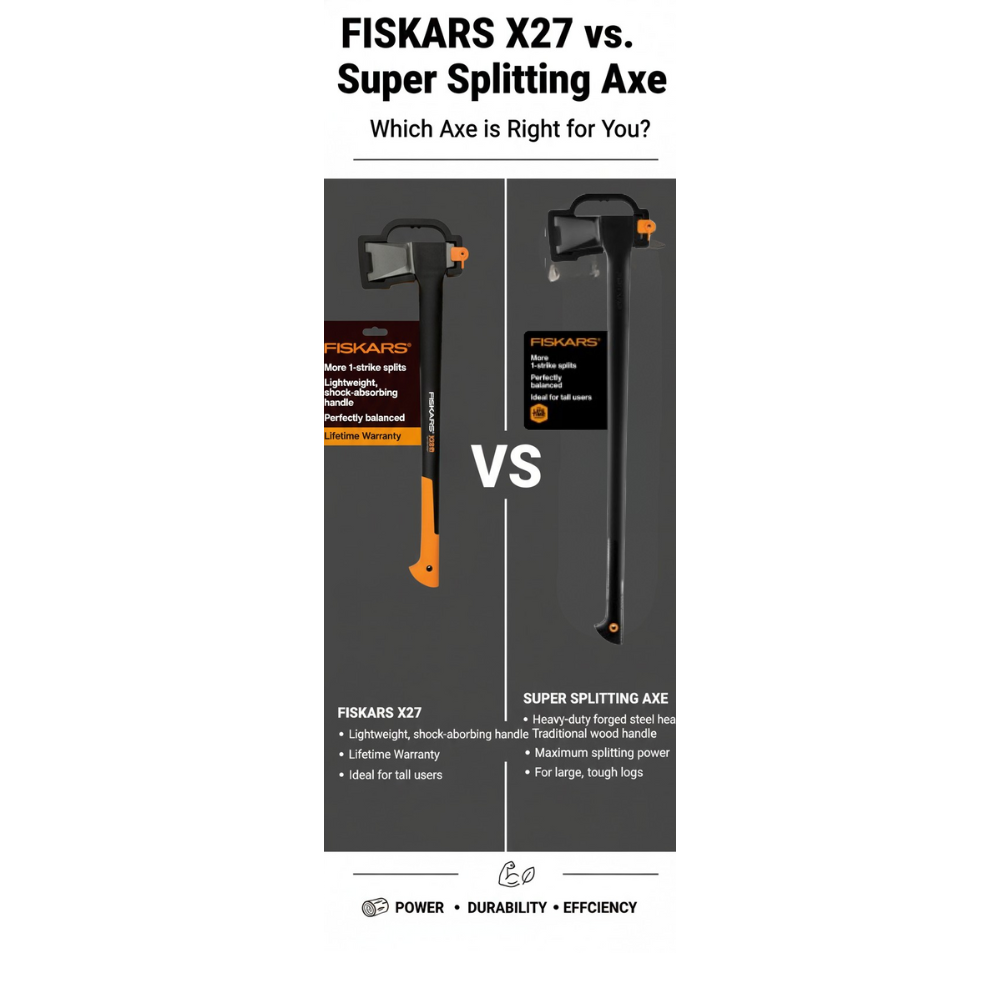
If you are browsing online hardware stores or standing in the aisle of a home center, you might find yourself staring at two very similar looking tools. One is labeled the Fiskars X27. The other is simply labeled the Fiskars Super Splitting Axe (often with a 36-inch handle). Sometimes, one has an orange grip, and the other is all black.
The question plagues forums and firewood groups every year: “Is the Super Splitting Axe better than the X27? Are they the same thing?”
The short answer is: Yes, they are essentially the same tool. The “Super Splitting Axe” is often the retail packaging name for the X27, or refers to the slightly older model with a black handle rather than the orange rubberized grip.
However, the real comparison you should be making isn’t between two versions of the same axe. It is between the X27 (The Speed Axe) and its big brother, the Fiskars IsoCore 8lb Maul (The Powerhouse). In this article, we will first clear up the X27 vs. Super Splitting Axe confusion, and then dive into the actual battle that matters: Speed vs. Mass. We will also explore the science of firewood, the anatomy of an axe, and the best techniques to keep you safe and efficient, regardless of which tool you choose. Understanding the nuances of grain structure, moisture content, and wood species will transform you from a weekend warrior into a seasoned firewood connoisseur. The journey into the world of wood splitting is as much about knowledge as it is about brute force, and selecting the proper implement is the first critical step on that path.
Part 1: Fiskars X27 vs. “Super Splitting Axe”
Fiskars marketing can be slightly inconsistent across different regions and retailers. Here is the definitive breakdown of the differences you might see on the shelf. The evolution of the product line reflects Fiskars’ commitment to ergonomics and user feedback. The original Super Splitting Axe was a revolution in its own right, moving away from traditional hickory to a virtually indestructible composite. The X27 is the refined, perfected version of that initial groundbreaking design, incorporating years of real-world testing and material science advancements to create what is arguably the most popular splitting tool on the planet. This iterative design process is a testament to the idea that even the best tools can be made better with attention to detail and user comfort.
The “Black Handle” vs. “Orange Grip”
Occasionally, you will find a cheaper version of the 36-inch splitting axe that is all black. This is often sold simply as the “Fiskars Super Splitting Axe” (Model 375581-1001 or similar variants). The X27 (Model 378841-1002) features the signature orange rubberized grip at the bottom of the handle.
- The Head: Identical. Both use the same forged steel wedge geometry designed to pop wood apart.
- The Handle Material: Identical. Both use FiberComp (fiberglass reinforced polyamide), which is virtually unbreakable.
- The Grip (The Real Difference): The X27 has a textured, orange, shock-absorbing rubber overmold. The basic “Super Splitting Axe” (Black) usually has a textured plastic pattern molded directly into the handle. The rubberized grip on the X27 is superior for reducing hand fatigue and preventing blisters during long splitting sessions.
Verdict: If the price difference is small ($5–$10), buy the X27. The rubber grip significantly reduces vibration shock, which your elbows will thank you for later. If the black version is half the price, grab it—it splits wood exactly the same way. The tactile feel of the grip is not merely a cosmetic upgrade; it is a functional one. During cold weather, a bare composite handle can feel slick and unyielding, whereas the rubber overmold maintains a degree of compliance and grip. In wet conditions, this difference is magnified, as the textured rubber channels water away and provides a non-slip surface even when your gloves are soaked. This feature alone can prevent a dangerous glancing blow that might occur if your hand slips on a smooth, wet handle.
Fiskars X27 Super Splitting Axe

The gold standard. 36-inch handle, shock-absorbing grip, and legendary durability.
Check Price on AmazonPart 2: The Real Battle – X27 vs. IsoCore Maul
Now that we’ve established that the X27 and the Super Splitting Axe are siblings, let’s look at the real competition. Many people buy the X27 thinking it can handle anything. Then they meet a 30-inch knotty oak round, and the X27 bounces off.
This is where the Fiskars IsoCore 8lb Maul enters the ring. This tool is often what people should be comparing the X27 against. The distinction between a splitting axe and a splitting maul is not just semantic; it’s a fundamental difference in tool philosophy. An axe is a finesse instrument designed to sever fibers, while a maul is a blunt instrument of brute force. The X27 walks a brilliant line between these two worlds, but it still leans toward the axe side of the spectrum. The IsoCore Maul, by contrast, is an unapologetically massive tool designed to do one thing: destroy the structural integrity of even the most stubborn wood round through sheer, unadulterated power. When you understand this core identity, you can select the right tool for the job with precision, rather than struggling with a mismatched implement.
| Feature | Fiskars X27 (Super Splitting Axe) | Fiskars IsoCore Maul (8lb) |
|---|---|---|
| Philosophy | Speed & Velocity | Brute Force & Mass |
| Total Weight | ~6 lbs (Light) | ~10.5 lbs (Heavy) |
| Head Weight | 4 lbs | 8 lbs |
| Handle Tech | Hollow FiberComp (Light) | Steel Core + IsoCore (Dampening) |
| Head Geometry | Sharp Wedge | Blunt Wide Wedge / Sledge |
| Best For | 80% of Firewood (Straight grain) | The nasty 20% (Knots, massive rounds) |
The Physics: Speed vs. Mass
Understanding why these tools feel so different requires a quick physics lesson. Force equals Mass times Acceleration ($F = ma$).
The X27 Approach: Kinetic Energy
The X27 is incredibly light for its size. The handle is hollow. This allows you to swing it at lightning speeds. When that 4lb head hits the wood at 50 mph, it creates an explosive “pop.” The thin, sharp edge penetrates slightly, and the widening cheeks blast the fibers apart. Because it is light, you can swing it all day without exhaustion. It relies on Tip Velocity.
The IsoCore Approach: Momentum
The IsoCore Maul is a sledgehammer with a blade. It is heavy. You cannot swing it fast. instead, you lift it and let gravity assist the drop. It relies on Mass. When 8lbs of steel hits a log, it doesn’t care if the wood is knotty or stringy; it crushes through using sheer momentum. It doesn’t “pop” the wood as much as it drives through it. The concept of momentum is critical here: the maul’s greater mass means it has more inertia, so it resists being stopped by tough, twisted fibers. While the X27’s kinetic energy is easily dissipated by a knot that acts like a shock absorber, the maul’s momentum carries it through the resistance, tearing the wood apart from the inside out. This is why technique differs so greatly: the X27 is thrown like a baseball pitch, while the IsoCore is hoisted like a deadlift and guided down with precision.
Part 3: The Science of Firewood – Why Your Choice of Tool Matters
To truly understand why a specific axe or maul is needed, one must first understand the fuel itself. Firewood is not a uniform substance; it is a complex, organic composite material. Its behavior under a splitting edge is governed by a multitude of factors including species, grain structure, moisture content, and even the temperature at the time of splitting. A deep appreciation for the anatomy of a log will not only make you a better splitter but will also save you countless hours of frustration. The cellular structure of wood is designed by nature to resist lateral forces. Trees have evolved to withstand high winds, which means their fibers are bound together with lignin, a natural polymer that acts as glue. Splitting wood is fundamentally the act of overcoming the tensile strength of this lignin bond, and different woods require different strategies to achieve this separation efficiently.
Moisture Content: Green vs. Seasoned Wood
The water inside a log acts as a cushion. Green, freshly cut wood can be surprisingly difficult to split because the internal water pressure resists the wedge. As wood seasons and dries, the cells shrink and microscopic cracks (called “checks”) begin to radiate from the center. This is why many experienced woodcutters prefer to fell trees in the winter and split them in the following autumn. A dry, well-checked round of ash will often fall apart with a single swing of the X27, whereas the same round when green will absorb the blow like a sponge. The X27’s sharp, penetrating edge is particularly effective on seasoned wood with visible end-grain cracks because it can find and exploit those natural fault lines. In contrast, the IsoCore Maul is less dependent on these checks, as its mass can overwhelm the hydraulic resistance of green wood, forcing a separation where a lighter tool would simply bounce back. The ideal moisture content for burning is below 20%, but the ideal moisture content for splitting can vary; some stringy woods like Elm actually split slightly easier when partially frozen or when they are at a specific stage of drying where the fibers become brittle but have not yet hardened completely.
The Hardwood Hierarchy: Janka Hardness and Splitting Difficulty
The Janka hardness test measures the force required to embed a steel ball into wood. While this relates more to flooring durability, it provides a rough guide to density. However, density does not always equal splitting difficulty. A high Janka rating means the wood is dense, which makes it excellent fuel with high BTU output, but it also suggests a need for a heavier tool. For example, Osage Orange (Hedge Apple) has an extremely high Janka rating and is notoriously difficult to split by hand, often requiring a hydraulic splitter or a very heavy maul. Sugar Maple and Hickory also rank high on the hardness scale but typically have a straight grain, making them prime candidates for the Fiskars X27. The key variable is grain interlock. Species like American Sycamore have a beautiful, interlocking grain that resists splitting despite having a moderate Janka rating. Understanding the specific wood species in your region is the first step to building a smart wood-splitting system. In the Northeastern United States, the prevalence of tough, knotty hardwoods often makes the IsoCore Maul a necessary complement to a splitting axe, while in the Pacific Northwest, where straight-grained softwoods like Douglas Fir dominate, the X27 alone may be all you ever need.
The Anatomy of a Round: Bark, Cambium, Sapwood, and Heartwood
A tree round is composed of concentric layers. The outermost bark is a protective shell. Just inside is the cambium, a thin layer of growing tissue. Next is the sapwood, which is typically lighter in color and transports water. At the center is the heartwood, which is denser, darker, and often loaded with resins and extractives that make it more resistant to decay. Knots originate from the heartwood and represent the base of a former branch. These knots are dense, twisted, and are the bane of any wood splitter. When you face a round, you should examine the end grain. Look for the pith (the exact center), the radiating medullary rays, and the pattern of knots. The old adage is to split from the outside in, targeting the path of least resistance between knots. The Fiskars X27 is perfect for “reading” this grain and popping slabs off the side of a round. The IsoCore Maul, however, is the tool you reach for when the grain is so chaotic that no readable path exists, and you must simply break the round in half through raw power aimed right through the center where the pith provides a natural, albeit tough, starting point.
Deep Dive: Fiskars X27 (The Super Splitter)
The X27 is arguably the most popular splitting axe in modern history. Its design changed the game by moving away from heavy wooden handles to lightweight composites. The engineering behind its hollow, FiberComp handle is a marvel of modern material science. Unlike a solid wooden handle, the FiberComp structure is injection-molded into a complex, hollow shape that provides incredible rigidity along the striking axis while remaining lightweight. This weight distribution is called a “forward balance,” where the mass is concentrated in the head, not the handle. This is the opposite of a traditional wood-handled maul, where the handle itself constitutes a significant portion of the total weight. The forward balance of the X27 allows the head to lead the swing naturally, promoting a whip-like action at the bottom of the arc that dramatically increases tip speed without requiring the user to muscle the tool through the entire motion. This efficiency is why users report being able to split for hours longer with the X27 than with a traditional tool.
Why It Wins
For straight-grained wood like Ash, Pine, or straight Oak, the X27 is unbeatable. You can process a cord of wood in half the time it takes with a maul because you aren’t fighting the tool’s weight. The 36-inch handle allows tall users (over 6ft) to strike the ground safely if they miss the log, rather than their shin. (For shorter users, see our Fiskars X27 vs X25 comparison). The X27’s head geometry is a masterclass in controlled penetration. Unlike a conventional axe which can stick deep into the wood, the X27’s flared cheeks make contact and then actively push the wood apart, converting downward kinetic energy into outward lateral force. This prevents the “stuck axe” problem that plagues cheaper, thinner splitting axes. The non-stick coating on the head also plays a crucial role, reducing friction so the steel slides through the fibers rather than being gripped by them. Over a long splitting session, this anti-friction coating can save a significant amount of energy, as you are not constantly wrenching the axe back out of a half-split log.
The Weakness
The X27 struggles with “stringy” wood (like Elm) or massive rounds with interlocking knots. Because it relies on speed, if the wood absorbs the impact (like a sponge), the X27 loses all its energy and gets stuck. It lacks the mass to plow through resistance. This is a fundamental limitation of the lightweight design. The kinetic energy of the X27 is high, but its momentum is relatively low. In physics terms, it has a high velocity but low mass. When it hits an immovable object, the energy is reflected back into the tool rather than into the wood. This is the “bounce” you feel. Adding more force to the swing often doesn’t help; it just makes the bounce more violent and can lead to injury or a broken overstrike guard. The solution is not to swing harder but to switch to a tool with more mass, which is precisely the role the IsoCore Maul fills. Understanding this limitation prevents you from damaging your tool or your pride on a log that was never a candidate for the X27 in the first place.
Deep Dive: Fiskars IsoCore Maul
The IsoCore Maul is built like a tank. Unlike the X27’s hollow handle, the IsoCore has a steel rod running through the handle, encased in vibration-dampening materials. This construction is a direct answer to the failures of traditional wood-handled mauls, which often break at the eye when a wild overstrike occurs. The steel core running from the head down through the grip area means the structural integrity of the tool is absolute. Even if the outer composite shell is damaged, the internal steel skeleton will not fail. This is a critical safety feature, as a detached maul head flying through the air at high speed is a life-threatening hazard. The engineering team at Fiskars essentially created a tool that combines the best aspects of a one-piece steel maul (unbreakable) and a composite maul (shock absorption), without the downsides of either. A solid steel maul transmits all vibration directly to the user, while the IsoCore isolates it, allowing you to swing with maximum force without paying the price in joint pain.
The “IsoCore” Technology
Standard mauls are notorious for sending a painful “sting” up your arms when you hit a hard knot. Fiskars’ IsoCore system isolates the steel core from the grip, reducing shock by 2X compared to wood handles. It genuinely works. You feel a “thud” rather than a “crack” in your elbows. This technology uses a soft polymer layer between the steel core and the outer grip, acting like a suspension system for your hands. For individuals who suffer from tendonitis, tennis elbow, or early-onset arthritis, this vibration reduction is not a luxury; it is a necessity that allows them to continue processing their own firewood. The cumulative trauma of repeated impact is a serious health concern for lifelong wood burners. By dramatically reducing peak vibration amplitude, the IsoCore system protects the small bones and ligaments of the hand and wrist. It’s an investment in long-term health, and for users splitting several cords per year, the medical savings alone justify the price of the maul over a cheaper, solid-wood model that transfers every shock into your body.
The Sledge Hammer Function
One massive advantage of the IsoCore Maul over the X27 is the poll (the back of the head). The X27 has a small, unhardened poll—you cannot hammer with it. The IsoCore Maul has a massive, hardened driving face. You can use it to drive steel wedges into the toughest logs, effectively giving you two tools in one. This dual-purpose capability is invaluable in the field. When you encounter a massive, knot-laden round that even the maul won’t split on the first hit, you don’t need to walk back to the shed for a sledgehammer. You simply pull out a wedge, start it with a tap of the maul’s poll, and then drive it home. The hardened face ensures that the poll won’t mushroom or deform from repeated metal-on-metal contact, a problem that renders many combination tools useless over time. This feature turns the IsoCore Maul into a complete log-destroying system. The ability to pound wedges effectively also means you can safely split extremely large, dangerous rounds from the sides without having to swing dangerously at the center, a technique we will explore further in the safety section.
Fiskars IsoCore 8lb Maul

The heavy hitter for knotty wood. Features a steel-reinforced handle and a sledgehammer face.
Check Price on AmazonWhich One Is Right For You?
We often recommend a “Two-Tool System,” but if you can only buy one, here is how to choose. The “Two-Tool System” involves keeping both an X27 and an IsoCore Maul on your rack. You reach for the X27 for 90% of your swings, using it to quickly process the easy stuff. When you hit a stubborn log, you set it aside in a “naughty pile” and, after you’ve processed all the easy rounds, you come back with the IsoCore Maul to dispatch the tough ones. This method maximizes your energy efficiency and minimizes fatigue. It prevents you from wasting your strongest energy on the hardest logs at the beginning of your session. Starting with the X27 allows you to warm up your muscles and perfect your swing rhythm, so when you finally do pick up the heavy maul, your body is already primed for the motion, reducing the risk of a pulled muscle from swinging a heavy tool cold. This progressive system is used by veteran woodcutters to double their output while reducing the chance of injury.
Choose the Fiskars X27 IF:
- You split volume: You need to process cords of firewood quickly for winter. The speed and low fatigue factor will allow you to maintain a steady pace for hours.
- You value endurance: You want to split for 2 hours without your back giving out. The light weight is a game-changer for those with less upper body mass.
- Your wood is decent: You mostly have rounds under 20 inches diameter that are relatively straight-grained. Ash, Maple, and Birch are perfect targets.
- You are tall: The 36-inch length is safer for users over 6’0″. The long handle provides a powerful lever and keeps the arc of the swing safely away from your legs.
Choose the IsoCore Maul IF:
- You have “Nasty” wood: You deal with huge rounds, crotches, knots, and stringy Elm or Gum. These woods are notorious for trapping lighter axes.
- You use wedges: You need a tool that can double as a sledgehammer to drive wedges. This makes it the most versatile single tool for the toughest jobs.
- You are strong: Swinging 10lbs repeatedly requires significant upper body strength and a solid core. It’s a full-body workout.
- You split casually: You only split a few logs for a campfire and want guaranteed success on every swing, regardless of technique. For weekend campers, the maul’s guaranteed first-hit power is satisfying and efficient.
Advanced Splitting Techniques and Crucial Safety Protocols
Owning a premium tool does not inherently make one a safe or effective splitter. The technique is just as important as the tool itself. Countless injuries occur each year because individuals underestimate the power and danger of a flying axe head. We will cover the methodologies that professional arborists and firewood processors use to stay safe and efficient. The first rule of splitting is to always wear appropriate personal protective equipment (PPE). Steel-toed boots are non-negotiable. The boot should have a high ankle support and a thick leather upper to protect your foot from a glancing blow. Safety glasses or a face shield protect your eyes from flying wood chips, which can be ejected at high velocity. Hearing protection is often overlooked; the sharp “crack” of a successful split can be surprisingly loud and damaging over time, especially with the ringing steel of a maul.
The Overstrike Problem and How to Avoid It
The most common failure mode for any axe is an overstrike. This occurs when the user misjudges the distance and the handle, rather than the head, strikes the log. With a wooden handle, this often results in a snapped helve. With the X27’s FiberComp handle, the material is incredibly resistant, but a particularly violent overstrike on a sharp edge of wood can still damage the handle’s integrity. The IsoCore Maul’s steel core provides near-total immunity to overstrike breakage, which is a major selling point for beginners who haven’t yet perfected their swing. To prevent overstrikes, never extend your arms fully at the moment of impact. Keep a slight bend in your elbows. Focus on the exact point you want to hit, not the entire log. The most accurate swingers often report aiming for a small crack or a specific fiber line. If you consistently overstrike, your chopping block is likely too low. The ideal chopping block is a large, flat log round that raises your splitting target to a height where the axe head hits the wood while your hands are still around waist or upper thigh level. A block that is too high makes you swing awkwardly up; a block that is too low dramatically increases the overstrike risk. The standard recommendation is to have the top of your splitting round sit at about knee height, but this can vary based on your personal biomechanics.
The Tire Method for Beginners
For new wood splitters, or for splitting smaller pieces of kindling with a full-sized axe, the tire method is invaluable. You simply place a round of wood inside an old, used car tire. If you miss your strike, the tire absorbs the blow and prevents the axe from slicing into your leg or foot. The tire also holds the split pieces upright, so you don’t have to bend over and reset the log after every single swing. For someone splitting an entire cord of wood, the constant bending and resetting of logs can exhaust the lower back far more than the actual swinging. By using a tire to corral the pieces, you can often split a round into four or five pieces with rapid, successive strikes without ever bending over. This method works exceptionally well with the Fiskars X27, as its lightweight nature allows for the rapid, repetitive strikes that the tire method enables. Simply keep your eye on the target, maintain a steady rhythm, and let the tire handle the cleanup.
Splitting Large Rounds: The “Slab” Technique
Attempting to split a massive 30-inch oak round right down the center is often an exercise in futility, even with an 8lb maul. The energy required to fracture the entire diameter is immense. The professional technique is to work from the outside in, cleaving off manageable “slabs.” Start by aiming your first strike about 3-4 inches from the edge of the round, not the center. With the X27, a sharp strike here will often pop a slab off the side. You continue rotating the round, popping slabs off the circumference. As the round gets smaller, you eventually reach a manageable core that can be split conventionally. This method is energy-efficient and safe because the piece you are trying to separate has a natural place to move outward. When you hit the center of a massive round, the wood often has nowhere to go, and the force reflects back. When you hit a slab near the edge, the force has a clear path to push the piece away. This is the single most important technique concept for a new splitter to learn, and it saves more labor than any tool upgrade. If the slab won’t pop off with the X27, this is where you use the IsoCore Maul: drive it down the same near-edge line, and the mass will shear the slab free where the light axe could not.
Tool Maintenance: Keeping Your Edge and Storing for Longevity
While both Fiskars tools are famously low-maintenance compared to their wooden-handled counterparts, they are not zero-maintenance. Proper care will ensure they last a lifetime and perform at their peak. The composite handles are UV resistant, but prolonged exposure to direct, intense sunlight can eventually degrade the polymers. Storing your tools in a cool, dry shed or under a cover is always recommended. While the FiberComp handles won’t absorb water and swell like wood, the steel heads are still susceptible to rust. A light coating of oil—linseed oil, WD-40, or even used motor oil—wiped on the head after a splitting session will prevent rust and keep the non-stick coating performing well. Rust on the surface creates friction, which reduces the splitting efficiency and makes the axe stick in the wood. Keeping the head clean and shiny is a quick step that pays off in performance. Additionally, you should periodically inspect the area where the head meets the handle for any signs of cracking or separation. On the X27, the head is molded into the handle and cannot be replaced, but it is also extremely rare for it to fail. If you do notice any deformation or cracks, Fiskars’ lifetime warranty should cover the damage, and you should stop using the tool immediately.
Sharpening a Splitting Axe: The Right Way
Many people mistakenly believe a splitting axe should be razor-sharp. This is dangerous. A splitting axe needs a durable, working edge that bites without being brittle. The X27 comes with a surprisingly sharp edge from the factory, but you can maintain it without a professional sharpening rig. The ideal sharpening tool is a fine-cut mill bastard file. You do not want a hollow-grind or a polished, razor-like edge that will fold over or chip on the first knot. Draw the file from the poll towards the bit, maintaining the factory angle (usually around 25-30 degrees). You are not trying to remove a lot of material; you are just removing any minor burs or rolled edges. After filing, a few strops on a piece of leather loaded with polishing compound will align the microscopic edge perfectly. If you get a small nick in the blade, don’t panic. A splitting axe can have small imperfections and still work effectively, as the wedge shape is doing most of the work. Avoid grinding wheels, as the heat generated by a high-speed grinder can ruin the temper of the steel, creating soft spots that will dull instantly. A patient, manual filing once a season is often all the maintenance an X27 head requires, unless you strike a rock or a hidden nail in the wood.
Winter Storage and the Frozen Wood Advantage
Storing your firewood processing tools in the cold is perfectly fine—in fact, it’s preferred to bringing them into a warm, humid house and letting them sweat and rust. The extreme cold is no threat to the FiberComp material. Interestingly, the best splitting often occurs when the wood is frozen. Many wood burners strategically wait for a deep freeze to tackle their toughest piles. When water inside the wood cells freezes, it expands and weakens the lignin bonds. Additionally, the frozen wood fibers become brittle, meaning they snap and separate under the force of the wedge rather than bending and stretching as they do when warm. A round of stringy Elm that would laugh at an axe in July often shatters into pieces when struck in January at -10 degrees Fahrenheit. The X27 is particularly delightful in these conditions; its lightning-fast speed coupled with the brittleness of the frozen wood results in explosive, satisfying splits with minimal effort. If you’ve been struggling with a particular pile, wait for a good, hard frost. You may find that your tool selection problem disappears, and the X27 suddenly becomes all the power you need.
Pros & Cons Breakdown
✅ Fiskars X27 Pros
- Extremely lightweight and fast.
- Best-in-class vibration absorption (FiberComp).
- Virtually unbreakable handle.
- Sharp edge cuts fibers cleanly.
- Lifetime Warranty.
❌ Fiskars X27 Cons
- Bounces off large, knotty rounds.
- Cannot be used as a hammer.
- Edge can chip on rocks (softer steel).
✅ IsoCore Maul Pros
- Unstoppable splitting force.
- Can drive wedges (Sledge face).
- IsoCore tech reduces shock significantly.
- Handles the wood the X27 can’t.
❌ IsoCore Maul Cons
- Heavy (10+ lbs total).
- Causes fatigue quickly.
- Slower cycle time (fewer swings per minute).
Building a Complete Firewood Processing System
Thinking beyond just the axe, an efficient firewood operation is a system of ergonomic flow. The goal is to move the log from the tree to the stove with as few touches and lifts as possible. The sequence typically involves a chainsaw for bucking, the splitting axe/maul for splitting, and some form of conveyance to move the splits to the woodpile. The Fiskars X27 shines in a system where the rounds are delivered to a central splitting station. Set up your chopping block in a location where you can easily bring wheelbarrow loads of rounds to it. As you split, the finished pieces fall to the ground. If you have a helper, they can be picking up those splits and loading them directly into a trailer or wheelbarrow, preventing the primary splitter from ever having to lift a finished log off the ground. This division of labor is critical for high-volume processing. The splitter stays in a semi-upright athletic stance, swinging the X27, while the helper manages the repetitive bending and stacking. This partnership can see a full cord of wood processed in an afternoon without either person becoming excessively fatigued. If you work alone, the tire method becomes essential to minimize your own bending. Furthermore, consider the height of your woodpile. Stacking wood on pallets keeps it off the damp ground and reduces the distance you have to bend to pick up splits. The entire system should be designed around protecting your back, with the tool choice being the dynamic element in the middle of the operation.
The Kindling Kit: Hatchets and Small Splitters
While the X27 and IsoCore Maul cover the heavy lifting, no fire-starting kit is complete without a dedicated kindling splitter. Using a 36-inch axe to split kindling is like swatting a fly with a sledgehammer—dangerous and imprecise. The Fiskars X7 hatchet is a popular choice due to its balanced weight, ultra-sharp edge, and FiberComp handle. However, for absolute safety, nothing beats a kindling splitter like the manual, gravity-fed splitters where you place a small log on a fixed wedge and hit it with a short-handled sledge. This completely removes the risk of a blade hitting your fingers, which is the most common injury in firewood preparation. If you insist on using a blade for kindling, adopt the “pencil grip” method: hold the small piece of wood you wish to split by placing the kindling splitter’s edge against the top of the log, and then, holding both the log and the hatchet handle together, tap the poll of the hatchet gently on your chopping block. This keeps your fingers safely behind the blade at all times. Never, under any circumstances, hold a small log with one hand and swing a hatchet with the other; a slight miss can result in a catastrophic tendon injury. A sharp hatchet is safer than a dull one because it bites reliably and doesn’t glance off, but situational awareness is the ultimate safety tool.
Are There Other Options?
If the X27 feels too long (36 inches) but you love the design, look at the Fiskars X25 (28 inches). It is safer for shorter users. (Read more: Fiskars X27 vs X25).
For handling kindling (small sticks), do not use the X27 or the Maul. It is dangerous to swing a long tool at small pieces of wood. Use a dedicated hatchet like the Fiskars X7 or a safe splitter like the Estwing Fireside Friend.
For those who prefer traditional tools, the debate of Gransfors Bruk vs Hults Bruk offers beautiful, wooden-handled alternatives, though they lack the indestructibility of the Fiskars X-series. The hand-forged Swedish axes offer a soulful connection to the craft that a composite tool can’t replicate, but they demand respect in the form of careful handling, annual oiling of the handle, and precise edge geometry maintenance with a whetstone. They are the choice for the romantic purist, while the Fiskars is the choice for the pragmatic production splitter. Neither is wrong, but they serve different philosophies. If you heat exclusively with wood and need to process five cords a year just to stay warm, the Fiskars is the logical, economical choice. If you split a cord a year for ambiance and enjoy the ritual, a Gransfors Bruk or Hults Bruk splitting axe will bring a smile to your face with every swing.
The Ecological and Health Benefits of Manual Splitting
In an age of automation and hydraulic log splitters, the decision to split manually is often a conscious choice. A gas-powered hydraulic splitter is loud, requires fuel, needs engine maintenance, and emits fumes. While they are a godsend for the physically disabled or for those processing dozens of cords commercially, they remove a significant health benefit for the average homeowner. Manual wood splitting is one of the most complete forms of functional fitness available. It engages the legs, core, back, shoulders, and arms in a complex, coordinated movement pattern. An hour of splitting with an X27 can burn over 500 calories, rivaling a high-intensity interval training session. Beyond the caloric burn, the rhythmic, meditative nature of splitting wood has profound mental health benefits. The focus required to place the edge accurately, the satisfying “thwack” of a clean split, and the immediate, tangible progress you can see in a growing woodpile are all deeply grounding experiences. It connects you to a primal human activity that provided warmth and survival to our ancestors. By choosing a manual tool like the Fiskars X27, you are not just heating your home; you are investing in your cardiovascular health and mental well-being while leaving a smaller carbon footprint than you would by burning gasoline to process your renewable fuel source.
Seasoning and Stacking: The End Goal
The split is just the beginning. A perfectly split log’s journey is not complete until it has been properly seasoned. The shape of your split matters. Triangular, wedge-shaped splits with sharp edges dry faster than chunky blocks because they have a higher surface area-to-volume ratio. The X27’s geometry is particularly good at creating these desirable, sharp-edged splits. Once split, the wood must be stacked off the ground in a location that receives prevailing winds and sunlight. The top of the stack should be covered, but the sides must remain open to allow airflow. A well-stacked cord of split and seasoned hardwood is a beautiful and satisfying sight—it represents energy independence, physical labor, and a warm, safe home. The choice between the X27 and the IsoCore Maul is simply a choice about how you wish to convert the raw, chaotic energy of a fallen tree into the ordered, life-sustaining warmth of a winter hearth. The tool is the bridge between the forest and the fire, and selecting the right one is the first act of a timeless ritual.
Frequently Asked Questions
Is the “Super Splitting Axe” different from the X27?
Functionally, no. The X27 is the modern version of the Super Splitting Axe. The only difference is usually the handle grip (Orange rubber on X27 vs Black textured plastic on older Super Splitters). The head geometry and weight are identical.
Can I use the back of the X27 to hit a wedge?
No. Never strike a metal wedge with the back of the X27, and never hit the back of the X27 with a sledgehammer. The steel around the eye is not hardened for impact and can deform, potentially loosening the head or cracking the composite handle housing. Use the IsoCore Maul for this task.
Does the Fiskars X27 come sharp?
Yes, surprisingly sharp for a splitter. Unlike traditional mauls which are blunt, the X27 has a knife-like edge to help it bite into the wood before the wedge shape takes over. This makes it efficient but means you should keep it out of the dirt to avoid dulling it.
Will the plastic handle break in cold weather?
It is extremely rare. Fiskars tests their FiberComp handles in temperatures down to -40°F. While standard plastics get brittle, this composite material remains durable. They are arguably more reliable in freezing temps than wooden handles, which can shrink and loosen the head.
Final Verdict: The Winner
So, Fiskars X27 vs. Super Splitting Axe? They are the same hero with different capes. Buy the X27 for the better grip.
But between the X27 and the IsoCore Maul? The winner depends on your woodpile.
For 90% of homeowners, the Fiskars X27 is the best tool. It transforms wood splitting from a grueling chore into a satisfying workout. It is fast, efficient, and fun.
However, keep an IsoCore Maul (or a wedge and sledge) in the corner for those 10% of logs that refuse to crack. You don’t want to be fighting a knotted oak round with a lightweight axe—you want the nuclear option.