Are Messermeister Knives Good? The Boutique German Brand Explained
When diving into the world of premium kitchen cutlery, most conversations inevitably circle around the two massive German titans: Wüsthof and Zwilling J.A. Henckels. Their logos are ubiquitous, their marketing budgets are massive, and their knives are found in high-end department stores worldwide. But lurking just off the mainstream radar is a third German contender, a brand revered by professional chefs and knife enthusiasts alike: Messermeister.
If you are asking, “Are Messermeister knives good?” the short answer is a resounding yes. In fact, many culinary professionals argue that they offer a superior cutting experience compared to their more famous Solingen neighbors. Messermeister blends the legendary durability of traditional German steel with the refined, aggressive edge geometry typically reserved for Japanese knives.
In this exhaustive 12-section review, we are going to dissect the Messermeister brand. We will analyze their hot-drop forging process, their unique half-bolster design, the physics of their 15-degree edges, and directly compare them to the biggest names in the industry to help you decide if they belong on your magnetic knife strip.
What truly distinguishes Messermeister in the crowded premium cutlery marketplace is their unwavering commitment to professional-grade performance without compromising on traditional craftsmanship values. While many manufacturers have slowly shifted toward cost-cutting measures like laser sintering and automated stamping processes, Messermeister has doubled down on time-tested forging methods that produce blades of exceptional density and structural integrity. The result is a knife that feels substantial in the hand, responds predictably to cutting motions, and maintains its performance characteristics through years of rigorous daily use. This dedication to quality over quantity has earned them a fiercely loyal following among working chefs who demand tools that can keep pace with the relentless demands of commercial kitchen environments.
1. Introduction to Messermeister: The Boutique Alternative
Unlike massive corporate conglomerates, Messermeister has an intimate, family-driven history. Founded in 1981 by Bernd Dressler—a German immigrant to Australia who eventually settled in California—the company was built on a simple premise: to provide professional chefs with premium German cutlery that addressed the common flaws found in mass-produced knives.
Today, Messermeister is a 100% women-owned company, helmed by Bernd’s daughters, Kirsten and Chelcea. The name itself is a portmanteau of the German words Messer (knife) and Meister (master). What makes Messermeister uniquely appealing is their “stealth wealth” status in the culinary world. They don’t spend millions on celebrity chef endorsements or flashy television commercials. Instead, they funnel their resources into manufacturing.
When you buy a premium Messermeister knife, you are buying a tool that feels distinctly handcrafted. They remain committed to hot-drop forging their flagship blades—an old-world technique that aligns the molecular structure of the steel for superior strength—rather than transitioning entirely to the cheaper, laser-cut stamped methods favored by modern mass-market brands.
The company’s philosophy extends far beyond mere manufacturing techniques. Messermeister operates on the fundamental belief that a kitchen knife should be an extension of the chef’s hand, not merely a sharpened piece of metal with a handle attached. This philosophy manifests in their meticulous attention to balance points, handle contours, and blade geometry. Every curve, every angle, and every transition point on a Messermeister knife has been thoughtfully considered and refined based on feedback from culinary professionals who use these tools for ten to twelve hours daily. The company maintains active relationships with culinary schools, restaurant kitchens, and individual chefs who provide ongoing input that directly influences product development and refinement.
Bernd Dressler’s original vision was remarkably prescient. In the early 1980s, when he observed the dominance of full-bolster German knives that were virtually impossible to sharpen properly at the heel, he recognized an opportunity to create something better. His solution—the cambered or half-bolster design—was initially met with skepticism from traditionalists who believed the full bolster was essential for safety and balance. However, as professional chefs began adopting Messermeister knives and experiencing the practical advantages of the half-bolster design, the brand’s reputation grew organically through word-of-mouth recommendations rather than expensive marketing campaigns. This grassroots growth pattern continues today, with many chefs discovering Messermeister through colleagues rather than advertisements.
The transition to women-owned leadership under Kirsten and Chelcea Dressler has brought fresh perspective while maintaining the core values that made the brand successful. They have expanded the product line thoughtfully, introducing innovative handle materials like Mediterranean olive wood and canvas Micarta while preserving the traditional forged blade construction that defines the brand. Under their stewardship, Messermeister has also strengthened its commitment to sustainability and ethical manufacturing practices, ensuring that the company’s growth doesn’t come at the expense of environmental responsibility or worker welfare.
2. The History and Heritage of Solingen, Germany
To understand the quality of a Messermeister blade, you must look to its birthplace: Solingen, Germany. Known globally as the “City of Blades,” Solingen has been the epicenter of European sword and knife making for over 700 years. The region’s natural resources—abundant iron ore, dense forests for charcoal, and fast-flowing rivers to power grinding wheels—created the perfect storm for metallurgical mastery.
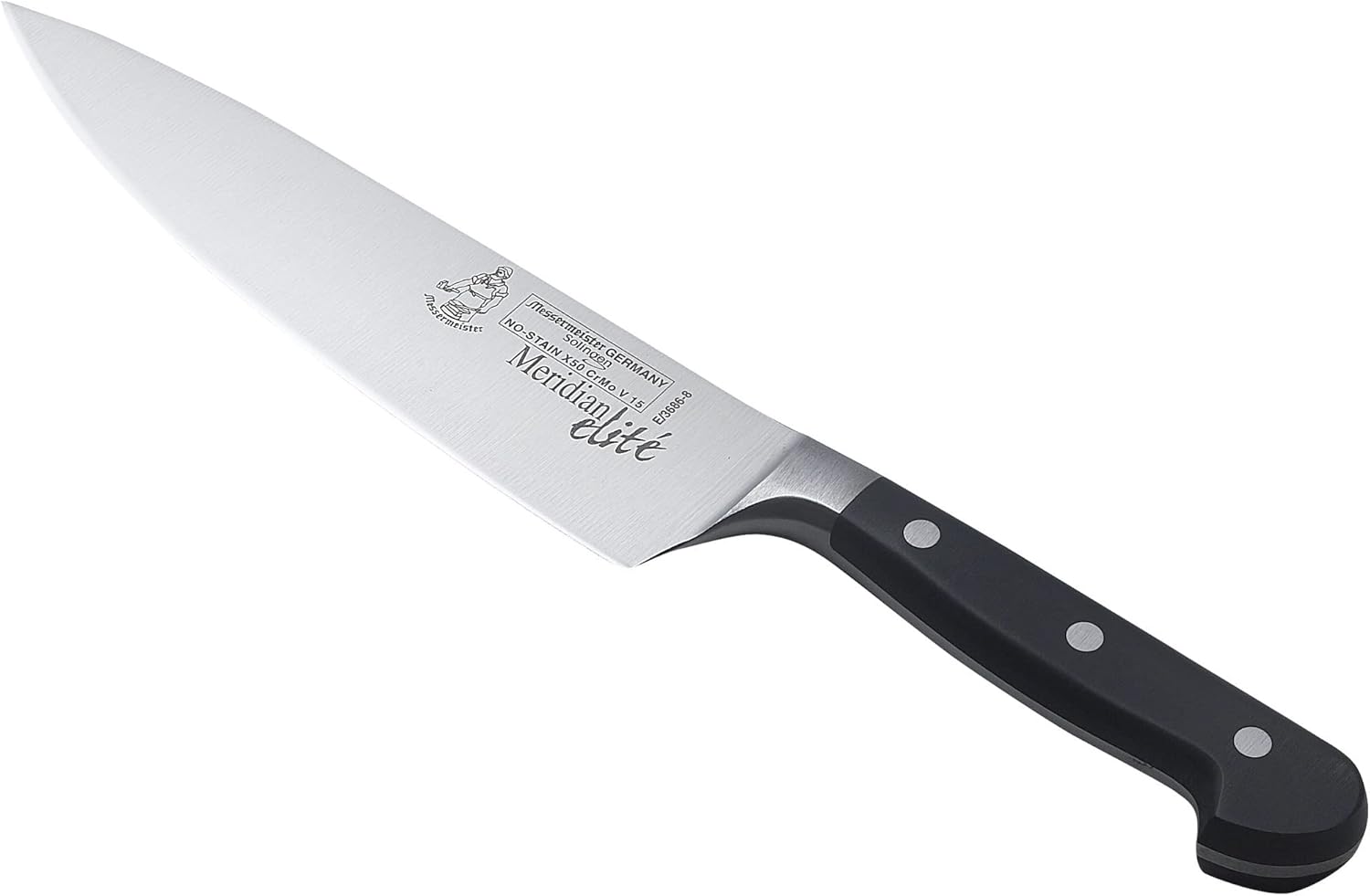
Messermeister’s premium lines (Meridian Elite, Oliva Elite, and Custom) are proudly stamped with the Solingen mark. This is not just a geographical indicator; it is a legally protected designation of quality. To bear the name “Solingen” on a blade, the knife must meet incredibly strict manufacturing standards set by the local German government regarding material quality and the forging process.
For a deeper understanding of why this region dictates the global standard for European cutlery, exploring the history of Solingen steel and the best German kitchen knives reveals the centuries of metallurgical science backing every Messermeister blade.
The Solingen cutlery tradition dates back to the medieval period, when the region’s swordsmiths gained renown throughout Europe for producing blades of exceptional quality. The guild system that developed in Solingen established rigorous standards for apprenticeship, mastery, and production quality that created a culture of excellence passed down through generations. Unlike many industrial centers that abandoned traditional methods in favor of mass production, Solingen maintained its commitment to craftsmanship while selectively incorporating modern technologies that enhanced rather than replaced human skill. This unique balance of tradition and innovation is precisely what Messermeister embodies in their contemporary knife production.
The geographical advantages of Solingen cannot be overstated in understanding its emergence as a cutlery capital. The Wupper River and its tributaries provided not only the water power necessary for grinding operations but also the transportation routes for importing raw materials and exporting finished products. The surrounding forests supplied charcoal for forging fires, while local iron deposits reduced dependence on imported metal. These natural advantages, combined with the accumulated expertise of generations of craftsmen, created an ecosystem where knife-making excellence could flourish. When Messermeister sources their blades from Solingen forges, they are tapping into this deep reservoir of metallurgical knowledge that has been refined over centuries of continuous practice and innovation.
The legal protection of the Solingen designation, established through the Solingen Ordinance, ensures that consumers can trust the quality of products bearing this mark. The ordinance specifies requirements for manufacturing processes, material composition, and quality control that exceed standard industrial norms. For a knife to carry the Solingen mark, it must undergo forging or stock removal processes within the city limits using steel that meets specified compositional standards. This legal framework prevents the dilution of the Solingen reputation through outsourcing or cost-cutting measures that would compromise quality. When you purchase a Messermeister knife bearing the Solingen stamp, you are acquiring a product that has been manufactured according to standards that have been refined and enforced for generations.
3. Core Characteristics: What Makes Messermeister Different?
If Messermeister uses the same German steel as Wüsthof and Zwilling, and they are forged in the exact same city, what actually sets them apart? The magic lies in the subtle design choices driven by chef feedback.
Here are the core pillars of the Messermeister philosophy:
- The 15-Degree Edge: While traditional German knives are sharpened to a blunt, durable 20 degrees per side, Messermeister pushes the envelope by sharpening their blades to a razor-thin 15 degrees, mimicking Japanese performance.
- The Half-Bolster (Cambered Bolster): They eliminate the thick, heavy chunk of steel at the heel of the blade (the full bolster), allowing you to sharpen the knife completely from tip to heel.
- Polished Spines: Run your finger along the top spine of a cheap knife, and it feels sharp and angular. Messermeister rounds and hand-polishes the spine, making pinch-gripping the knife incredibly comfortable for hours of prep work.
- Hot-Drop Forging: They continue to use traditional hammer forging, compacting the steel to create a denser, tougher blade than standard stamping processes allow.
The polished spine characteristic deserves particular attention because it exemplifies Messermeister’s attention to ergonomic detail. Professional chefs typically employ a pinch grip, where the thumb and forefinger grasp the blade itself rather than the handle. In this position, the spine of the knife rests against the webbing between thumb and forefinger. On knives with unpolished spines, the sharp edges can cause discomfort, calluses, and even blisters during extended prep sessions. Messermeister’s spine polishing eliminates this issue entirely, transforming what could be a source of irritation into a comfortable contact point. This seemingly minor refinement represents hundreds of hours of professional kitchen observation and feedback, demonstrating how Messermeister translates real-world user experience into tangible product improvements.
The company’s commitment to hot-drop forging also merits deeper examination. In this process, steel billets are heated to approximately 1,100 degrees Celsius until they reach a plastic state, then hammered under enormous pressure—often exceeding 2,000 tons—into the rough shape of a knife blade. This hammering action does more than simply shape the metal; it refines the internal grain structure of the steel, eliminating microscopic voids and aligning the crystalline matrix for maximum strength. The result is a blade that is denser, tougher, and more resistant to chipping than stamped blades cut from rolled sheet steel. While hot-drop forging is more expensive and time-consuming than stamping, the performance benefits it confers are substantial and long-lasting, justifying the additional cost for serious cooks who demand the best from their tools.
Messermeister’s design philosophy also extends to blade profile and curvature. Their chef’s knives feature a pronounced belly curve that facilitates the rocking cutting motion preferred by Western-trained chefs. This curvature allows the blade to pivot smoothly on the cutting board without lifting the tip, enabling rapid, efficient chopping of herbs, vegetables, and other ingredients. The curve is carefully calculated to provide optimal contact with the cutting surface throughout the rocking motion, ensuring clean, complete cuts without accordion-style incomplete severing that plagues poorly designed blades. This attention to cutting dynamics demonstrates Messermeister’s understanding that knife performance extends beyond sharpness to encompass the entire cutting experience.
4. Steel Quality: Analyzing the 1.4116 Stainless Alloy
The beating heart of any knife is its steel. Messermeister utilizes X50CrMoV15 (also known as 1.4116), which is the undisputed gold standard for premium German cutlery. Let’s break down what this alphabet soup actually means for your daily cooking:
| Chemical Element | Percentage | What It Does for the Knife |
|---|---|---|
| Carbon (X50) | 0.50% | Provides hardness and edge retention. While lower than Japanese carbon steel, it is high enough to take a razor edge. |
| Chromium (Cr) | 15% | Provides extreme stain and rust resistance. This makes the knife virtually maintenance-free regarding corrosion. |
| Molybdenum (Mo) | ~0.5% | Increases strength and hardness, preventing the steel from becoming brittle. |
| Vanadium (V) | ~0.1% | Refines the grain structure of the steel, allowing for a sharper, finer edge during the grinding process. |
Messermeister heat-treats this alloy to a Rockwell Hardness (HRC) of 58. This is the sweet spot for a kitchen workhorse. It is hard enough to hold its edge for months of home use, but soft enough that it will roll rather than chip if you accidentally strike a bone or drop it in the sink. When it does dull, HRC 58 steel is incredibly easy to bring back to life on a honing rod or whetstone.
The heat treatment process that brings X50CrMoV15 steel to its optimal hardness is as critical as the alloy composition itself. Messermeister’s heat treatment protocol involves precisely controlled heating and cooling cycles that transform the steel’s crystalline structure. The blades are first heated to approximately 1,050 degrees Celsius in computer-controlled furnaces that ensure uniform temperature throughout the blade. This austenitizing phase dissolves carbides within the steel matrix, preparing it for transformation. The blades are then quenched in oil or molten salt, rapidly cooling the steel and locking in a hard martensitic structure. However, this freshly quenched martensite is extremely brittle, so the blades undergo tempering—reheating to a lower temperature, typically around 200-250 degrees Celsius—which relieves internal stresses and trades a small amount of hardness for significantly increased toughness. This carefully calibrated balance between hardness and toughness is what gives Messermeister knives their legendary durability and edge retention characteristics.
The 0.50% carbon content in X50CrMoV15 represents a carefully chosen compromise. Higher carbon levels, such as the 0.80-1.00% found in Japanese carbon steels, can achieve higher hardness and potentially better edge retention. However, this increased hardness comes with a corresponding increase in brittleness, making the blade more susceptible to chipping when encountering hard materials like bone or frozen food. The moderate carbon content of X50CrMoV15, combined with its generous chromium content, produces a blade that will resist corrosion even in the demanding environment of a professional kitchen while maintaining sufficient hardness for excellent cutting performance. This balance of properties explains why X50CrMoV15 has become the preferred steel for premium German kitchen knives across multiple manufacturers.
The role of vanadium in the alloy, though present in small quantities, is disproportionately significant for edge performance. Vanadium forms extremely hard carbide particles within the steel matrix that are substantially harder than the surrounding steel. These vanadium carbides act as wear-resistant points along the cutting edge, dramatically improving edge retention without the brittleness penalty associated with higher overall carbon content. During sharpening, these carbides help create a micro-serrated edge structure that enhances cutting aggression, particularly on fibrous materials like meat and vegetables with tough skins. This micro-structure is one reason why properly sharpened X50CrMoV15 blades can outperform knives made from steels with higher nominal hardness ratings but less refined carbide structures.
Understanding the Rockwell Hardness scale provides valuable context for evaluating knife performance. The Rockwell C scale (HRC) measures the resistance of a material to permanent deformation from a standardized indenter. Kitchen knives typically range from HRC 54 for very soft, tough blades to HRC 65 for extremely hard, brittle blades. The HRC 58 target that Messermeister achieves represents the upper range of what is practical for a general-purpose kitchen knife. At this hardness, the steel retains sufficient ductility to absorb impacts without cracking, yet is hard enough to maintain a keen edge through extended use. Knives hardened above HRC 60 become increasingly difficult to sharpen and more prone to chipping, while those below HRC 56 tend to dull quickly and require frequent maintenance. Messermeister’s precise targeting of this optimal hardness range demonstrates their deep understanding of practical kitchen knife requirements.

5. The 15-Degree Edge Advantage (German Brawn, Japanese Sharpness)
For decades, the culinary world operated on a strict binary: you either bought a thick German knife (20-degree edge) that could survive a nuclear blast but struggled with delicate vegetable work, or you bought a thin Japanese knife (12-15 degree edge) that cut like a laser but chipped easily.
Messermeister recognized this gap and asked, “Why not both?” By putting an acute 15-degree edge on tough German X50CrMoV15 steel, they created a hybrid. Out of the box, a Messermeister chef’s knife effortlessly glides through ripe tomatoes and delicate herbs with the finesse of a Japanese Gyuto.
Furthermore, the blade geometry of their chef’s knife features a distinct, sweeping belly. This is crucial depending on how you operate on the cutting board. If you want to understand why this sweeping curve matters, exploring the dynamics of chef knife uses in rocking vs push cutting reveals why Messermeister’s profile is highly favored by Western-trained chefs who rely on the rapid rocking motion to mince garlic and herbs.
The physics behind edge angles reveals why the 15-degree specification represents such a significant departure from German tradition. The edge angle directly affects both cutting performance and durability. A more acute angle concentrates force onto a smaller area, reducing the effort required to initiate and complete a cut. This is why a razor blade, sharpened to approximately 7-10 degrees per side, glides through hair with minimal resistance. However, as the angle decreases, the amount of steel supporting the very apex of the edge also decreases, making the edge more susceptible to folding, rolling, or chipping when encountering resistance. The traditional 20-degree German edge prioritized durability over cutting ease, ensuring the knife could withstand heavy use and occasional abuse in busy kitchens where proper technique wasn’t always observed.
Messermeister’s decision to sharpen to 15 degrees required confidence in both their steel quality and their understanding of how professional chefs actually use their knives. They recognized that modern chefs, trained in proper cutting techniques and equipped with appropriate cutting boards, didn’t need the excessive durability margin of a 20-degree edge. Furthermore, the toughness of properly heat-treated X50CrMoV15 steel provides sufficient edge stability at 15 degrees to resist the deformation that would quickly dull a less robust steel at the same angle. The result is a knife that cuts with noticeably less effort than traditional German alternatives while maintaining far greater durability than comparable Japanese knives. This hybrid approach has proven so successful that other German manufacturers have since followed Messermeister’s lead, introducing their own acute-edge offerings to compete in this middle ground.
The practical implications of the 15-degree edge become apparent immediately upon use. Cutting through a ripe tomato, which often separates excellent knives from mediocre ones, reveals the advantage. A dull 20-degree edge will slide across the tomato skin, requiring sawing motion and pressure that crushes the delicate flesh. A Messermeister at 15 degrees bites into the skin immediately, allowing clean, effortless slices that preserve the tomato’s structural integrity. Similarly, when chiffonading basil or slicing chives, the acute edge produces clean cuts without bruising, preserving the herbs’ vibrant color and fresh flavor. These seemingly small differences accumulate over hours of prep work, reducing fatigue and improving the quality of the finished dish.
6. Half-Bolster vs. Full Bolster: A Game Changer for Sharpening
If you ask a professional sharpener what they hate most about traditional German knives, the answer is unanimous: the full bolster. The bolster is the thick band of steel where the handle meets the blade. Brands like Wüsthof Classic use a “full bolster” that drops all the way down to the cutting edge.
Messermeister was one of the first German brands to champion the half-bolster (or cambered bolster). They grind away the bottom half of the bolster, exposing the heel of the blade. Why is this so important?
First, it allows you to utilize the entire length of the blade. When cutting through wide produce like squash, you need the heel to bite. Second, and most importantly, it makes sharpening infinitely easier. With a full bolster, you cannot sharpen the back inch of the knife on a whetstone. Over years of sharpening, the blade wears away, but the thick bolster does not, eventually creating a hollow “bird’s beak” gap where the knife no longer touches the cutting board.
The “bird’s beak” phenomenon deserves detailed explanation because it represents a fundamental design flaw that has plagued full-bolster knives for generations. When a knife with a full bolster is sharpened on a flat whetstone, the protruding bolster prevents the heel portion of the blade from contacting the stone. As sharpening progressively removes material from the accessible portion of the blade, the unsharpened heel remains at its original height. Over time, this creates a concave gap between the cutting edge and the bolster—the eponymous bird’s beak. At this point, the knife can no longer make complete contact with the cutting board at the heel, leaving ingredients partially severed and requiring additional cuts to complete the job. Correcting this condition requires grinding down the bolster itself, a labor-intensive process that most home users lack the equipment to perform.
Messermeister’s half-bolster design eliminates this problem entirely by ensuring the entire cutting edge, from tip to heel, can contact a flat sharpening surface. This design choice reflects their commitment to long-term knife performance and user satisfaction. A knife is a long-term investment, and Messermeister engineers their products to maintain optimal functionality throughout decades of use and maintenance. The half-bolster also contributes to a lighter overall weight compared to full-bolster designs, reducing fatigue during extended prep sessions. The weight reduction, while seemingly modest—perhaps 15-20 grams—becomes significant when multiplied across thousands of cutting motions during a typical shift in a professional kitchen.
The safety implications of the half-bolster design are frequently misunderstood. Traditional full-bolster advocates argue that the full bolster protects the user’s hand from slipping forward onto the blade. While this argument has surface plausibility, practical experience reveals that proper knife technique—specifically the pinch grip where thumb and forefinger grip the blade itself—renders the bolster’s protective function largely irrelevant. In fact, many professional chefs find that full bolsters create a false sense of security that encourages sloppy technique, whereas the half-bolster design encourages the user to maintain proper grip discipline. Additionally, the polished spine on Messermeister knives provides a comfortable, non-abrasive contact point for the pinch grip that full-bolster designs often lack, further enhancing safety through proper technique rather than mechanical barriers.

7. Top Messermeister Lines Compared
Messermeister offers several lines to accommodate different budgets and aesthetic preferences. Let’s break down the top contenders:
| Knife Line | Construction | Handle Material | Best For |
|---|---|---|---|
| Meridian Elite | Hot-Drop Forged | POM (Polyoxymethylene) Synthetic | The ultimate professional workhorse. Indestructible, classic triple-rivet look. |
| Oliva Elite | Hot-Drop Forged | Mediterranean Olive Wood | The luxury home cook. Stunning aesthetics, incredible warmth and grip. |
| Custom | Hot-Drop Forged | Canvas Micarta or Wood | The enthusiast. Features interchangeable handles and hardware for ultimate personalization. |
| Four Seasons | Stamped | Molded Polypropylene | Culinary students and commercial kitchens looking for high-carbon stainless on a budget. |
Beyond these four primary lines, Messermeister also offers specialty collections that cater to specific culinary niches and aesthetic preferences. The Royale Elite line features handles crafted from richly grained walnut wood, offering a darker, more traditional appearance than the olive wood of the Oliva collection. Walnut provides excellent durability and a warm, organic feel that appeals to cooks who appreciate natural materials but prefer a more understated aesthetic than olive wood’s dramatic grain patterns. The Avanta line represents Messermeister’s entry into the forged German steel segment at a more accessible price point. While still featuring the same X50CrMoV15 steel and Solingen manufacturing heritage, the Avanta line employs streamlined production methods and simpler handle designs to reduce costs without compromising the essential cutting performance that defines the brand.
For those who appreciate Japanese knife aesthetics but prefer German steel characteristics, Messermeister offers the Kawashima line, which blends traditional Japanese handle shapes with German blade steel and construction. These knives feature octagonal wa-handles reminiscent of traditional Japanese cutlery but are crafted from durable synthetic materials that withstand the rigors of Western kitchen environments. This fusion approach demonstrates Messermeister’s willingness to innovate beyond rigid national categories, creating tools that combine the best attributes of different cutlery traditions.
The Stealth collection represents Messermeister’s most contemporary design language, featuring blades with a dark, non-reflective coating that reduces glare and provides a distinctive modern appearance. The coating also offers additional corrosion resistance, making these knives particularly suitable for humid environments or cooks who occasionally forget to immediately dry their blades. While the coating will eventually show wear with extended use, many users appreciate the unique aesthetic and practical benefits it provides during the knife’s service life.
8. Spotlight: The Messermeister Oliva Elite Collection
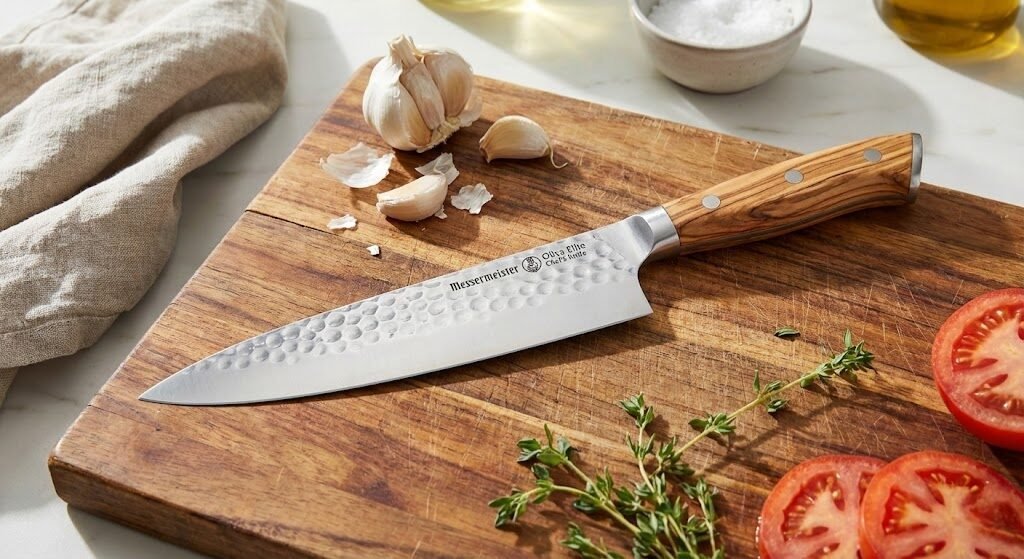
If there is one knife that defines the modern era of Messermeister, it is the Oliva Elite 8-inch Chef’s Knife. It takes the flawless forged blade of the Meridian line and replaces the synthetic handle with a stunning piece of Mediterranean olive wood.
Olive wood is uniquely suited for kitchen knives. It is incredibly dense, highly resistant to water, and naturally rich in oils, which gives it a secure, velvety grip even when your hands are wet. Visually, no two Oliva Elite knives are identical. The swirling golden-brown grain patterns ensure that your knife is a one-of-a-kind piece of functional art.
However, beauty requires maintenance. You cannot let the Oliva Elite soak in a sink, and it absolutely cannot go in the dishwasher (no good knife should, but wood handles will literally split and crack under the intense heat). You will need to rub the handle with food-safe mineral oil every few months to keep the wood hydrated and vibrant.
The Mediterranean olive wood used in the Oliva Elite line carries cultural significance that enhances its appeal. Olive trees have been cultivated throughout the Mediterranean basin for thousands of years, providing oil, food, and wood that have sustained civilizations. The wood itself comes from trees that have typically produced olives for decades before being harvested for lumber, giving each handle a connection to agricultural heritage that synthetic materials cannot replicate. The density of olive wood—significantly higher than common hardwoods like oak or maple—contributes to the knife’s overall balance, adding weight to the handle that counterbalances the forged blade and creates a natural, comfortable equilibrium in the hand.
Each Oliva Elite handle undergoes a meticulous finishing process that enhances both its appearance and durability. After the rough handle shape is cut and attached to the tang, skilled craftspeople sand the wood through progressively finer grits, ultimately achieving a silky-smooth surface that feels luxurious against the skin. The handles then receive multiple applications of food-grade oil that penetrates deep into the wood’s cellular structure, providing moisture resistance and bringing out the rich color variations in the grain. This oil treatment continues to protect the handle throughout its service life, but regular reapplication by the owner is essential to maintain the wood’s appearance and prevent drying or cracking. This maintenance requirement is modest—perhaps five minutes every few months—but represents the trade-off for owning a natural material handle rather than a maintenance-free synthetic alternative.
The visual impact of the Oliva Elite in a kitchen setting cannot be overstated. Displayed on a magnetic knife strip or in a knife block, these knives serve as functional sculpture, elevating the aesthetic of the entire cooking space. The organic warmth of the wood provides a striking contrast to the clinical precision of the steel blade, creating a visual harmony that appeals to both professional chefs and design-conscious home cooks. Many Oliva Elite owners report that the beauty of their knives actually encourages more frequent cooking and more attentive knife maintenance, as the pleasure of using and caring for such a beautiful tool becomes its own motivation.

9. Messermeister vs. Wüsthof vs. Zwilling (The German Big Three)
How does the boutique underdog stack up against the Goliaths of Solingen?
Vs. Wüsthof: Wüsthof is the standard bearer. Their Classic line is legendary. Both use the exact same X50CrMoV15 steel. However, many Wüsthof Classic models still use a full bolster (though they have recently introduced “half-bolster” models to compete). Wüsthof utilizes PEtec (Precision Edge Technology) to laser-sharpen their blades to 14 degrees. Messermeister feels slightly more front-heavy, offering better gravity-assisted chopping power. To see how these giants hold up in extreme testing, review this Wüsthof vs Zwilling vs Shun edge retention test.
Vs. Zwilling J.A. Henckels: Zwilling’s flagship Pro line was designed by architect Matteo Thun and features a unique, wedge-shaped half-bolster. Zwilling uses a proprietary ice-hardening process (Friodur) which they claim alters the steel structure. In real-world application, the edge retention between Zwilling Pro and Messermeister Meridian Elite is virtually indistinguishable. The choice here comes down to handle comfort; Zwilling handles are often thicker and squarer, while Messermeister favors smooth, rounded contours.
The competitive dynamics between these three Solingen manufacturers reveal interesting patterns in product development and market positioning. Wüsthof, as the largest and most commercially aggressive of the three, has historically set the benchmark for German knife marketing and distribution. Their extensive product lines, prominent retail presence, and significant advertising investments have made Wüsthof the default choice for consumers seeking premium German cutlery. However, this market dominance has also created opportunities for competitors like Messermeister to differentiate themselves through design choices that address the criticisms frequently leveled at Wüsthof products—most notably the full bolster and the relatively conservative edge geometry of their traditional lines.
Zwilling J.A. Henckels occupies an interesting middle position, combining the manufacturing scale and brand recognition of a major corporation with a willingness to innovate that sometimes exceeds Wüsthof’s more cautious approach. The Pro line’s distinctive handle design, created by a renowned industrial designer, demonstrates Zwilling’s investment in ergonomics and aesthetics beyond traditional forms. Their Friodur ice-hardening process, while controversial among metallurgists regarding its actual impact on edge performance, represents the kind of proprietary technology differentiation that large manufacturers use to distinguish otherwise similar products. However, Zwilling’s enormous product range—spanning from premium forged knives to budget stamped options—can create brand confusion that Messermeister avoids through their focused, quality-first approach.
For the discerning knife buyer, the choice between these three brands often comes down to subtle preferences rather than clear superiority. Wüsthof offers the broadest selection and the most established reputation. Zwilling provides innovative design and manufacturing at scale. Messermeister delivers chef-focused refinements and a boutique sensibility that appeals to those who appreciate attention to detail and a more personal connection to the manufacturer. All three produce excellent knives that will serve their owners well for decades. The deciding factors are often the half-bolster preference, handle comfort, and the intangible appeal of supporting a smaller, family-owned enterprise rather than a corporate giant.
Price positioning among the three brands also merits consideration. Messermeister typically prices their knives slightly below comparable Wüsthof and Zwilling models, offering what many consider superior value given the half-bolster design and polished spine refinements. This pricing strategy reflects Messermeister’s lower marketing overhead and their focus on product quality rather than brand prestige. For budget-conscious buyers who still demand professional-grade performance, this pricing advantage can be significant, particularly when building a complete knife set where the per-piece savings accumulate substantially.
10. Handle Materials and Ergonomics: The Unsung Hero
You interact with the handle far more than the blade. Messermeister understands that a sharp knife is useless if it causes blisters after an hour of dicing onions.
The Meridian Elite features POM (Polyoxymethylene), an incredibly dense synthetic polymer that is practically indestructible, resists fading, and provides a solid, weighty feel. It utilizes traditional triple rivets and a full exposed tang.
The Custom line offers Canvas Micarta. Micarta is created by soaking layers of canvas in resin and baking it under high pressure. Originally used for electrical insulation, it has become a premium knife material because it offers “grippiness.” The wetter Micarta gets, the more texture it provides, making it the safest option for messy, fast-paced kitchen environments.
The science of knife handle ergonomics extends far beyond simple comfort considerations. The human hand contains a complex network of muscles, tendons, and nerves that can become fatigued or injured through repetitive gripping motions. A well-designed knife handle distributes grip pressure evenly across the palm and fingers, reducing peak pressure points that can cause discomfort or, in extreme cases, repetitive strain injuries. Messermeister’s handle designs, refined through decades of professional chef feedback, achieve this pressure distribution through carefully calculated curves and contours that accommodate a wide range of hand sizes and grip styles.
The triple-rivet construction used in the Meridian Elite line represents a time-tested method of securing handle scales to a full-tang blade. Each rivet passes completely through both handle scales and the steel tang, creating a mechanical connection that will not fail even under extreme conditions. The rivets themselves are typically made of brass or stainless steel, materials selected for their corrosion resistance and aesthetic complement to the handle material. While some manufacturers have moved toward seamless, rivetless handle designs for aesthetic reasons, the visible rivets on Messermeister knives serve as a visual assurance of the mechanical integrity of the handle assembly.
Canvas Micarta deserves special attention for its unique properties that make it ideal for professional kitchen environments. The material’s manufacturing process—layering canvas or linen fabric impregnated with phenolic resin under heat and pressure—creates a composite that combines the strength of fiber reinforcement with the moisture resistance of thermoset plastic. The resulting material can be machined, shaped, and polished like wood but offers superior dimensional stability and resistance to the temperature and humidity fluctuations common in kitchen environments. Most importantly, Micarta’s surface texture actually improves when wet, with the fabric fibers providing enhanced grip as moisture raises their profile slightly above the surrounding resin matrix. This property makes Micarta-handled knives exceptionally secure in the wet, slippery conditions that frequently occur during intensive food preparation.
11. Are Messermeister Knives Good for Professional Chefs?
The professional kitchen is a brutal proving ground. Knives are dropped on tile floors, tossed onto stainless steel prep tables, and passed between line cooks. Delicate Japanese carbon steel knives often don’t survive this environment without chipping.
Messermeister is highly revered in professional circles because it offers the perfect compromise. The HRC 58 German steel is tough enough to bash through a chicken carcass or crack open a lobster shell without the blade shattering. Simultaneously, the 15-degree edge allows for the fine brunoise cuts required for high-end plating. The lack of a full bolster means a prep cook can aggressively sharpen the blade on a stone during a quick break before dinner service without altering the knife’s geometry.
The professional kitchen environment imposes demands on cutlery that home cooks rarely encounter. A typical prep cook might process hundreds of pounds of vegetables during a single shift, performing thousands of repetitive cutting motions that quickly reveal any ergonomic deficiencies in knife design. The knife must maintain sufficient sharpness throughout the shift to enable efficient work without requiring constant honing, yet be tough enough to survive occasional encounters with bones, stems, and other hard materials that would chip a more brittle blade. The handle must provide secure grip even when coated with vegetable juices, animal fats, or water, and the overall balance must minimize fatigue during extended use.
Messermeister’s popularity in professional kitchens extends beyond the performance characteristics of individual knives to encompass their approach to knife sets and kitchen organization. Many professional chefs maintain personal knife rolls containing a curated selection of tools tailored to their specific cooking style and the demands of their station. Messermeister’s consistent quality across their product lines allows chefs to build customized sets mixing different handle materials and blade styles while maintaining uniform performance expectations. A chef might choose a Meridian Elite chef’s knife as their primary workhorse, an Oliva Elite slicer for presentation cuts, and a Custom line petty knife for intricate work, all sharing the same steel quality, edge geometry, and maintenance requirements.
Culinary schools have also embraced Messermeister as a preferred brand for student knife kits, recognizing that the half-bolster design facilitates the development of proper sharpening technique. Students learning to sharpen on full-bolster knives often develop compensating behaviors that must later be unlearned, whereas those who begin with half-bolster designs develop correct technique from the start. The durability of Messermeister knives also makes them suitable for the inevitable abuse that occurs in educational settings, where knives may be used by multiple students with varying levels of skill and care.
The relationship between Messermeister and the professional culinary community extends beyond product sales to encompass education and advocacy. The company maintains active relationships with culinary organizations, participates in industry events, and supports initiatives that promote culinary education and professional development. This engagement demonstrates a commitment to the culinary community that transcends commercial considerations, reinforcing the brand’s reputation as a genuine partner to professional chefs rather than merely a supplier of tools.
12. Final Verdict: Are They Worth the Investment?
A premium chef’s knife is an investment that, if properly cared for, will outlive the chef who bought it. Messermeister commands a premium price tag, often sitting in the $150 to $200 range for an 8-inch chef’s knife.
If you are looking for a cheap throwaway blade, look elsewhere. But if you want a heritage-quality tool that marries the indestructible durability of German forging with the precision of an acute Japanese edge, Messermeister is absolutely worth the investment. By ditching the full bolster and polishing the spine, they have eliminated the two biggest annoyances of traditional European knives.
You aren’t just paying for the Solingen stamp; you are paying for decades of thoughtful, chef-driven design from a family-owned company that prioritizes cutting performance above mass-market appeal.
The value proposition of a Messermeister knife becomes clearer when considered over its expected lifespan. A well-maintained Messermeister chef’s knife will easily provide thirty to fifty years of daily service, potentially longer if used in a home kitchen rather than a commercial environment. Amortized over this period, the initial purchase price becomes trivial—perhaps five dollars per year for a tool that transforms daily cooking from a chore into a pleasure. Compare this to the cost of replacing inferior knives every few years as they develop irreparable damage or become impossible to sharpen properly, and the economic argument for investing in quality becomes compelling.
Beyond the purely economic calculation, there is an intangible value to owning and using a tool of genuine quality. The satisfaction of effortless cutting, the pride of maintaining a beautiful object, and the connection to a tradition of craftsmanship that spans centuries all contribute to the ownership experience in ways that transcend utilitarian function. A Messermeister knife, displayed on a magnetic strip or stored in a knife block, serves as a daily reminder of the value of quality and the pleasure of skilled craftsmanship. For those who view cooking not merely as a necessity but as a creative pursuit worthy of serious investment, Messermeister represents a choice that honors both the craft of cooking and the tools that make it possible.
The decision to purchase a Messermeister knife ultimately reflects a philosophy about cooking and the tools we use to create food. It represents a rejection of disposability and planned obsolescence in favor of permanence and craftsmanship. It acknowledges that the quality of our tools influences not just the efficiency of our work but the enjoyment we derive from it. And it recognizes that some purchases transcend mere utility to become sources of satisfaction and even joy in our daily lives. By these measures, a Messermeister knife is not merely worth its price—it is a bargain.
Frequently Asked Questions
Transform Your Culinary Experience
Choosing the right chef’s knife is the single most important decision you can make for your kitchen. A good blade makes prep work a joy; a bad blade turns cooking into a chore. Messermeister stands out as a brand that refuses to compromise, blending old-world Solingen forging techniques with modern, performance-driven geometry.
Whether you are a seasoned executive chef slicing through a chaotic dinner rush, or an enthusiastic home cook looking to upgrade your kitchen arsenal, a Messermeister knife will undoubtedly elevate your capabilities on the cutting board. The combination of German durability, Japanese-inspired sharpness, and thoughtful design refinements creates a cutting experience that transforms meal preparation from a necessary task into a genuine pleasure.
Ready to Upgrade to the Knife Master?
Ditch the dull, clunky knives of the past. Experience the razor-sharp 15-degree edge and perfectly balanced half-bolster design of a genuine Messermeister today.
Shop Messermeister on Amazon