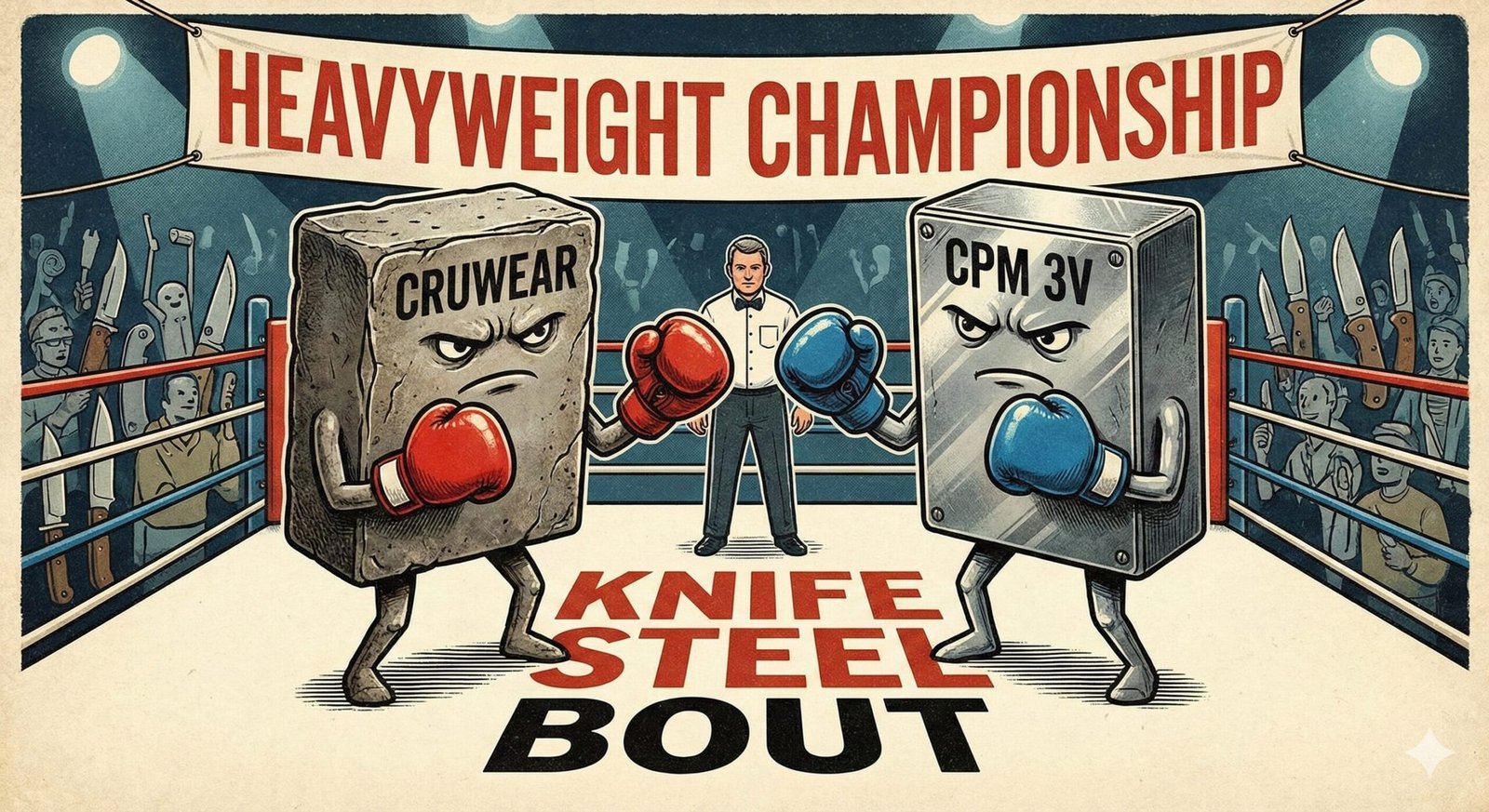
CruWear vs. CPM 3V: The Heavyweight Championship
Introduction: The Titans of Toughness
If you are looking for a knife to slice tomatoes, these steels are overkill. If you are looking for a knife to chop down a tree, pry open a crate, or survive the apocalypse, you have arrived at the right place.
CPM CruWear and CPM 3V are the kings of the “Hard Use” category. They are powder metallurgy tool steels designed to withstand impact that would shatter stainless steels like VG10 or S30V. But while they share a reputation for being unbreakable, they achieve it in very different ways.
Understanding where they fit in the broader market helps—compare them to the stainless super steels like MagnaCut to see the trade-off between toughness and corrosion resistance.
This guide goes well beyond the basic chemistry chart. We will walk through how each steel is actually heat treated in production knives, what independent CATRA lab testing shows about real edge retention, how each alloy compares to other tool steels like D2, M4, and MagnaCut, which specific use cases favor which steel, how owners describe long-term performance in the field, and a practical buying checklist so you can make a confident decision regardless of whether you are shopping for a folder, a fixed blade, or your first “premium” tool steel knife.
The Contenders
CPM 3V
Produced by Crucible Industries, 3V is legendary among bushcrafters and fixed-blade enthusiasts. It was engineered to provide maximum resistance to breakage and chipping. It is widely considered the benchmark for “Super Tough” steel.
CPM CruWear
Also from Crucible, CruWear is an air-hardening tool steel that is essentially an upgrade to the classic D2 (often compared in our D2 vs 8Cr13MoV guide). It offers a unique balance: it is almost as tough as 3V but holds an edge significantly longer.
Both steels belong to the same broad family sometimes called “high-vanadium air-hardening tool steels,” which distinguishes them from oil-hardening steels like O1 or water-hardening carbon steels like 1095. Air-hardening means the steel can reach full hardness during heat treatment with a relatively gentle cooling process, which reduces the risk of warping or cracking during production — a meaningful advantage for makers working with thin folding-knife stock. This shared manufacturing category is part of why both steels show up so often on the same “premium hard-use” shortlist, even though their end performance characteristics diverge once you get into the details.
Chemistry: Vanadium vs. Tungsten
The magic lies in the carbide structure.
| Element | CPM CruWear | CPM 3V | Effect |
|---|---|---|---|
| Carbon | 1.10% | 0.80% | Hardness |
| Chromium | 7.50% | 7.50% | Corrosion Resistance |
| Vanadium | 2.40% | 2.75% | Grain Refinement / Toughness |
| Tungsten | 1.15% | – | Wear Resistance |
| Molybdenum | 1.60% | 1.30% | Hardenability |
The Takeaway: CruWear uses Tungsten and higher Carbon to achieve higher hardness (63-65 HRC). 3V keeps carbon lower to maximize impact shock resistance.
Why Powder Metallurgy Matters Here
Both steels are made using Crucible’s proprietary CPM (Crucible Particle Metallurgy) process rather than conventional ingot casting. In conventional steelmaking, molten metal cools slowly, which allows carbides to grow large and clump together unevenly throughout the matrix. Those large, unevenly distributed carbides act like fault lines: they are prone to being pulled out of the matrix during use (reducing wear resistance) and they concentrate stress in ways that promote cracking (reducing toughness). The CPM process instead atomizes molten steel into a fine powder that solidifies almost instantly, then compacts and sinters that powder under heat and pressure. The result is a far finer, far more evenly distributed carbide structure. This is the real secret behind why both CruWear and 3V dramatically outperform older ingot-cast tool steels of similar chemistry, like standard D2 or O1, in toughness testing.
The Role of Vanadium in Both Alloys
Vanadium deserves special attention because it is doing double duty in both steels. At a chemistry level, vanadium forms extremely hard vanadium carbides that boost wear resistance, but vanadium also acts as a powerful grain refiner during heat treatment, keeping the steel’s crystal structure fine and uniform even at high austenitizing temperatures. This grain-refining effect is a major contributor to toughness, not just wear resistance, which is part of why 3V — despite having slightly more vanadium than CruWear — manages to be both tough and reasonably wear resistant rather than one at the expense of the other.
Toughness: The 3V Stronghold
Toughness is the ability to absorb energy before fracturing. In standardized Charpy C-Notch testing, CPM 3V is nearly off the charts.
Winner: CPM 3V. If you plan on batoning wood, chopping through ice, or abusing your knife as a pry bar, 3V is the safest choice. CruWear is incredibly tough—tougher than almost any stainless steel—but 3V is in a league of its own.
Edge Retention: CruWear Strikes Back
This is where CruWear shines. Because it can be heat-treated to a higher hardness (often 64-65 HRC) without becoming brittle, and because it contains tungsten carbides, it cuts for a very long time.
Winner: CruWear. It holds an edge significantly longer than 3V. While 3V is tough, it is “softer” (usually 60-61 HRC) and tends to roll its edge rather than chip. CruWear stays crisp and sharp through extended cardboard or rope cutting tests.
Because CruWear runs hard, you will need good equipment to maintain it. Check our guide on knife sharpeners for diamond-based recommendations.

A tank of a folding knife. Benchmade runs their CruWear hard (63-65 HRC), giving this knife incredible edge retention while retaining enough toughness for tactical use.
Check Price on AmazonCorrosion Resistance: The Patina Factor
Winner: Tie (CruWear slightly better). Both are “semi-stainless.” They will not rust overnight like 1095, but if you leave them wet or cut fruit without cleaning them, they will stain and eventually pit. CruWear seems to resist pitting slightly better in salt spray tests, but both require oil and care.
Cold Weather and Temperature Performance
Toughness in tool steels is temperature-sensitive: as ambient temperature drops, most steels become more brittle and more prone to fracture, which matters a great deal for anyone using these knives outdoors in winter conditions. 3V was specifically engineered with impact resistance as the top priority, and that toughness margin translates into a wider safety buffer in cold weather compared to most alloys, including CruWear. Bushcrafters and hunters who work in genuinely cold climates — well below freezing — often report a noticeable preference for 3V specifically because it seems to retain more of its toughness at low temperatures than harder, more wear-focused steels. CruWear still performs respectably in cold conditions, but its higher hardness means slightly less margin against a cold, brittle failure under a hard baton strike compared to 3V run at its typical, softer HRC range.
Humid and Coastal Environments
In humid or coastal environments, where salt air accelerates corrosion regardless of which semi-stainless tool steel you choose, the maintenance routine matters far more than the small chemistry difference between these two alloys. Owners in these climates should plan on daily wipe-downs and more frequent oiling than someone using the same knife in a dry inland climate, and should strongly consider a dedicated rust-preventative oil rather than general-purpose household oil for long-term storage.

If you need a fixed blade for hunting or survival that simply will not break, the DLC-coated 3V Master Hunter is an industry standard.
Check Price on AmazonBlade Geometry: The Variable Steel Charts Ignore
No discussion of steel performance is complete without addressing grind and geometry, because a thin, well-ground blade in a “weaker” steel will often outperform a thick, poorly-ground blade in a “stronger” steel for actual cutting tasks.
How Geometry Interacts With CruWear
Because CruWear can be run hard without becoming brittle, makers can afford to grind it relatively thin behind the edge, which improves slicing performance without sacrificing much edge stability. This is part of why CruWear performs so well in folder applications where thin, efficient grinds are valued for everyday cutting tasks like breaking down boxes or slicing rope.
How Geometry Interacts With 3V
3V’s toughness gives makers room to grind fixed blades with slightly more aggressive convex or high-flat grinds intended for chopping and batoning, without worrying as much about edge chipping under lateral stress. A thick, robust 3V blade with a modest edge angle can survive abuse that would destroy a thin, acutely ground blade in almost any other steel, stainless or not.
Matching Geometry to Steel Choice
When comparing two knives, always check the stated edge angle and blade stock thickness alongside the steel name. A 3V knife ground unusually thin for slicing performance will give up some of its toughness advantage, while a CruWear blade ground unusually thick for chopping will give up some of its slicing efficiency without gaining much extra durability, since CruWear was never meant to compete with 3V on outright impact resistance in the first place.
Final Verdict: Which is Better?
Choose CPM 3V If:
- You are buying a Fixed Blade or Chopper.
- Your priority is 100% Impact Toughness (survival, bushcraft).
- You prefer an edge that rolls/dents rather than chips (easier to fix in the field).
Choose CPM CruWear If:
- You are buying a Folding Knife (like the Benchmade Osborne series).
- You want better edge retention than 3V but far more toughness than stainless.
- You want a steel that is surprisingly easy to sharpen despite its hardness.
Origins & Development: How These Steels Were Born
To really understand why CruWear and 3V behave the way they do under a grinder, it helps to know where they came from. Neither steel was designed with pocket knives in mind. Both were born in industrial tooling, and their knife-world reputations are really a side effect of metallurgists solving completely different manufacturing problems decades apart.
3V: Built to Survive Industrial Punch Presses
CPM 3V was developed by Crucible Industries specifically for cold-work tooling applications where dies and punches were failing catastrophically from chipping and cracking, not from wearing out. Crucible’s metallurgists needed a die steel that could absorb repeated, violent impact cycles in a stamping press without fracturing, even when the wear resistance of the alloy was only moderate. The result was a steel that intentionally sacrifices some carbide volume in exchange for a incredibly clean, fine-grained matrix that resists crack propagation. In the industrial world, 3V is still specified for blanking dies, punches, and forming tools that see shock loading. It only migrated into the knife world once bushcraft and survival knife makers realized that a steel designed to never crack under a hydraulic press was, unsurprisingly, also very hard to break with a baton and a piece of oak.
CruWear: The Powder Metallurgy Heir to D2
CruWear has a longer and slightly more tangled lineage. Its direct ancestor is an ingot steel called Cru-Wear that Crucible sold for decades as a tougher alternative to D2 in cutting tools, punches, and blanking dies where D2’s brittleness was causing premature failures. When Crucible later re-released the alloy using their Crucible Particle Metallurgy (CPM) process, the resulting “CPM CruWear” gained a dramatically finer and more uniform carbide structure than the original ingot version. That refinement is what pushed its toughness up close to 3V territory while preserving the high wear resistance that made the original Cru-Wear popular for industrial cutting tools in the first place. Knife makers such as Bark River and, later, Spyderco and Benchmade adopted CPM CruWear because it offered something D2 never could: genuinely good toughness alongside genuinely good edge retention, without the corrosion resistance (and softer performance) of typical stainless offerings.
It is worth noting these two alloys were never designed to compete with each other directly. They ended up side by side on knife spec sheets because knife makers went looking for tough, non-stainless, high-performance steels and found two very different industrial answers to a similar underlying problem: how do you keep a tool steel from failing under repeated stress.
Heat Treatment and Achievable Hardness (HRC)
Steel chemistry only tells half the story. How a manufacturer heat-treats CruWear or 3V has an enormous effect on where that particular blade lands on the toughness-versus-edge-retention spectrum. This is one of the most misunderstood aspects of the CruWear vs 3V debate, and it explains why two knives in the “same” steel can feel completely different in use.
Typical CruWear Hardness Ranges
Most production knife makers run CPM CruWear somewhere between 61 and 65 HRC. Benchmade, for example, is known for pushing their CruWear blades toward the top of that range, often landing around 63-64 HRC, which maximizes edge retention and wear resistance at a small cost to outright toughness. Custom makers who want a more forgiving, harder-use blade sometimes back the hardness off closer to 60-61 HRC, trading a bit of edge holding for extra margin against chipping.
Typical 3V Hardness Ranges
CPM 3V is almost always run softer than CruWear, typically in the 58-61 HRC window. This is not a limitation of the steel; it is a deliberate choice. Because 3V’s whole reason for existing is maximizing toughness, pushing it too hard sacrifices the very property that makes it special. Some fixed-blade makers, particularly in the bushcraft and survival space, intentionally run 3V on the lower end of that range (around 58-59 HRC) for maximum shock absorption in batoning and prying tasks.
| Property | CPM CruWear | CPM 3V |
|---|---|---|
| Common Production HRC | 61-65 HRC | 58-61 HRC |
| Tempering Behavior | Wide, forgiving tempering window | Narrower window, more sensitive to cycle |
| Recommended Cryo Treatment | Beneficial, not always required | Strongly recommended for full properties |
| Grain Refinement Response | Excellent, responds well to double tempering | Excellent, sensitive to austenitizing temperature |
One practical takeaway: when you are comparing two knives on paper and one lists “CruWear” while the other lists “3V,” the actual heat treat recipe used by that specific manufacturer matters as much as the alloy name on the spec sheet. A poorly heat-treated CruWear blade run too soft will underperform a well heat-treated 3V blade in edge retention, and vice versa for toughness. Always check maker-specific reviews rather than assuming generic steel-chart numbers apply universally.
CATRA Testing: What The Lab Data Actually Shows
CATRA (Cutlery and Allied Trades Research Association) testing is the closest thing the knife industry has to a standardized edge retention benchmark. It measures how many strokes of a fixed-geometry blade it takes to cut through a specific abrasive medium before the edge stops cutting effectively.
In independent CATRA-style comparisons, CruWear consistently rates as “Very Good” for edge retention, outperforming 3V, which typically rates “Good.” This tracks with the chemistry: CruWear’s higher carbon content combined with its tungsten and vanadium carbides simply gives it more abrasion-resistant particles embedded in the matrix. On toughness testing (typically Charpy C-notch impact testing rather than CATRA), the relationship flips: 3V posts “Very Good” toughness scores that slightly edge out CruWear’s “Good” rating, driven by 3V’s lower carbon content and more favorable vanadium-to-chromium carbide ratio.
It is important to read these lab numbers with the right context. The gap between the two steels in CATRA testing is not enormous — both are firmly in the upper tier of tool steels for edge holding, well above budget stainless steels like 8Cr13MoV or even mid-tier steels like 154CM. The practical difference most owners notice in daily use is smaller than the difference between either of these steels and a cheap stainless blade.
One nuance worth flagging: powder metallurgy is what allows 3V to hit its toughness numbers without sacrificing wear resistance the way an ingot-cast steel of similar chemistry would. The CPM process produces fine, evenly distributed vanadium carbides (roughly 5% by volume) instead of the larger, unevenly distributed carbides you would get from conventional casting. That microstructural refinement is a big part of why 3V can be both extremely tough and still respectably wear resistant, rather than tough at the expense of everything else.
How CruWear and 3V Compare to Other Tool Steels
CruWear and 3V do not exist in a vacuum. Both are frequently cross-shopped against other high-performance tool steels, and understanding those comparisons helps place this matchup in context.
CruWear vs. D2
D2 is often called a “semi-stainless tool steel” and was, for a long time, the default choice for hard-use folders before CPM CruWear arrived. CruWear is essentially what D2 wanted to be: similar chromium content (so similarly modest corrosion resistance) but with dramatically better toughness thanks to the CPM manufacturing process and the addition of tungsten and molybdenum. If you currently own a D2 knife and are wondering whether to upgrade, CruWear is a straightforward step up in nearly every measurable category except cost. We cover this comparison in more detail in our D2 vs 8Cr13MoV guide.
3V vs. M4
CPM M4 is another Crucible powder steel that trades blows with 3V, but in the opposite direction from CruWear: M4 leans hard into wear resistance and edge retention (thanks to a high carbon and vanadium content) at the cost of both toughness and corrosion resistance. If CruWear is the “balanced middle ground” and 3V is the “toughness extreme,” M4 represents the “wear resistance extreme” of this same family of non-stainless tool steels. M4 also tends to need more frequent oiling than either CruWear or 3V, since it has essentially no chromium for corrosion resistance.
CruWear/3V vs. MagnaCut and Modern Stainless Super Steels
The newest generation of powder-metallurgy stainless steels, led by CPM MagnaCut, has narrowed the gap that used to separate “tough non-stainless tool steels” from “wear-resistant stainless super steels.” MagnaCut in particular was engineered specifically to combine high toughness, strong wear resistance, and genuine stainless-grade corrosion resistance in one alloy. It does not quite match 3V’s outright toughness ceiling, and it does not quite match CruWear’s edge retention at very high hardness, but it eliminates the corrosion downside entirely. For buyers who are torn between CruWear/3V toughness and worry-free maintenance, MagnaCut is worth cross-shopping. Our MagnaCut vs M390 comparison goes into that trade-off in depth.
CruWear vs. S45VN and Other Balanced Stainless Steels
Buyers who want a folder that lives in a pocket every day, gets exposed to sweat and humidity, but still want strong all-around performance often compare CruWear to newer balanced stainless steels like S45VN or 20CV. These steels will never match CruWear’s toughness ceiling, but they close most of the edge retention gap while adding genuine stainless-grade corrosion resistance, which matters a great deal for anyone who does not want to think about oiling their blade.
Best Steel By Use Case
Rather than asking “which steel is better” in the abstract, it is far more useful to ask which steel is better for what you are actually going to do with the knife. Here is how CruWear and 3V stack up across the most common use cases knife buyers search for.
Everyday Carry (EDC) Folding Knives
For a pocket knife you will use dozens of times a day on envelopes, boxes, food packaging, and the occasional light chore, CruWear is generally the better fit. Its superior edge retention means fewer touch-ups between sharpening sessions, and its toughness is already far beyond what a typical EDC task requires. 3V’s extreme toughness is simply overkill for a folder that will rarely see anything close to a survival-knife workload.
Bushcraft and Survival Fixed Blades
This is 3V’s home turf. Batoning wood, feathering kindling in cold weather, and occasional prying are exactly the abuse scenarios 3V was engineered to survive without chipping or snapping. A bushcraft knife that spends its life being hit with another piece of wood benefits far more from maximum toughness than from maximum edge retention, since a rolled edge is a five-minute strop fix in the field while a broken tip can end a trip.
Hunting Knives
Hunting sits in a middle ground. A caping or skinning knife that mostly does controlled, precise cutting on soft tissue benefits from CruWear’s edge retention, since you want to process an animal without constantly re-sharpening. A larger hunting/camp knife that might also see wood processing or light batoning leans toward 3V for the extra impact margin. Many hunters carry one of each.
Tactical and Duty Knives
Tactical folders and fixed blades that need to survive worst-case abuse — prying, striking, unpredictable impact — generally favor toughness over edge retention, which tilts the scale toward 3V for pure fixed-blade tactical use. That said, popular tactical folders like the Benchmade Adamas line run CruWear specifically because a folding mechanism already limits how much prying abuse is realistic, making CruWear’s edge retention advantage more valuable in that format.
Kitchen and Food Prep
Neither steel is a natural fit for kitchen use. Both are semi-stainless and will stain or pit if left wet or in contact with acidic food for extended periods, and neither is designed for the thin, acute edge geometry that kitchen knives typically use. If food prep is a priority, look toward genuinely stainless steels instead.
Fishing and Outdoor Utility
Fishing knives face a different challenge than either steel was built for: constant exposure to salt water and fish oils rather than impact stress. In this environment, CruWear’s slightly better corrosion resistance gives it a small edge over 3V, but honestly both alloys will require more diligent freshwater rinsing and oiling than a true stainless fillet knife. Anglers who fish primarily in freshwater and simply want a durable multi-purpose blade for cutting line, cleaning small catches, and general camp tasks will find either steel more than capable, provided it gets wiped down and oiled after each outing.
Collectible and Enthusiast Purchases
For steel collectors and knife enthusiasts building out a rotation of different alloys to compare firsthand, owning both a CruWear and a 3V knife is a common and worthwhile pairing precisely because they represent opposite ends of the same toughness-vs-edge-retention spectrum within the non-stainless tool steel family. Spyderco’s Mule Team series, mentioned above, is a popular way to do this comparison on genuinely identical blade geometry.
Common Myths About CruWear and 3V
Because both steels have passionate fan bases in online knife communities, a few persistent myths tend to circulate. It is worth addressing them directly.
Myth: “3V Never Chips”
3V dramatically reduces the likelihood of chipping compared to most stainless steels, but it is not immune to it, especially at higher hardness or with a poor heat treat. Extreme lateral stress, striking a blade edge-first into a hard surface like rock or metal, or a rushed heat treatment can still cause 3V to chip. “Very tough” does not mean “indestructible.”
Myth: “CruWear Is Basically a Stainless Steel”
At 7.5% chromium, CruWear sits well below the roughly 13% threshold generally required to call a steel stainless. It will develop surface rust and pitting if neglected, particularly in humid climates or coastal environments. Treat it like a semi-stainless tool steel, not a true stainless one.
Myth: “Higher HRC Always Means a Better Knife”
Hardness alone does not determine knife quality. A CruWear blade pushed too hard without a matching heat treatment can become brittle despite the alloy’s inherent toughness advantages, and a 3V blade run too soft can lose the wear resistance it needs to hold a working edge. The full heat treatment recipe, not just the peak HRC number on a spec sheet, determines real-world performance.
Myth: “These Steels Are Interchangeable in Any Knife Design”
Blade geometry interacts heavily with steel choice. A thin, acutely ground CruWear folder optimized for slicing will behave very differently from a thick, robustly ground 3V chopper, even before accounting for the steel itself. Comparing two knives purely by steel name while ignoring grind and thickness is one of the most common mistakes buyers make when researching a purchase.
Maintenance and Patina Guide
Since neither steel is fully stainless, ongoing care matters more than it would with a chromium-rich stainless blade. Both alloys sit at roughly 7.5% chromium, well below the ~13% threshold generally needed to call a steel “stainless,” which places them in the “semi-stainless” category alongside D2 and similar tool steels.
Daily Care
Wipe the blade dry after use, especially after cutting acidic foods, exposure to salt air, or extended contact with moisture. A light coat of mineral oil or a dedicated knife oil on the blade before storage significantly reduces staining and pitting risk for both steels. CruWear has shown a slight edge in salt-spray corrosion testing compared to 3V, but the difference is small enough that maintenance habits matter more than the alloy choice.
Understanding Patina Development
Both steels can develop a gray-blue patina over time with repeated use and cleaning, similar to (though less dramatic than) high-carbon steels like 1095. Many users intentionally force an even patina using diluted vinegar or mustard, which creates a protective oxide layer that actually helps guard against deeper, uglier pitting corrosion. This is optional, purely cosmetic in most cases, and does not affect performance.
Long-Term Storage
If a knife in either steel will be stored for an extended period, avoid leather sheaths for direct blade contact, since leather can trap moisture and accelerate corrosion. A lightly oiled blade stored in a dry environment, ideally wrapped in a silicone-treated cloth or stored in a kydex sheath rather than leather, will hold up far better long-term.
Notable Production Knife Models
Both steels have found homes in well-regarded production knives from major manufacturers, which is often the easiest way for buyers to try either alloy without going the custom-maker route.
Popular CruWear Models
- Benchmade Mini Adamas / Adamas — tactical folders running CruWear hard for maximum edge retention.
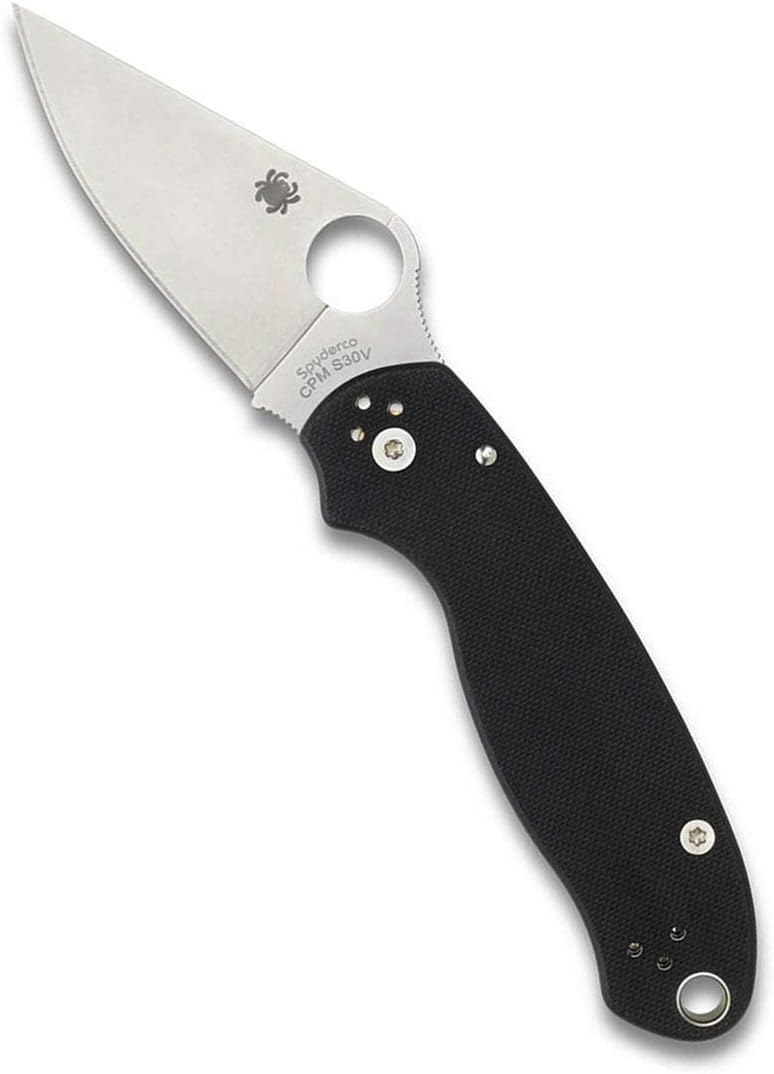
- Spyderco Paramilitary 2 (CruWear versions) — a fan-favorite limited release prized for its balance of toughness and edge holding.
- Spyderco Manix 2, Military, and Shaman (CruWear versions) — recurring limited runs across Spyderco’s core lineup.
- Bark River fixed blades in Cru-Wear — one of the earliest adopters of the steel in production fixed blades.
Popular 3V Models
- Cold Steel Master Hunter and SR-series — fixed blades built specifically around 3V’s impact resistance.
- Bark River 3V fixed blades — a large catalogue of bushcraft and survival knives offered in 3V.
- ESEE and custom bushcraft makers — 3V is a common premium upgrade option over their standard carbon steel offerings.
Spyderco’s Mule Team project is also worth knowing about for steel enthusiasts: it produces identical fixed-blade knives in a rotating cast of different steels, including both CruWear and 3V, specifically so that enthusiasts can compare alloys on a level playing field without geometry or heat-treat differences muddying the results.
What Owners Actually Report in the Field
Beyond lab numbers, it is worth looking at what long-term owners of both steels report after months or years of real use, since forum and community discussion often surfaces nuances that spec sheets miss entirely.
CruWear Owner Feedback
Owners of CruWear knives, particularly folders like the Benchmade Adamas line and Spyderco’s various CruWear releases, consistently report that the steel holds a working edge noticeably longer than typical stainless offerings under daily EDC tasks like breaking down cardboard, opening mail, and light whittling. A recurring theme is that CruWear “feels” harder on the stone than its HRC number might suggest, but that once sharpened, it stays sharp longer than most users expect from a non-super-steel. Some owners who have compared CruWear and 3V side by side in similar knife models note that CruWear’s edge, when it does eventually dull, tends to go gradually and predictably rather than suddenly, which many EDC users find preferable to steels that seem sharp one day and noticeably dull the next.
3V Owner Feedback
3V owners, especially those running fixed blades for bushcraft, hunting, and general outdoor use, frequently comment on how difficult the steel is to actually damage. Reports of chipped or cracked edges in 3V knives are rare even among users who deliberately abuse test their blades by batoning knotty wood or prying stuck objects. The trade-off users report most often is that 3V’s edge will roll or “dent” microscopically under hard use well before it would ever chip, but that this rolled edge is trivially easy to fix with a few strokes on a strop or fine stone in the field, without needing a full resharpening session. Several long-time bushcraft users specifically prefer this failure mode over a steel that holds a perfect edge until it suddenly chips, since a rolled edge is far less disruptive mid-task.
Direct Side-By-Side Comparisons
Enthusiasts who own comparable knife models in both steels — for example, a Spyderco Manix 2 or Shaman in CruWear alongside a similar knife in 3V — tend to describe the practical difference as smaller than the spec sheets imply for typical daily tasks, but clearly noticeable once you push into harder use. For light-to-moderate cutting, most owners say they would struggle to tell the steels apart blind. It is only once you introduce impact, prying, or extended abrasive cutting that the two alloys’ different design philosophies become obvious.
Buying Guide: Questions to Ask Before You Choose
If you are still undecided between a CruWear and a 3V knife, working through the following questions in order will usually surface a clear answer.
1. What is the primary task?
If the knife’s main job is repeated, controlled cutting — opening boxes, food prep, general utility — prioritize CruWear’s edge retention. If the knife’s main job involves any realistic chance of impact, prying, or batoning, prioritize 3V’s toughness.
2. Folder or fixed blade?
Folding knife locks are rarely rated for serious prying regardless of blade steel, which somewhat reduces the practical value of 3V’s toughness advantage in a folder format. This is part of why CruWear dominates the folder market while 3V dominates the fixed-blade market.
3. How disciplined are you about maintenance?
Neither steel is stainless. If you know you will not reliably oil and dry the blade after wet use, both steels carry corrosion risk, and you may want to weigh a modern stainless super steel like MagnaCut instead, even if it means giving up some toughness or edge retention.
4. What hardness does the specific knife use?
Do not assume a generic steel chart applies to every knife. Check the manufacturer’s published HRC for that specific model. A softer-than-typical CruWear blade will lose some of its edge retention advantage, and a harder-than-typical 3V blade will lose some of its toughness advantage.
5. What is your sharpening setup?
Both steels reward diamond abrasives and punish cheap oil stones. If you are not prepared to invest in at least a basic diamond sharpening system, either steel will be a frustrating ownership experience regardless of which one you pick.
Quick Decision Checklist
- Need a hard-use fixed blade for wood processing or survival tasks → 3V
- Need a daily-carry folder that holds an edge through heavy use → CruWear
- Worried about rust and want minimal maintenance → consider a stainless super steel instead
- Own a diamond sharpening system already → either steel will reward the investment
- Want maximum resistance to chipping under impact → 3V
- Want the longest stretch between sharpenings on a pocket knife → CruWear
Price and Value Analysis
Both steels command a premium over basic stainless offerings like 8Cr13MoV or 420HC, and a smaller premium over mid-tier steels like 154CM or VG-10. Pricing is driven less by the raw steel cost and more by the CPM manufacturing process, which is more expensive than conventional steelmaking, plus the more demanding heat treatment both alloys require to reach their full potential.
In practice, CruWear and 3V tend to land in a similar price bracket when comparing knives of similar size, handle materials, and brand tier. Neither should be considered dramatically more expensive than the other purely because of the steel choice; differences in retail price between specific models are usually driven by handle materials, country of manufacture, and brand positioning rather than the steel itself.
For buyers trying to maximize value, the more important question is usage-fit rather than price: buying a 3V fixed blade for light EDC tasks wastes the steel’s toughness advantage, while buying a CruWear folder for heavy batoning wastes money on edge retention you will not fully use before the tip potentially fails under stress it was never designed to handle. Match the steel to the job, and both alloys deliver excellent value for a premium tool steel.
Expert FAQs
It can rust, but not easily. It has 7.5% chromium, which puts it in the “semi-stainless” category. It resists rust much better than D2 or M4, but not as well as S30V or MagnaCut. Keep it oiled.
It can be. Because 3V is so tough, the “burr” can be stubborn and hard to remove (it’s gummy). It doesn’t grind away easily. Diamond stones are highly recommended for sharpening 3V.
CruWear offers the perfect balance for a pocket knife: it holds an edge for a long time (like a super steel) but is tough enough to handle prying or accidental impacts that would snap a brittle stainless blade.
For CruWear, look for 61-65 HRC; most quality production knives land around 63-64 HRC. For 3V, look for 58-61 HRC. If a knife runs noticeably outside these ranges, ask the maker why, since it usually signals a deliberate trade-off toward extra toughness or extra hardness.
3V is generally the better choice for a dedicated survival or bushcraft fixed blade because its toughness ceiling gives you the widest safety margin against chipping or breaking during batoning and prying tasks in the field.
Technically yes, but neither is ideal. Both are semi-stainless and will stain or pit with regular exposure to acidic foods and moisture, and neither is typically ground to the thin kitchen-knife geometry that makes food prep effortless.
3V benefits strongly from a cryogenic treatment step to fully convert retained austenite and reach its published toughness numbers, and most reputable makers include it. CruWear also benefits from cryo treatment but is somewhat more forgiving without it.
CruWear can be thought of as an upgraded D2. It shares similar chromium content and corrosion behavior but offers meaningfully better toughness thanks to the CPM manufacturing process and added tungsten and molybdenum.