Quick Answer: What’s the Best Way to Remove Rust from a Knife?
For most kitchen knives with light to moderate rust, a baking soda paste is the best first approach — it’s safe for all steel types, won’t over-etch the blade, and requires nothing more than pantry staples and five minutes. For stubborn or moderate rust, a short white vinegar soak (5–20 minutes) combined with a non-metallic scrubber will dissolve iron oxide quickly. For very light surface rust spots, a dedicated rust eraser is the fastest solution available — two or three passes and the rust is simply gone.
The method you choose should depend on three things: how severe the rust is, what type of steel your knife is made from, and what tools and products you have available. This guide covers all the realistic options, ranked honestly, with specific instructions for each.
Why Knives Rust: The Science in Plain Language
Rust is iron oxide — a compound formed when iron in the steel reacts with oxygen in the presence of moisture. The chemical shorthand is 4Fe + 3O₂ + 6H₂O → 4Fe(OH)₃, which eventually dehydrates to the familiar red-brown Fe₂O₃ we recognize as rust. The reaction is electrochemical, meaning it’s driven by the flow of electrons between different areas of the metal surface — which is why even a microscopic scratch can become a rust nucleation point if the conditions are right.
Why Some Knives Rust Faster Than Others
The key variable is chromium content. When steel contains 13% or more chromium by mass, the chromium preferentially oxidizes before the iron, forming a microscopically thin, transparent layer of chromium oxide on the surface. This passive layer is self-repairing — if you scratch it, it reforms in contact with air. Steels with this level of chromium are called “stainless,” though none are truly rust-proof, just rust-resistant.
High-carbon steels used in many traditional Japanese knives — blue paper steel (Aogami), white paper steel (Shirogami), and similar alloys — contain little to no chromium. They rust extremely readily, sometimes within minutes of exposure to moisture. This is the trade-off for their exceptional sharpness and edge retention: extraordinary cutting performance paired with high maintenance requirements. Understanding these trade-offs matters when you’re choosing knives — a comparison like stainless vs. carbon steel for rust risk and edge retention gives the full picture.
Kitchen Rust Triggers
- Leaving knives wet after washing — the single biggest cause
- Dishwasher use — prolonged exposure to steam, harsh detergents, and heat damages the passive layer on stainless and rapidly corrodes carbon steel
- Storing in a wet environment — inside a damp knife block, a wet drawer, or in a cloth roll that wasn’t dried
- Cutting acidic foods — citrus, tomatoes, onions, and vinegar-based dishes accelerate corrosion; rinse the blade promptly after
- Salty environments — salt (NaCl) dramatically accelerates the electrochemical corrosion process
- Scratched or damaged surface coatings — once the passive layer is breached, corrosion spreads laterally underneath
Assess Your Rust Severity Before Choosing a Method
Not all rust is the same. Choosing the right method starts with an honest assessment of what you’re dealing with. Here’s how to read the severity scale:
| Severity | What You See | Best Method | Salvageable? |
|---|---|---|---|
| Level 1 | Light discoloration, slight dullness | Rust eraser or baking soda paste | Completely |
| Level 2 | Orange-brown spots, no texture change | Baking soda paste or 10-min vinegar soak | Completely |
| Level 3 | Widespread rust, rough texture when touched | Vinegar soak + steel wool scrub | Yes, with effort |
| Level 4 | Visible pits, flaking, orange powder | Commercial rust remover or wet sanding | Mostly — pits remain |
| Level 5 | Blade thinned, structural weakness | Power tools + re-grind, or retire the knife | Partially — judge carefully |
All Rust Removal Methods at a Glance
Here’s an honest overview of every practical method, with an effectiveness rating and a quick verdict before we dive into detailed instructions for each.
Baking Soda Paste
Safe for all steel types. No over-etching risk. Works on all rust levels when combined with scrubbing.
Rust Eraser
Removes light–moderate rust in seconds. Minimal effort, zero chemistry. Requires purchasing the eraser.
White Vinegar Soak
Very effective but must be timed carefully. Don’t exceed 30 min on carbon steel or etching will occur.
Steel Wool (0000)
Pure mechanical removal. Works on any rust, but may scratch polished finishes. Very fine grade required.
Lemon + Salt
Pantry method using citric acid. Works on light rust. Not suitable for extended contact with premium steel.
Potato (Oxalic Acid)
Very gentle — best for light rust only. Works slowly overnight. Safe for all steel types including delicate finishes.
Commercial Rust Remover
Products like Flitz, Bar Keepers Friend, or naval jelly for serious rust. Follow instructions carefully.
Power Tools
Wire wheel or flap disc removes severe rust but alters blade geometry. Only for heavily rusted blades.
Method 1: Baking Soda Paste — The Safest All-Purpose Approach
Baking soda (sodium bicarbonate) works through two mechanisms simultaneously: its mild alkalinity helps break down the iron oxide compound, and its fine crystalline particles provide gentle mechanical abrasion that lifts loosened rust from the surface. It’s the only common household rust treatment that is genuinely safe for all steel types without any time-limit risk — you can’t over-treat with baking soda paste.
What You Need
- Baking soda (2–3 tablespoons)
- Water (a few drops to make a thick paste)
- A cork, soft-bristle toothbrush, or non-metallic scrubber
- A clean cloth for wiping
- Food-grade mineral oil for finishing
- Mix a thick pasteCombine baking soda with just enough water to form a paste the consistency of toothpaste. Too watery and it won’t cling to vertical surfaces; too dry and it won’t spread. A squeeze of lemon juice in place of water provides a slight acid boost for stubborn rust.
- Apply generously to the rusted areasUse your fingers or a soft brush to apply a thick coat of paste to all rusted surfaces. For spots, a cotton swab gives precision. Make sure the paste covers the rust completely with some margin around it.
- Let it sit for 15–30 minutesThis dwell time allows the alkalinity to begin breaking down the iron oxide. For light surface rust, 15 minutes is enough. For Level 3 rust with visible texture, 30–45 minutes will improve results significantly.
- Scrub in the direction of the grainUsing a cork, soft brass brush, or folded 400-grit wet/dry sandpaper, scrub along the length of the blade (with the grain of the steel, not across it). Apply moderate pressure. You should see rust-colored paste coming off the blade — that’s the iron oxide being removed.
- Rinse thoroughly and inspectRinse with warm water and dry immediately. Inspect the blade — if rust remains, repeat the process. Particularly stubborn rust may require 2–3 cycles of paste and scrubbing.
- Dry completely and oil the bladeAfter all rust is removed, dry the blade with a clean cloth and immediately apply a thin film of food-grade mineral oil or camellia oil. This fills the micro-pores in the steel surface and creates a barrier against future moisture contact.
✅ Advantages
- Safe for all steel types
- No timing risk — can’t over-treat
- Inexpensive, always available
- No harsh chemical fumes
- Works on all rust severity levels with patience
⚠️ Limitations
- Slower than acid methods
- Requires active scrubbing effort
- May need multiple passes for heavy rust
- Slight abrasion may dull mirror finishes
What You’ll Need for This Method
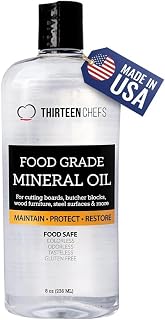
Food-Grade Mineral Oil, 16 oz

Non-Scratch Scrub Sponges (6-Pack)
Method 2: White Vinegar Soak — Effective but Requires Timing
White distilled vinegar contains 5% acetic acid, which reacts directly with iron oxide (Fe₂O₃ + 6CH₃COOH → 2Fe(CH₃COO)₃ + 3H₂O) to dissolve rust into solution. It’s significantly faster than baking soda and requires less scrubbing — particularly useful for uniform surface rust across a large blade area. The critical caveat is timing: acetic acid doesn’t distinguish between rust and bare steel, so leaving a blade submerged too long will begin etching the metal itself, creating a rough, matte surface that’s difficult to reverse.
Timing Guidelines by Steel Type
| Steel Type | Maximum Soak Time | Notes |
|---|---|---|
| High-carbon steel (Aogami, Shirogami) | 5–15 minutes | Extremely sensitive — check every 5 min |
| Semi-stainless (VG-10, AUS-10) | 15–20 minutes | Monitor closely after 15 min |
| German stainless (X50CrMoV15) | 20–30 minutes | Most forgiving; stop when rust dissolves |
| Budget stainless (420HC, 8Cr13MoV) | 15–25 minutes | Watch for patchy etching on blade faces |
- Fill a container just deep enough to submerge the bladeUse a dish or tray — you only need to cover the blade, not the handle. Submersing a wooden or composite handle in vinegar will damage it.
- Submerge and set a timerStart conservatively — 10 minutes for stainless, 5 minutes for carbon steel. You can always soak longer, but you can’t un-etch an over-soaked blade.
- Remove and scrub while wetDon’t let the vinegar dry on the blade — it leaves residue and continues etching. While still wet, scrub with a non-metallic scrubber (nylon pad or cork) to lift loosened rust. The rust should come away easily with light pressure.
- Neutralize with baking soda solutionThis is a step many guides skip but shouldn’t: rinse the blade with a dilute baking soda solution (1 tablespoon per cup of water) to neutralize any remaining acid. Then rinse with clean water.
- Dry and oil immediatelyVinegar strips the passive layer and leaves bare metal highly vulnerable to flash rusting — new rust can appear within minutes if the blade is left wet. Dry immediately and apply oil before the blade fully cools to room temperature.
Handy for Vinegar Soaks

Narrow Stainless Soaking Tray
Method 3: Rust Eraser — The Professional’s Go-To for Light Rust
A rust eraser (also called a rust gum or rust cleaning block) is a purpose-made abrasive block — typically made from rubber or polyurethane embedded with fine abrasive particles. They’re a staple at Japanese knife shops and sharpening supply stores, and for light to moderate rust they are genuinely the fastest, simplest, and least risky method available. Drag the eraser across the rust and it’s gone in seconds, leaving the surrounding metal undisturbed.
The most well-known options are those made by King, Suehiro, and Shapton for Japanese knives, and Flitz’s polishing compounds in eraser form for Western blades. Several grades exist — coarser for heavier rust, finer for polishing after rust removal.
- Wet the blade lightlyA few drops of water on the rusted area help the eraser work more smoothly and reduce metallic dust.
- Rub the eraser along the grainWork in firm strokes parallel to the length of the blade. For heavily rusted areas, start with a coarser eraser and follow up with a finer one. The eraser wears down as it works — this is normal.
- Wipe and inspect frequentlyEvery few strokes, wipe the blade with a damp cloth and check progress. Light rust is often completely gone in under a minute per area.
- Follow up with fine sandpaper if neededFor any remaining surface marks, 600-grit wet/dry sandpaper followed by 1000-grit will restore a clean finish.
- Wash, dry, and oilRinse off abrasive particles, dry thoroughly, and apply a protective oil film.
Top-Rated Rust Erasers

King Japan Rust Eraser Block

Flitz Metal Polish Paste
Method 4: Lemon Juice and Salt — The Pantry Acid Method
Lemon juice contains citric acid at roughly 5–8% concentration, which dissolves iron oxide through the same mechanism as vinegar (acetic acid). Salt adds a mild abrasive element and can slightly enhance the electrochemical activity of the acid on the rust surface. This is a reliable pantry method for light to moderate rust when you don’t have baking soda or a rust eraser handy.
The important distinction from vinegar: citric acid is slightly gentler and less likely to cause rapid etching, but it’s still an acid and should be timed carefully on carbon steel blades. The same principle applies — don’t leave it on longer than necessary, and neutralize afterward.
Instructions
- Squeeze lemon juice over the rusted areaFresh lemon works best; bottled lemon juice also works. Cover the rust completely.
- Apply a generous coat of coarse saltKosher salt or coarse sea salt works well. The crystals provide mechanical abrasion when you scrub.
- Let it sit for 10–20 minutesThe acid needs time to react with the iron oxide. You’ll often see the rust visibly change color — becoming brighter orange as it loosens.
- Scrub with the lemon rindUse the squeezed-out lemon half itself as your scrubbing tool — the rind is firm enough to scrub, the remaining juice continues the treatment, and it avoids introducing any new material to the surface.
- Rinse, neutralize, dry, and oilRinse thoroughly, use a baking soda rinse to neutralize the acid, dry immediately, and apply oil.
Method 5: The Potato Method — Slow but Safe
Raw potatoes contain oxalic acid at low concentrations — the same compound found in more concentrated form in dedicated rust-removal products like Bar Keepers Friend. The concentration in a potato is gentle enough that extended contact won’t damage even the most reactive carbon steel, making this the most forgiving of all rust-removal methods. The trade-off is that it works slowly and is only practical for light rust.
Instructions
- Cut a potato in halfA fresh, raw potato works best. Sprinkle a teaspoon of dish soap on the cut face — this provides mild surfactant action that helps lift rust into solution.
- Press the blade into the potato and leave itInsert the blade into the potato body so the rusted surface has full contact with the cut face. Leave for 2–8 hours (or overnight for stubborn rust).
- Remove and scrubRemove the blade and scrub the treated area lightly with a soft cloth. The loosened rust should wipe away easily. Repeat with a fresh potato half if necessary.
- Rinse, dry, and oilStandard finishing routine applies — rinse clean, dry immediately and thoroughly, oil immediately.
This method is particularly well-suited for heirloom knives, delicate single-bevel Japanese blades, or anything where you’re worried about damaging a mirror or kasumi finish that other methods might disturb.
Method 6: Steel Wool and Sandpaper — Pure Mechanical Removal
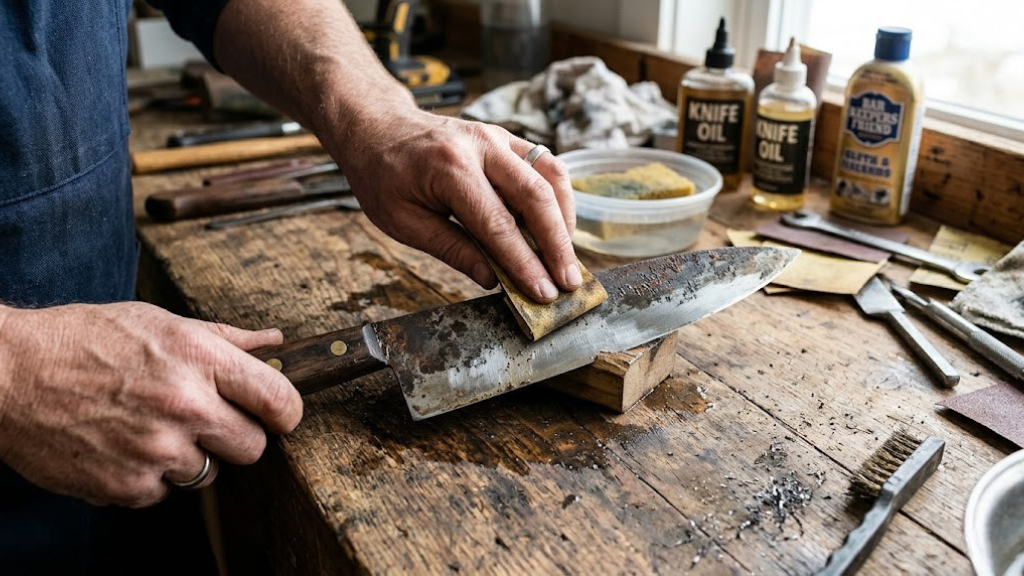
When chemistry isn’t working fast enough or when rust is at Level 3–4 severity, mechanical removal becomes the practical approach. Very fine steel wool (0000 grade — four zeros, which is the finest available) or wet/dry sandpaper in fine to medium grits will physically abrade the rust off the blade surface.
Steel Wool Instructions
Use 0000-grade steel wool only. Coarser grades will leave deep scratches that look worse than the rust and create new sites for future corrosion. Work in small circular motions on rusted patches, or long strokes along the blade length for uniform rust coverage. Use with a light machine oil (WD-40, mineral oil) as a lubricant to improve cutting action and prevent re-depositing metal particles.
Wet Sanding with Sandpaper
For more controlled results on larger rusted areas, wet sanding with 400-grit wet/dry sandpaper is highly effective. Progress to 600-grit, then 800, then 1000 if you want to restore a refined finish. Always sand with the grain — along the blade length, never across it. Use water or mineral oil as a lubricant. This method also effectively removes minor pitting by leveling the surface around the pits.
Protecting the Edge During Mechanical Work
When using abrasive methods near the cutting edge, work carefully. A slip toward the edge is a fast way to cut yourself. Consider running a strip of painter’s tape along the edge as a guide strip — not for protection (tape won’t stop a knife) but as a visual reminder of where the edge is while your focus is on the blade face.
Mechanical Removal Supplies

0000 Grade Fine Steel Wool (12-Pack)

Wet/Dry Sandpaper Assortment (400–3000 Grit)
Method 7: Commercial Rust Removers — When Household Methods Fall Short
For Level 3–4 rust that household methods aren’t shifting efficiently, purpose-made commercial products are the practical step up. Here’s a rundown of the most effective options specifically appropriate for knife blades.
Bar Keepers Friend (Powder or Liquid)
The workhorse of kitchen rust removal. Bar Keepers Friend contains oxalic acid (the same compound in potatoes, but at far higher concentration) plus a mild abrasive. It’s safe for stainless steel and semi-stainless alloys and will remove heavy surface rust quickly. Apply as a paste, leave for 1–5 minutes, scrub, and rinse. Use with caution on high-carbon steel — limit contact time to 2 minutes maximum.
Flitz Metal Polish
A paste metal polish that contains very fine abrasive particles plus chemical polishing agents. Excellent for removing light-to-moderate rust while simultaneously polishing the blade surface. Use with a soft cloth in circular motions. Flitz is safe for all metals including chrome, so it works well across steel types. Its polishing action means the blade looks better after treatment than before the rust appeared.
Naval Jelly (Phosphoric Acid-Based)
Naval jelly converts iron oxide into iron phosphate — a more stable compound that adheres to the steel surface and actually provides some corrosion resistance. It’s a very effective rust neutralizer for heavily rusted blades. Apply with a brush, leave 10–15 minutes, rinse thoroughly, and oil. Important: naval jelly residue must be completely rinsed off before any contact with food. It’s better suited to knives stored in workshops than kitchen blades.
Evapo-Rust
A water-based, non-toxic rust remover that works through selective chelation — it binds to iron oxide but leaves bare metal untouched. This makes it genuinely safe for long soaks without the etching risk of acid-based products. Submerge the blade for 30 minutes to several hours depending on severity. It’s also reusable until the solution turns black. The main downside is cost relative to vinegar, but it’s worth having for restoration projects.
🛒 Commercial Product Comparison
| Product | Active Agent | Carbon Steel Safe | Ease of Use | Best For |
|---|---|---|---|---|
| Bar Keepers Friend | Oxalic acid | With caution | Very Easy | Surface to moderate rust |
| Flitz Polish | Fine abrasives | Yes | Very Easy | Light rust + polishing |
| Naval Jelly | Phosphoric acid | With caution | Moderate | Heavy rust, non-kitchen use |
| Evapo-Rust | Chelating agent | Yes — completely | Easy (soak) | All severities, safe method |
| Rust eraser | Abrasive block | Yes | Easiest | Light–moderate rust |
Commercial Rust Removers Featured Above

Bar Keepers Friend Powder Cleanser
Flitz Metal Polish Paste

Evapo-Rust Rust Remover, 1 Gallon

Naval Jelly Rust Dissolver
Method 8: Power Tools for Severely Rusted Knives
When a knife has been neglected for months or years and has Level 4–5 rust with heavy pitting and flaking oxide, chemical methods and hand scrubbing won’t be practical. Power tools become the realistic path to restoration — but they require skill and restraint to avoid permanently damaging the blade geometry.
Wire Wheel on an Angle Grinder or Bench Grinder
A fine wire wheel (not a coarse knotted wheel) will quickly strip heavy rust from a blade in seconds. The key is using a fine crimped wire wheel and working with a light touch — the wire should brush the rust off, not grind into the steel. Work across the flat of the blade only, and never run the wheel along the cutting edge, as this will round and damage it.
Flap Disc Sanding
A 120-grit flap disc on an angle grinder will remove severe rust and minor pitting very efficiently. Progress to 180, then 240 to smooth the surface. Again, preserve the blade’s geometry — especially the shoulders and primary grind lines. If you’re not experienced with angle grinders on thin metal, practice on a scrap piece first. Overheating a blade during grinding can ruin its heat treatment and soften the steel permanently.
Drill with Wire Brush Attachment
For better control than a bench grinder, a fine wire brush on a drill provides enough aggression for Level 3–4 rust while allowing you to work in smaller, more controlled movements. Use at low RPM and keep the wire brush parallel to the blade face.
After power tool restoration, the blade face will need progressive hand sanding (from 220-grit up through 600–1000) to smooth the surface and remove grinding scratches before it’s ready for food use. The knife will likely need resharpening as well, since any restoration work this significant will affect the edge. If you’re rebuilding the edge from scratch, understanding steel geometry and sharpening approach is essential — the complete knife sharpening guide covers everything from angle selection to finishing on a strop.
Power Tool Attachments for Heavy Rust

Fine Crimped Wire Wheel, 4-inch

Fine Wire Brush Drill Attachment
Rust Removal by Steel Type: Matching Method to Your Knife
The best approach depends significantly on what steel your knife is made from. Here’s a direct guide for the most common categories.
High-Carbon Japanese Steel (Aogami, Shirogami, SK Steel)
These are the most reactive steels you’ll encounter in a kitchen. They rust fast and react strongly to acids. Use the baking soda method as your primary approach, or a rust eraser for light surface rust. If using vinegar, limit exposure to 5 minutes maximum and neutralize immediately. Apply camellia oil or food-grade mineral oil after every cleaning — not just when rust appears. Many owners of these knives build a deliberate patina (called a kasumi or dark patina) through controlled exposure to foods like onions and potatoes, which creates a stable iron compound layer that actually slows future rusting.
VG-10 and AUS-10 Japanese Stainless
These semi-stainless steels are far more rust-resistant than pure carbon steel but still more reactive than German stainless. The baking soda, rust eraser, and 15-minute vinegar methods are all appropriate. Avoid prolonged acid exposure, which can cause a patchy matte effect on the blade finish. The difference between AUS-10 and VG-10 also extends to how they respond to rust treatments — VG-10’s slightly higher chromium content makes it marginally more forgiving.
German Stainless (X50CrMoV15 and Similar)
The most forgiving category for rust removal. These steels — used by Zwilling, Henckels, Wüsthof, and Victorinox — have high enough chromium content to tolerate all methods without risk of rapid etching. Vinegar soaks up to 30 minutes, Bar Keepers Friend, and steel wool are all appropriate. The steel will reform its passive chromium oxide layer within hours of treatment with air exposure.
Budget Stainless (420HC, 8Cr13MoV)
Budget stainless knives have adequate rust resistance for normal kitchen use but thinner passive layers than premium German steel. Standard methods apply — baking soda is ideal, vinegar works with a 15–20 minute limit. These knives typically have satin or brushed finishes that tolerate light abrasive methods without visible damage.
Ceramic Knives
Ceramic knives (zirconia blades) don’t rust — the material doesn’t contain iron. If you see discoloration on a ceramic blade, it’s almost certainly a stain from food or mineral deposits, not rust. Clean with a dilute white vinegar solution or a gentle abrasive like Bar Keepers Friend applied with a soft cloth. Never use metallic abrasives or steel wool on ceramic blades.
Rust Prevention: Making This a One-Time Problem
Every rust removal session is a sign that something in your knife care routine isn’t working. The good news is that preventing rust is simpler than removing it — it comes down to three non-negotiable habits and a few good-practice choices in storage and maintenance.
The Three Non-Negotiable Habits
1. Dry Your Knives Immediately After Washing
Never leave a knife in the drying rack, in the sink, or on the counter wet. Wash, then immediately dry with a clean cloth — blade spine down against the cloth, wiping away from the edge. This single habit eliminates the vast majority of kitchen knife rust. It takes five seconds and makes an enormous difference.
2. Never Put Kitchen Knives in the Dishwasher
The dishwasher is hostile to knives in multiple ways: the hot water and steam create prolonged moisture exposure, the detergents are alkaline and abrasive to steel surfaces, the tumbling of utensils can chip edges, and the heat-dry cycle does nothing for the blade’s passive layer. Even dishwasher-marketed stainless steel knives suffer in this environment over time. Hand wash, every time, without exception.
3. Oil Carbon Steel Blades Regularly
Any knife made from high-carbon (non-stainless) steel should receive a thin film of camellia oil or food-grade mineral oil after every use. Apply a few drops to a soft cloth, wipe the blade, then wipe off the excess. The oil occupies the micro-pores and surface features that would otherwise trap moisture. This is standard practice for all traditional Japanese knife maintenance.
Storage Best Practices
How you store knives has a direct impact on rust formation. A dry knife block, a magnetic knife strip, or individual blade guards are all better options than a wet kitchen drawer. If your knife block has damp slots (common if knives are stored slightly wet), consider alternatives like magnetic strips or drawer docks that allow better airflow around the blade.
Magnetic knife strips deserve specific mention: they hold blades away from contact surfaces and allow full air circulation, which is genuinely the best environment for carbon steel knives. The only caveat is ensuring the magnet material is covered with wood or another buffer — bare magnets can cause edge contact and micro-damage on soft stainless. More on this in resources covering magnetic strip edge damage considerations.
Building a Patina on Carbon Steel
A deliberate patina is a stable, dark layer of iron compound that forms on carbon steel through controlled exposure to food acids. Unlike rust, a patina is tightly adherent and actually slows further oxidation. You can develop a patina by cutting onions or potatoes for a few minutes, or by wiping the blade with a mustard paste and leaving it for 30–60 minutes, then rinsing. The resulting dark grey-blue or brown surface is not rust — it’s protective and desirable. Many traditional Japanese knives develop beautiful patterned patinas through years of regular use.
- Wash with warm water and mild dish soap (not dishwasher)
- Rinse clean
- Dry immediately with a clean cloth, spine toward cloth, wiping away from edge
- For carbon steel: apply a thin film of mineral oil or camellia oil, wipe off excess
- Store on a magnetic strip, in a dry block, or with blade guard
Humidity and Seasonal Considerations
In humid climates — or humid kitchens (near a stove, dishwasher steam, or open windows in rainy seasons) — the rate of rust formation accelerates. If you live in a high-humidity environment and own carbon steel knives, consider keeping a small silica gel desiccant pack inside your knife block or knife roll. This dramatically reduces the ambient moisture that your blades are exposed to during storage.
Prevention & Storage Essentials

Traditional Camellia Oil, 3.4 oz

Wood-Encased Magnetic Knife Strip, 16-inch

Rechargeable Silica Gel Desiccant Packs

Universal Knife Blade Guards (Set of 8)
Complete Method Comparison Reference
| Method | Rust Levels | Time Required | Carbon Steel Safe | Skill Required | Cost |
|---|---|---|---|---|---|
| Baking Soda Paste | 1–3 | 20–45 min | Yes — fully safe | None | Free |
| Rust Eraser | 1–3 | 2–10 min | Yes — fully safe | None | $8–$15 |
| White Vinegar | 2–4 | 10–30 min | Caution — timed only | Moderate | Free |
| Lemon + Salt | 1–3 | 15–25 min | Caution — timed only | None | Free |
| Potato | 1–2 | 2–8 hours | Yes — fully safe | None | Free |
| Steel Wool (0000) | 2–4 | 5–20 min | Yes | Moderate | $3–$5 |
| Bar Keepers Friend | 2–4 | 5–15 min | Caution — brief contact | None | $6–$10 |
| Evapo-Rust | 2–5 | 30 min–8 hrs | Yes — fully safe | None | $12–$20 |
| Power Tools | 4–5 | 5–30 min | Yes (with care) | High | Requires tools |
Recommended Products: Build Your Rust Removal Kit
If you’d rather assemble a complete kit once than gather pantry ingredients every time rust shows up, here’s the full shopping list pulled from every method above — organized by what each product handles best.
Best Overall Picks
King Japan Rust Eraser Block
Evapo-Rust Rust Remover, 1 Gallon
Traditional Camellia Oil, 3.4 oz

Wood-Encased Magnetic Knife Strip, 16-inch
Frequently Asked Questions
A Rusted Knife Is a Recoverable Knife
Surface rust is one of the most alarming-looking, least damaging things that can happen to a knife. With baking soda, vinegar, or a rust eraser and fifteen minutes, even a heavily spotted blade can be restored to clean metal. The real question is always what happens after — build the three habits that prevent rust from returning, and you’ll never need this guide again.
And if you’re thinking about upgrading the knives that are worth protecting in the first place, or improving how they’re stored, we’ve got both covered.