The Quick Answer: Can a Minor Carry a Knife?
The short answer is: sometimes yes, often it depends, and in certain situations absolutely not. Knife carry laws in the United States are not federal — they vary dramatically from state to state, county to county, and even city to city. What’s perfectly legal for a 15-year-old in rural Montana can land a teen in serious trouble in New York City.
Here’s what nearly every jurisdiction in the country agrees on, regardless of location or politics:
- No knife on school grounds. Period. Zero exceptions in virtually every state.
- Blade length matters. Shorter blades (typically under 2.5–3 inches) are far less restricted than longer ones.
- Intent and context matter enormously. A scout carrying a pocketknife to a camping trip is treated very differently than a teenager carrying a fixed-blade knife in a city park.
- Type of knife matters. A Swiss Army knife is not the same as a switchblade in the eyes of the law, and most states treat them very differently.
Throughout this guide, we’ll break down the landscape clearly — from federal statutes to state-specific rules, from school policies to campsite carry. Whether you’re a parent wondering what knife your child can take to Boy Scouts, or a teenager trying to understand what you can legally carry on a trail, this is the guide for you.
Federal Law and Knife Carry for Minors
The United States federal government does not have a single, unified knife carry law that governs all minors in all situations. However, several federal statutes do touch on knife access and minors, particularly around interstate commerce and school environments.
The Federal Switchblade Knife Act (1958)
The Federal Switchblade Knife Act prohibits the interstate commerce, importation, and mailing of switchblade knives. While this doesn’t directly regulate whether a minor can carry such a knife within their state, it does restrict how they can be acquired. A minor cannot legally receive a switchblade through mail-order in most states precisely because of this federal framework, regardless of whether their state permits possession.
The Gun-Free School Zones Act
While the Gun-Free School Zones Act primarily addresses firearms, its framework has heavily influenced how states craft their own school weapons policies. Under most state implementations, knives of virtually any kind — even small folding blades — are treated as weapons when brought onto school property. Many states explicitly reference “dangerous weapons” in a way that covers knives with blades over a certain threshold (often just 2.5 inches).
No Federal Minimum Age for Knife Carry
Critically, there is no federal minimum age for carrying a pocket knife. This surprises many parents. Age restrictions around knives are entirely a state and local matter. Some states have minimum ages for purchasing knives (often 18), while others have no minimum age at all for carry — leaving it entirely up to context, blade length, and location. This decentralized legal landscape is precisely why understanding your specific state’s laws is so important.
State-by-State Knife Laws for Minors: The Big Picture
Across all 50 states, you’ll find three broad categories of knife law environments for minors: permissive, moderate, and strict. Let’s examine representative examples from each before diving into a more detailed comparison table later in this guide.
Permissive States
States like Texas, Montana, Arizona (post-2011 reforms), and Oklahoma have relatively open knife laws. Texas removed most blade length restrictions in 2017 for adults, though locations like schools, courts, and sporting events remain restricted. Minors in these states often have more latitude to carry folding knives and even some fixed blades for outdoor purposes — though parental oversight is still strongly advisable.
Moderate States
The majority of U.S. states fall into the moderate category — places where folding knives with blades under 3–3.5 inches are generally legal for minors to carry in public, while larger blades, fixed blades, and automatic knives face more restriction. States like Florida, Colorado, Ohio, Georgia, and Virginia typically fall here, though local city ordinances can tighten the picture significantly even within moderate states.
Strict States
States like California, New York, Illinois, Hawaii, and Massachusetts have significantly stricter knife laws. In California, folding knives may be carried as long as they are not concealed with a blade over 2.5 inches, but switchblades with blades over 2 inches are banned outright. New York prohibits “dangerous knives” and gravity knives — a broad category that historically swept in many common folding knives, though 2019 reforms narrowed this. Illinois has complex laws that vary significantly by municipality; Chicago, for example, is far stricter than rural downstate Illinois.
The patchwork nature of these laws means that even moving from one county to another within the same state can change what’s legal. Always check local ordinances, not just state law. Many cities and counties layer additional restrictions on top of state minimums, and it’s those local layers that most often catch unsuspecting minors — and their parents — off guard.
If you’re researching knives appropriate for young people to carry — particularly those designed for outdoor utility and everyday tasks — it helps to understand the broader world of compact, practical blades. Our detailed review of the CIVIVI Elementum covers one of the most popular slim folder designs on the market, with a blade length that falls within legal parameters in most U.S. states — making it a common recommendation for responsible teen carry where local law permits.
Blade Length Limits: The Number That Matters Most
If there is one piece of information that most directly determines whether a minor can legally carry a knife in a given location, it’s blade length. Nearly every state’s knife carry law references blade length as a primary criterion, and understanding these thresholds is absolutely essential for parents and young carriers alike.
Common Blade Length Thresholds by Category
| Blade Length | Typical Legal Status | Common Examples |
|---|---|---|
| Under 2 inches | Legal in nearly all states | Small penknives, keychain knives, nail files with blades |
| 2–2.5 inches | Legal in most states | Swiss Army Classic, small slip-joints, SAK models |
| 2.5–3 inches | Legal in many states; restricted in strict states | Standard pocket knives, small EDC folders |
| 3–3.5 inches | Moderate restriction — varies widely by state | Most full-size pocket folders, medium EDC knives |
| 3.5–4 inches | Restricted in many states for minors | Larger folders, utility work knives |
| Over 4 inches | Restricted or prohibited in most states for minors | Fixed blades, hunting knives, large folder designs |
| Over 5.5 inches | Prohibited in strict states; heavily restricted everywhere | Bowie knives, large fixed blades, combat-style knives |
Why Blade Length Became the Legal Standard
From a legislative standpoint, blade length became the dominant measure of a knife’s potential danger because it’s an objective, measurable quality. Courts and law enforcement can easily determine whether a knife exceeds a specified blade length, whereas “dangerous weapon” intent is far more subjective and harder to prosecute consistently. Over decades of legal evolution, most states settled on blade length as the most practical threshold — even though knife experts will readily point out that a 2-inch blade can be equally dangerous in the wrong hands as a 6-inch one.
How to Measure Blade Length Correctly
For legal purposes, blade length is measured from the tip of the blade to the point where the blade meets the handle — specifically where the edge-side of the blade meets the guard or handle, not including any ricasso or unsharpened choil area. This is important: measuring from the tip to the end of the handle would falsely inflate the number. When in doubt, measure conservatively and choose a blade that leaves comfortable legal margin.
It’s also worth noting that blade length limits often apply differently depending on whether the knife is carried openly or concealed. Some states are perfectly fine with open carry of a 3.5-inch folding knife but prohibit concealed carry of anything over 2.5 inches. This distinction matters particularly for older teens who carry a folder clipped to their pocket — in some states, a pocket clip visible from the outside counts as “open carry,” while in others it may be treated as “concealed.”
Types of Knives and Their Legal Status for Minors
Not all knives are treated equally by the law. The mechanism, blade style, and intended use of a knife all factor into how it’s regulated. Understanding the different categories — and which are most likely to cause legal trouble — is essential before choosing a knife for a young person to carry.
Folding Pocket Knives (Slip-Joint & Lockback)
These are the most common and widely legal knives for minors. A simple slip-joint pocket knife — the classic image of a Boy Scout knife — is legal in the vast majority of U.S. jurisdictions for minors when the blade is under 3 inches. Lockback folders provide added safety (preventing blade closure on fingers) and are similarly legal in most places. These knives open manually, require deliberate effort to deploy, and are generally considered utility tools rather than weapons. They’re the gold standard starting point for any young knife carrier.
✅ Pros for Young Carriers
- Legal in most states when blade is under 3″
- Widely understood as everyday utility tools
- Safe, controlled opening mechanism
- Wide variety of styles and price points
- Easy for parents to explain to authorities
❌ Legal Cautions
- Still prohibited on all school grounds
- Concealed carry may be restricted even at legal lengths
- Local city ordinances may override state law
- Larger models (3.5″+) face more scrutiny
- Some states restrict carry without parental supervision
Multi-Tools & Swiss Army Knives
Multi-tools and Swiss Army knives occupy a particularly favorable legal position in most jurisdictions. Because they are clearly utility items — containing tools like scissors, screwdrivers, can openers, and files alongside a small blade — courts and law enforcement typically treat them as tools rather than weapons. A minor carrying a Victorinox Swiss Army knife for camping or everyday tasks is unlikely to face legal issues in most states, provided they are not on school grounds. The Victorinox Cadet Alox is one of the most popular and well-regarded compact options in this category.
Fixed-Blade Knives
Fixed-blade knives face more restrictions than folding knives in most states for minors, even when shorter. Even blades in the 3–4 inch range may be restricted in many jurisdictions if carried in urban areas. That said, fixed-blade knives are widely accepted in outdoor, hunting, and camping contexts in most states, provided they are carried openly — sheathed on the hip — rather than concealed under clothing. The intent and setting are everything with fixed blades.
Switchblades & Automatic Knives
Switchblades and automatic knives — those that open with a button, lever, or other spring-driven mechanism — are among the most heavily regulated knife types for everyone, including minors. The Federal Switchblade Knife Act restricts their interstate commerce, and most states either ban them outright or heavily restrict their carry. For minors specifically, carrying a switchblade is illegal in the overwhelming majority of U.S. jurisdictions regardless of blade length. This is one of the clearest legal lines in all of knife law.
Balisong (Butterfly) Knives
Butterfly knives are banned or heavily restricted in many states including California, New York, Hawaii, and others. Their distinctive flipping mechanism and association with martial arts culture have led legislatures to treat them similarly to switchblades. A minor carrying a balisong is at significant legal risk in most states, and even in states where they’re technically legal for adults, selling them to minors is often prohibited.
Dirks, Daggers & Double-Edged Blades
Knives with double-edged blades — designed primarily as stabbing weapons rather than utility tools — are banned or heavily restricted in most states. Carrying a dirk or dagger is generally illegal for anyone in many jurisdictions. For minors, the penalties are typically even more severe. These knife types have almost no legitimate everyday carry application for a young person, and there is no good reason for a minor to possess one outside of highly supervised historical re-enactment contexts.
For older teens interested in quality everyday carry knives that remain within legal parameters across most states, our review of the Ontario RAT 2 — a compact, well-built folder with a 3-inch blade — offers a thorough look at a knife that hits the ideal balance of utility, durability, and legal carry-friendliness for young adults in most U.S. jurisdictions.
Knives at School: The Absolute Prohibition
If you take only one thing from this entire guide, let it be this: bringing any knife to school is almost universally illegal in the United States and carries severe, potentially life-altering consequences. This is the one area where there is near-universal agreement across all 50 states, regardless of how permissive or strict a state’s general knife laws might otherwise be.
Why School Knife Rules Are So Strict
The wave of school violence legislation that followed major incidents throughout the 1990s and 2000s led to the adoption of zero-tolerance weapons policies in virtually every school district in the country. These policies were designed to remove ambiguity — school administrators and staff should not have to make judgment calls about whether a particular knife poses a genuine threat. The policy answer is simply: no knives. Period. And the courts have consistently upheld these policies even in cases where the knife was clearly a utility tool carried without malicious intent.
What Counts as “School Grounds”?
“School grounds” typically extends well beyond the school building itself. Most state laws and district policies include:
- The school building, including all classrooms, hallways, bathrooms, and offices
- School parking lots and access driveways
- School athletic fields, gymnasiums, and sports facilities
- School-sponsored events, including those held at off-campus locations
- School buses and other district transportation
- Some states extend restrictions to any area within a specified radius of a school (commonly 1,000 feet)
The Full Range of Consequences at School
The consequences of a student being found with a knife at school can be surprisingly severe and unexpectedly long-lasting:
- Immediate removal from campus and notification of parents
- Short-term suspension — typically 5–10 school days pending investigation
- Long-term suspension or expulsion — mandatory in many states for weapons violations of any kind
- Criminal charges — depending on the state and circumstances, a student may face misdemeanor or felony charges simply for possessing a knife on school property
- Juvenile court proceedings — which can affect future college applications, financial aid eligibility, employment background checks, and military service eligibility
- Mandatory alternative school placement — many districts require expelled students to attend alternative educational programs that carry their own social stigma
- Permanent disciplinary record — in some states, school weapons violations are entered into statewide education databases that follow a student throughout their academic career
The “Forgot It Was in My Bag” Defense
One of the most common and genuinely heartbreaking scenarios involves a student who forgot a small pocketknife was in their backpack after a camping trip or outdoor activity the previous weekend. In a zero-tolerance environment, intent and forgetfulness are often legally irrelevant at the administrative level. The knife’s presence is the violation.
The practical lesson for families: establish an unbreakable household rule that knives and school bags simply never occupy the same space. Ever. Not temporarily. Not “just this once.” The habit of complete separation is the only reliable protection against this type of accidental violation.
When Exceptions Might Apply
It’s worth noting that some states carve out narrow exceptions for specific educational contexts — culinary arts classes that use knives as part of instruction, for example, or woodshop programs. These exceptions are tightly controlled, apply only when the knives are school property under teacher supervision, and do not grant any general permission to bring personal knives onto campus. Never assume an exception applies without explicit written confirmation from the school administration.
Knives for Outdoor Activities: Camping, Hiking, Hunting & Scouts
Here’s where the conversation about knife carry for minors enters genuinely positive territory. Outdoor activities — camping, hiking, fishing, hunting, and organized youth programs like Boy Scouts and 4-H — represent the most traditionally accepted and legally defensible context for a minor to carry a knife. The law generally recognizes the legitimate utility of knives in the outdoors, and context matters enormously to how law enforcement and prosecutors approach these situations.
Camping & Hiking
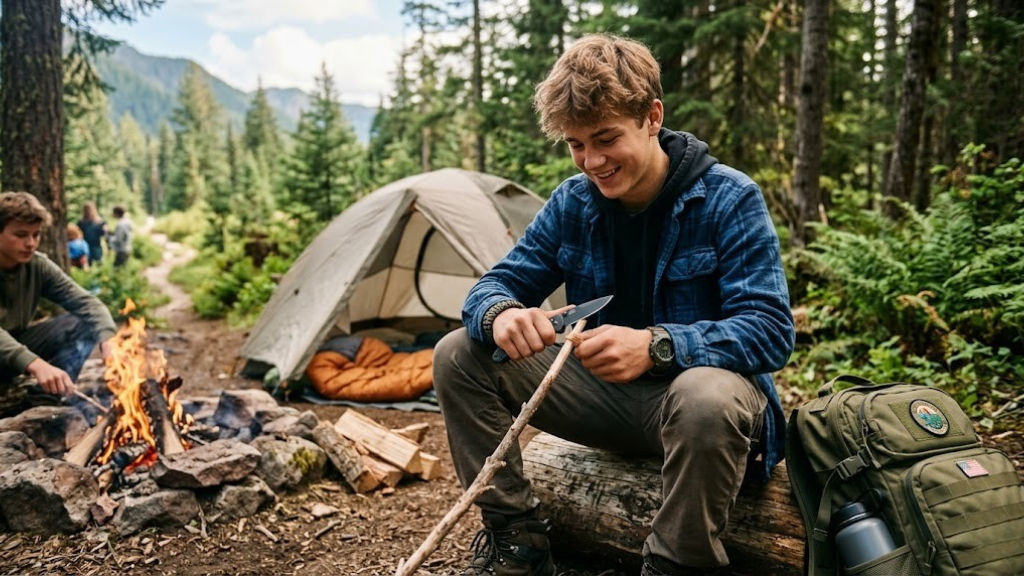
In most U.S. states, a minor can carry a folding pocket knife or a sheathed fixed-blade knife while camping or hiking, provided the blade is within the state’s general legal limits. The purpose is clear (utility, fire-starting, food preparation, first aid), the setting is appropriate (wilderness areas, state parks, national forests), and the context removes any reasonable presumption of malicious intent. Most law enforcement officers in outdoor recreation areas encounter young people with knives regularly and treat it as entirely normal when the context is clearly recreational.
Some national parks and state parks have their own weapons policies — it’s worth checking the specific park’s rules before heading out, particularly in states with stricter knife laws. Generally speaking, national park rules follow federal law, which does not specifically prohibit knife carry beyond switchblade restrictions.
Hunting & Fishing
Most states explicitly allow minors to carry knives appropriate for hunting and fishing while actively engaged in those activities. A 14-year-old field-dressing a deer with a parent present is engaging in a time-honored tradition that most state laws explicitly protect. Fixed-blade hunting knives, gut hook blades, and filleting knives are all typically legal in hunting and fishing contexts even when they wouldn’t be legal for general urban carry. The key legal element is active engagement in the licensed activity — carrying the same knife to the mall on the way home changes the legal picture significantly.
Boy Scouts, 4-H & Youth Organizations
Organized youth programs have a long and socially recognized tradition of knife use and education. Boy Scouts of America has its own knife safety curriculum and the Totin’ Chip program, which formally authorizes knife carry as part of its activities. Most courts and law enforcement agencies recognize participation in these programs as a legitimate context for knife carry by minors when the activity is taking place. That organizational context matters legally — it establishes purpose and demonstrates that responsible adults have evaluated and sanctioned the carry.
That said, organizational sanction does not override local law. A scout carrying a knife to school before an afternoon meeting is still violating school weapons policy, regardless of the organization’s rules about knife carry during activities. The exemption applies during the activity itself, not during transit through restricted areas.
Open Carry vs. Concealed Carry in Outdoor Settings
Even in outdoor settings, how you carry a knife matters. A fixed-blade hunting knife worn openly in a sheath on a belt is generally treated very differently than the same knife tucked inside a jacket. Most states that restrict concealed carry of knives make specific exceptions for outdoor activities with openly carried blades. The practical rule for young people: in outdoor settings, carry openly, carry purposefully, and let the setting and context speak for themselves.
Parental Consent, Supervision & Legal Liability
A question that comes up repeatedly from concerned parents: “Does my permission as a parent make it legal for my child to carry a knife?” The answer is genuinely nuanced — parental consent matters in some important ways, but it absolutely does not override state law.
What Parental Consent Can Do
- Demonstrate legitimate intent in ambiguous situations — a parent present at a camping trip with their child who has a pocketknife creates a very different legal picture than an unsupervised teen with a blade in an urban area at night
- Satisfy some state law provisions that explicitly allow minors to carry knives under active parental supervision
- Provide important context that prosecutors and judges consider when deciding how to handle a case
- Fulfill the requirements of some youth organization programs that require parental sign-off before knife privileges are granted
- Establish the responsible adult chain that courts look for when evaluating juvenile knife possession cases
What Parental Consent Cannot Do
- Override a state or local law that explicitly prohibits a minor from carrying a specific type of knife
- Make it legal to bring a knife to school
- Grant permission to carry a knife in restricted public areas like government buildings, courthouses, or airports
- Authorize carry of a knife type that is flatly banned by state law, such as a switchblade in California or a butterfly knife in Hawaii
- Protect the minor from charges if the knife falls into a prohibited category regardless of parental awareness
Parental Legal Liability
Parents should be aware that some states hold parents legally responsible for a minor’s possession of a weapon when the parent knew or should have known. This is particularly relevant in cases where a parent knowingly gave a minor a knife that is illegal in their jurisdiction, or where a parent left knives casually accessible and a minor took one without explicit permission. Some states have enacted negligent storage or negligent supervision laws that extend to weapons including knives in households with minors. While prosecutions under these laws are relatively rare, the legal exposure is real.
Safe storage of knives in a household with young people is just as important as knowing the carry laws. Whether you’re storing kitchen knives or outdoor blades, our guide on knife storage options covers magnetic strips, drawer docks, and other systems that keep blades accessible to adults while reducing the risk of unsupervised access by children and younger teens.
Having the Conversation Before the First Carry
Before handing any young person a knife to carry, parents should have a clear, direct conversation about the responsibilities involved. This conversation should cover the specific laws in your state and city, where the knife can and cannot be carried, safe handling and storage practices, the critical importance of never drawing or brandishing a knife in a social situation, and what to do if questioned by law enforcement (remain calm, be polite, be honest about the knife’s presence). This isn’t about creating fear around knives — it’s about setting the young person up to be a responsible, law-abiding carrier from day one.
What Happens If a Minor Is Caught With a Knife Illegally?
Understanding the potential consequences of illegal knife carry is essential for both minors and their parents. The range of outcomes is wide — from a simple warning all the way to juvenile felony charges — and depends heavily on the state, the type of knife, the location, the circumstances of the stop, and the minor’s prior history.
Scenario 1: Minor Stopped in Public with a Knife Over the Legal Limit
If a police officer stops a minor and discovers a knife that exceeds the local blade length limit but is otherwise a common folding knife, the outcome might range considerably. First-time encounters with cooperative, respectful young people in non-threatening contexts often result in a verbal warning and confiscation of the knife. As the circumstances become more concerning — prior encounters, late hours, urban environments, or a less cooperative demeanor — the response can escalate to a citation, a misdemeanor charge, or juvenile court proceedings depending on the jurisdiction.
Scenario 2: Minor Found with a Prohibited Knife Type
If the knife is of a type that is flatly prohibited — a switchblade, balisong, or double-edged dagger — the legal response is typically significantly more serious regardless of circumstances. Expect juvenile misdemeanor or felony charges depending on the state, possible juvenile detention in serious cases, and a permanent record of the offense that can affect college admissions, employment background checks, and military service eligibility for years afterward.
Scenario 3: Minor Found with a Knife at School
As covered in the school section, this is typically the most severely handled scenario outside of a direct threat to use the knife. Even a small pocketknife triggers immediate removal from campus, short-term suspension pending investigation, mandatory long-term suspension or expulsion under many district policies, referral to law enforcement with potential criminal charges, and requirement to complete alternative educational programs before returning to a regular school environment.
Scenario 4: Minor Found with a Knife During Another Offense
If a minor is found with a knife while committing another offense — even a relatively minor one — the presence of the knife can dramatically escalate the charges. A knife found during a shoplifting stop might transform a simple theft charge into an aggravated offense with a weapons enhancement. This “escalator effect” is one of the most important reasons for young people to understand that there is no “safe” context for illegal knife carry.
Teaching Knife Safety to Young People: The Right Way
A knife is a tool. Like any tool, it can be used safely and responsibly with proper instruction, or dangerously without it. The best outcome for any young person who will carry a knife is thorough, patient instruction in safe handling — not just legal compliance, but genuine competence and deeply internalized respect for what a knife can do.
The Four Foundational Rules of Knife Safety
- Always cut away from your body. This is the first and most fundamental rule. The blade should always move away from the hand, arm, and body — never toward it. Establish this as an absolute habit before anything else.
- Keep the blade sharp. This is counterintuitive but critically true: a dull knife requires far more force to cut, which leads to slipping and loss of control. A properly sharpened knife provides predictable, controlled cuts. Teaching a young person to maintain their knife is teaching them to use it safely.
- Always close and secure the knife when not in use. A folding knife should be closed and pocketed between uses. A fixed blade should be sheathed. Knives should never be left open on surfaces, carried loose in bags, or set down within reach of younger children.
- Never point or wave a knife at another person. Ever. Not in play. Not jokingly. Not to show someone the blade. This establishes both a critical safety habit and an important legal boundary — brandishing a knife at another person can result in assault charges regardless of intent.
Age-Appropriate Introduction to Knives
Child development professionals and experienced outdoor educators generally suggest that children as young as 5–7 can begin supervised introduction to simple cutting tools (whittling soft wood with a supervised adult, using kitchen knives for food prep with constant oversight). Meaningful pocketknife carry and independent use is typically most appropriate starting around ages 10–12 with active parental supervision for every use, progressing to more independent carry in the 14–16+ range depending on the individual child’s demonstrated maturity, judgment, and track record with supervised use.
Structured Training Programs
Organized programs often provide the best environment for introducing knife skills to young people, because they combine peer accountability with experienced adult instruction:
- Boy Scouts of America — the Whittlin’ Chip program for Cub Scouts and the Totin’ Chip for older scouts provide structured, progressive knife safety education
- 4-H Shooting Sports & Outdoor programs — offer supervised tool and knife safety instruction as part of broader outdoor education
- Wilderness survival courses — many accredited programs include dedicated knife safety modules
- Traditional woodworking and carving clubs — provide focused, supervised skill development with real accountability
Safe Storage at Home
Even after a minor has been given a knife for legitimate use, proper storage at home matters for safety and for legal reasons. A knife given to a teenager should have a designated storage location — not casually tossed in a shared drawer — and should be inaccessible to younger children in the household. This is simply good practice, and it may also be relevant to parental liability considerations under negligent supervision standards in some states.
Choosing the Right Knife for a Young Person: What to Look For
If you’ve decided that a knife is appropriate for your child or teenager — for camping, scouting, outdoor recreation, or everyday utility — choosing the right knife matters enormously, both for safety and for legal compliance. Here’s what to prioritize.
Ideal Characteristics for a Young Carrier’s First Knife
- Blade length under 3 inches — this keeps the knife legal in the widest possible range of U.S. jurisdictions
- Folding design — significantly safer for carry than fixed blades for developing knife skills
- Locking mechanism — a lockback or liner lock prevents accidental blade closure on fingers during use
- Slip-resistant handle material — important for young hands that haven’t yet developed full grip strength and technique
- No automatic or assisted-opening mechanism — these are restricted in more jurisdictions and add unnecessary complication for beginners
- Single plain-edge blade — serrated edges are harder to control and harder to sharpen; a simple drop point or sheepsfoot blade is the right starting point
- Appropriate weight — not so heavy that fatigue causes loss of control; not so light that it feels cheap or fragile
Recommended Knife Styles by Age and Use Case
| Knife Style | Best Use Case | Legal Risk Level | Recommended Starting Age |
|---|---|---|---|
| Swiss Army / multi-tool | Everyday utility, camping, scouts, school-adjacent activities (not at school) | Very Low | 10+ |
| Small slip-joint folder (under 2.5″) | General utility, first knife experience | Very Low | 10+ |
| Lockback folder (2.5–3″) | Camping, hiking, general outdoor activities | Low in most states | 12+ |
| Fixed-blade knife (3–4″, openly sheathed) | Camping, hunting, fishing — always with adult supervision | Moderate (location-dependent) | 14+ with active supervision |
| Frame-lock / liner-lock folder (3–3.5″) | Older teen EDC, outdoor utility work | Moderate (state-dependent) | 15–16+ depending on state |
| Switchblade / automatic | Not appropriate for minors in most states | Very High — illegal in most states | Not applicable for minors |
Knives to Absolutely Avoid for Young Carriers
Regardless of how cool they might look online or how enthusiastically a teen might request them, certain knife types should simply be off the table for minors:
- Switchblades and all automatic-opening knives
- Balisong (butterfly) knives
- Double-edged or dagger-style blades
- Any blade over 4 inches for everyday carry (outdoor activities excepted with appropriate supervision)
- Knives with knuckle-guard or finger-hole handles (these classify as deadly weapons in some jurisdictions)
- Karambits or other curved, talon-style blades
- Any knife marketed explicitly as a “fighting knife,” “tactical combat knife,” or similar
For parents researching quality first knives, the Morakniv series represents one of the best values in outdoor knives for young people learning proper carry and use under supervision. Our full Morakniv Companion review covers why this Swedish-made blade has become the go-to recommendation from outdoor educators, scout leaders, and knife enthusiasts for young people starting their journey with fixed-blade knives in properly supervised outdoor settings.
State Knife Law Comparison for Minors: 2026 Reference Table
The following table provides a general overview of knife carry laws for minors in selected U.S. states. This is a general reference only — always verify current laws directly through official state statutes or a licensed attorney, as laws change and local ordinances frequently add further restrictions beyond what state law specifies.
| State | Pocket Knife Carry (Minors) | Common Blade Limit | Switchblades | Open Fixed-Blade | At School |
|---|---|---|---|---|---|
| Texas | Generally Allowed | No general length limit (location-based restrictions) | Permitted with location restrictions | Generally Allowed | Prohibited |
| California | Allowed if not concealed and under 2.5″ | 2.5″ concealed; open carry varies by city | Banned (over 2″) | Allowed openly in most areas | Prohibited |
| New York | Allowed with significant restrictions | 4″ state; NYC more restrictive | Banned statewide | Varies significantly by county | Prohibited |
| Florida | Generally Allowed | 4″ general limit; concealed restricted | Banned statewide | Allowed openly | Prohibited |
| Illinois | Varies significantly by municipality | Chicago: 2.5″; rest of state varies widely | Banned statewide | Varies by location | Prohibited |
| Montana | Generally Allowed | No general state length limit | Generally Permitted | Generally Allowed | Prohibited |
| Georgia | Generally Allowed | 5″ general limit | Banned statewide | Allowed openly | Prohibited |
| Ohio | Generally Allowed | No statewide limit (local ordinances vary) | Varies — check local | Allowed openly | Prohibited |
| Massachusetts | Significantly Restricted | 1.5″ for folding knives in most contexts | Banned statewide | Generally Prohibited | Prohibited |
| Washington | Generally Allowed with restrictions | 3.5″ general; concealed restricted | Banned statewide | Allowed openly in most areas | Prohibited |
| Colorado | Generally Allowed | 3.5″ concealed; open carry with some restrictions | Banned statewide | Allowed openly | Prohibited |
| Hawaii | Significantly Restricted | Broad “dangerous weapon” definitions limit most carry | Banned statewide | Generally Prohibited | Prohibited |
Notice the one universal in the table above: regardless of how permissive or strict a state’s general knife laws are, every single state prohibits knives at school. This universal prohibition is the clearest, most consistent line across an otherwise deeply fragmented national legal landscape.
It’s also important to note that several states with moderate laws become functionally strict when you factor in the additional layers imposed by major city ordinances. Chicago, New York City, Los Angeles, and other large urban centers often impose restrictions significantly tighter than their respective state laws, which can catch young people — and their parents — completely off guard when they move to or visit these cities.
Frequently Asked Questions: Minors and Knife Laws
Final Thoughts: Knowledge Protects Everyone
The question of whether a minor can legally carry a knife doesn’t have a single clean answer — but it does have a clear framework. Understand your state’s laws. Respect blade length limits (under 3 inches is almost always safest). Never bring any knife to school under any circumstances. Ensure outdoor carry is supervised, purposeful, and openly carried. Teach proper handling before the first carry, not after.
Knives are tools with genuine real-world utility — from campsite tasks to outdoor survival to kitchen work to emergency preparedness. A young person who learns to carry and use a knife responsibly gains a skill and a mindset that will serve them safely for decades. The goal is to make that journey legal, safe, and confidence-building — and it starts with information exactly like what you’ve read here.
Explore the resources below to find appropriate knives and further your understanding of responsible carry at any age.