Spyderco Paramilitary 2 Review: The Undisputed Ruler of EDC Knives?
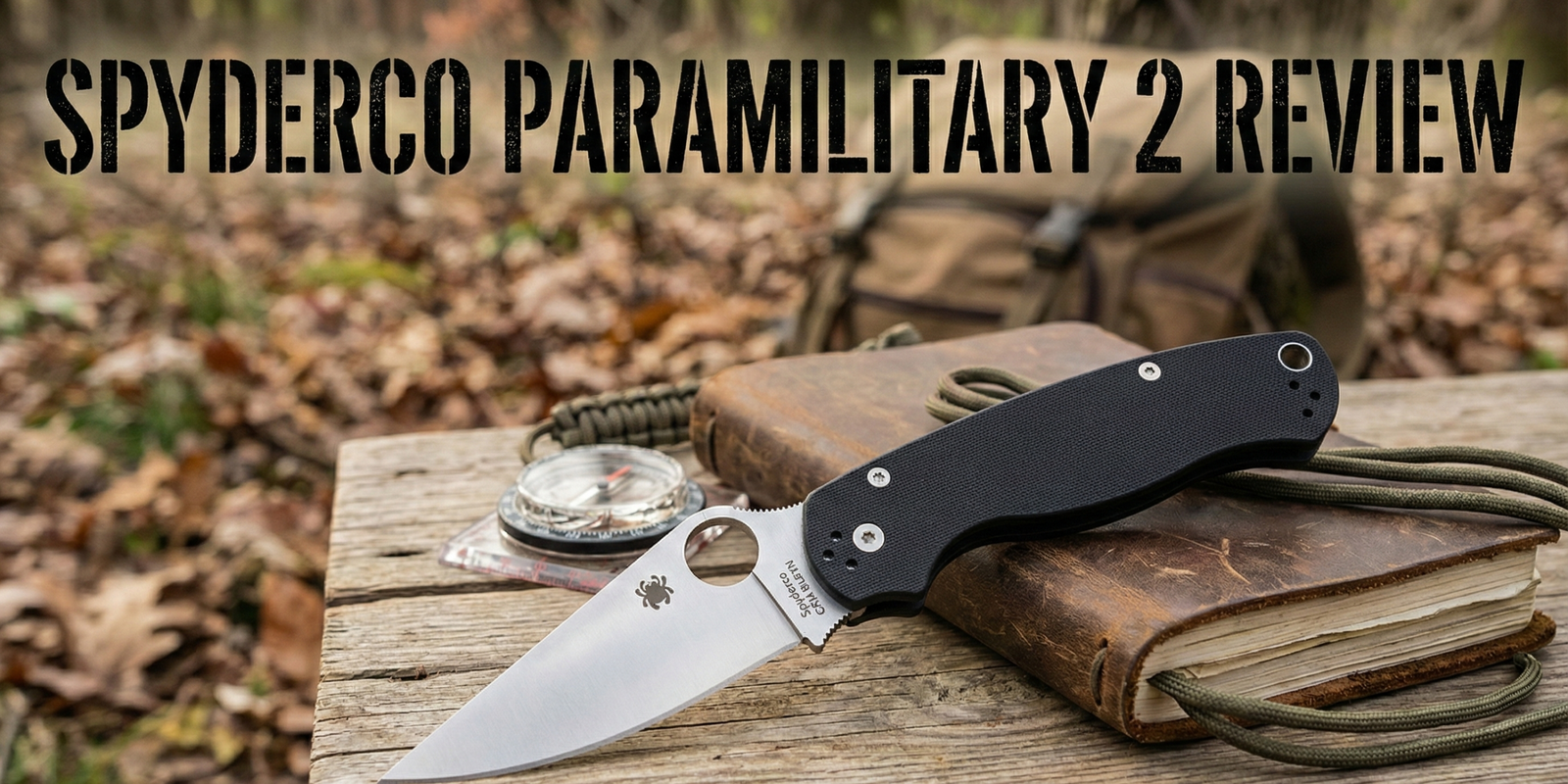
There are knives, and then there are institutions. The Spyderco Paramilitary 2 (commonly known as the PM2) belongs firmly in the latter category. Since its release in 2010, it has consistently topped “best of” lists, survived countless trends, and remained the benchmark against which almost all other folding knives are measured.
But why? It’s not the lightest knife. It’s certainly not the smallest. It has a distinctively “odd” look if you aren’t used to the Spyderco aesthetic. Yet, once you get it in hand, everything changes. The PM2 is a masterclass in functional design over form.
In this comprehensive review, we are going to dissect the Spyderco Paramilitary 2. We will look at its signature Compression Lock, the slicing capabilities of its full-flat grind, and whether this veteran of the EDC world can still hold the crown in 2025 against modern competitors.
Spyderco & The History of the Paramilitary Line
To understand why the Paramilitary 2 earned its cult following, it helps to understand where it came from. Spyderco was founded in 1976 in Golden, Colorado, and the company is credited with popularizing several features that are now standard across the entire knife industry: the pocket clip, the opening hole, and serrated edges on folding knives all trace back to Spyderco’s early catalog. Long before “EDC” was a hashtag, Spyderco was quietly building a reputation among law enforcement, outdoorsmen, and knife collectors as the company that took ergonomics and functional design seriously.
The original Civilian and Military models set the tone in the late 1980s and 1990s, but it was the first Paramilitary, released in the early 2000s, that really cemented the platform. The original Paramilitary used a spine-mounted lock similar in spirit to what would eventually become the Compression Lock, and it built a small but devoted following among people who wanted a rugged, mid-sized folder that could take abuse without feeling like a liability in the pocket.
When Spyderco introduced the Paramilitary 2 in 2010, it wasn’t just a minor refresh. The company took feedback from a decade of Paramilitary ownership and rebuilt the knife almost from the ground up. The blade shape was refined, the handle was reshaped for a more secure grip, the pivot was upgraded to use phosphor bronze washers, and most importantly, the lock mechanism was finalized into the modern Compression Lock we know today. The result was a knife that felt tighter, safer, and more refined than its predecessor while keeping the same DNA of rugged, no-nonsense utility.
In the years since, the PM2 has become something of a proving ground for Spyderco. New steels are frequently debuted on the Paramilitary 2 platform before trickling down to other models, and the knife has become the default recommendation whenever someone asks an online forum or a knife shop employee, “What’s the best all-around folding knife I can buy?” That reputation didn’t happen by accident. It happened because the PM2 keeps getting reevaluated against newer releases and keeps winning.

Experience the “click” that changed the knife world. The PM2 is the standard for a reason.
Check Price on AmazonTechnical Specifications
The PM2 is a medium-to-large everyday carry knife. It strikes a balance that allows it to perform hard work without being too heavy to carry, though it is wider in the pocket than some might prefer.
| Blade Length | 3.44 inches (8.74 cm) |
|---|---|
| Cutting Edge | 3.00 inches (7.62 cm) |
| Overall Length | 8.28 inches (21.03 cm) |
| Closed Length | 4.81 inches (12.22 cm) |
| Blade Thickness | 0.145 inches (3.7 mm) |
| Weight | 3.75 ounces (106 g) |
| Handle Material | Textured G-10 |
| Blade Steel | CPM-S45VN (Standard Production) |
| Lock Type | Compression Lock |
The Blade: Geometry is King
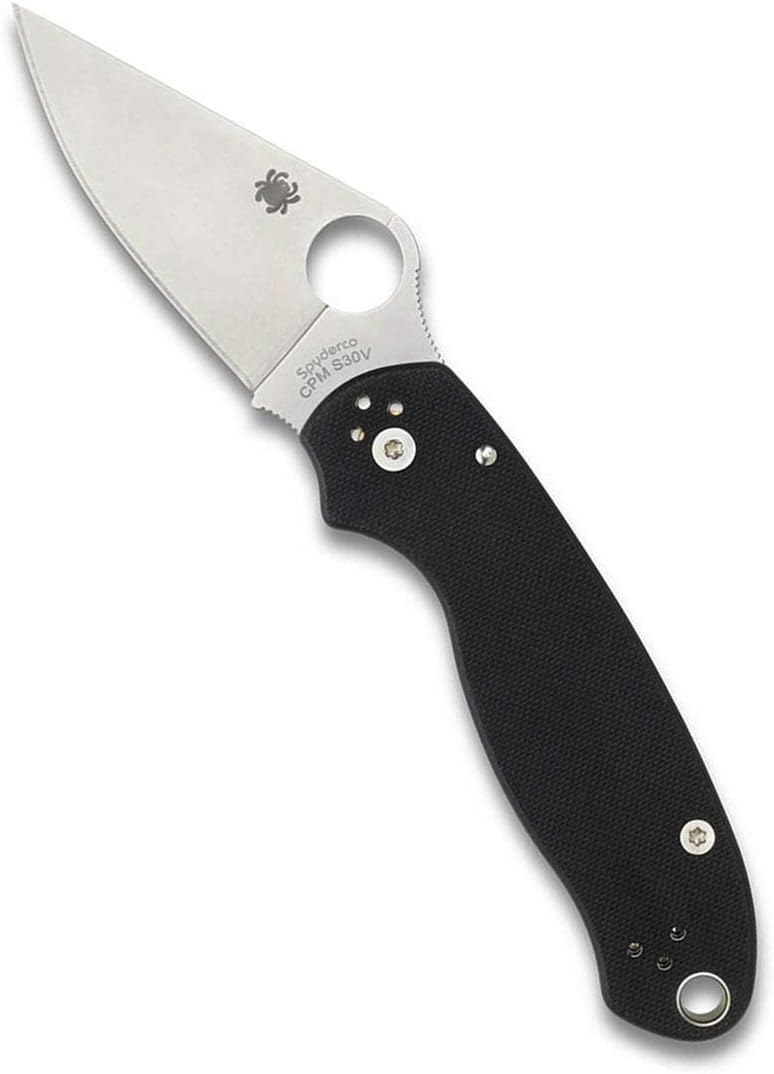
The blade of the Paramilitary 2 is a testament to performance-driven geometry. It features Spyderco’s signature leaf-shaped blade with a Full Flat Grind (FFG). This grind tapers from the spine all the way to the edge, creating a wedge that slices through cardboard, food, and rope with terrifying efficiency.
Steel Evolution: S30V to S45VN
For years, the standard PM2 came in CPM-S30V. Recently, Spyderco upgraded the base model to CPM-S45VN. This steel offers a slight improvement in corrosion resistance and edge retention over S30V while being easier to machine and sharpen. It is a true “Goldilocks” steel for EDC.
Understanding the nuances of blade material is critical. If you are unsure why S45VN is preferred over budget options, read our guide on stainless steel vs. carbon steel to see why this stainless particulate steel is a top-tier choice for maintenance-free carry.
The “Spydie Hole”
Instead of thumb studs, the PM2 uses the trademark Round Hole. It allows for easy ambidextrous opening, even while wearing gloves. It also enables the famous “Spydie Flick” (using your middle finger to flick the blade open), which is incredibly satisfying.
Understanding the Leaf-Shaped Blade
A lot of first-time Spyderco buyers get hung up on the look of the blade before they understand the logic behind it. The PM2 uses what Spyderco calls a modified leaf-shaped blade, which is essentially a hybrid between a drop point and a clip point. The spine curves gently downward toward the tip, while the belly of the edge sweeps upward to meet it, creating a fine, controllable point without sacrificing the sweeping curve needed for slicing motions.
This matters more than it sounds like it should. A pure drop point, like you’ll find on many hunting knives, has a rounded, robust tip that’s great for control but not particularly good at piercing. A clip point, common on traditional pocket knives and tactical fixed blades, has a thinner, more aggressive tip that pierces well but can be fragile under lateral stress. The PM2’s leaf shape splits the difference: the tip is fine enough for detail work and piercing cardboard or plastic packaging, but there’s enough steel behind it to avoid snapping under normal use.
Combine that blade shape with the full flat grind discussed above, and you get a knife that behaves almost like a straight razor when slicing through thin material, yet retains enough belly to roll through thicker cuts like rope or fibrous material without binding. This is why so many reviewers describe the PM2 as “surgical” in cardboard and rope-cutting tests — the geometry is doing most of the work, not the edge angle or steel alone.
Steel Deep Dive: S30V vs S45VN vs S110V vs Maxamet
Because the PM2 has been in continuous production for over a decade, it has been offered in a huge range of steels, both as standard production and as limited sprint runs. If you’re trying to decide which version to buy, understanding how these steels differ in real-world use will save you a lot of second-guessing.
CPM-S30V
This was the original standard steel on the PM2 for many years. It offers a good balance of edge retention, toughness, and corrosion resistance, and it’s relatively easy to sharpen on standard ceramic or diamond stones. It’s no longer considered cutting-edge by 2025 standards, but it remains a completely competent steel, and older PM2s in S30V are still excellent users.
CPM-S45VN
The current standard steel. S45VN improves on S30V’s corrosion resistance thanks to a higher chromium content, and it’s slightly easier to machine at the factory, which translates to more consistent factory edges. Edge retention is marginally better than S30V in most independent cutting tests, while toughness stays roughly comparable. For the vast majority of buyers, this is the steel to get.
CPM-S110V
Offered on select sprint runs, S110V trades some toughness and ease of sharpening for dramatically improved edge retention and wear resistance. This is a steel for people who cut a lot of abrasive material — cardboard by the pallet, drywall, carpet — and don’t want to sharpen often. The tradeoff is that when it does need sharpening, you’ll want diamond stones; conventional aluminum oxide stones will struggle.
Maxamet
Maxamet sprint runs are the extreme end of the spectrum. This is a powder-metallurgy steel with an enormous amount of carbide content, giving it edge retention that borders on absurd in cutting competitions. The tradeoff is toughness: Maxamet is more prone to chipping if you twist the blade or pry with it, and sharpening requires patience and the right equipment. It’s a steel for collectors and cutting-competition enthusiasts more than a daily hard-use tool.
Other Notable Sprint Steels
Over the years the PM2 has also been released in CPM-CruWear (a fantastic middle ground of toughness and edge retention favored by many hard-use enthusiasts), CTS-XHP, M4 (a tool steel with exceptional edge retention but more susceptibility to corrosion), and MagnaCut, a newer steel that many consider close to the theoretical sweet spot of toughness, edge retention, and corrosion resistance. If you can find a MagnaCut sprint run PM2, it’s widely regarded as one of the best versions of the knife ever produced.
Compression Lock: A Game Changer
If the blade is the heart of the PM2, the Compression Lock is its soul. Located on the spine of the handle (rather than the liner), it functions like an inverted liner lock but is significantly stronger.
Why is it superior?
- Safety: You never have to put your fingers in the path of the closing blade. You pinch the lock on the spine, and the blade swings shut freely.
- Strength: The geometry of the lock wedges a steel leaf between the blade tang and the stop pin. It is virtually impossible to disengage accidentally.
- Fidget Factor: Combined with the pivot bushings, the Compression Lock allows the blade to “drop shut” with zero resistance. It is addictive.

Safety meets speed. The Compression Lock allows for one-handed closing without cutting your fingers.
Check Price on AmazonHandle & Ergonomics
The handle is made from peel-ply textured G-10. It is grippy—almost aggressive—ensuring the knife stays in your hand even when wet, muddy, or bloody. The ergonomics are “locked in,” meaning the handle shape forces your hand into a secure grip.
The Forward Finger Choil
One of the PM2’s defining features is the 50/50 finger choil (the unsharpened area at the base of the blade). This allows you to choke up on the blade for detailed control. It effectively gives you two grip options: a full-handle grip for power cuts and a choked-up grip for precision work like whittling or food prep.
This versatility makes it one of the few folding knives that can legitimately compete with fixed blades for utility tasks, providing fine control when you need it most.
Handle Materials: G-10 vs FRN vs Carbon Fiber
While the standard PM2 ships with textured G-10 scales, Spyderco has released the model in a handful of alternate handle materials over the years, and it’s worth understanding what each one brings to the table before you decide which version fits your needs.
G-10 (Standard)
G-10 is a fiberglass laminate, made by pressing layers of glass cloth soaked in epoxy resin. It’s stiff, dimensionally stable, resistant to moisture, and can be textured aggressively during manufacturing, which is why the standard PM2 handle has that peel-ply grip pattern. G-10 is generally considered the best all-around handle material for a hard-use knife because it doesn’t flex, doesn’t absorb water, and holds up to abrasion over years of pocket carry.
FRN (Fiberglass Reinforced Nylon)
Some lightweight and budget-oriented variants use FRN, a glass-filled nylon that’s noticeably lighter than G-10 but slightly less rigid and less premium-feeling in hand. FRN handles flex a small amount under heavy grip pressure, which some users actually appreciate for comfort during extended cutting sessions, while others feel it makes the knife feel less “solid.” It’s a reasonable tradeoff if shaving grams is your priority.
Carbon Fiber
Limited sprint runs have used carbon fiber scales, which are lighter than G-10 while looking considerably more upscale, with the distinctive woven pattern showing through a clear resin coat. Carbon fiber is more brittle than G-10 under impact, though, so while it looks fantastic, it’s generally viewed more as a collector or occasional-carry option than a beat-around-the-jobsite choice.
For the vast majority of buyers, sticking with the standard G-10 version is the right call. It’s proven, it’s durable, and it’s what the PM2’s reputation was built on.
Pocket Carry Experience
If the PM2 has a flaw, it is the “pocket footprint.” Because the handle is tall (to accommodate the blade hole), it takes up a fair amount of horizontal space in your pocket. It is often affectionately called a “pocket hog.”
The pocket clip is a standard 4-position spoon clip. It’s functional, but not deep-carry. About half an inch of the knife handle sticks out of your pocket. Many owners immediately swap this for an aftermarket deep-carry titanium clip to make it more discreet.
PM2 vs. PM2 Lightweight
Spyderco also produces a Lightweight version of the Paramilitary 2, built around FRN scales and a slightly thinner blade stock in some releases. The Lightweight trades a bit of the “tank-like” feeling of the standard G-10 model for a noticeable weight reduction — often shaving off close to an ounce, which matters more than you’d expect when a knife rides in your pocket all day.
The tradeoff isn’t purely about weight, though. The FRN handle on the Lightweight flexes slightly more under hard grip pressure, and the overall feel in hand is less substantial. For office carry, travel, or anyone who’s sensitive to pocket weight, the Lightweight is a smart pick. For jobsite use, camping, or anyone who wants the knife to double as a light-duty pry tool in a pinch (even though you shouldn’t really pry with any folder), the standard G-10 version is the more confidence-inspiring choice.
Price-wise, the Lightweight typically runs a bit cheaper than the standard model, since FRN is less expensive to produce than G-10, making it an appealing entry point for buyers who want the PM2 experience without the full price tag.
Disassembly, Cleaning & Maintenance
One of the underrated advantages of the PM2 platform is how maintainable it is. Unlike many modern folders that use proprietary hardware or press-fit pivots, the PM2 is fully user-serviceable with common tools, and Spyderco even sells official replacement parts.
Tools You’ll Need
A T8 Torx driver handles the pivot screw and body screws on most production PM2s, though some sprint runs use slightly different hardware. A small bit of blue threadlocker, a light knife-specific lubricant, and a microfiber cloth round out everything you need for routine maintenance.
Basic Cleaning
Because the pivot uses phosphor bronze washers rather than bearings, the PM2 tolerates dirt and grime better than many bearing-equipped flippers, but it still benefits from occasional attention. Flushing the pivot area with isopropyl alcohol or a light degreaser and working the blade open and closed several times will clear out most pocket lint and debris without a full teardown.
Full Disassembly
For a deeper clean, the PM2 can be fully disassembled by removing the pivot screw, the body screws, and carefully separating the scales from the liners. This exposes the phosphor bronze washers, the blade tang, and the Compression Lock’s leaf spring. Once apart, everything can be cleaned individually, and a drop of lubricant can be applied to the washers before reassembly. It’s worth taking a photo before you start, since keeping track of washer orientation matters for smooth action afterward.
Adjusting Pivot Tension
Over time, or after disassembly, you may notice the blade has slight side-to-side play or, conversely, feels too tight to flick open smoothly. The pivot screw can be adjusted in small increments to dial in the exact amount of resistance you prefer. A drop of blue (removable) threadlocker on the pivot screw threads will keep it from backing out under regular use without making future adjustments a fight.
Lubrication
A thin, knife-specific oil applied sparingly to the washers and the lock face keeps the action smooth and helps prevent the phosphor bronze from developing a gritty feel over months of pocket carry. Over-lubricating is a common mistake — a single small drop per washer, worked in by opening and closing the blade a dozen times, is plenty.
Sprint Runs & Exclusive Collaborations
Part of what keeps the PM2 perpetually interesting, even fourteen-plus years after release, is Spyderco’s habit of using it as a testbed for new steels, handle materials, and colorways through limited sprint runs. Retailers like Blade HQ and DLT Trading frequently commission exclusive versions in eye-catching colors like orange, purple, or “burnt bronze” anodized hardware, often paired with a premium steel to justify the higher price point.
These runs typically sell out within days, sometimes hours, of release, which has created a secondary collector’s market where discontinued sprint runs can command a real premium over their original retail price. If you see a colorway or steel combination you like, it’s generally wise not to wait — unlike the standard black G-10/S45VN model, which Spyderco keeps in continuous production, sprint runs are genuinely limited and won’t be restocked once they’re gone.
For most buyers, though, chasing sprint runs isn’t necessary. The standard production PM2 in S45VN and black G-10 delivers essentially the same cutting performance as most of the exotic versions; you’re mainly paying extra for steel bragging rights or handle color when you go the sprint-run route.
Who Is the PM2 Really For?
Not every knife suits every person, and despite its reputation, the PM2 isn’t automatically the right choice for everyone. Here’s a breakdown of how it performs across common use cases.
Everyday Carry & General Utility
This is where the PM2 shines brightest. Opening packages, breaking down boxes, cutting zip ties, trimming loose threads — the combination of a full flat grind and premium steel makes short work of the small tasks that fill a typical day. If you only own one knife, this is the category the PM2 was built for.
Outdoor & Camping Use
For light camp tasks like food prep, cutting cordage, or feathering kindling, the PM2 performs well thanks to its comfortable choil grip and thin, slicey edge. It’s not a substitute for a fixed-blade survival knife if you’re doing heavy batoning or wilderness bushcraft, but as a supplementary tool alongside a hatchet or fixed blade, it earns its place in a pack.
Professional Trades (Warehouse, Construction, Delivery)
Workers who open hundreds of boxes a day consistently rate the PM2 highly for this exact task. The blade holds an edge through heavy cardboard use, and the Compression Lock means there’s no risk of the blade folding back onto your fingers during rapid, repetitive cutting. Some tradespeople do prefer a cheaper, more disposable option for jobsite use where knives get lost or damaged regularly — in that case, the PM2’s price tag might be harder to justify than a budget blade.
Food Prep
Thanks to the fine tip and the forward choil allowing a pinch-grip similar to a paring knife, the PM2 handles light food prep duties (camping meals, fruit, cheese) surprisingly well. It’s not a kitchen knife replacement at home, but for outdoor or travel food prep it’s more than capable.
Self-Defense & Tactical Use
The PM2 was designed with tactical applications in mind, and its fast deployment, secure grip, and strong lock make it a reasonable option in this category for people who’ve had proper training. That said, a folding knife of any kind is a limited defensive tool compared to dedicated options, and this use case should never be the sole justification for the purchase.
Collectors
Between the constant stream of sprint runs, steel variants, and handle colors, the PM2 has become a legitimate collector’s platform in its own right. Many enthusiasts own several versions purely to compare steels or handle materials side by side.
PM2 vs. The Competition
Spyderco PM2 vs. Benchmade 940 Osborne
This is the classic rivalry. The Benchmade 940 Osborne is slimmer, carries much better in the pocket, and has a stronger tip. However, the PM2 has better slicing geometry, better ergonomics for prolonged use, and a more reliable lock (springs don’t break). Choose the 940 for office carry; choose the PM2 for actual work.
Spyderco PM2 vs. Spyderco Para 3
The Para 3 is essentially a shrunken PM2. It has a 3-inch blade, making it legal in more jurisdictions. If you have smaller hands or strict knife laws, the Para 3 is excellent. But for anyone with L/XL hands, the PM2 offers a full four-finger grip that the Para 3 lacks.
Spyderco PM2 vs. Chris Reeve Sebenza 31
The Sebenza sits in an entirely different price tier, typically two to three times the cost of the PM2, and it shows in the fit, finish, and titanium framelock construction. For pure fit and finish, the Sebenza edges ahead. But in terms of raw cutting performance per dollar, the PM2 is very hard to beat, and many owners who’ve spent time with both still reach for the PM2 for actual hard-use tasks, saving the Sebenza for dressier carry.
Spyderco PM2 vs. Kizer/CJRB Budget Alternatives
Companies like Kizer and CJRB have released budget folders that borrow heavily from the PM2’s silhouette and lock style at a fraction of the price, often using steels like D2 or 14C28N instead of S45VN. These can be a smart entry point for someone who isn’t sure they’ll like the format yet, but the fit, finish, and steel performance generally can’t match the genuine PM2. Think of them as a way to try the concept before committing to the original.
Spyderco PM2 vs. Spyderco Manix 2
The Manix 2 uses Spyderco’s Ball Bearing Lock rather than the Compression Lock, along with a slightly rounder handle shape. Both are excellent, hard-use-rated knives from the same company, and the choice largely comes down to handle shape preference and lock mechanism preference rather than one being objectively better than the other.
How to Spot a Counterfeit PM2
Because the PM2 is so popular, it’s also one of the most commonly counterfeited knives on the market, especially through third-party marketplace sellers. A few things to check before buying from an unfamiliar seller:
- Pricing: If a “genuine” PM2 is listed well below the typical retail range, treat it as a red flag. Counterfeits are often priced to look like a steal.
- Compression Lock Action: Genuine PM2s have a distinctively crisp, ball-bearing-smooth lock engagement. Counterfeits often feel gritty or have a mushy, imprecise lock-up.
- Steel Markings: The blade should be clearly marked with the correct steel type and “Golden, Colorado” or the appropriate country-of-manufacture stamp. Blurry, misspelled, or missing markings are a strong indicator of a fake.
- Packaging: Genuine Spyderco packaging includes specific branding, a warranty card, and often a sharpening guide insert. Generic or missing packaging is a warning sign.
- Seller Reputation: Buying directly from Spyderco’s authorized dealer network (or reputable retailers) all but eliminates the risk. Marketplace listings from unfamiliar third-party sellers carry the most risk.
Warranty & Customer Support
Spyderco backs the Paramilitary 2 with a warranty against manufacturing defects, and the company has a well-earned reputation in the knife community for taking care of customers even outside the strict letter of the warranty terms. Common turnaround for warranty service tends to run a few weeks, and the company will typically repair or replace a knife with a genuine manufacturing issue at no cost, though shipping to their Golden, Colorado facility is usually the customer’s responsibility.
It’s worth noting that the warranty covers manufacturing defects, not general wear and tear, misuse, or damage from prying and abuse — a broken tip from prying open a paint can, for instance, isn’t going to be covered. For genuine issues like lock rock developing prematurely or a grinding pivot straight out of the box, though, Spyderco’s customer service has a strong track record of making it right.
Pros & Cons
The Pros
- Incredible slicing geometry (FFG).
- Compression Lock is safe, strong, and fun.
- Forward finger choil allows precision work.
- Premium S45VN steel is standard.
- Made in the USA (Golden, Colorado).
- Fully user-serviceable with common tools.
- Huge range of steels and colorways to choose from.
The Cons
- Wide profile takes up pocket space.
- Standard clip is not deep-carry.
- Delicate tip (needle-like point).
- Price has increased ($180+ range).
- Sprint runs sell out fast and command premiums.
- Widely counterfeited, so buying from trusted sellers matters.
Frequently Asked Questions
Is the Spyderco Paramilitary 2 worth the money?
Absolutely. While the price has risen, the combination of USA manufacturing, premium materials, and flawless quality control makes it a tool that can last a lifetime.
Is the tip of the PM2 fragile?
The tip is very fine, designed for piercing and detail work. It is not a pry bar. If you pry with it, it will snap. Use it for cutting, and it will be fine.
How often do I need to sharpen the PM2?
With S45VN steel, edge retention is excellent. For an average user, a monthly strop and a bi-annual sharpen are usually sufficient. Knowing the difference between a sharpening stone vs. honing steel can extend the time between major sharpenings significantly.
Is the Compression Lock better than the Axis Lock?
Mechanically, the Compression Lock is simpler and relies on fewer moving parts (no omega springs to break). Many consider it more reliable long-term, though both are excellent.
Is the PM2 legal to carry?
It has a 3.44-inch blade, which is legal in most US states. However, because it can be flicked open and locks, it is illegal in restrictive areas like the UK or NYC. Always check local laws.
Can I change the pocket clip position?
Yes. The PM2 has pre-drilled holes for 4 positions: Tip-up or Tip-down carry, for both Left and Right-handed users.
Does the PM2 come in other steels?
Spyderco is famous for “Sprint Runs.” You can find the PM2 in Maxamet, CPM-CruWear, S110V, MagnaCut, and more, though these special versions often cost more and sell out quickly.
Is it good for self-defense?
The PM2 was originally designed with “Paramilitary” applications in mind. It deploys fast and has a secure grip. However, without training, a knife is a poor defense tool compared to other options.
How do I know if my PM2 is genuine?
Check the steel markings on the blade, buy from an authorized retailer, and pay attention to how crisp the Compression Lock feels. Gritty lock-up, blurry markings, or too-good-to-be-true pricing are all signs of a counterfeit.
Can I disassemble the PM2 myself?
Yes. A T8 Torx driver is all you need for most versions. The pivot uses phosphor bronze washers rather than bearings, making the knife easy to clean, lubricate, and reassemble at home.
Should I get the standard G-10 or the Lightweight FRN version?
If pocket weight is your top priority, go Lightweight. If you want the most solid, hard-use feel, stick with the standard G-10 model.

Join the legion of fans who swear by the PM2. It might just be the last knife you ever need.
Check Price on AmazonFinal Verdict
The Spyderco Paramilitary 2 is not a piece of jewelry; it is a cutting tool designed for performance above all else. Its aesthetics are polarizing, and its pocket footprint is large. But in terms of ergonomics, cutting ability, and lock reliability, it remains the King of the Hill.
Whether you are breaking down boxes in a warehouse, prepping food at a campsite, or just need a reliable companion for daily life, the PM2 delivers. It is the gold standard for a reason.