

What Is the Microtech Ultratech?
There are a handful of names in the OTF (out-the-front) automatic knife world that carry genuine weight. Microtech is one of them, and the Ultratech is the knife that built the brand’s reputation for manufacturing quality that simply doesn’t apologize. It isn’t a knife for everyone — it sits in a legal gray area in many jurisdictions, it’s expensive, and it’s utterly unnecessary for most cutting tasks. That’s almost exactly why it has such a passionate following.
First introduced in 1999, the Ultratech was Microtech’s answer to a market demand for a dual-action OTF that felt surgical rather than tactical-toy. Where most OTFs of that era were loose, rattly, and prone to accidental deployment, the Ultratech was machined from aerospace-grade 6061-T6 aluminum with tolerances measured in thousandths. Over two and a half decades later, the formula hasn’t fundamentally changed — it’s just been refined.
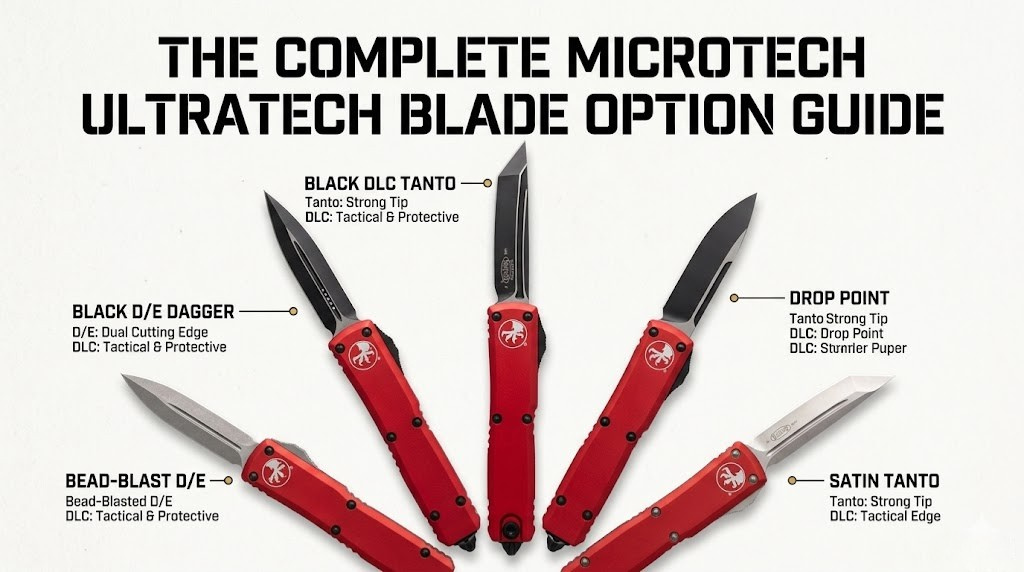
What separates the Ultratech from competitors and even from other Microtech models is the sheer breadth of its blade configuration options. You can order a single Ultratech in configurations spanning three primary blade profiles, three edge types, a dozen finish combinations, and multiple handle colorways. Understanding what each of those options actually means in practice — and which combination suits your needs — is the entire purpose of this guide.
The mechanism is a dual-action OTF: pushing the thumb slider forward deploys the blade; pushing it backward retracts it. This single-slider dual-action design is more elegant than two-button systems and gives the Ultratech its characteristic smooth, snappy action. The spring tension is strong enough that accidental deployment during normal carry is genuinely not a concern — this is one of the tightest OTF mechanisms in production.
OTF automatic knives are federally regulated and subject to individual state laws. Federal law prohibits interstate commerce of switchblades with blades over 1.5 inches to civilians. Most states have their own rules — some prohibit OTFs entirely, others require concealed carry permits, and some are unrestricted. Always verify local law before purchasing or carrying.
Microtech Ultratech Blade Profile Options
This is where the Ultratech earns its reputation as the most versatile production OTF available. Three primary blade profiles cover a wide arc of use cases — from traditional utility to purpose-built tactical applications. Each profile has functional implications that go far beyond aesthetics.
Classic drop point or modified clip point. One sharpened edge, spine runs flat. Most legal and most versatile option.
Most PopularSymmetrical dagger profile. Both edges sharpened. Primarily a collector’s configuration with tactical heritage.
Restricted in Some StatesWharncliffe/reverse tanto geometry. Flat cutting edge, pronounced spine curve, chisel-like tip. Optimized for slicing.
SpecialtySingle Edge Variants: The Foundation
The single-edge Ultratech is the entry point for most buyers, and for good reason. A single sharpened edge with a flat or slightly curved spine is legal in virtually every jurisdiction that permits OTF knives at all, is easier to sharpen, and handles the full range of EDC tasks from box cutting to food preparation. The blade geometry on the Ultratech SE sits somewhere between a modified drop point and a clip point — the spine has a gentle upward sweep near the tip that creates a fine, usable point.
The grind on single-edge Ultratechs is a hollow grind. Microtech’s hollow grind on M390 produces a remarkably thin edge that cuts with startling ease for a knife of this blade thickness. You’ll notice this immediately if you’ve ever tried an OTF from lesser manufacturers — cheap OTF blades tend to have thick, wedge-like geometry that pushes rather than cuts. The Ultratech SE actually slices.
In terms of everyday carry suitability, the single-edge Ultratech handles all routine tasks competently. Cardboard, food, rope, plastic packaging — the 3.35-inch blade is neither too short to be useful nor so long that it becomes cumbersome. The tip is fine enough for detail work but not so fragile that incidental contact is a concern.
Double Edge (Dagger): The Collector’s Configuration
The double-edge Ultratech is symmetrical — both the top and bottom edges are ground and sharpened, creating a true dagger profile. This configuration is the most visually dramatic and the most restricted from a legal standpoint. In many US states, double-edged knives (sometimes called daggers) face additional restrictions beyond those applied to OTF automatics generally. Research your local laws thoroughly before pursuing this configuration.
From a functional standpoint, the double-edge Ultratech is optimized for stabbing/thrusting rather than slicing utility. The symmetric blade creates a centered tip that’s extraordinarily fine — the kind of point that focuses all the cutting energy of a thrust into a very small area. This makes it extremely effective at its intended purpose (military/tactical applications) and considerably less practical for everyday cutting tasks.
The double-edge configuration is also simply more beautiful in a classical sense. The symmetry is elegant, the balanced geometry is visually striking, and there’s a reason this form has remained a constant in the knife world since the dagger first evolved. For collectors, the DE Ultratech represents the purest expression of Microtech’s OTF craft — there’s nowhere to hide in a symmetric profile, and Microtech’s execution is flawless.
Hellhound: The Wharncliffe Specialist
The Hellhound variant is the most unusual of the Ultratech family, and it has developed a passionate following among EDC enthusiasts who prioritize slicing geometry over piercing capability. Named for the aggressive visual presence its reverse curve creates, the Hellhound uses a wharncliffe-inspired blade profile where the cutting edge runs nearly flat from the base of the blade to the tip, and the spine curves dramatically downward to meet it.
What this geometry produces in practice is a blade that is exceptionally controlled during slicing. The flat cutting edge means the entire edge engages the material at once — unlike a curved drop point, there’s no belly to “rock” on. This is ideal for applications where you want linear, controlled cuts: opening boxes, scoring materials, food prep, and tasks where precision matters more than versatile point work.
The Hellhound’s tip is also much more robust than the standard Ultratech’s — the convergence angle at the tip is wider, meaning it’s far less likely to snap under lateral stress. Trade-off: the tip isn’t particularly fine, so detail piercing work is not where this blade shines. Think of the Hellhound as the Ultratech for the person who actually uses their knife rather than displaying it — the geometry is purpose-built for cutting, not aesthetics.
Edge Types & Grinds: Plain, Serrated & Combo
Every Microtech Ultratech blade profile is available in three edge configurations. Understanding which edge type suits your intended use is arguably more important than the blade profile choice, because the edge is what actually does the work. The three options — plain edge (PE), partially serrated (combo), and fully serrated (SE) — each represent a meaningful functional trade-off.
Plain Edge: Maximum Versatility and Sharpenability
A plain edge is exactly what it sounds like: a single, continuous edge bevel running from the base of the blade to the tip without interruption. On the Ultratech, this is a hollow-ground plain edge finished to a hair-shaving sharp factory edge from the factory. The plain edge is the most versatile configuration because it handles both push-cutting and slicing tasks equally well, and when it dulls, you can re-sharpen it to factory performance with standard diamond or ceramic honing equipment.
For most buyers, a plain-edge Ultratech is the correct choice. Unless you have a specific, identifiable need for serrations — regular rope cutting, seatbelt emergencies, cutting through web strapping — a plain edge will outperform a serrated edge on nearly every other task while remaining far easier to maintain at home.
Edge retention on the M390 plain-edge Ultratech is genuinely excellent. M390 holds an edge longer than the vast majority of production knife steels, which means the intervals between sharpening sessions are long. Most EDC users will go months or years of moderate use before needing to touch the edge with anything beyond a light strop. You can learn more about edge retention across different steels in our AUS-10 vs VG-10 edge retention comparison.
Partially Serrated (Combo Edge)
Partially serrated Ultratechs — often called “combo” configurations — divide the blade into two functional zones. The rear portion of the cutting edge (near the handle) features recurved serrations, while the forward portion (toward the tip) maintains a plain edge. This gives you a single blade capable of both tasks without having to carry two knives.
The reality is more nuanced than the marketing suggests. The combo edge excels at rope and fibrous material cutting but is more difficult to sharpen because you now need two different techniques for one edge: a flat stone or diamond plate for the plain section, and a ceramic or diamond rod for the serrated section. Many users find the combo edge unsatisfying in both directions — not as good at pure utility tasks as a full plain edge, and not as aggressive at fibrous cutting as a full serration.
That said, if you carry in an environment where emergency cutting of webbing or seatbelts is a legitimate scenario, the combo edge is a reasonable compromise. It’s particularly popular with first responders who want an OTF that can handle both tactical utility and emergency extrication in a single tool.
Fully Serrated
A fully serrated Ultratech puts recurved serrations along the entire cutting edge. This configuration is devastatingly effective at cutting rope, webbing, seatbelts, tent lines, and any other fibrous material where serrations can grab and tear. It’s genuinely the right tool for certain specialized jobs.
It is genuinely terrible for most other jobs. Serrations cannot be dragged across a cutting board cleanly. They tear rather than slice. They’re difficult to sharpen without specialized equipment (round ceramic or diamond rods matched to serration radius). And they’re essentially impossible to maintain to factory sharpness at home without a dedicated serration sharpener.
The fully serrated Ultratech is a niche product for buyers who have a clear, specific application where serrations excel. Emergency responders, rescue personnel, sailors, and anyone regularly working with rope or webbing will find genuine value here. EDC users without those specific needs will find a plain edge more satisfying in every daily use scenario.
| Edge Type | Best For | Sharpening | EDC Practicality | Rope/Webbing |
|---|---|---|---|---|
| Plain Edge | All-around utility | Easy | Excellent | Moderate |
| Combo (Partial Serr.) | Mixed utility/rescue | Moderate | Good | Good |
| Full Serrated | Rope, webbing, rescue | Difficult | Limited | Excellent |
M390 Steel: Why Microtech Chose It and What It Delivers
Böhler M390 is a third-generation micro-carbide powder metallurgy stainless steel that has become the de facto benchmark for premium production knife steel. Microtech’s decision to standardize on M390 for the Ultratech is both a quality statement and a practical one — M390 represents the best balance of corrosion resistance, edge retention, and grindability available in a production-viable steel.
The chemistry is where M390 gets interesting. With approximately 20% chromium, 4% vanadium, 0.7% molybdenum, and 1.9% carbon, M390 forms a dense matrix of fine vanadium carbides that provide cutting resistance, surrounded by a high-chromium martensitic matrix that provides corrosion resistance. At 60–62 HRC (Microtech’s heat treatment specification), this steel holds an edge significantly longer than popular mid-grade steels like 154CM or VG-10, while maintaining corrosion resistance that far exceeds carbon-heavy steels at similar hardness levels.
Böhler M390 and Carpenter CTS-204P share essentially the same composition (minor production variations). If you’ve heard M390 compared to 204P, they are functionally interchangeable and performance data applies to both. Damasteel RWL-34 is similar but distinct.
In practice, an M390 Ultratech with a proper factory edge will stay sharp through an amount of EDC cutting that would leave 440C or 8Cr13MoV blades noticeably dulled. Users who carry regularly and use their knife for light daily tasks can often go six months to a year before needing to sharpen (not just strop) the edge. This is a meaningful quality-of-life advantage for an EDC tool.
M390 vs. Other OTF Knife Steels
| Steel | Hardness (HRC) | Edge Retention | Corrosion Resist. | Home Sharpen. | Tier |
|---|---|---|---|---|---|
| M390 | 60–62 | Excellent | Excellent | Moderate (needs diamond) | Premium |
| S35VN | 59–61 | Very Good | Very Good | Good | Premium |
| S30V | 58–60 | Good | Very Good | Good | Mid-High |
| 154CM | 58–60 | Good | Good | Easy | Mid |
| AUS-8 | 57–59 | Moderate | Good | Very Easy | Budget |
| 420HC (OTF budget) | 55–57 | Poor | Good | Very Easy | Budget |
What the table above illustrates clearly is that M390 sits at the apex of what’s available in production OTF knives. The gap between M390 and the steels used by budget OTF manufacturers isn’t subtle — it’s the difference between a blade that holds a functional working edge and one that dulls noticeably within a day of real use. For those accustomed to analyzing kitchen knife steels — comparing, say, Zwilling vs. Henckels blade hardness — the gap between premium and budget OTF steels is even more dramatic than in culinary knives.
Hardness, Toughness & the Real Trade-Off
At 60–62 HRC, M390 is genuinely hard — harder than most German kitchen knife steels (which typically run 56–58 HRC) and comparable to premium Japanese gyuto steels. This hardness is what enables the thin hollow grind and the long edge retention, but it comes with a trade-off: harder steels are more brittle. Snapping the tip of an M390 blade requires considerably more force than snapping softer steel, but it’s not impossible under extreme lateral stress.
Microtech mitigates this by maintaining appropriate blade geometry. The Ultratech’s blade is thick enough at the spine to provide structural integrity while the grind creates the thin edge geometry that cuts well. This is engineering rather than compromise — the blade is designed to perform within the parameters of its use case, not to be pried with or used as a screwdriver.
Blade Finish Options: Aesthetics Meet Durability
Microtech offers the Ultratech in a wider range of blade finishes than almost any other OTF manufacturer. These aren’t just cosmetic choices — the finish affects the blade’s reflectivity (relevant for tactical applications), scratch resistance, and in some cases, corrosion resistance at the surface level. Understanding what each finish actually is helps you make an informed choice rather than just selecting your favorite color.
Stonewash
Stonewash is achieved by tumbling blades with abrasive media — literally “washing” the steel surface with stones. The result is a matte-to-satin finish with a distinctly non-uniform, slightly mottled surface texture. This is the most practically durable finish in Microtech’s lineup because scratches and handling marks blend into the existing texture virtually invisibly. A stonewash Ultratech looks virtually the same after three years of carry as it did out of the box.
Stonewash is also the most reflectivity-neutral option — not as bright as satin, not as dark as DLC. For everyday carry where you’d rather the knife not catch attention, stonewash is ideal. It’s also the most forgiving finish to photograph (which may explain why it dominates in product imagery).
Satin Finish
Satin-finished Ultratechs have a directional, brushed appearance — machining marks run parallel along the flat of the blade, creating a surface that’s bright but not mirror-reflective. The satin finish on M390 is visually striking because the steel’s fine carbide structure polishes cleanly, and the finish highlights the blade geometry beautifully.
The trade-off is that satin finishes show every fingerprint and fine scratch. After a week of regular use, a satin blade shows handling marks clearly. Many owners don’t mind — some prefer the “working patina” — but if pristine appearance matters, satin requires more maintenance attention than stonewash. Touch-up is possible with fine-grit abrasive or a scotch-brite pad if you want to restore the directional finish.
Black DLC (Diamond-Like Carbon)
DLC coating is a physical vapor deposition (PVD) process that applies an amorphous carbon film to the blade surface. The result is an extremely hard (DLC hardness rivals diamond), ultra-thin black coating that is essentially impervious to scratching from normal EDC use. A DLC-coated Ultratech maintains its dark, matte appearance through years of hard use in ways that no other finish can match.
DLC also provides an additional layer of corrosion protection, though M390’s native corrosion resistance already makes this somewhat redundant. The more meaningful advantage is optical — the non-reflective black surface makes the blade effectively invisible in low light, which is significant for users in professional defensive or law enforcement applications.
The one caveat: DLC coatings, while extremely hard, are thin. A sufficiently deep scratch (from rock contact, concrete, metal-on-metal) can breach the coating locally. Spot DLC repairs aren’t practical — the coating is applied in a vacuum chamber. This doesn’t affect function, but if pristine cosmetics matter over the knife’s lifetime, be aware that DLC can be damaged.
Apocalyptic Finish
The “apocalyptic” finish is Microtech’s signature aesthetic — a multi-tonal, chemically-induced surface that mimics the look of a well-used, battle-worn blade without actual battle damage. The finish uses controlled surface chemistry to produce swirling patterns of gray, brown, and dark tones across the blade face. No two apocalyptic finishes are exactly identical, making each knife technically unique.
Apocalyptic Ultratechs are among the most visually arresting production knives available at any price point. The finish is genuinely beautiful in a rugged, industrial way that photographs exceptionally well. It’s also reasonably durable — not as impervious as DLC, but significantly more scratch-forgiving than satin.
Colored / Anodized Variants
Microtech produces limited-run and special-edition Ultratechs with hardware-level anodized color finishes — gold titanium hardware, bronzed blades, purple, blue, and other colors. These are collector-oriented configurations where aesthetics override tactical considerations. The blade finish colors are typically achieved through anodizing (for titanium hardware) or PVD coating (for blade colors beyond the base steels). Their durability varies by specific finish — anodized titanium hardware is highly durable; colored blade coatings vary.
| Finish | Appearance | Scratch Resistance | Reflectivity | Best For |
|---|---|---|---|---|
| Stonewash | Matte/mottled gray | Excellent | Low | EDC, hard use |
| Satin | Bright, directional | Moderate | High | Display, aesthetics |
| Black DLC | Matte black | Excellent | Very Low | Tactical, hard use |
| Apocalyptic | Multi-tonal, unique | Good | Low-Medium | Collectors, display |
| Bronzed/Gold | Warm metallic | Moderate | Medium-High | Collectors, gifts |
Handle Configurations: Colors, Hardware & Materials
The Ultratech’s handle is 6061-T6 aluminum — aircraft-grade alloy that provides an exceptional strength-to-weight ratio. The T6 temper designation means the aluminum has been solution heat-treated and artificially aged to maximize hardness and strength, giving the handle a structural rigidity that compares favorably with stainless steel while being substantially lighter.
Microtech anodizes the handle in a wide range of colors. Standard production colors include black, OD green, tan/coyote, blue, red, and several others that rotate through production runs. The anodizing process creates a hard oxide layer directly on the aluminum surface — it’s not a coating that can peel, but rather a transformation of the surface material itself. This means handle colors are extraordinarily durable even under hard use.
Clip Options and Carry Configurations
All Ultratechs ship with a deep carry pocket clip that positions the knife as a tip-down carry in the pocket. Microtech’s standard clip is stainless steel with a black or silver finish matched to the overall configuration. The clip is mounted via two screws and is replaceable — third-party and Microtech aftermarket clips are available for those who prefer tip-up carry or different clip profiles.
The clip geometry is well-designed for pocket carry. The Ultratech’s 4.72-inch handle is neither too short to control nor so long that it prints visibly through a pocket. Most users report the knife sitting securely with the clip, with minimal movement during active carry. The only complaint occasionally raised is the clip’s draw angle — some users prefer a more aggressive cant for faster deployment, though for an OTF this is somewhat academic since the blade deployment itself is already extremely fast.
Safety Mechanism
An important but often-overlooked aspect of the Ultratech’s design is its integrated safety. A small lever on the spine of the handle locks the thumb slider in place, preventing any deployment — intentional or accidental. This safety is not the kind that interferes with rapid deployment when you need it (disengaging is fast and intuitive), but it provides genuine peace of mind for those concerned about OTF carry safety.
The safety is particularly well-positioned — reachable with the natural thumb grip, but not in a location where you’d engage it accidentally during normal handling. This is a detail that separates Microtech’s engineering from cheaper OTF manufacturers, where “safety” mechanisms are often either ineffective, annoying, or both.
Special Series, Limited Runs & Custom Configurations
Part of what makes the Ultratech ecosystem so compelling to collectors is the constant stream of special-edition and limited-run configurations that Microtech produces. These range from serialized limited editions with unique materials to dealer-exclusive color combinations, to annual signature series knives with distinctive design elements.
Signature Series
Microtech’s Signature Series Ultratechs typically feature enhanced handle materials (carbon fiber inserts, G10 overlays, or specialized anodizing patterns) paired with specific blade configurations that aren’t available in standard production. These are produced in numbered quantities and command significant premiums on the secondary market. Their collector value often exceeds their functional utility premium, making them more appropriate as investment pieces than daily carry tools.
Apocalyptic Series
The Apocalyptic Series is technically a finish variant, but it has evolved into effectively its own product line within the Ultratech family. These feature the distinctive apocalyptic blade finish paired with matching hardware — bronzed or similarly finished hardware components create a cohesive, industrial aesthetic that reads as a complete design statement rather than an accessory option. The Apocalyptic series is produced in sufficiently high volume to be available through authorized dealers, but individual color and finish combinations rotate.
Tactical Series and LE Configurations
Microtech produces law enforcement and military-oriented limited editions with specific configuration requirements — typically double-edge blades with black DLC finish and OD green or tan handles. These are the configurations that most closely reflect the Ultratech’s tactical heritage, and they’re produced in controlled quantities for both the professional market and the collector market that follows tactical EDC closely.
Microtech limited editions and special runs are heavily counterfeited. If purchasing from the secondary market, verify serial numbers and hardware details against known-authentic examples. Microtech’s quality of fit and finish is a reliable indicator — counterfeit Ultratechs invariably show slop in the OTF mechanism and rough handle machining.
Custom Shop Options
Microtech’s Custom Shop division offers bespoke configurations that can include unique blade steels (Elmax, CPM-S90V, or other non-standard materials), handle material upgrades, specialized engravings, and configuration combinations not available in standard production. Custom Shop Ultratechs are priced significantly above standard production — expect $600–$1200+ depending on specifications — but represent genuine one-of-a-kind tools. Lead times through the Custom Shop typically run several months.
Ultratech vs. The Competition: Where Does It Stand?
The Ultratech doesn’t exist in a vacuum. The OTF automatic knife market has several serious competitors, and the Ultratech’s position at the premium end needs to be justified against alternatives from both Microtech’s own lineup and competing manufacturers.
Microtech Ultratech vs. UTX-85
Within Microtech’s own lineup, the UTX-85 is the Ultratech’s closest sibling. The UTX-85 shares the same general design philosophy but is smaller (2.9-inch blade vs. 3.35 inches) and is manufactured by Microtech’s sister brand, making it more accessible at a lower price point. The Ultratech wins on mechanism refinement, handle quality, and blade steel specification. The UTX-85 wins on price and compact carry for those who prefer a smaller footprint.
Microtech Ultratech vs. Combat Troodon
The Combat Troodon is Microtech’s larger, more overtly tactical OTF — featuring a 3.8-inch blade, a larger overall package, and a distinctly more aggressive aesthetic. If the Ultratech is Microtech’s everyday refined OTF, the Combat Troodon is the tactical statement. The Troodon’s larger blade and handle are an advantage for defensive applications and harder-use scenarios, while the Ultratech’s more compact dimensions and refined aesthetic make it the superior daily carry choice.
| Model | Blade Length | Steel | Weight | Price Range | Best For |
|---|---|---|---|---|---|
| Ultratech | 3.35″ | M390 | 3.9 oz | $300–$450 | EDC, collect |
| UTX-85 | 2.9″ | M390 | 3.0 oz | $180–$260 | Compact EDC |
| Combat Troodon | 3.8″ | M390 | 5.0 oz | $400–$550 | Tactical, duty |
| Ultratech Mini | 2.0″ | M390 | 2.4 oz | $230–$320 | Minimalist EDC |
| Benchmade Infidel | 3.95″ | D2/M390 | 4.7 oz | $360–$500 | Tactical, duty |
| Protech TR-3 | 3.5″ | CPM-154 | 4.0 oz | $200–$280 | Budget premium OTF |
Ultratech vs. Benchmade Infidel
The Benchmade Infidel is the Ultratech’s most direct head-to-head competitor in the premium OTF space. Both are US-made, premium-steel, dual-action OTFs with strong reputations. The Infidel is slightly larger — 3.95-inch blade vs. 3.35 inches — and historically used D2 before Benchmade transitioned some configurations to M390. The mechanism feel between the two is a matter of personal preference, but the Ultratech is generally considered to have a crisper, more precise action. The Infidel has a longer track record in law enforcement and military use, while the Ultratech has a stronger collector following. Both are excellent — the choice often comes down to blade profile preference and handle aesthetics.
- Wider blade configuration matrix
- More finish options available
- Crisper OTF action feel
- More compact and refined for EDC
- Larger collector/aftermarket ecosystem
- M390 standard across production
- Legal in fewer jurisdictions than folders
- Expensive ($300–$450+)
- DE version highly restricted legally
- Less practical for food prep than folders
- Requires diamond tools for sharpening

How to Choose Your Microtech Ultratech Configuration
With the full range of blade profiles, edge types, and finishes laid out, the question becomes practical: how do you actually choose? The matrix of options can feel overwhelming, but a structured approach narrows the field quickly. Work through these decisions in order.
Step 1: Verify Your Local Laws
This is not optional, and it’s the decision that shapes everything else. If your state prohibits OTF automatics for civilians, the discussion ends here. If your state permits OTFs but restricts double-edged blades (which is common), that eliminates the DE configuration. Some jurisdictions have blade-length restrictions that make the standard Ultratech non-compliant for carry. Know your laws before investing $300–$450.
Step 2: Choose Your Blade Profile
If you want the most legally permissive, versatile, and practically useful Ultratech, the single-edge configuration is the answer for virtually all buyers. It handles everyday tasks, it’s legal everywhere OTFs are legal, and it’s sharpenable at home with appropriate tools.
If you’re a collector and double-edge legality isn’t an issue in your jurisdiction, the DE Ultratech is the aesthetic peak of the lineup — symmetrical, visually striking, and the most “pure” expression of what an OTF can be. If you carry a knife primarily as a utility tool and prioritize controlled slicing over point work, the Hellhound offers a genuinely superior cutting geometry for those specific tasks.
Step 3: Choose Your Edge Type
Default to plain edge unless you have a specific, articulatable need for serrations. Ask yourself: do I regularly cut rope, webbing, seatbelts, or other fibrous materials that would benefit from serrations? If the honest answer is no, a plain-edge Ultratech will serve you better in every daily use scenario.
If you answered yes to the above, consider the combo edge as a compromise before committing to full serrations. Full serrations are appropriate only if fibrous material cutting is your primary use case, not an occasional secondary one.
Step 4: Choose Your Finish
For EDC where the knife will actually be used and carried, stonewash or black DLC are the most durable choices. Stonewash handles everyday carry marks gracefully. DLC is the most scratch-resistant option available and provides the lowest visual profile.
For display, collecting, or occasional carry where appearance is a priority, satin or apocalyptic finishes offer greater visual interest. Limited-edition and colored configurations are primarily for collectors — they command premium prices and often appreciate in value on the secondary market.
Decision Matrix
| Use Case | Recommended Profile | Edge | Finish |
|---|---|---|---|
| Everyday Carry Utility | Single Edge | Plain | Stonewash |
| Tactical/Professional | Single Edge or DE | Plain or Combo | Black DLC |
| Emergency Rescue | Single Edge | Combo or Full Serr. | Stonewash or DLC |
| Slicing / Utility Focus | Hellhound | Plain | Stonewash |
| Collection / Display | DE or SE | Plain | Satin, Apocalyptic |
| Gift (First OTF) | Single Edge | Plain | Stonewash or Satin |
Maintenance & Sharpening the Microtech Ultratech
Premium steel and precision manufacturing don’t eliminate the need for maintenance — they extend the intervals between required maintenance and raise the ceiling of what the knife can perform. Understanding how to care for an M390 Ultratech blade keeps it performing at the level you paid for.
Routine Cleaning
The OTF mechanism accumulates debris — pocket lint, dust, and in hard-use environments, grit and moisture. Microtech recommends periodic cleaning of the mechanism by deploying and retracting the blade repeatedly while applying a light lubricant spray (Rem Oil, Sentry Solutions TUF-GLIDE, or similar) to flush debris from the channel. For heavier contamination, full disassembly is possible but requires Torx drivers and patience — most users find the periodic oil-and-cycle method sufficient for maintenance between professional service intervals.
The blade surface can be cleaned with warm water and a soft cloth. M390’s high chromium content means surface rust from ordinary moisture exposure is essentially impossible under normal use conditions. If the knife sees saltwater or heavy chemical exposure, rinse thoroughly and dry completely.
Sharpening M390 at Home
M390’s 60–62 HRC hardness means standard whetstones may struggle to cut it efficiently without diamond abrasives in the mix. The practical approach for home sharpening: start with a diamond plate or diamond-embedded stone (400-600 grit for edge repair, 1000+ grit for refinement) and finish with a ceramic rod or fine ceramic stone. A leather strop loaded with 0.5-micron chromium oxide compound brings the edge to razor sharpness.
The hollow grind on the Ultratech blade means you’re maintaining a relatively thin bevel — aggressive sharpening angles can round the edge quickly. Maintaining the factory bevel angle (approximately 20–22 degrees per side) with a guided system like the Lansky Controlled Angle or Edge Pro produces the most consistent results. For those experienced with freehand sharpening, maintaining the hollow grind geometry freehand is achievable with practice. You can explore sharpening strategies and angle selection in our 15 vs. 20 degree sharpener guide.
Lubrication Schedule
The OTF spring mechanism requires lubrication to maintain consistent deployment speed and prevent wear. Microtech recommends a light application of quality lubricant to the spring and slider mechanism every 6–12 months for moderate use, more frequently for heavy use or exposure to moisture and debris. Over-lubrication is counterproductive — excess oil attracts pocket lint and grit that accelerates wear and can gum up the mechanism. A single drop of quality synthetic oil distributed through the mechanism is sufficient.
Professional Service
For major service — spring replacement, mechanism rebuilding, blade replacement — Microtech offers factory service through their authorized service program. The cost is reasonable relative to the knife’s value, and factory service restores the mechanism to production specifications. Most Ultratechs, properly maintained, will never require factory service for mechanism issues. The most common service scenario is blade replacement after damage or when the user wants to change configuration.
Store your Ultratech with the blade retracted and the safety engaged when not carrying it. Long-term storage with the blade deployed keeps the spring in a compressed state, which can gradually reduce spring tension over time. This is a minor concern but good practice for maintaining optimal mechanism function.
If you’re new to maintaining high-hardness steels or want to build a comprehensive sharpening system for your knife collection, our whetstone vs. electric sharpener breakdown provides an excellent framework for choosing the right tools for your skill level and budget.
The Ultratech in the Broader EDC Knife Context
The Microtech Ultratech occupies a very specific position in the EDC landscape — it’s a purpose-built automatic OTF that offers capabilities and a carry experience that conventional folding knives simply cannot replicate. But understanding where it fits relative to other premium EDC options helps set accurate expectations, particularly for buyers coming from the folder world.
An OTF’s deployment advantage is real but situationally specific. One-handed opening of conventional folders has become so refined — assisted opening mechanisms, thumb studs, flippers — that the speed differential between a quality folder and a quality OTF in a non-emergency context is measured in fractions of a second. Where the OTF genuinely wins is in ambiguous situations where you need a blade available quickly with a single hand already occupied by something else. The thumb-slider action requires only one thumb, no wrist rotation, and no pre-positioning of the knife.
For buyers who want to explore the full spectrum of EDC folding knives before committing to an OTF, Zero Tolerance’s lineup breakdown provides an excellent comparative framework — the ZT 0350, 0450, and 0562Ti each represent different philosophies within the premium folder space that share some design DNA with the Ultratech’s aesthetic.
The Ultratech is also meaningful to consider in context with the broader Microtech family. The brand’s OTF lineup — from the compact UTX-85 through the Ultratech to the Combat Troodon and the Halo — represents a complete ecosystem for different use cases, carry preferences, and legal environments. Understanding the Ultratech’s position within that family (the versatile, refined flagship) helps clarify when another Microtech OTF might be more appropriate for a specific user’s needs.
Is the Microtech Ultratech Worth the Price?
At $300–$450 for a standard production model and $500+ for limited editions and custom configurations, the Ultratech is expensive by any reasonable standard. The question isn’t whether there are cheaper OTF knives — there are many — but whether the Ultratech’s premium over those alternatives is justified.
The answer, from a manufacturing quality standpoint, is unambiguous: yes. The OTF mechanism in a Microtech Ultratech has tolerances and consistency that no budget OTF manufacturer comes close to matching. The blade-to-handle alignment, the spring tension consistency, the precision of the slider travel — these are the products of CNC machining with aerospace standards applied to knife production. Budget OTF knives from Chinese manufacturers show blade wobble, inconsistent deployment force, and rattling handles that make direct comparison almost unfair.
The M390 steel specification is also meaningful in value terms. M390 at 60–62 HRC costs real money in material and heat treatment. Budget OTF knives use 420HC or similar low-tier stainless at 55–57 HRC — steel that requires resharpen after every serious use session. The long edge retention of M390 reduces the lifetime maintenance burden meaningfully.
The USA manufacturing argument is more nuanced. Microtech produces in Florida with American labor and quality control. This adds cost, but it also means genuine accountability for quality and consistent production standards. Service and warranty support is real and responsive. These aren’t abstract benefits for a tool you’re carrying daily.
For collectors, the value argument is even clearer — Microtech Ultratechs hold their value on the secondary market remarkably well, and limited editions often appreciate. This is a knife that doesn’t depreciate like most consumer goods.
Where the value argument weakens is for casual buyers who want an OTF primarily as a novelty. If your genuine cutting needs are covered by a $30 folder and you just want to enjoy the spring-loaded deployment action occasionally, a used Ultratech is probably the right approach over a new one — let someone else absorb the initial price depreciation.
Frequently Asked Questions
Final Verdict: Which Microtech Ultratech Configuration Should You Choose?
The Microtech Ultratech is the benchmark for production OTF automatic knives — full stop. Its M390 steel, dual-action mechanism, and broad configuration matrix represent the result of 25+ years of continuous refinement applied to a design that was already excellent at its introduction. For most buyers, the optimal configuration is a single-edge, plain-edge Ultratech in either stonewash or black DLC finish — the most versatile, legally permissive, and practically useful combination of options the lineup offers.
If you’re drawn to the double-edge for aesthetic and collection reasons and your jurisdiction permits it, the DE Ultratech is genuinely beautiful in a way the SE version isn’t, and it represents the purest expression of Microtech’s OTF craft. If slicing utility is your primary use case, the Hellhound’s wharncliffe geometry is the most functionally specialized option in the lineup. Whatever configuration you choose, the mechanism quality and material specification ensure the Ultratech will outperform every competitor at or below its price point for the functional life of the knife.
View Microtech Ultratech Options