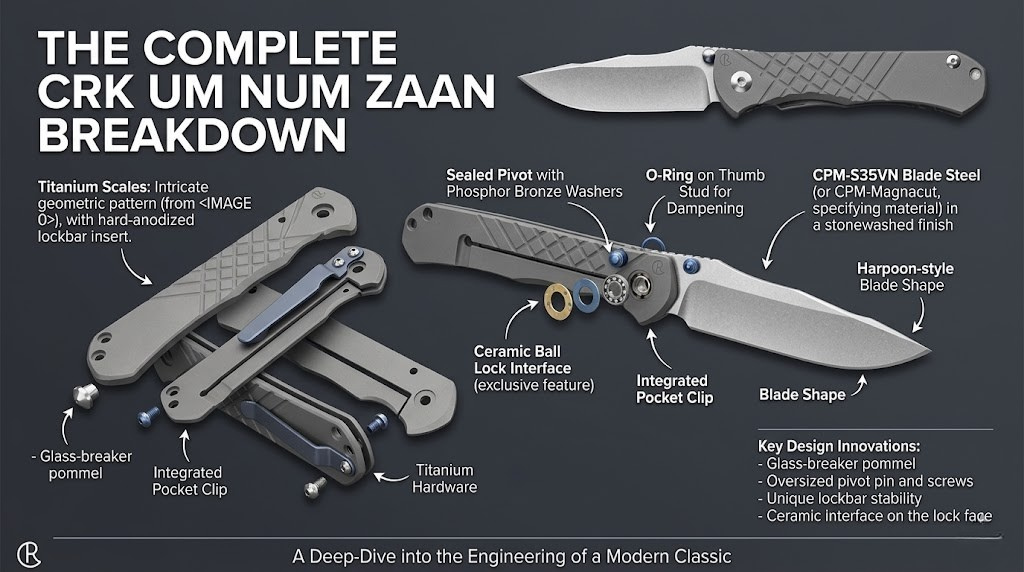

What Is the Chris Reeve Umnumzaan?
The name “Umnumzaan” comes from the Zulu word for head of household or man of great responsibility — and that etymology tells you something important about how Chris Reeve Knives (CRK) thinks about their tools. This is not a novelty piece, not a collector’s shelf display. It’s a working instrument built to the kind of tolerances that would embarrass most surgical instrument manufacturers.
Designed by Chris Reeve and master knifemaker Gawie Herbst and introduced in 2009, the Umnumzaan was CRK’s answer to a specific question: what would a Sebenza look like if you started over and prioritized operational toughness above all else? The result is a knife that shares the Sebenza’s legendary precision but rethinks the geometry, the materials, and the ergonomics for hard-use performance without losing a single molecule of refinement.
The knife is manufactured in Boise, Idaho, almost entirely in-house. The tolerances CRK maintains — consistent to within thousandths of an inch — are verifiable with a set of calipers. Every Umnumzaan that leaves that factory has been handled by a human being who cares about their name being associated with the work. That backstory matters because it shapes every aspect of what you hold in your hand.
If you’ve been researching premium American-made folders, you’ve already seen this knife mentioned alongside a handful of serious competitors. But “mentioned alongside” understates the Umnumzaan’s position — it tends to end up at the top of most shortlists, and this article will explain exactly why, component by component, decision by decision.
Full Specs at a Glance
Before we get into the detailed analysis of each component, here’s the complete technical specification sheet. Every number here matters and will be referenced throughout the breakdown.
| Specification | Value | Notes |
|---|---|---|
| Overall Length (open) | 8.40″ | Comfortable for medium-to-large hands |
| Overall Length (closed) | 4.60″ | Fits most front pockets |
| Blade Length | 3.80″ | Drop-point profile |
| Blade Thickness | 0.141″ (behind edge) | Ground to ~0.010–0.015″ at edge |
| Blade Steel | CPM-S35VN | Crucible particle metallurgy |
| Blade Hardness | 58–60 HRC | CRK in-house heat treat |
| Blade Finish | Stonewash or Satin | Stonewash hides wear better |
| Grind | Hollow grind | Full flat ground on some variants |
| Handle Material | 6AL-4V Titanium | Both scales; no liner inserts |
| Handle Length | 4.60″ | Fully filleted for grip comfort |
| Handle Thickness | 0.50″ | Slim profile without sacrificing ergonomics |
| Weight | 4.50 oz (127.6 g) | Dense but not cumbersome |
| Lock Type | Framelock (Titanium) | With lockbar stabilizer |
| Pivot System | Phosphor-bronze bushings | Smooth, self-lubricating |
| Clip | Titanium, tip-up only | Right-hand carry standard; left available |
| Opening Mechanism | Thumb disc | Both sides; ambidextrous deployment |
| Country of Origin | USA (Boise, Idaho) | Fully in-house production |
| MSRP (standard) | ~$500–$530 | Street price varies by finish/inlay |
Blade Geometry and Grind: Decisions With Consequences
The Umnumzaan’s blade profile is a drop-point — but calling it that without elaboration is like calling a Patek Philippe a “watch.” The geometry is the result of careful, considered design choices that prioritize a specific performance envelope, and understanding why each decision was made is essential to appreciating what this knife is.
The Drop-Point Profile
Drop-points are not inherently exciting. They are, however, extraordinarily practical. The Umnumzaan’s drop-point features a relatively controlled clip — the spine drops from the heel toward the tip at a moderate, steady rate. This gives the knife a strong, thick tip that is far less vulnerable to lateral stress or tip flex than the swept or wharncliffe profiles you see on some tactical folders.
The belly is moderate — enough to make slicing cuts efficient, not so much that piercing work becomes awkward. The overall arc of the edge starts at a low, aggressive angle near the heel and rises smoothly to the tip. This is the geometry that makes a knife feel like it “sticks” to cutting surfaces rather than skating across them.
The Hollow Grind
CRK uses a hollow grind on the standard Umnumzaan. This is a decision that often raises eyebrows among the “full-flat-grind-or-nothing” crowd, but the hollow grind here is executed with precision that neuters most of the traditional objections. A hollow grind provides inherent bite — the curved geometry of the grind creates a natural wedge relief that slices through fibrous materials and food with remarkable efficiency.
The secondary bevel (the actual edge) is ground to an aggressive geometry by CRK’s standards — arriving from the factory somewhere in the 15–17° per side range. That’s on the sharper end of what S35VN is typically asked to maintain, but CRK’s heat treatment protocol handles it without issue, delivering an edge that bites immediately and lasts through extended use cycles.
For those exploring the nuances of blade geometry and grind selection, understanding how bolster geometry affects sharpenability provides useful context for evaluating production folder design choices like this one.
Blade Thickness and the “Behind the Edge” Metric
The stock thickness of 0.141″ is meaningless without knowing what happens as the grind approaches the edge. CRK typically delivers the Umnumzaan with a behind-the-edge measurement around 0.010″–0.015″ — thin enough to slice with surprising ease, thick enough that you’re not babying the knife on demanding tasks. It is not a slicer in the Japanese sense; it is a workhorse with a refined shave.
| Feature | Umnumzaan | Sebenza 31 | Zero Tolerance 0562 |
|---|---|---|---|
| Blade Profile | Drop-point | Drop-point | Drop-point |
| Blade Length | 3.80″ | 3.61″ (large) | 3.50″ |
| Stock Thickness | 0.141″ | 0.130″ | 0.148″ |
| Grind Type | Hollow | Hollow | Flat saber |
| Factory Edge Angle | ~15–17° p/s | ~15–17° p/s | ~20° p/s |
| Tip Strength | Very strong | Strong | Strong |
One important nuance: the Umnumzaan has a slightly more aggressive tip geometry than the Sebenza 31. The tip is still robust — CRK isn’t making a sushi knife — but there’s a bit more acuity there, which translates to better performance on detail cuts and initial penetration tasks. It’s a small difference that matters in practice.
S35VN Steel: The Right Tool for This Application
CPM-S35VN is Crucible Industries’ refinement of the already-excellent S30V. The story of this steel is a collaboration between Crucible and Chris Reeve himself — CRK reportedly worked with Crucible’s metallurgical team to address the one complaint he consistently heard about S30V: it was occasionally chippy on hard impacts and somewhat difficult to touch up in the field. S35VN’s addition of niobium carbides addressed both concerns.
The Metallurgical Profile
S35VN contains roughly 1.4% carbon, 14% chromium, 3% vanadium, 2% molybdenum, and 0.5% niobium. The particle metallurgy (PM) production process ensures an even distribution of carbides throughout the steel matrix — a major advantage over conventional stainless steels, where carbide distribution can be uneven, leading to inconsistent performance across different areas of the same blade.
What this means at the practical level: you get a steel with edge retention that comfortably outperforms conventional stainless options like X50CrMoV15 or AUS-8, combined with corrosion resistance that is among the best in the premium powder steel category. The toughness — critically for a folder that sees demanding tasks — is meaningfully higher than S30V, particularly in resistance to micro-chipping at lower edge angles.
For a broader comparison of premium blade steels and how they stack up on edge retention versus toughness trade-offs, the MagnaCut vs M390 comparison on this site provides excellent context, and the same principles apply when evaluating S35VN against the latest generation of PM steels.
Heat Treatment: Where CRK Earns Its Reputation
Steel composition is only half the equation. Heat treatment determines how the steel’s potential is realized in practice. CRK’s in-house heat treat protocol for S35VN lands at 58–60 HRC — a range that prioritizes toughness and field-sharpenability without sacrificing meaningful edge retention. This is not a company that chases hardness numbers for marketing purposes. They hit a hardness that serves the knife’s actual use case.
The cryogenic treatment step in CRK’s process is worth noting specifically. Post-quench cryogenic treatment converts retained austenite (a softer, unstable phase) into martensite (harder, more wear-resistant). Many production facilities skip this step because it adds cost and complexity. CRK does not skip it, and the resulting blade consistency is measurably better.
✓ S35VN Advantages
- Excellent edge retention for fine kitchen and EDC tasks
- High corrosion resistance — handles humidity, salt environments well
- More field-sharpenable than M390 or S90V
- Tough enough for impact-prone tasks at lower edge angles
- Consistent carbide distribution from PM process
- Long track record of real-world validation
✗ S35VN Limitations
- Edge retention trails newer powders like MagnaCut or M390
- Not the best choice for extended wood carving
- Requires diamond or ceramic stones to sharpen efficiently
- Cannot match carbon steel patina aesthetics
- Some competitors now offer S45VN for similar money
There is legitimate debate about whether newer steels have surpassed S35VN as the optimal choice for a folder in this price range. The S35VN versus S45VN comparison covers this in detail — the short answer is that S45VN offers incremental gains, but the improvements are meaningful only if you’re pushing the steel hard, regularly. For the vast majority of Umnumzaan buyers, S35VN at CRK’s heat treatment remains an excellent choice.
The Framelock: Precision Over Trend
The Umnumzaan uses a framelock — the same fundamental mechanism Chris Reeve commercialized and popularized in the 1980s with the original Sebenza. Understanding why CRK remains committed to this design despite the emergence of competing lock mechanisms tells you something fundamental about the company’s design philosophy.
How the CRK Framelock Works
In a framelock folder, the lock bar is an integral part of the handle’s titanium frame itself — not a separate insert or spring-loaded bar. When the blade opens, the lock bar springs inward behind the blade’s integral tab (the “ramp”), preventing the blade from closing under load. The engagement is metal-on-metal, with no secondary components that can wear independently or fail at inopportune moments.
CRK’s execution of this mechanism is distinguished by the geometry of the lock bar engagement. The lock bar on the Umnumzaan engages the blade’s titanium ramp at a slight angle — when load is applied to the cutting edge, the geometry actually increases lock-up pressure rather than relieving it. This is the physical principle behind what knife people call “safety lockup” — the harder you push, the more securely the lock engages.
The Lockbar Stabilizer
One enhancement that differentiates the Umnumzaan’s framelock from lesser implementations is the lockbar stabilizer — a small component (typically a titanium or stainless set screw) that prevents the lock bar from over-deflecting. In a framelock without this feature, repeated hard opening strokes can gradually “walk” the lock bar too far inward, reducing engagement geometry and ultimately leading to a lockup that doesn’t fully engage. The stabilizer prevents this entirely, extending the functional life of the lock mechanism indefinitely under normal use.
Blade Play and Fit
A lock mechanism is only as good as the precision with which it’s fitted. Blade play — lateral wobble, vertical rattle — is the telltale sign of a lock that wasn’t tuned with care. Out of the box, every Umnumzaan should demonstrate essentially zero blade play in any direction. This is not accidental. CRK uses phosphor-bronze bushings at the pivot rather than ball bearings precisely because bushings provide more surface contact for lateral stability, and they self-lubricate over time rather than requiring relubrication on a schedule.
The tradeoff — and it’s a fair one to raise — is that a bushing-based pivot is typically less “flickable” than a well-tuned ball-bearing pivot. You cannot one-hand-flick an Umnumzaan with the wrist-snap that sends some other folders flying open. What you get instead is a deliberate, smooth, controlled deployment that never feels cheap or fast-and-loose. Whether that’s a benefit or a drawback depends entirely on what you want from your carry knife.
Handle Design and Ergonomics: The Architecture of Grip
If the blade is the soul of a knife, the handle is the body — the part that determines whether carrying and using the tool is effortless or exhausting. CRK’s handle work on the Umnumzaan represents some of the finest ergonomic thinking in production folder manufacturing, and it’s worth examining in detail because the solutions here are non-obvious.
The Titanium Framework
The entire handle — both scales — is machined from 6AL-4V titanium. This is the same alloy grade used in aerospace fasteners and medical implants: an alloy with an excellent strength-to-weight ratio, biocompatibility, and natural corrosion resistance that requires zero surface treatment to maintain. The machining tolerances CRK holds on these scales are visible under close inspection — the edges are consistently filleted, the surfaces are consistently finished, and the mating surfaces between the two scales fit with no gaps.
The scale geometry is where the ergonomic intelligence lives. The Umnumzaan’s handle has a distinctive “milled” texture along both sides — a series of precisely machined grooves and channels that function both aesthetically and functionally. The milling creates traction without being uncomfortable; your fingers find natural purchase in the valleys, and the raised sections sit between the sensitive areas of your fingertips rather than on them.
The Three-Finger Groove
Looking at the handle from the side, you’ll notice three distinct concave sections that correspond to index, middle, and ring fingers. This is not accidental contour work — it’s a deliberate ergonomic architecture. Each groove positions its corresponding finger at the optimal angle for force transfer during cutting tasks, while simultaneously preventing the hand from shifting during hard use. There is a reason professional users who put serious cutting loads on their folders gravitate to the Umnumzaan specifically: the handle does not move in your hand.
The Choil and Guard
The Umnumzaan features a modest but functional finger choil — a cutout at the junction of blade and handle that allows you to choke up on the knife for controlled detail work. Forward-choked grip positions the index finger directly at the ricasso, shortening the effective lever arm and giving you far more precise control than the full handle provides. For a knife that sees EDC use — box opening, food prep, rope cutting — this is a frequently-used feature rather than an afterthought.
There is no traditional bolster, but the front of the handle (the “guard” area) is thick enough to prevent accidental forward hand slip under load. It’s a more elegant solution than a traditional guard and it doesn’t add bulk.
Handle Width and Thickness
The Umnumzaan’s handle profile is 0.50″ thick — noticeably slimmer than many titanium framelock folders, which hover around 0.55″–0.62″. This slim profile is a significant factor in all-day carry comfort; it’s the difference between a pocket presence you forget about and one that reminds you it’s there every time you sit down. The trade-off is a very slightly reduced grip security in extremely wet conditions, but the milled texture and groove geometry largely compensate.
Clip, Carry Geometry, and Deployment
A knife’s carry system shapes how it integrates into your daily life more than almost any other single factor. Even a perfect blade on a perfectly-built handle becomes frustrating if the clip positioning, clip tension, or deployment mechanism fights you every time you reach for it.
The Titanium Clip
The Umnumzaan ships with a titanium clip positioned for tip-up right-hand carry. The clip is machined from the same 6AL-4V titanium as the handle, which means it is not going to deform, fatigue, or develop the “banana” curve that afflicts lesser clip designs over time. The spring tension is calibrated for positive retention without requiring excessive force to deploy — a balance that sounds simple but is one of the most frequently fumbled aspects of folder design.
The clip profile is relatively low — it sits close to the handle and close to the fabric surface of your pocket rather than projecting awkwardly outward. This matters for comfort during seated positions and for minimizing snag potential. Left-hand tip-up clips are available from CRK as a separate purchase for southpaw carriers.
One notable detail: the clip on the Umnumzaan is not reversible between tip-up and tip-down positions using the same screw holes. This is an intentional design choice by CRK — they believe tip-up deployment is objectively faster and more reliable, and they’ve designed the handle to optimize for it rather than trying to satisfy every preference with a compromise design.
Pocket Depth and Presence
At 4.60″ closed, the Umnumzaan is not a small knife. In standard trouser pockets, the handle will protrude approximately 0.5″–0.8″ above the pocket lip with the standard clip. In jeans with deeper pockets, it can disappear entirely. This is a normal tradeoff for a 3.8″ blade folder and is not specific to the Umnumzaan — it’s simply the geometry of the package.
The weight of 4.5 oz is perceptible in a pocket. You will know it’s there. This is either irrelevant or a dealbreaker depending on your carry philosophy; users who have carried premium titanium folders for years typically stop noticing weight once a knife earns consistent trust.
Thumb Disc Deployment
The Umnumzaan opens via a thumb disc — a low-profile disc-shaped thumbstud on each side of the blade. This ambidextrous design enables one-hand opening from either side. The action is smooth through the phosphor-bronze pivot bushings, with a noticeable detent that holds the blade firmly closed until deliberate deployment pressure is applied.
The deployment requires intentional input — this is a knife that does not open accidentally. For a tool with a 3.8″ hollow-ground drop-point blade, that’s the appropriate design choice. The “flick-open” trend in EDC folders has its enthusiasts, but a knife carried in the same pocket as your keys and phone benefits from a deployment mechanism that demands conscious engagement.
Real-World EDC Performance: What Owners Actually Experience
Specification sheets and design analysis can only take evaluation so far. The question that matters most for a knife at this price point is not “is it technically excellent?” but “does that technical excellence translate into daily-use satisfaction?” The answer, for the Umnumzaan, is a firm yes — but with some important contextual notes.
The First Week Experience
New Umnumzaan owners consistently report the same sequence of experiences. First: the out-of-box edge quality is immediately noticeable — CRK ships their knives at functional sharpness, not “passable” sharpness, and the blade will slice paper without resistance and hair-pop readily. Second: the action feels deliberate but not stiff; it loosens incrementally over the first week as the phosphor-bronze bushings seat themselves. Third: the handle grip positioning begins to feel like muscle memory, and users stop thinking about how to hold it.
Tasks that the Umnumzaan handles daily without friction: cardboard breaking-down (an underrated test of edge durability), food prep during outdoor activities, cord and rope management, opening packages and letters, and general utility cutting in both office and field contexts. None of these tasks push the knife. They are the tasks a great folder should handle transparently, and the Umnumzaan handles them transparently.
Edge Retention in Practice
S35VN at CRK’s heat treatment holds a working edge through extended use before requiring attention. For most EDC use profiles — primarily cardboard, food, rope, and occasional wood — a realistic touch-up interval is every 3–6 weeks, depending on use intensity. This is not exceptional by the standards of the very hardest PM steels, but it is excellent by any practical measure, and the ease of touch-up on diamond ceramic systems compensates for the slightly lower raw retention compared to top-tier steels like M390.
When the edge does begin to roll (rather than chip, which is rare at these task levels), a few passes on a ceramic rod realigns the apex. Full reprofile sharpening on a diamond stone every several months maintains the factory geometry without significant effort. Those looking to maintain their sharpening discipline across both Japanese and German tools may find the best sharpeners for German vs Japanese knife angles guide helpful for establishing an angle-consistent workflow.
Hard Use Testing
The Umnumzaan is not a dedicated bushcraft knife. It’s not designed to baton wood, pry, or perform tasks that are more appropriate for a fixed blade. That said, its structural integrity under demanding folding-knife tasks — thick rope, fibrous materials, food breakdown in outdoor contexts — is exceptional. The pivot shows no wear-related play even after several years of use reported by long-term owners. The blade maintains its geometry without detectable deformation under lateral load.
One specific test that flatters the Umnumzaan: sustained push cutting on vegetables and fruit. The hollow grind geometry combined with the relatively aggressive factory edge angle creates a slicing efficiency that surprises users expecting a tactical/EDC folder to feel workmanlike rather than refined. Push cutting slices of apple or cheese in the field, this knife behaves more like a specialized slicer than a general-purpose workhorse.
Gloved Use
The milled handle texture provides surprisingly effective grip retention with work gloves — the grip pattern is sized appropriately for gloved fingers and doesn’t require bare-hand precision to operate. The thumb disc sits proud enough from the blade to find under leather work gloves, and the lockback engagement and release are both executable with gloved hands. This is not guaranteed with all premium folders, and it’s a meaningful point in the Umnumzaan’s favor for users in trades or outdoor professions.

Chris Reeve Knives
Umnumzaan Stonewash — S35VN Titanium Framelock Check Price on Amazon →Variants, Configurations, and Customization
The Umnumzaan is available in a meaningful but controlled range of configurations. CRK does not produce dozens of SKUs with minor variations — they produce a deliberate product matrix where each variant reflects a different aesthetic preference or functional consideration, not marketing segmentation for its own sake.
Blade Finish Options
The standard production Umnumzaan is available in either a stonewash or satin finish. Stonewash — a tumble-media finish that creates a matte, “used” texture — is the more practical choice. It hides fingerprints, minor surface scratches, and edge scuffs completely, maintaining a consistent appearance through years of carry. The satin finish is more formal and reflective, showing a striking contrast between the blade flat and the grind line, but it will develop visible carry wear over time. Neither finish affects performance; it is entirely an aesthetic consideration.
Handle Inlay Options
One of the Umnumzaan’s most distinctive configuration options is the availability of handle inlays — decorative inserts set into the non-lock-side scale. Materials CRK has used include CF (carbon fiber), bocote wood, spalted maple, and various stone or synthetic materials. These inlays are set flush with the titanium surface and finished to the same tolerance as the rest of the handle — they are not afterthoughts. They transform the knife from an excellent tool into an excellent tool with significant visual presence.
A CF-inlaid Umnumzaan with a satin blade is arguably one of the most visually compelling production folders available — the contrast between the dark woven carbon, the silver-gray titanium, and the polished S35VN blade is legitimately striking. Inlay options add to the price but remain within the $600 range for most configurations.
Left-Hand Configuration
CRK offers the Umnumzaan in a left-hand carry configuration with the clip repositioned for left-side tip-up carry. This is not merely a clip relocation — the lock bar is on the opposite scale in the left-hand version, which represents a different machining setup. CRK’s commitment to producing this variant properly rather than as a compromised afterthought reflects their broader customer-service philosophy.
The “Tanto” Variant
While not a permanent part of the production lineup, CRK has offered limited Umnumzaan runs with modified blade profiles. The core knife geometry — handle, lock, pivot, dimensions — remains constant across variants, making the Umnumzaan a platform as much as a fixed design.
| Variant | Blade Finish | Inlay | Approx. Price | Best For |
|---|---|---|---|---|
| Standard Stonewash | Stonewash | None | ~$500 | Daily hard use |
| Standard Satin | Satin | None | ~$510 | Desk/formal carry |
| CF Inlay Stonewash | Stonewash | Carbon fiber | ~$570 | Best all-rounder |
| Natural Inlay | Satin | Wood/stone | ~$590–620 | Collector/display |
| Left-Hand Version | Stonewash/Satin | Optional | ~$510+ | Left-hand EDC |
How the Umnumzaan Compares to the Competition
At $500+, the Umnumzaan operates in a market segment where almost every competitor is excellent. The question is not whether comparable knives exist, but whether the specific package the Umnumzaan represents is superior for the buyer’s specific priorities. Here’s an honest comparison against the most frequently mentioned alternatives.
Umnumzaan vs. Chris Reeve Sebenza 31
This is the most obvious comparison since they share a manufacturer, price tier, and core philosophy. The Sebenza 31 is the purer, simpler expression of CRK’s design language — clean, elegant, uncluttered. The Umnumzaan is more aggressive in geometry, more tactile in handle texture, and slightly larger in blade length. In practice: if you do light EDC tasks and want something that carries more formally, the Sebenza 31 is the better choice. If you want a more purposeful grip geometry and a tool orientation rather than a gentleman’s carry orientation, the Umnumzaan wins.
Umnumzaan vs. Benchmade 940 Osborne
The Benchmade 940 competes at a lower price point (~$200–$220) with a similar target user. The 940 is lighter, uses an Axis lock (which many argue is mechanically superior to any framelock for ease of operation), and features S90V or S30V in some configurations. The Umnumzaan answers with meaningfully better fit and finish, longer-term pivot durability, a more refined grip, and the intangible but real satisfaction of American craft manufacturing. If budget is a significant factor, the 940 is excellent value. If you’re specifically evaluating both at their asking price, the Umnumzaan justifies its premium through execution quality that the 940 — as good as it is — cannot fully match.
Umnumzaan vs. Zero Tolerance 0562Ti
The ZT 0562Ti is frequently mentioned as a direct competitor: titanium scales, premium steel, American design, similar price range. The ZT uses a KVT ball-bearing pivot — significantly faster and more fluid for one-hand deployment. The lockup on the 0562 is a button lock rather than a framelock, which many users find easier to disengage. The Umnumzaan counters with a more refined handle geometry, a thinner carry profile, and CRK’s unmatched long-term durability track record. Both are excellent. The choice often comes down to whether you prioritize deployment speed (ZT wins) or long-term refinement and carry comfort (Umnumzaan wins).
Umnumzaan vs. Spyderco Paramilitary 2
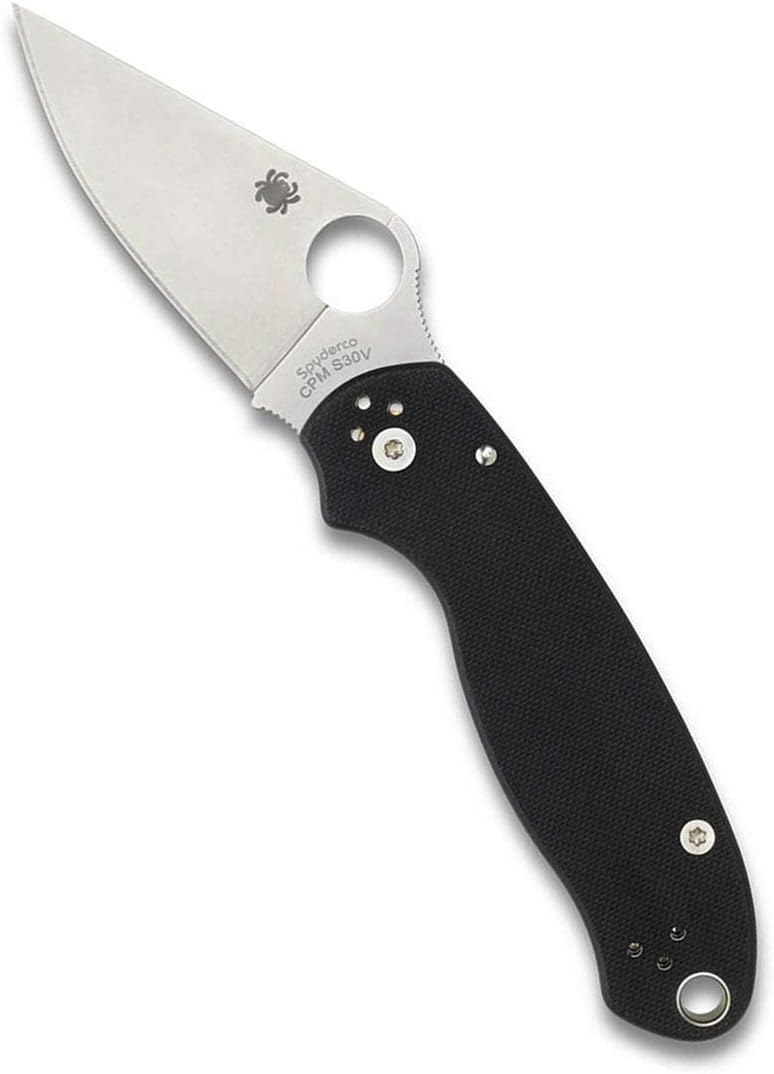
The Spyderco PM2 is a dramatically different value proposition — $180–$200 versus $500+, with an Axis-style Compression Lock that many enthusiasts consider the most user-friendly lock mechanism in production. The PM2 punches well above its price; the Umnumzaan punches at its price. This comparison most usefully illustrates what the Umnumzaan’s premium actually buys you: titanium over G10, American hand-fitted production over offshore assembly, and materials/construction tolerances that a $180 knife simply cannot achieve regardless of design quality.
| Knife | Price | Steel | Lock | Weight | Handle | Made In |
|---|---|---|---|---|---|---|
| CRK Umnumzaan | ~$510 | S35VN | Framelock | 4.5 oz | Ti + milled | USA |
| CRK Sebenza 31 L | ~$490 | S35VN | Framelock | 4.4 oz | Ti + inlay | USA |
| ZT 0562Ti | ~$430 | S35VN | Button lock | 5.0 oz | Ti | USA |
| Benchmade 940 | ~$210 | S30V/S90V | Axis | 2.9 oz | Aluminum | USA |
| Spyderco PM2 | ~$185 | S30V/S45VN | Compression | 3.8 oz | G10 | USA |
| Hinderer XM-18 | ~$500 | S45VN | Framelock | 5.1 oz | Ti + G10 | USA |
Researchers exploring the broader premium knife landscape may also find value in our roundup of Zero Tolerance’s full lineup, which covers performance tier by tier and provides useful comparative context for anyone building a premium EDC shortlist.
Is the $500+ Price Justified? An Honest Assessment
This is the question that every serious review must answer directly, and the answer requires honesty about what you’re actually buying when you spend five hundred dollars on a folding knife.
What the Premium Pays For
The Umnumzaan’s price reflects three things: materials, manufacturing tolerances, and the human labor involved in achieving both. The titanium scales alone — aerospace-grade 6AL-4V, machined to thousandths of an inch — represent a significant material and machining cost. S35VN blanks from Crucible are not cheap raw material. The CRK facility in Boise employs skilled American workers who are paid appropriately for skilled work. None of this is padding — it’s the cost structure of making something exactly right.
The manufacturing tolerance argument is not abstract. Pick up any Umnumzaan and any $150 titanium framelock folder side by side, and the difference is immediately tactile. The CRK piece fits together without gaps, without blade play, without any sense of “good enough.” The cheaper knife fits together at a tolerance that passes the shipping and retail test but does not pass the long-term precision test. The question is whether that difference matters to you in proportion to the price difference — and for many buyers, it absolutely does.
The Durability Argument
A well-maintained Umnumzaan will still be performing at essentially the same level in ten or twenty years. The phosphor-bronze pivot bushings will have burnished to a beautiful smoothness; the titanium scales will show carry patina but no structural degradation; the S35VN blade will resharpen to the same geometry it left the factory with. This is not guaranteed with every premium folder. The Umnumzaan has a track record — there are many examples of ten-plus-year-old CRK folders in regular use that prove the durability claim with evidence.
Who Should and Should Not Buy This Knife
Buy the Umnumzaan if: you carry a knife daily and genuinely use it, you care about American craft manufacturing, you want a single tool that handles a wide task range with excellence, you value long-term durability over short-term value, or you simply want to own something that represents the highest tier of production folder quality.
Do not buy the Umnumzaan if: you want the fastest-deploying folder possible (look at ball-bearing pivots), you need a beater knife that you won’t worry about losing or damaging, your primary use case is tasks that require a dedicated fixed blade (the Umnumzaan is not a replacement for a proper field knife), or you want the newest powder metallurgy steel — if the latest steels matter to you, look at competitors who have moved to S45VN or MagnaCut.
The Chris Reeve Umnumzaan earns its price tag through execution quality that is genuinely difficult to find at any price in production folder manufacturing. It is not the most feature-rich folder at $500, nor the most aggressively performing. It is the most consistently, durably, and beautifully made folder at or near its price point — and for buyers who recognize that distinction, it represents excellent long-term value. This is a tool you buy once and keep for decades.
✓ Who It’s Perfect For
- Discerning daily carriers who value craftsmanship
- Professionals who rely on their tools under pressure
- Collectors building a heirloom-quality EDC collection
- Users who appreciate American manufacturing heritage
- Anyone upgrading from a mid-tier folder permanently
✗ Better Alternatives Exist If…
- Budget under $300 → Benchmade 940 or Spyderco PM2
- Need fast one-hand deployment → ZT 0562 or Bugout
- Prefer Japanese aesthetics → Spyderco Yojimbo or Kizer Intrepid
- Want newest steel → Hinderer XM-18 with S45VN
For those still building out their knife knowledge base, understanding what separates elite folders from the field starts with understanding how blade steel choices cascade into real-world performance. Our analysis of VG-10 vs AUS-10 covers the mid-tier steel comparison landscape, while the Spyderco Paramilitary 2 review provides a strong benchmark against which to compare the Umnumzaan’s premium.
Final Verdict: The Umnumzaan in Full
Chris Reeve designed the Umnumzaan to be the Sebenza’s harder-working sibling — a folder with the same commitment to precision and longevity but with more aggressive ergonomics, a longer blade, and a grip architecture built for demanding tasks. On every design intention, it succeeds.
The blade is precisely what S35VN should be when heat-treated by people who understand the steel — sharp, durable, corrosion-resistant, and fieldable with readily available sharpening equipment. The lock is the framelock mechanism executed at a level of refinement that eliminates every practical objection to the platform. The handle is an ergonomic architecture that rewards users with varying grip styles and hand sizes (within a reasonable range). The carry system works.
What sets the Umnumzaan apart from its technically-comparable competitors is not any single specification but the cumulative effect of consistent, uncompromising execution across every component. There are no weak links in this knife. There are no design compromises made for cost, convenience, or marketing appeal. What you hold is what was actually intended — and that, at this price tier, is rarer than it should be.
Rating: 9.4 / 10 — One of the finest production folders made anywhere in the world.
Ready to Add the Umnumzaan to Your Collection?
Check current pricing and availability on Amazon with our affiliate link — supports the site at no extra cost to you.
View on Amazon →