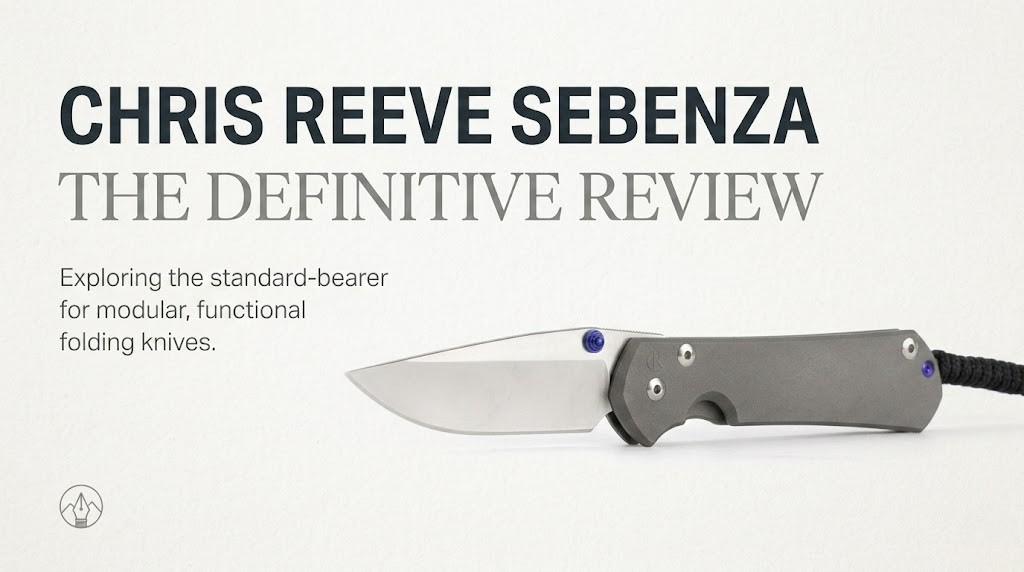

There are folding knives, there are luxury folding knives, and then there is the Chris Reeve Sebenza. For more than three decades it has been the quiet, anodized-bead-blasted titanium reference point that every other premium folder gets measured against. When forum threads argue about value, fit, finish, lockup, or whether a $475 pocketknife can ever make sense, the conversation eventually circles back to one question: but is it as good as a Sebenza?
This review is the long-form answer. I have been carrying, cutting with, disassembling, sharpening, and (very gently) abusing the Sebenza 31 in both Small and Large variants, with plain titanium handles, Macassar ebony inlays, and the CGG (Computer Generated Graphic) finish. Some weeks it slides into a suit pocket for a wedding. Other weeks it lives clipped to selvedge denim and breaks down Amazon boxes. The goal here is not to repeat the mythology—you have read that everywhere—but to tell you, mechanically and honestly, what makes this knife the way it is, where the price actually goes, and what it cannot do that cheaper knives can.
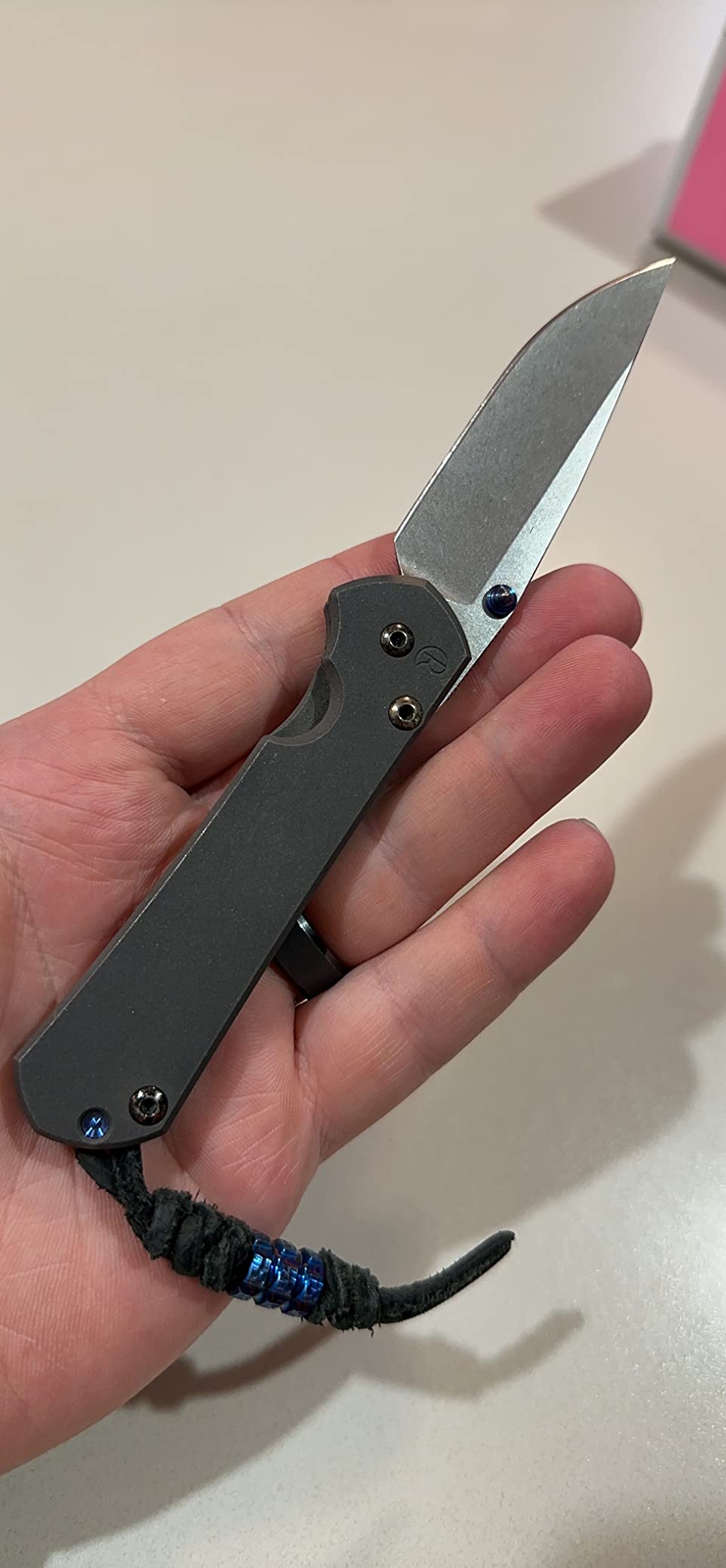
The Sebenza in One Paragraph
The Sebenza 31 is a single-blade, frame-lock, manual-opening folding knife built almost entirely from CPM-S45VN steel and 6Al4V titanium, machined and assembled in Boise, Idaho, by a small team trained under the direct lineage of Chris Reeve himself. It exists in two sizes—Small (2.99-inch blade) and Large (3.61-inch blade)—with two primary blade shapes, drop point and tanto. The hallmark is not a feature list but a tolerance: every interface inside this knife is finished to a level that is genuinely difficult to find at any price, and impossible to find at this price from a major American or European maker. The detent is firm, the lockup is metallic and dry, and the action—after a brief break-in—develops a glassy, washer-on-washer smoothness that no bearing-pivot folder can quite imitate.

Chris Reeve Sebenza 31 — Large, Drop Point, S45VN
Made in Idaho. Lifetime “Spa Service.” The benchmark every premium framelock chases.
Check Price on AmazonA Short History of the Sebenza: From Small Workshop to Cult Object
The Sebenza was not designed to be a luxury item. The word itself is Zulu for “work,” and Chris Reeve, a South African machinist who emigrated first to Canada and then to the United States, named it that on purpose. The original 1990 Sebenza was a working folder for serious users who wanted something more durable than the riveted, leather-spacer pocketknives of the era. Reeve had already been making the legendary Project series of one-piece fixed blades, but the Sebenza was something new: a folder where the lock and the handle were the same piece of metal. Today we call this the “frame lock,” and Reeve is properly credited with inventing it.
The lineage is essential because it explains the knife’s personality. The Sebenza was never trying to be the lightest, or the fastest-deploying, or the most modern in profile. It was trying to be the most reliable. Every change that has happened in 35 years has been incremental and engineering-driven: a switch from BG-42 to S30V, then S35VN, and now S45VN. The pivot system evolved from a slot-head screw to a captive design, then to a hardened ceramic detent ball that prevents lock-side wear—a change first introduced on the Inkosi and then back-ported to the Sebenza 31 in 2019. Each step was small. Each step measurably improved the knife. Nothing was changed for fashion.
That is rare. Most folding knife brands now release new models several times a year and re-tool blade shapes for whatever is trending on Instagram. Reeve releases roughly one design generation per decade. The Sebenza 21, which was current from 2008 to 2018, is still considered by many users to be a peer—if not equal—to the current 31. The knife is built to be inherited, not refreshed.
What Actually Changed in the Sebenza 31
If you are upgrading from a Sebenza 21, or considering a used 21 instead of a new 31, the differences matter. They are subtle on paper and noticeable in the hand.
| Specification | Sebenza 21 (2008–2018) | Sebenza 31 (2019–present) |
|---|---|---|
| Blade Steel | S35VN | CPM-S45VN |
| Lock Interface | Steel-on-titanium | Ceramic ball-on-titanium |
| Blade Hollow | Slightly fuller hollow | Refined, slightly higher hollow grind |
| Pivot Design | Captive perch washer | Refined captive system, easier reassembly |
| Detent Feel | Crisp, slight metal-on-metal | Smoother, more consistent over time |
| Closed Length (Small) | 4.13 in | 4.13 in |
| Weight (Small, Plain) | ≈ 3.0 oz | ≈ 3.0 oz |
| Aesthetic Profile | Slightly more pronounced lanyard hump | Slimmer, cleaner lock cutout |
The biggest functional upgrade is the ceramic ball detent. In the 21 (and every framelock that copies a steel-on-steel detent), the lock face slowly burnishes itself into the blade tang as the knife is opened and closed. Over thousands of cycles you can sometimes see lock travel migrate further into the blade. With the ceramic ball, the wear surface is a polished sphere harder than the titanium it touches, so the contact patch stays consistent essentially forever. This is the same engineering logic that drove the Inkosi and is the closest the Sebenza has ever come to being a “forever” knife in the literal sense.
The S45VN steel is also a real, if undramatic, improvement over S35VN. We will dig into that in detail later, but the short version is: slightly better corrosion resistance, slightly better edge stability, sharpens with the same equipment and time you would use on S35VN. It is not a generational leap; it is a quiet refinement, which is exactly the Reeve house style.
Build Quality & Materials: Where the Money Goes
The first time you handle a Sebenza, it does not feel exotic. The handle is bead-blasted titanium with no contouring, no jimping forest, no aggressive milling. The clip is a simple, slightly curved piece of bent titanium. It looks almost agricultural compared to the latest milled-handle, three-color-anodized boutique folders. This is a deliberate choice and arguably the most misunderstood thing about the brand. You are not paying for visual complexity. You are paying for the absence of mistakes.
Titanium Slabs and Tolerances
Each handle slab is machined from 6Al4V titanium—the same alloy used in aerospace fasteners and surgical implants—and finished to thicknesses that are uniform within fractions of a thousandth of an inch. The bead blast is consistent end to end, which sounds trivial until you compare it to a similar knife where the blast is patchy or directional. The pocket clip is a stressed three-screw design, and unlike the cheap stamped clips that bend permanently after a year of clipping onto thick denim, the Sebenza clip holds its tension for the life of the knife.
Hardware Throughout
The pivot, body screws, and clip screws are stainless steel, but the heads are recessed and concentric with the handle face. There is no “proud screw” feel. Slot widths are accurate. The Sebenza ships with a custom branded screwdriver and lubricant—small touches that signal the knife is meant to be opened, cleaned, and lived with.
Blade Finish Variations
The 31 is offered in plain stonewash, several inlay options (cocobolo, micarta, Macassar ebony, box elder burl), CGG patterns (basket weave, raindrop, snakeskin), and unique graphics like the Insingo/Tanto Damascus runs. The inlay versions add real visual warmth without compromising structural integrity—the inlay sits in a recessed pocket cut into the slab, so even if the wood were destroyed, the lock geometry would be unchanged. For pure utility, the plain stonewash version is the lightest, the toughest, and the easiest to refinish.
If you want a primer on how titanium slab construction differs from G10/steel liner construction more broadly, our breakdown of framelock construction across the Zero Tolerance lineup walks through where each design choice gains and loses you something.
Blade Geometry & CPM-S45VN: The Steel That Quietly Replaced S35VN
The Sebenza 31 ships with a hollow-ground blade in CPM-S45VN, manufactured by Crucible Industries in the United States. S45VN was developed in collaboration between Crucible and Chris Reeve Knives specifically to address two minor complaints that had accumulated about S35VN: corrosion resistance in salty or sweaty environments, and edge stability at the apex during prolonged use.
| Element | S35VN | S45VN | Effect of the Change |
|---|---|---|---|
| Carbon | 1.40% | 1.48% | Slightly more wear resistance |
| Chromium | 14.0% | 16.0% | Markedly better corrosion resistance |
| Vanadium | 3.0% | 3.0% | Maintains fine carbide structure |
| Niobium | 0.5% | 0.5% | Refines grain |
| Nitrogen | — | 0.15% | Improved toughness, finer carbides |
| Typical HRC | 59–60 | 59–61 | Slightly harder, more controlled |
In real-world cutting, the difference between S35VN and S45VN is felt in two places. First, S45VN feels more “stable” at very fine edges. If you take a Sebenza down to a 15-degree-per-side micro-bevel and start slicing through corrugated cardboard, the apex deformation is genuinely reduced compared to the same edge on S35VN. Second, S45VN handles sweat better. After a hot day of carrying it in shorts pocket linings, you can wipe it down without seeing the faint patina spots that occasionally appear on S35VN.
The geometry is more important than the steel for most users. The Sebenza’s hollow grind is shallow enough to be truly tough—you can baton through dense cardboard, light wood, or zip ties without rolling—and steep enough to slice cleanly through onions, apples, and meat fascia. It is not a Japanese-style laser like a Spyderco Caribbean or a Benchmade 940-1, but it is far thinner behind the edge than most of its similarly priced framelock peers.
For those debating premium powder steels in pocket knives, our deeper comparison of S35VN vs S45VN edge retention and toughness goes into the metallurgy with cutting test data.
The Frame Lock & Ceramic Ball Interface: A Lock You Don’t Have to Think About
The Reeve Integral Lock (RIL) is the cleanest implementation of a frame lock currently in production. The lock bar engages between roughly 25% and 40% of the blade tang—the “sweet spot” zone where the bar is loaded enough to be vertically stable but not so far over that future wear becomes a concern. There is no lock stick, ever. There is no lock rock, ever, on a properly assembled Sebenza. There is no vertical play, no horizontal play, and the dry, metallic snap when you open it has a sound profile that is almost unmistakable.
Chris Reeve introduced the ceramic detent ball on the Inkosi in 2014, and the Sebenza 31 inherited it five years later. The ball serves two functions:
- It acts as the detent that holds the blade closed, biting into a tiny, precise dimple on the tang.
- It is the upper contact point on the lock face, sliding up onto a polished ramp on the tang as the blade opens, then settling onto the lock face surface.
Because ceramic is dramatically harder than 6Al4V titanium, the lock face gets the wear, not the blade. This is the inverse of every other framelock made before it. As a result, two Sebenzas opened 10,000 times still have nearly identical lock-up positions—maybe a one-percent migration. On many competing framelocks, you would see a clear creep toward the lock-bar side after that many cycles.
How It Feels Day to Day
The detent strength is moderate-firm. It is enough to keep the blade snapped closed in a deep pocket, but not so strong that you need to mash the thumb stud. Opening is a single, controlled motion: thumb on the stud, gentle push, and the blade snaps over with a clean, slightly wet-sounding click. Disengaging the lock is just as deliberate—your thumb pushes the lock bar inward, and the blade falls free of detent without any “help.” The whole process is satisfying in a way that almost no production folder under $300 can match.
Ergonomics & In-Hand Feel: Engineered Indifference
The Sebenza is not the most ergonomic knife you will ever hold. It is one of the most ergonomic knives you will ever forget you are holding. There is a difference. A heavily contoured handle with finger grooves locks your hand into one position. The Sebenza, with its flat titanium slabs, two gentle concave reliefs near the lanyard hole, and a simple ramp at the spine, lets your hand slide into whatever grip the task wants. Pinch grip, hammer grip, reverse, choil—all of them are stable.
Small vs Large: Which One Should You Buy?
This is the single most-asked question about the knife, and the answer depends on your real-world EDC environment, not your hand size.
| Use Case | Better Choice | Reason |
|---|---|---|
| Office EDC, slacks, suit pockets | Small Sebenza | Disappears at 3.0 oz, 2.99-inch blade is non-confrontational |
| Heavy daily breakdown of cardboard, packages | Large Sebenza | Longer blade, more leverage, larger handle for hammer grip |
| Outdoor / weekend / camp tasks | Large Sebenza | Better food prep, fire prep, paracord work |
| Hands smaller than 7″ finger spread | Small Sebenza | Large can crowd a small hand in pinch grip |
| You only carry one knife, ever | Large Sebenza | More versatile across all task sizes |
| Restrictive jurisdiction (sub-3″ blade) | Small Sebenza | Legal in most U.S. cities and many other countries |
If you cannot decide, the Small is the historically dominant choice and the one most casual collectors gravitate toward. The Large is the one you will reach for if you actually use a folding knife as a tool every day.
Thumb Stud and Opening Geometry
The dual thumb studs are knurled, ambidextrous, and just tall enough to grip without snagging on pockets. The opening arc is 180 degrees with a hard stop at the open position—there is no bouncing or “past lock” deflection. Closing is the inverse: thumb on lock bar, controlled drop, and the detent catches with a small, satisfying click. There is no flipper tab. There is no assist. The whole experience is honest and quiet.
Edge Retention & Real Cutting Tests: What I Did to Mine
I run any premium folder I review through the same five-part protocol so the data is comparable across knives. Here is how the Sebenza 31 Large in S45VN performed, with stock factory edge.
Test 1: Dry Cardboard Slicing
I cut continuous 1-inch-wide strips of double-walled corrugated cardboard until the knife could no longer push-cut printer paper without tearing. The Sebenza completed approximately 380 linear feet of cardboard before failing the paper test. This puts it solidly above S30V (typical: 250–300 feet) and roughly even with peers in S35VN (350–400 feet). It is below knives in M390, 20CV, or MagnaCut, which often go past 500 feet. Edge retention is good, not class-leading.
Test 2: Manila Rope
Three-quarter-inch manila rope, single-pull cuts. The Sebenza managed 47 clean, full-pull severs before requiring more pressure than felt right. Reasonable, predictable, and consistent with hardness in the upper-59 to low-60 HRC range.
Test 3: Apex Stability (Whittling Hardwood)
This is where S45VN shines. After 30 minutes of whittling seasoned oak, the edge showed almost no rolling, just a uniform, tiny dulling that polished out in minutes on a strop. Compared to S35VN of the same hardness, the apex felt more stable. This suggests Crucible’s nitrogen addition is doing exactly what it was designed to do.
Test 4: Sharpening
S45VN is friendly to most modern systems. I touched up the edge on a SharpMaker ceramic medium, then a fine, then a stropping pass with green compound. Took roughly 12 minutes from “shaving paper edge” back to “shaving arm.” On a Wicked Edge or KME at 17 degrees per side, it goes fast. Even diamond-only systems are not strictly necessary the way they are with S110V or M398. If you want a primer on the broader question of system choice for high-vanadium steels, our guide to choosing the right sharpening system for hard wear-resistant steels covers the trade-offs in detail.
Test 5: Corrosion
Left in a sweaty pocket through a humid August week without wiping. No spotting. No rust. Compared to my S35VN reference knife in the same conditions, the difference is real.
Pocket Carry & Daily EDC Profile
The Small Sebenza weighs about 3.0 ounces. The Large weighs about 4.7 ounces. That puts the Small in the same league as a Spyderco Sage 5 or Benchmade Bugout, and the Large in the same neighborhood as a Spyderco PM2 in carbon fiber. The difference is density: titanium feels solid but unobtrusive, like a slightly heavy pen rather than a hunk of metal.
Clip Geometry and Carry Position
The Sebenza ships with a tip-up, right-hand-only stainless clip. Left-hand and tip-down options exist but require ordering accordingly or installing a swap clip. The clip tension is correct from the factory—firm enough that the knife does not migrate on stairs or sprints, gentle enough that it does not chew up jeans hems over time.
The knife rides medium-deep in the pocket. About a quarter inch of handle and the lanyard hole sit above the clip line. This is intentional. Reeve has resisted pressure to move to a deep-carry clip because it would change the knife’s draw geometry, which has been consistent for three decades. If you absolutely need deep carry, third-party clips exist, but most owners adapt to the original within a week.
Pocket Wear and Aesthetic Aging
Bead-blasted titanium develops a soft, satin patina with use. After about a year of daily carry, my Large Sebenza shows micro-scratches on the show side, polished spots near the clip, and a slightly burnished feel along the spine where my thumb has spent 365 days. None of it looks bad. The knife is meant to age, and unlike anodized aluminum or coated steel handles, titanium’s patina is just a refined surface—it never flakes, never chips, never reveals an ugly base color.
For more on how high-end EDC folders actually wear in pocket carry over years rather than days, our broader guide to the best gentleman’s knives for daily carry lays out which premium folders age gracefully and which look beat after a season.
Disassembly, Lubrication, and the Famous “Spa Service”
The Sebenza is one of the very few high-end production folders explicitly designed to be taken apart by the owner. The hardware is all standard Torx, the captive pivot makes reassembly almost impossible to mis-time, and Chris Reeve includes the correct driver and a small tube of Reeve-branded fluorinated grease in the box.
Step-By-Step Field Disassembly
Removing the four body screws and the pivot screw allows the knife to come apart into seven main components: the two slabs, the blade, the lock side perch washer, the show side perch washer, the pivot bushing, and the captive pivot itself. Cleaning is done with isopropyl alcohol on a microfiber. Reassembly takes ten minutes the first time, three minutes after that. The pivot torque is set by tightening the screw fully against the bushing—it is a hard stop, not a feel-it-out screw, which is one of the cleverest parts of the design. You cannot over- or under-tension the pivot. It self-regulates.
The Spa Service
This is the program that makes the Sebenza unique among production knives in the long run. You can ship the knife back to Boise at any time, for any reason, for as long as you own it. Reeve will:
- Disassemble it completely
- Inspect every component for wear
- Sharpen the blade back to factory geometry
- Re-bead-blast the titanium
- Replace any worn hardware
- Reassemble, test, and return it
The cost is modest—usually $40–$60 plus return shipping at this writing—and the knife comes back functionally indistinguishable from new. I have seen Spa-Serviced Sebenzas from 1998 that look better than most three-year-old knives from other premium brands. This is the long-tail value proposition that makes the price calculation work for a lot of buyers.
The Sebenza vs the Competition: Honest Comparisons
The Sebenza does not exist in a vacuum. There are now at least a dozen production folders that are seriously well-made and seriously expensive. Here is how the Sebenza fares against its real peers.
Sebenza 31 vs Chris Reeve Inkosi
The Inkosi is the bigger brother of the Sebenza. Same materials, same lock interface, but with a thicker handle and a beefier lock cutout. The Inkosi was Reeve’s answer to users who wanted a slightly more rugged version of the Sebenza geometry. In real use, the Sebenza is the better daily carry; the Inkosi is the better hard-use cutter. If you are choosing between them and your daily tasks are normal—mail, fruit, packages, light cordage—the Sebenza is the one. The Inkosi is for people who push folders harder.
Sebenza 31 vs Chris Reeve Umnumzaan
The Umnumzaan is the deliberate hard-use folder in the Reeve lineup. Thicker stock, recessed thumb stud, more aggressive lock geometry. It is heavier and less elegant than the Sebenza, and it is meant to be. If you are a tradesperson, mechanic, or active-duty user who needs a serious folder, the Umnumzaan is arguably more appropriate. For everyone else, the Sebenza wins on weight, profile, and pocket presence.
Sebenza 31 vs Benchmade 940 / 940-1
The Benchmade 940 in S30V is around $200; the 940-1 in M390/CPM-20CV with carbon fiber is around $300. They are both excellent EDC folders. The 940-1 in particular is lighter than the Sebenza Large and has a more aggressive, more “sliceable” blade geometry. Where the Sebenza wins decisively: lockup precision, long-term wear, fit and finish, and the sheer feel of the action. The Axis lock on the 940 is fast and ambidextrous, but the Omega springs do eventually fatigue, and Benchmade does not service knives the way Reeve does. For a deeper look at where the Benchmade 940 sits in the EDC folder hierarchy, see our hands-on Benchmade 940 Osborne review.
Sebenza 31 vs Spyderco Paramilitary 2
The PM2 in S45VN now exists in some sprint runs, but the standard model uses CPM-S30V or S45VN G-10 versions. The PM2 is half the price of a Sebenza, lighter, has a more aggressive blade shape, and uses the Compression Lock—arguably as good as the Reeve Integral Lock for vertical strength and easier to disengage one-handed. What you give up: titanium handles, the consistent fit and finish year over year, and the lifetime serviceability. The PM2 is the rational EDC choice. The Sebenza is the long-haul choice.
Sebenza 31 vs Zero Tolerance 0562 / 0566 / Premium ZT Lineup
Zero Tolerance makes some of the best premium framelocks in production at roughly half the Sebenza price. The 0562 and similar Hinderer-collab models have CPM-20CV blades and titanium handles. The lockup is excellent. The action, with its bearings, is faster and snappier than a Sebenza out of the box. Where ZT loses ground: long-term lock geometry, washer break-in feel, and the sense that the knife is hand-finished rather than machined. ZTs are tools; Sebenzas are tools that happen to be heirlooms.
| Knife | Steel | Lock | Weight (oz) | Approx. Price (USD) | Best For |
|---|---|---|---|---|---|
| CR Sebenza 31 Small | S45VN | RIL + ceramic ball | 3.0 | $475 | Refined daily EDC |
| CR Sebenza 31 Large | S45VN | RIL + ceramic ball | 4.7 | $500 | All-around EDC + light work |
| CR Inkosi Large | S45VN | RIL + ceramic ball | 5.2 | $525 | Heavier daily use |
| CR Umnumzaan | S45VN | RIL + ceramic ball | 5.6 | $550 | Hard-use folding |
| Benchmade 940-1 | CPM-20CV | Axis | 2.4 | $300 | Lightweight EDC |
| Spyderco PM2 | S45VN/S30V | Compression | 3.7 | $220 | Practical EDC slicer |
| ZT 0562 | CPM-20CV | Frame lock | 5.6 | $280 | Tactical-leaning framelock |
Is the Sebenza Worth $475+? An Honest Value Analysis
The Sebenza is not the best value EDC knife on Earth. The Spyderco PM2 is. The Civivi Elementum is. The QSP Hawk is. The Sebenza is something different: a value proposition that only makes sense over a long enough timeline. Here is how the math actually works in my experience.
The 25-Year Cost Curve
Suppose you buy a $475 Sebenza Small in 2026 and carry it daily for 25 years. Over that span, you ship it back to Boise four times for Spa Service at roughly $50 each: $200 total. Your total spend is $675 over 25 years. That is $27 per year for a knife that arrives back to you essentially new every time it is serviced.
Compare that to buying a $200 Benchmade or Spyderco every five years (because the lock springs wear, the action loosens, the clips fatigue, the blade gets sharpened down): five knives over 25 years, $1,000 total, plus you have lost the patina and history that come with a single knife you have actually carried that long.
This is the calculation that makes Sebenza ownership rational. It is not a luxury watch. It is a tool with an unusual maintenance contract.
Where the Value Falls Apart
The Sebenza is a poor choice if any of the following are true:
- You lose knives. If you have lost more than one folder in the last five years, buy something cheaper. Losing a $475 knife is genuinely painful.
- You need a snappy, fast-deploying tactical folder. The Sebenza is a manual folder by design.
- You want left-handed operation, ambidextrous opening, or full reversibility out of the box.
- You want a thinner-grind slicer. Look at Japanese-style folders or the Spyderco Caribbean instead.
- You will not actually use it. A drawer-queen Sebenza is a sad object.
Pros and Cons Summary
What I Love
- Lockup is dry, dead, and consistent
- S45VN is genuinely better than S35VN, not just renamed
- Ceramic ball detent ends framelock wear concerns
- Lifetime Spa Service is the real value
- Handles age into beautiful, satin-worn patina
- Owner-serviceable hardware and captive pivot
- Made in the USA in small batches by a small team
- Geometry handles 95% of EDC tasks gracefully
What I Don’t
- Right-hand tip-up clip only out of the box
- Not a deep-carry clip
- Hollow grind is good, not class-leading on slicing
- Bead-blasted finish scratches more than stonewash
- Manual opening will feel slow if you’re used to flippers
- Titanium clip is comfortable but bends if abused
- The price gates a lot of buyers who would otherwise love it
- No flipper option, no full-flat grind option
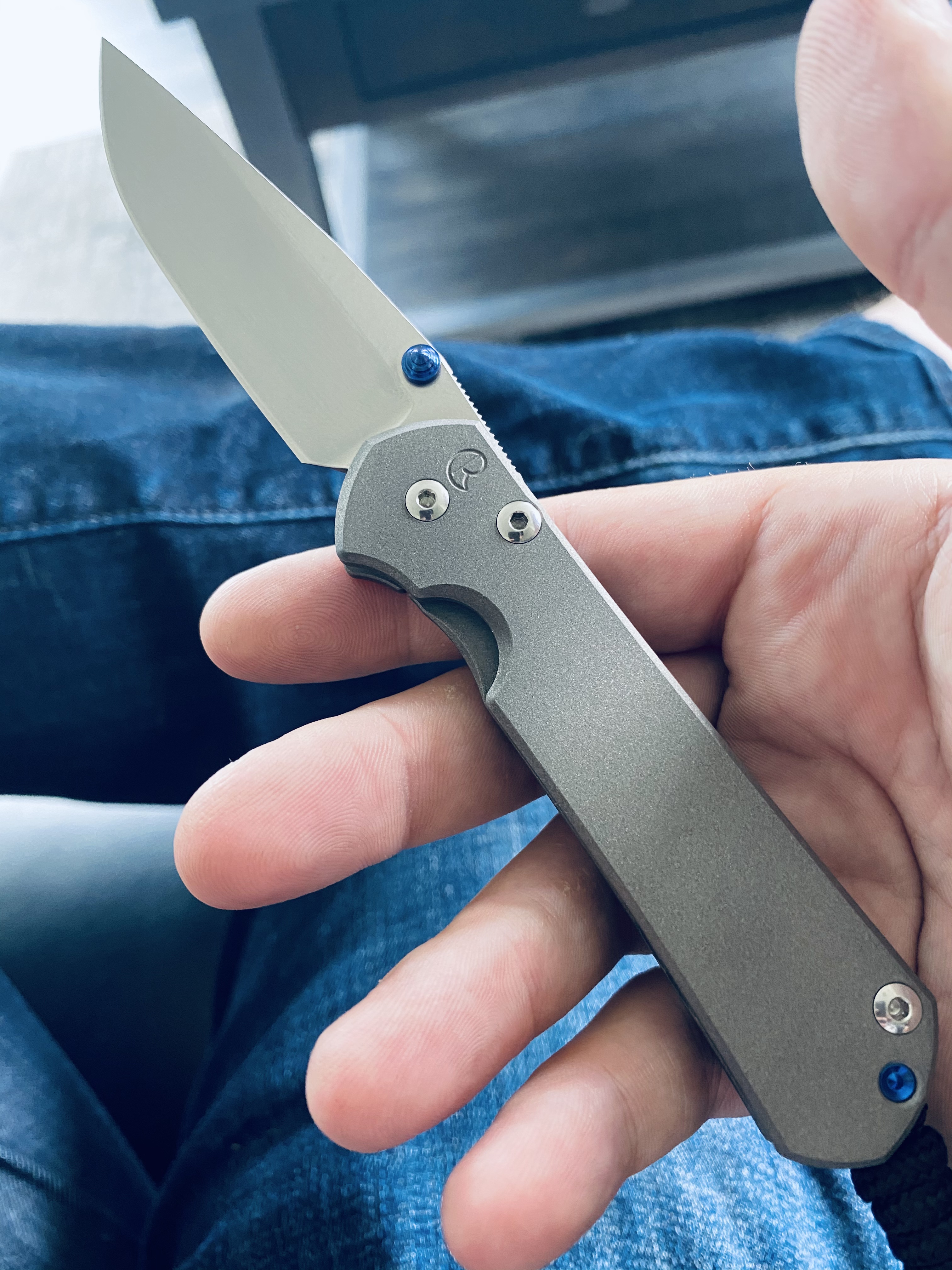
Ready to Own the Benchmark?
The Sebenza 31 Large in S45VN, drop point, plain titanium — the configuration most users buy first.
Buy the Sebenza 31 on AmazonDay-In, Day-Out Tasks: How the Sebenza Actually Performs
Office and Travel
This is where the Small Sebenza is exceptional. Three ounces, sub-three-inch blade, neutral profile, no flipper to draw second glances. It opens letters, parts vinyl tape, slits packing tape on Amazon boxes, and disappears into a suit pocket without bulking the line. I have flown domestically with mine in checked luggage for years; international travel requires checking the destination’s knife laws, but in the U.S., a 2.99-inch blade is essentially universally legal.
Kitchen Backup
Not the Sebenza’s natural environment, but it works. The hollow grind handles fruit and vegetables fine, though it is not a substitute for a dedicated paring knife. If you are looking for the right tool for kitchen prep instead, our explainer on paring knife uses for citrus and detail prep covers what a paring knife actually does well.
Outdoor Light Use
Camp tasks like opening rations, processing kindling, slicing rope, and trimming cordage are all comfortable with the Large. It is not a fixed-blade replacement, but for one-knife-only weekend trips, it is enough. Where it falls short is processing fatwood or splitting kindling—any folder will, but especially one with a hollow grind.
Hard-Use Tasks (Don’t)
Do not pry with the tip. Do not baton through hardwood. Do not use it as a screwdriver. The Sebenza is rated for pocket use, not abuse. If you need a hard-use folder, the Umnumzaan exists in the same family.
Collecting and Aesthetic Carry
Many Sebenza buyers carry one as their daily and own one in inlay or CGG as a special-occasion knife. The inlay versions, especially Macassar ebony and box elder burl, are stunning and age beautifully. The CGG basket weave version is a quiet conversation piece. None of these versions compromise function—they all use the same blade, lock, and pivot system.
Final Performance Scores
Frequently Asked Questions
Is the Chris Reeve Sebenza 31 worth the high price?
For users who plan to carry the knife daily for a decade or longer, yes. The combination of lifetime Spa Service, owner-serviceable hardware, and the consistency of fit and finish makes the long-term cost reasonable. For users who lose knives, rotate frequently, or treat folders as disposable, the value calculation falls apart and a cheaper option is more rational.
What is the difference between Sebenza 21 and Sebenza 31?
The Sebenza 31 uses CPM-S45VN steel rather than S35VN, a ceramic detent ball that prevents lock-side wear, a refined hollow grind, and a slimmer overall handle profile. Mechanically, the 31 is the small-but-real upgrade Reeve introduced after a decade of the 21.
Can I disassemble my Sebenza without voiding the warranty?
Yes. Chris Reeve Knives explicitly designs the Sebenza for owner disassembly, and includes the correct screwdriver and lubricant in the box. Disassembly does not void the warranty as long as you do not damage components. Reassembly is straightforward thanks to the captive pivot.
How often should I send my Sebenza in for Spa Service?
For daily carriers, every five to seven years is a reasonable cadence. For occasional users, you can go a decade or more between services. The service restores the bead-blast finish, sharpens the blade to factory geometry, and replaces any worn hardware.
Is S45VN better than M390 or 20CV for a folding knife?
It depends on what you optimize for. S45VN sharpens more easily and resists corrosion better than most premium powder steels. M390 and CPM-20CV hold an edge longer in pure cardboard testing but are harder to sharpen. For a folder you actually maintain, S45VN is arguably the better all-around choice.
Should I buy the Small or Large Sebenza?
If you carry a knife in dress slacks, suit pockets, or restrictive jurisdictions, buy the Small. If you want a one-knife-only EDC for any task—office, outdoor, kitchen backup—the Large is more versatile. The Small is the historically dominant choice; the Large is the more practical tool.
Does the Sebenza have any blade play after years of use?
Properly assembled and lightly maintained, the Sebenza should have zero perceptible play in any direction across the life of the knife. If play develops, it is almost always a slightly loose pivot or body screw, fixable in two minutes with the included Torx driver.
Is the Sebenza ambidextrous?
The thumb studs are ambidextrous, but the frame lock and clip are right-hand by default. Reeve will configure a left-hand variant on request, and aftermarket clips exist. Lefties should plan to special-order or factor in a clip swap.
Can I use the Sebenza for hard-use tasks like batoning or prying?
No. The Sebenza is a refined daily carry knife, not a hard-use folder. For batoning or prying-adjacent tasks within Reeve’s lineup, the Umnumzaan is purpose-built. For most other framelocks, look at thicker-stock options like the Zero Tolerance 0566 or 0562.
How does the Sebenza compare to the Benchmade 940 for daily carry?
The 940 is lighter, faster to deploy, and significantly cheaper. The Sebenza has tighter tolerances, better long-term lockup integrity, and better service support. Both are excellent EDC folders; the choice is between immediate value (940) and long-term value (Sebenza).
Will my Sebenza rust if I carry it in humid conditions?
The titanium handle never rusts. The S45VN blade has 16% chromium and is highly corrosion resistant—well above S30V or S35VN. Reasonable wipe-downs after exposure to sweat or salt water are sufficient. I have not seen a single corrosion spot on my carry sample after a year of varied conditions.
Is the Chris Reeve Sebenza made in the USA?
Yes. Every Sebenza is machined, finished, and assembled at the Chris Reeve Knives facility in Boise, Idaho. The S45VN steel is produced by Crucible Industries in Syracuse, New York. The titanium is U.S.-sourced 6Al4V aerospace stock.
Final Verdict: A Knife That Earns Its Reputation Quietly
The Chris Reeve Sebenza 31 is not the knife you buy because of marketing. It is the knife you buy after you have owned a dozen others and started to notice what wears, what wobbles, what fades, and what does not. It is the framelock that other framelocks are measured against, not because it is the loudest in the room, but because it is the one that simply works exactly the same way it did the day you bought it, ten years from now.
It is not perfect. The right-hand-only clip frustrates lefties. The hollow grind is good without being a class-leading slicer. The price gates entry for many buyers who would otherwise love it. The manual opening will feel slow if your last knife was a flipper. None of these are deal-breakers; they are honest trade-offs that come with a particular design philosophy.
If you carry a folder daily, if you maintain your tools, if you value tolerances and lock integrity over flash, and if you can amortize the price over a decade or more of carry, the Sebenza 31 is one of the easiest premium recommendations in the entire knife world. Buy the Small if you live in dress pants. Buy the Large if you want one knife to do everything. Either way, plan to send it home to Boise every few years and let it come back better than new.
Final score: 9.3 / 10. Not because it is flashy, but because it is right.

Get Yours Before the Next Price Bump
Chris Reeve Sebenza 31, S45VN, made in Boise, Idaho. Lifetime Spa Service. The benchmark.
Check Today’s Price on Amazon