Victorinox Fibrox Pro Review: Why This $40 Knife is a Legend
I need to tell you a secret. It’s a secret that professional chefs, line cooks, and butchers have known for decades. In a world of gorgeous $200 German knives and artistic Japanese blades, one of the best-performing, most reliable chef’s knives you can buy costs less than two movie tickets. It’s the Victorinox Fibrox Pro. It’s not beautiful. It won’t win any design awards. But it is, without a doubt, the single greatest value in the entire culinary world. I’ve owned this knife for 15 years. It was my first “real” chef’s knife, and despite having a block filled with expensive German and Japanese steel, I still find myself reaching for it constantly. This is the story of why this humble Swiss knife is a giant-slayer.
Affiliate Disclosure & Transparency: This review is a labor of love based on over a decade of personal experience. To support my work, this post contains affiliate links. If you buy through them, I may earn a commission at no extra cost to you. My loyalty is to you, the reader, and my goal is to give you the most honest, unfiltered advice possible.
The Verdict in a Nutshell
The Victorinox Fibrox Pro 8-inch Chef’s Knife is the best value chef’s knife on the planet. Period. It offers 90% of the cutting performance of knives that cost 4-5 times as much. Its combination of a razor-sharp edge, incredible durability, and an ultra-practical, non-slip handle makes it the default recommendation for beginners, culinary students, and pros on a budget. It is a tool of pure function, and it is brilliant.
| Sharpness (Out of Box): | ★★★★★ |
| Ergonomics & Grip: | ★★★★★ |
| Durability & Toughness: | ★★★★☆ |
| Ease of Maintenance: | ★★★★★ |
| Aesthetics & Design: | ★★☆☆☆ |
| Overall Value: | ★★★★★ |
The Deep Dive: An Unflinching Look at the Fibrox Pro 8-Inch
Let’s break down this legendary knife piece by piece, from its unassuming blade to its deceptively brilliant handle.

Victorinox Fibrox Pro 8-Inch Chef’s Knife
This is the flagship, the icon, the knife that started it all. It’s the perfect size for 99% of kitchen tasks. Whether you’re a seasoned pro or have never held a proper chef’s knife before, this is the place to start. Its lightweight nature makes it approachable, while its wickedly sharp edge delivers professional-grade results from the very first cut.
Pros
- Incredible sharpness out of the box
- Exceptional value for money
- Fibrox handle offers a secure, non-slip grip
- Lightweight and easy to handle
- Extremely easy to sharpen and maintain
Cons
- Stamped blade lacks the balance of forged knives
- Plain, utilitarian appearance
- Handle may feel cheap to some
The Blade: Deceptively Simple, Shockingly Effective
At first glance, the Fibrox Pro’s blade looks ordinary. There’s no fancy Damascus pattern or mirror polish. But its genius lies in its simplicity.
Stamped Construction & European Steel
The blade is stamped, not forged. This means it’s cut from a large sheet of cold-rolled steel, then shaped, ground, and heat-treated. This is a much more efficient manufacturing process than forging, which is a primary reason for its low cost. The steel itself is a proprietary high-carbon stainless formula from Switzerland. It’s hardened to about 56 HRC, which is the sweet spot for a workhorse knife.
This hardness means the steel is tough enough to resist chipping, but soft enough to be honed back to a razor edge in seconds with a honing steel. It strikes a perfect balance between edge retention and ease of maintenance.
Geometry & The “No Bolster” Advantage
The blade has a relatively flat spine and a gentle curve, making it surprisingly versatile for both rocking and slicing. Crucially, because it’s stamped, it has no bolster (the thick part of metal between the blade and handle). While a bolster adds weight and balance to forged knives, its absence here is a huge advantage: you can sharpen the entire length of the blade, right to the heel. Over years of sharpening, the blade will wear evenly without developing a gap near the handle.
The Handle: The Unsung Hero of Grip and Comfort
If the blade is the business end, the handle is the reason professionals can use this knife for 10 hours straight. The “Fibrox” handle is made from a patented Thermoplastic Elastomer (TPE).
In plain English, it’s a slightly soft, textured, rubber-like material. The feeling is not one of luxury, but of absolute, unshakable security. I’ve used this knife with wet hands, greasy hands while breaking down a chicken, and slimy hands after fileting fish. My grip has never once slipped. The handle is ergonomically shaped to reduce wrist tension, and its lightweight nature makes the entire knife feel nimble and tireless. It is also NSF (National Sanitation Foundation) Certified, meaning it has a sealed handle-to-blade interface that prevents bacteria from building up, a requirement in many commercial kitchens.
Full Tang vs. Stamped: Debunking the Biggest Myth About This Knife
The most common objection I hear about the Fibrox Pro comes from people who have never actually used one, and it usually goes something like this: “stamped knives are cheap and full tang knives are the only ones worth owning.” This is one of the most persistent, and most misleading, pieces of knife folklore floating around the internet, so let’s take it apart properly.
A full tang knife is one where the steel of the blade extends all the way through the handle, typically visible as a strip of metal sandwiched between two handle scales that are riveted in place. Because a stamped knife like the Fibrox Pro doesn’t have visible rivets or a bolster, people assume the tang must be short, or that the blade is somehow flimsy. In reality, the Fibrox Pro does have a full tang. The steel runs the entire length of the handle; it’s simply molded over with the single-piece TPE grip rather than sandwiched between two riveted scales. You can’t see the tang because Victorinox chose a cleaner manufacturing method, not because the knife lacks one.
The confusion usually comes from conflating two separate things: tang length and forging method. Forging and stamping describe how the blade blank is shaped out of raw steel. Tang construction describes how much of that steel extends into the handle. A knife can be stamped and full tang, or forged and partial tang; the two variables aren’t linked the way marketing copy often implies. Once you separate those concepts, the “cheap stamped knife” argument mostly falls apart, at least as it applies to this particular knife.
Where forged knives genuinely differ is in mass distribution and, in theory, grain structure. A forged blade typically carries more weight near the bolster, which shifts the balance point closer to the handle and gives a heavier, more momentum-driven feel through a cut. Some cooks love that heft; it can make rock-chopping through dense root vegetables feel more effortless. Others, myself included after 15 years with the Fibrox, actually prefer the lighter, faster feel of a stamped blade for high-repetition prep work like dicing onions or mincing herbs, where wrist fatigue matters more than raw momentum. Neither approach is objectively “better.” They’re different tools tuned for different working styles, and the idea that one is inherently inferior doesn’t hold up once you’ve actually used both side by side for a few years.
Beyond the Icon: Exploring the Victorinox Kitchen Knife Family
While the 8-inch chef’s knife is the star, Victorinox brings its philosophy of function-first value to a whole range of essential kitchen tools. If you love the Fibrox Pro, building out your collection with these is a no-brainer.
The 4-Inch Paring Knife
Arguably as essential as the chef’s knife, this little powerhouse is perfect for all in-hand tasks: peeling apples, hulling strawberries, or deveining shrimp. It’s incredibly sharp and so affordable that you won’t cry if a guest accidentally uses it to open a can. A must-have.
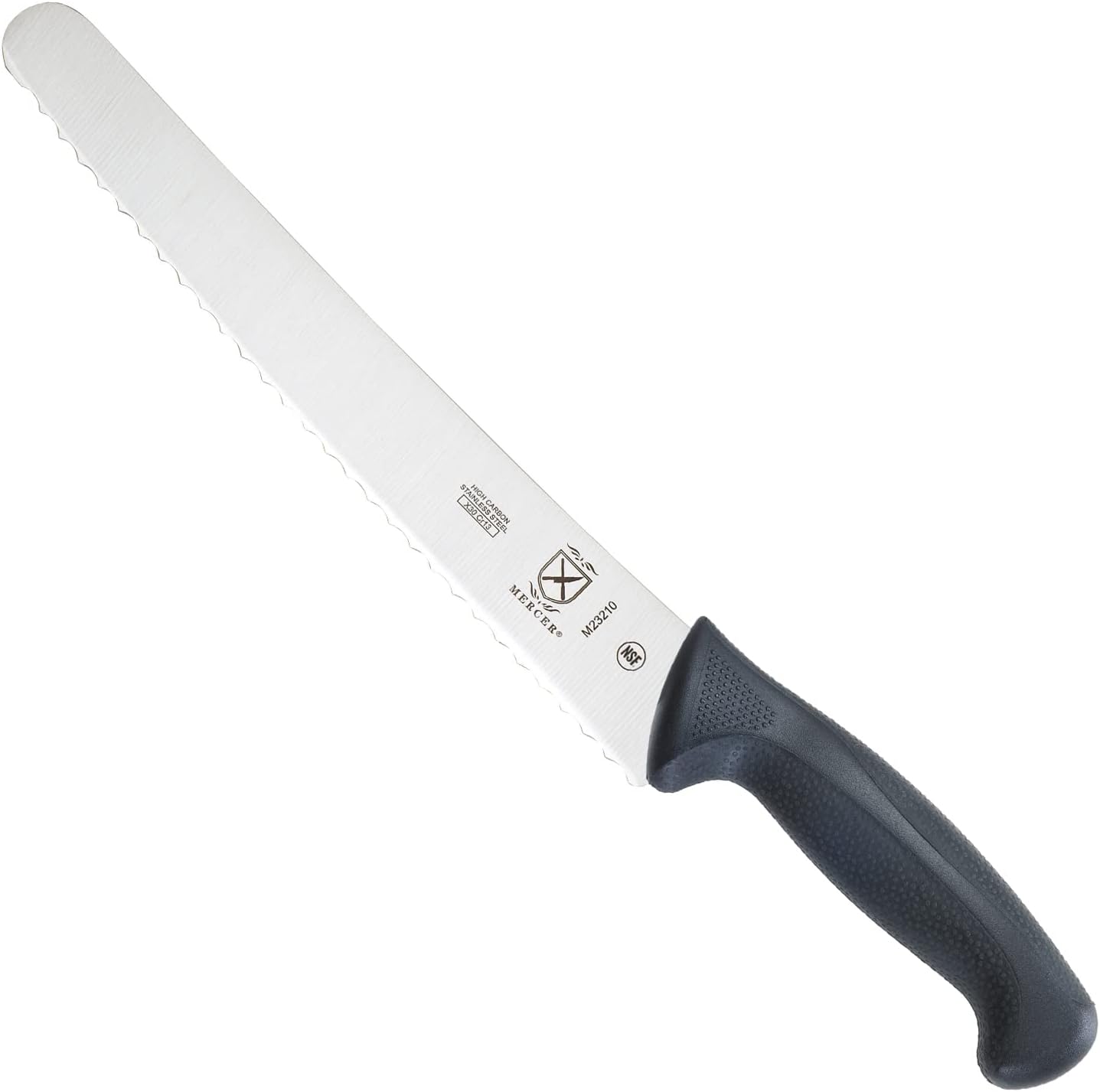
Check Paring KnifeThe 10.25-Inch Serrated Bread Knife
This is another legend in the culinary world. The long, serrated blade with its wavy edge cuts through crusty artisan bread without tearing the soft interior. It’s also a secret weapon for slicing delicate tomatoes or leveling cakes. The offset handle provides knuckle clearance. It consistently outperforms bread knives costing three times as much.
Check Bread KnifeThe Rest of the Fibrox Lineup You Should Know About
The chef’s knife, paring knife, and bread knife get most of the attention, but Victorinox actually builds out the entire Fibrox line into a nearly complete professional kitchen. Understanding the rest of the range helps explain why so many culinary schools issue students an entire Victorinox kit rather than mixing and matching brands.
The boning knife features a narrower, more flexible blade designed to follow the contours of bone and joint when breaking down poultry, pork, or beef. Butchers favor it because the thin profile lets you work close to the bone without wasting meat, and the same Fibrox handle that makes the chef’s knife so secure becomes even more valuable here, since boning work often happens with cold, wet, or fatty hands. Victorinox also sells a stiffer variant of the boning knife for cooks who work with tougher cuts and prefer less blade flex.
The Granton edge fillet knife is purpose-built for fish. Its long, thin, highly flexible blade lets it hug the spine and skin of a fillet, and the scalloped hollow-ground indentations along the blade (the “Granton edge”) create small air pockets that reduce drag and prevent thin slices of fish from sticking to the metal. If you process your own catch or work through whole fish regularly, this is arguably a more specialized upgrade than a second chef’s knife.
For heavier-duty tasks, Victorinox also produces a cleaver in the Fibrox line. It’s not intended for chopping through thick bone the way a butcher’s cleaver is; it’s better understood as a wide, heavy-duty chef’s knife substitute that excels at transferring chopped ingredients from the cutting board to the pan using the flat of the blade, and at crushing garlic cloves with a firm downward press.
Finally, the utility knife (typically in the 5 to 6-inch range) fills the gap between the paring knife and the chef’s knife. It’s the knife I reach for when a chef’s knife feels like overkill but a paring knife feels too small, things like slicing a sandwich, trimming the fat off a small cut of meat, or portioning citrus. If you’re building a full block from scratch, a chef’s knife, paring knife, bread knife, and utility knife together cover the overwhelming majority of home cooking tasks, and all four can be had for less than the price of a single premium Japanese chef’s knife.
Victorinox Fibrox Pro Set Options: Building a Full Block on a Budget
One question I get constantly is whether it’s better to buy the pieces individually or look for a bundled Fibrox set. The honest answer depends on how you cook. If you already know you want the 8-inch chef’s knife, the 4-inch paring knife, and the bread knife, buying a set can sometimes work out cheaper per-knife than buying each one separately, and it saves you from having three separate delivery boxes and shipping charges.
That said, sets aren’t always the better deal, and they aren’t always assembled with the specific pieces you actually need. Some bundles pair the chef’s knife with a boning knife you may never use if you don’t cook a lot of whole poultry or primal cuts, while skipping the utility knife that sees daily use in most home kitchens. Before buying any set, actually think through your last two weeks of cooking and ask which knife you reached for and which one sat untouched. Match the set contents to that pattern rather than to whatever combination happens to be marketed as the “starter kit.”
If you’re outfitting a kitchen from absolute zero, a reasonable starting order is: chef’s knife first, paring knife second, bread knife third, and a utility knife or boning knife fourth depending on whether you cook more produce or more meat. This mirrors almost exactly how culinary schools sequence knife purchases for first-year students, and it’s a sequence that has served home cooks well for decades because it front-loads the tools that get used every single day before spending money on more specialized blades.
How to Hold and Use the Fibrox Pro Like a Professional
A sharp knife in an untrained hand is both less efficient and, counterintuitively, more dangerous than a sharp knife in a trained one. If you’ve never been shown proper knife technique, the Fibrox Pro is actually one of the best knives to learn on, because its light weight and secure grip forgive small technique errors that would be punished by a heavier, more slippery knife.
The Pinch Grip
Professional cooks almost universally use what’s called a pinch grip. Instead of wrapping all four fingers and your thumb around the handle the way you’d hold a hammer, you pinch the blade itself, just in front of the handle, between your thumb and the side of your index finger. The remaining three fingers wrap around the handle for support. This grip moves your hand’s center of control from the handle onto the blade, which gives you dramatically more precision and reduces wrist strain over long prep sessions. The Fibrox Pro’s flat spine and lack of a bolster make this grip especially comfortable, since there’s no thick metal lip forcing your fingers back onto the handle.
The Claw Grip for Your Guiding Hand
Your non-knife hand matters just as much as your knife hand. Curl your fingertips under and back, so your first knuckles form a vertical wall that the flat of the blade can ride against as you cut. Your thumb tucks behind your fingers, well out of the blade’s path. This “claw” position means the sharpest part of the blade is always guided by the flat of your knuckles rather than by your fingertips, so even if your rhythm slips for a moment, the knife bumps against bone and cartilage in your hand rather than skin.
The Rock Chop and the Slide Cut
The Fibrox Pro’s gentle blade curve is well suited to the classic rock chop: keeping the tip in light contact with the board and rocking the heel of the blade up and down through whatever you’re cutting, useful for fine mincing of herbs and garlic. For denser or larger ingredients, a slide cut, drawing the blade forward and down through the food in one continuous motion, uses the full length of the edge and requires less downward force, which reduces fatigue during long prep sessions.
Caring for Your Fibrox Pro: Cleaning, Storage, and Rust Prevention
One reason this knife has such a strong reputation among professionals is that it’s genuinely low-maintenance, but “low-maintenance” doesn’t mean “no maintenance.” A little bit of care goes a long way toward keeping the blade performing the way it did on day one.
Is the Victorinox Fibrox Pro Dishwasher Safe?
Victorinox states the handle can technically survive a dishwasher cycle, but I strongly recommend against it, and so does nearly every professional who owns one. Dishwashers subject blades to prolonged moisture, harsh detergent, and the risk of the edge banging against other utensils, plates, or the rack itself, which can chip or dull the edge far faster than normal use. Hand washing takes fifteen seconds: a quick pass under warm water with mild dish soap, immediately dried with a towel. That’s the entire routine, and it’s the single biggest factor in how long this knife stays sharp.
Rust and Stainless Steel
The steel is stainless, which means it resists rust far better than high-carbon Japanese steels, but “stainless” does not mean “rust-proof.” Leaving the blade wet in a sink, especially in contact with acidic foods like tomato or citrus residue, for extended periods can eventually cause light surface spotting. Drying the blade immediately after washing eliminates this risk entirely. If you do spot light surface rust, a paste of baking soda and water on a soft cloth, or a Bar Keepers Friend application, will typically buff it right out.
Storage: Blocks, Magnetic Strips, and Sheaths
Because the Fibrox Pro has no bolster and a relatively slim profile, it fits comfortably in nearly any standard knife block slot, on a magnetic strip, or in an in-drawer knife tray. Magnetic strips are a great option for this knife specifically because the light blade won’t strain the magnet’s holding capacity the way a heavier forged knife might, and it keeps the edge fully visible and accessible. If you’re storing it loose in a drawer, a simple blade guard or edge sheath (often included with the knife or available cheaply on its own) prevents the edge from banging against other utensils and protects your fingers when reaching into the drawer.
How to Sharpen a Victorinox Fibrox Pro: A Deeper Look
We touched on this briefly in the FAQ below, but sharpening deserves its own detailed walkthrough because it’s the single skill that determines whether this knife performs like a $40 tool or a $150 one.
Honing vs. Sharpening: Know the Difference
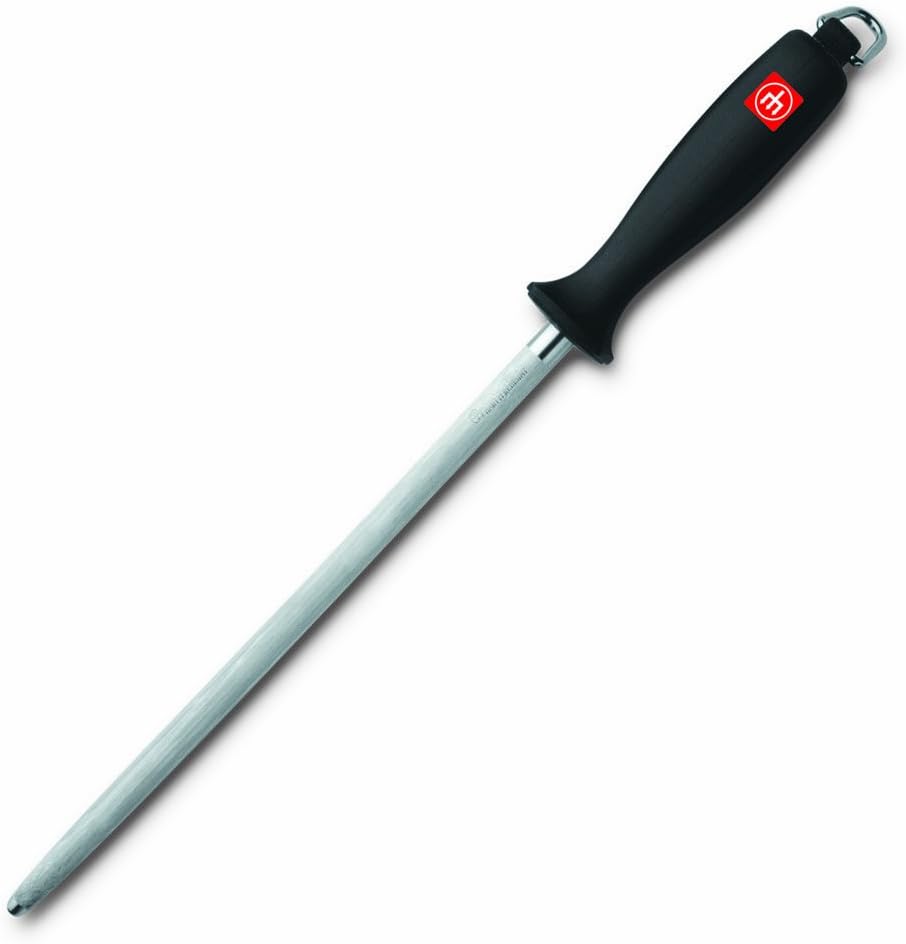
These two words get used interchangeably, but they describe different processes. Honing realigns the microscopic edge of the blade, which bends slightly out of true with every use, using a honing steel (sometimes called a sharpening steel, confusingly). It doesn’t remove metal; it just straightens what’s already there. You should hone before every single use, or at minimum every few uses, with light, consistent strokes at roughly a 15 to 20-degree angle along each side of the blade. Sharpening, by contrast, actually removes metal to create a new edge, and should happen far less frequently, maybe every few months for a home cook, more often for someone cooking daily.
Whetstones vs. Pull-Through Sharpeners
A pull-through sharpener is the fastest, easiest option and works well enough on this knife’s relatively soft, forgiving steel, but it removes more metal than necessary with each pass and offers no control over the angle. A whetstone takes longer to learn but gives you total control, removes minimal steel, and can put a noticeably sharper, longer-lasting edge on the blade. Because the Fibrox Pro’s steel is on the softer end at roughly 56 HRC, it’s actually one of the easier knives to learn whetstone sharpening on; the steel responds quickly, and mistakes are easy to correct on the next pass. A basic 1000/6000 grit combination stone is more than sufficient for maintaining this knife indefinitely.
Victorinox Fibrox Pro vs. Mercer Culinary Genesis
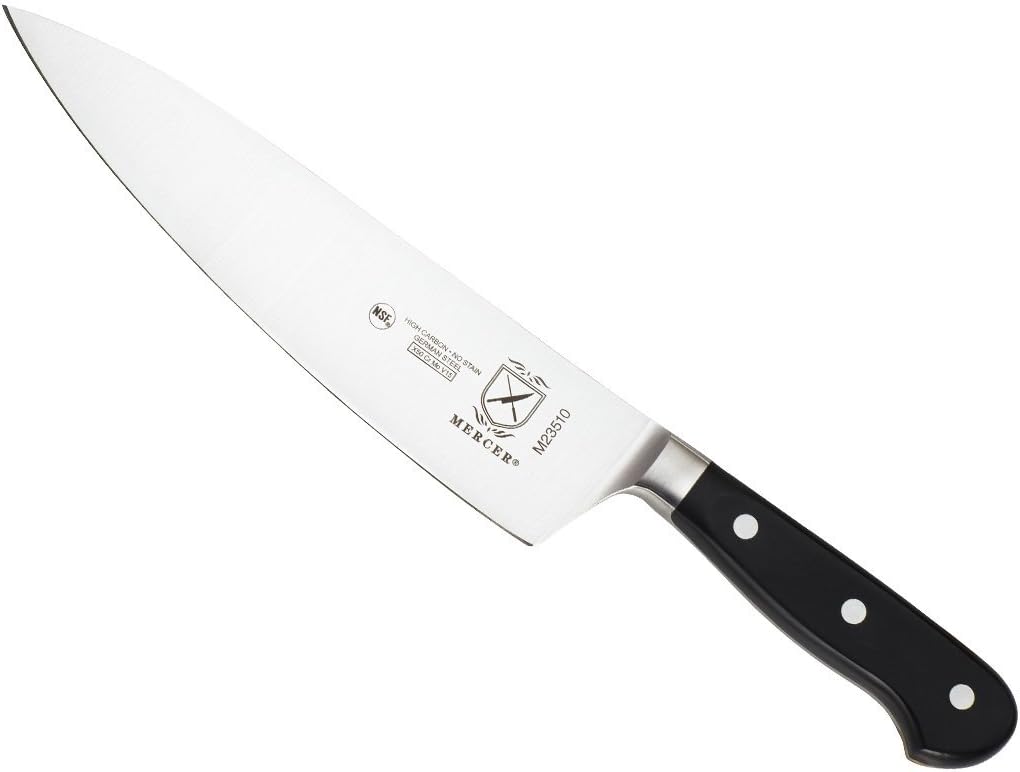
Outside of the big German names, the Mercer Culinary Genesis is probably the most common alternative recommendation you’ll see in the same price bracket, and it deserves a direct comparison. The Genesis uses a forged, full-bolstered German steel blade with a Santoprene handle, which gives it noticeably more heft and a more traditional balance point than the Fibrox Pro. Some cooks who trained on heavier knives genuinely prefer that feel.
Where the Fibrox pulls ahead is sharpness out of the box and long-term ease of maintenance; its softer steel takes an edge faster and is friendlier to beginners learning to sharpen. The Genesis, with its bolster, sacrifices some sharpenable blade length near the heel, the same tradeoff forged German knives generally make. Price-wise the two typically land close together, so the decision usually comes down to whether you want a lighter, faster knife (Fibrox) or a heavier, more traditionally balanced one (Genesis). Culinary schools have historically issued both brands to students in roughly equal measure, which tells you neither is a wrong choice.
The Ultimate Showdown: Victorinox vs. The World
Okay, the Victorinox is great for the price. But how does it *actually* stack up against the expensive legacy brands? This is where things get interesting. I’ve spent years comparing these knives, and here’s the honest truth.
Victorinox vs. Wüsthof
This is the ultimate battle of value vs. heritage. The Wüsthof Classic feels like a Mercedes-Benz: solid, powerful, perfectly balanced, and an heirloom piece. The Victorinox feels like a Honda Civic: lightweight, nimble, incredibly reliable, and gets the job done with shocking efficiency. The Wüsthof’s forged blade and bolster give it a satisfying heft that the Victorinox lacks, but the Victorinox’s blade is just as sharp, if not sharper, out of the box. For a full breakdown, you have to read our Wüsthof vs. Victorinox comparison.
Victorinox vs. Zwilling
The story is much the same when comparing it to the other German giant. The premium, German-made Zwilling Pro is a marvel of ergonomics and engineering. But when you look purely at cutting performance, the humble Victorinox is right on its heels. A Zwilling is an investment in feel, balance, and long-term edge retention. A Victorinox is an investment in pure, unadulterated cutting power for the lowest possible price. It’s a fascinating contrast we explore in Victorinox vs. Zwilling.
Victorinox vs. Henckels
This is the true battle of the budget kings. Henckels, the value brand from Zwilling, makes some of the best affordable knife sets. The key difference? Henckels often focuses on providing a more traditional “German feel” (even in their stamped knives) with heavier handles. Victorinox focuses 100% on a lightweight, utilitarian design. If you want a knife that feels more substantial, Henckels might be your pick. If you want pure, lightweight performance, Victorinox wins. We hash it out in our Henckels vs. Victorinox article.
Victorinox vs. Japanese Santoku Knives
A question I get almost as often as the German comparisons is how the Fibrox stacks up against a Japanese santoku, since both are frequently recommended as a first “serious” knife. They’re actually solving slightly different problems. A santoku uses a harder, more brittle steel typically ground to a steeper, more acute edge angle, which produces exceptional sharpness and clean, thin slices, particularly on vegetables and fish, but that same hardness makes the edge more prone to chipping if it hits bone or is used with a rocking chop motion the blade’s flatter profile doesn’t support well. The Fibrox’s softer, tougher steel and curved profile make it more forgiving and more versatile across a wider range of tasks, including the rock-chop technique the santoku’s flat edge resists. If your cooking leans heavily toward produce and fish prep, a santoku is worth considering as a second knife. As an only knife, the Fibrox’s versatility wins out for most home cooks.
Where Is the Victorinox Fibrox Pro Made, and What Does “Swiss Made” Actually Mean Here?
Victorinox, the same company behind the famous Swiss Army Knife, manufactures its kitchen knives at its facility in Ibach, Switzerland. This matters for quality control in a way that’s easy to overlook: unlike some budget knife brands that outsource stamping and grinding to third-party contract manufacturers with inconsistent tolerances, Victorinox controls the entire production chain in-house, from steel sourcing through heat treatment to final edge grinding. That vertical integration is a big part of why a $40 stamped knife can come out of the box sharper and more consistent than some forged knives costing two or three times as much. It’s also why you’ll rarely hear complaints about batch-to-batch quality inconsistency with this specific knife, a complaint that does come up occasionally with less established budget brands.
Warranty, Longevity, and What Happens When Something Goes Wrong
Victorinox backs the Fibrox Pro with a lifetime warranty against manufacturing defects in material and workmanship, which is a remarkable guarantee for a knife at this price point. It’s worth being clear about what that warranty does and doesn’t cover: normal wear, edge dulling from use, and handle discoloration from years of dishwasher abuse (despite my advice above) are not covered, since those are expected outcomes of use rather than manufacturing defects. What is covered are things like a handle that separates from the tang, a blade that develops a structural flaw unrelated to misuse, or any defect present from the factory.
In quite literally hundreds of hours of comment threads, forum posts, and professional kitchen conversations I’ve read on this knife over the years, warranty claims are rare, which speaks to how consistently well-made these knives are. The bigger practical point is longevity through use rather than warranty: a Fibrox Pro that’s hand washed, dried immediately, honed regularly, and sharpened every few months will comfortably outlast a decade of daily professional use, as mine has already proven firsthand.
A Brief History of Victorinox and the Fibrox Line
Victorinox traces its roots back to 1884, when Karl Elsener founded a cutlery workshop in Ibach, Switzerland, eventually developing the folding pocketknife that would become the original Swiss Army Knife supplied to the Swiss military. The company built its reputation over more than a century on the same principle that defines the Fibrox Pro today: rugged, dependable tools designed to be used hard, not admired from a display case. The Fibrox handle material itself, and the broader professional kitchen knife line built around it, grew out of Victorinox’s expansion into commercial and institutional foodservice equipment in the latter half of the 20th century, aimed squarely at the demands of restaurant kitchens rather than home cooking enthusiasts. That heritage explains why the design philosophy leans so heavily toward function, hygiene, and durability over aesthetics; it was built for people who use a knife for a living, and the home cooking market inherited that design almost by accident once word spread about how good the knives actually were.
Buying in Bulk: The Fibrox Pro for Restaurants and Commercial Kitchens
If you manage a restaurant, culinary program, or catering operation, the economics of the Fibrox Pro get even more compelling at scale. Because the knife is NSF certified and holds up to constant use, it’s one of the most commonly issued “house knives” in commercial kitchens, the knives kept on hand for staff who don’t bring their own roll, or supplied wholesale to culinary students at the start of a program. Buying multiples is often available through restaurant supply wholesalers at a further discount per unit compared to single retail purchases, and because the knives are so consistent from the factory, a kitchen manager can stock a dozen of them without worrying about the wide quality variance you sometimes see with cheaper unbranded stamped knives. For culinary schools specifically, it’s common practice to require this exact knife, or the equivalent Fibrox paring and utility knives, as part of a required student kit, precisely because it’s affordable enough that a first-year student won’t be devastated by nicks and mistakes made while learning.
Gift Guide: Why the Fibrox Pro Makes a Great Present
If you’re shopping for a new home cook, a college student moving into their first apartment, or even an experienced cook whose knives are embarrassingly dull, the Fibrox Pro is one of the easiest, safest gifts in the kitchen category. It avoids the two big risks that come with gifting more expensive knives: price anxiety (nobody feels bad about a knife nick or a drop on a $40 tool the way they would with a $150 one) and the personal-preference mismatch that comes with gifting a heavier forged knife to someone who might actually prefer a lighter blade. Pairing the chef’s knife with the paring knife makes a genuinely useful two-piece gift set that covers most everyday kitchen tasks, and unlike a lot of kitchen gadgets, it’s something the recipient will likely still be using ten years later.
Common Complaints About the Fibrox Pro, and Whether They Hold Up
No product review is complete without an honest look at the negative feedback, so let’s go through the most common complaints I see repeated across owner reviews and forum threads, and evaluate each one on its merits rather than dismissing them outright.
“The Handle Feels Cheap”
This is the single most repeated complaint, and it’s not entirely unfounded. The Fibrox handle doesn’t have the dense, substantial feel of a resin-infused wood handle or a heavy polymer scale handle riveted onto a bolstered blade. It’s a lightweight, slightly springy plastic. Whether that reads as “cheap” or “practical” really comes down to expectations. If you’re expecting a knife that feels like a luxury object, you’ll be disappointed. If you’re expecting a knife that won’t slip out of your hand while breaking down a whole chicken, it delivers exactly what it promises.
“It Doesn’t Hold an Edge as Long as My Japanese Knife”
This one is simply true, and it’s worth acknowledging directly rather than spinning it. The softer 56 HRC steel dulls faster under heavy use than a harder Japanese steel in the 60-62 HRC range. The tradeoff is that when it does dull, it takes seconds to bring back with a honing steel, and minutes to fully resharpen, versus the more involved sharpening process harder steels often require. For most home cooks, that tradeoff favors the Fibrox; for someone who wants to sharpen a knife twice a year and have it hold an edge the whole time, a harder Japanese steel may be worth the added cost and fragility.
“The Blade Flexes Too Much”
Some reviewers new to stamped knives interpret the blade’s slight flex as a structural weakness. In reality, a small amount of flex in a thin stamped blade is normal and doesn’t meaningfully affect cutting performance for standard kitchen tasks. It only becomes a real issue if you’re using the knife for tasks it wasn’t designed for, like prying apart frozen food or twisting the blade sideways in a cut, both of which will stress any thin blade regardless of brand.
Frequently Asked Questions
Is the Victorinox Fibrox Pro a forged knife?
No, it is a stamped knife. The blade is cut from a sheet of steel rather than being hammered from a single piece. This is a key reason for its affordable price and lightweight feel.
Is this knife good for professional chefs?
Yes, absolutely. It is one of the most common knives found in professional kitchens around the world. Its low cost, high performance, durability, and NSF-certified handle make it an ideal tool for the demanding environment of a commercial kitchen.
Why is the Victorinox knife so cheap?
It comes down to three things: 1) Efficient stamped construction is much cheaper than forging. 2) The TPE Fibrox handle is an inexpensive but highly functional material. 3) They sell millions of them, creating economies of scale. You are paying for pure performance, not expensive materials, marketing, or intricate hand-finishing.
How do I sharpen a Victorinox knife?
It’s incredibly easy. Because the steel is tough but not overly hard, it responds very well to simple sharpening methods. A few passes on a honing steel before each use will keep the edge straight. When it dulls, a simple pull-through sharpener will work wonders. For the best possible edge, learning to use a whetstone is ideal, but not strictly necessary for this forgiving blade.
Is the Victorinox Fibrox Pro dishwasher safe?
Victorinox says the handle can survive it, but it’s not recommended. Hand washing and immediately drying the blade takes seconds and will keep the edge sharper and the blade free of any risk of spotting or chipping for much longer.
Does the Victorinox Fibrox Pro have a full tang?
Yes. The steel extends the full length of the handle; it’s simply molded over in a single piece of TPE rather than sandwiched between two riveted scales, which is why it isn’t visible the way a full tang is on many forged knives.
What size Victorinox Fibrox Pro should I buy?
For most home cooks, the 8-inch chef’s knife is the ideal all-purpose size. Those with smaller hands or a preference for more control sometimes prefer the 6-inch version, while cooks who process a lot of large produce or proteins sometimes step up to the 10-inch.
Does Victorinox offer a warranty on the Fibrox Pro?
Yes, Victorinox provides a lifetime warranty against manufacturing defects in material and workmanship. Normal wear such as edge dulling or handle discoloration from dishwasher use is not covered.
Final Verdict: Who Should (and Shouldn’t) Buy This Knife?
The Victorinox Fibrox Pro is a masterpiece of utility, but it’s not for everyone.
You SHOULD Buy The Victorinox Fibrox Pro If:
- You are a beginner or a culinary student. This is, without question, the best first knife to buy.
- You value performance and function above all else. You want a tool that works, and you don’t care about fancy looks.
- You are on a budget. This is one of the few times in life where the most affordable option is also one of the best. It’s the king of all the best affordable chef knives.
- You need a reliable “beater” knife. Even if you own expensive knives, the Fibrox Pro is perfect for tasks you wouldn’t risk your prized Shun on, like cutting through a tough winter squash.
You SHOULD NOT Buy The Victorinox Fibrox Pro If:
- You want a knife that feels substantial and weighty. If you love the balance of a forged German knife, the Victorinox will feel flimsy to you.
- You appreciate aesthetics and craftsmanship. This is not an heirloom piece. It’s a tool, and it looks like one. A Wüsthof or Shun is a piece of kitchen art; a Victorinox is a hammer.
- You want a knife that holds its edge for a very long time. While easy to sharpen, its softer steel will require more frequent maintenance than the hard steel of Japanese knives.
In the end, the Victorinox Fibrox Pro’s legacy is secure. It has nothing to prove. It’s a testament to the idea that great design is not about how something looks, but about how it works. It’s a tool that democratized high-performance cooking, making it accessible to everyone. And for that, it deserves a place of honor in any kitchen.