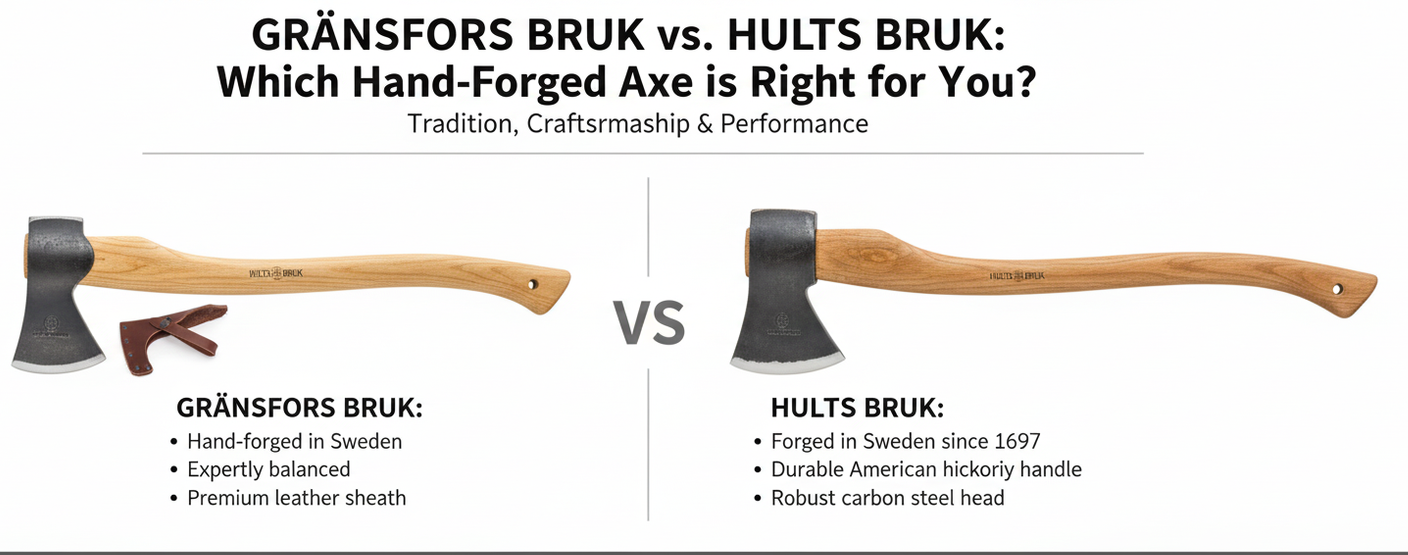
Gränsfors Bruk vs Hults Bruk: The Battle of Swedish Steel
Two legendary forges, one country, and centuries of rich forestry history. We dive deep into the metallurgy, handle dynamics, fit-and-finish, and field performance of the world’s finest axes to decide which one belongs in your bushcraft kit.
Introduction: The Swedish Axe Renaissance
In the world of bushcraft, traditional woodworking, and forestry, there is a distinct, heavy line drawn in the sawdust. On one side, you have the highly modern, composite-handled utility tools—the indestructible plastic splitters and campers like those we analyzed in our Fiskars vs Estwing comparison. On the exact opposite side, you have the absolute “soul” of the woods: traditional, hand-forged Swedish axes featuring premium American hickory handles and high-carbon steel heads.
If you have decided to graduate from hardware store hatchets and invest in a true heritage tool—one you intend to pass down to your grandchildren—you have likely narrowed your search down to the two undisputed heavyweights of the industry: Gränsfors Bruk (often abbreviated as GB) and Hults Bruk (HB). Both are meticulously forged in Sweden. Both are globally revered for their uncompromising quality. And both carry a premium price tag that reflects their artisanal nature.
But the axe community is fiercely divided. Is Gränsfors Bruk genuinely worth the premium “status” price tag? Or is Hults Bruk the sleeping giant that offers a more authentic, utilitarian value? What about other famous Swedish names like Wetterlings or Husqvarna? In this exhaustive comparison, we strip away the marketing romance and aggressively scrutinize the steel, the edge geometry, the wedging techniques, and the handle quality to help you make an informed decision. The allure of a Swedish axe is undeniable. The heft of a perfectly balanced tool, the scent of linseed oil on fresh hickory, and the ringing sound of steel biting into birch or pine—these sensory experiences connect us to a lineage of forestry, craftsmanship, and survival that stretches back over a millennium. Understanding which tool best suits your specific needs, whether you are a professional lumberjack, a weekend carver, a backcountry canoe guide, or a suburban firewood processor, requires a meticulous, almost obsessive level of detail. We must move beyond the superficial branding and glossy marketing photographs to analyze the crystalline structure of the steel itself, the ergonomic taper of the handle, and the long-term durability of the edge under extreme duress.
History, Pedigree, and the Industry Landscape
Before analyzing the steel, we must look at the history. The Swedish axe industry underwent a massive crisis in the mid-20th century with the widespread adoption of the chainsaw. To survive, these forges had to adapt. The narrative of survival is written in the fires of the blast furnaces and the hydraulic presses that shape the glowing billets. Sweden’s rich iron ore deposits, combined with centuries of charcoal burning and water power from the northern rivers, created a perfect geographical and geological crucible for axe production. The transition from a life-sustaining forestry tool to a recreational and artisanal object is a fascinating study in industrial adaptation and the preservation of intangible cultural heritage.
Hults Bruk: The Ancient Master
It is virtually impossible to discuss Hults Bruk without acknowledging a staggering historical fact: they have been continuously forging steel in the Hulta Valley since 1697. They are widely recognized as the oldest active axe manufacturer in the world. Today, they operate under the massive Hultafors Group umbrella. The history of the Hulta Valley itself is steeped in iron. The rapids of the local river provided the mechanical energy to drive the massive trip hammers long before electricity. Generations of smiths passed down the closely guarded secrets of the tempering process—knowing exactly when the steel reached the critical non-magnetic temperature by the color of the glow, a deep cherry red transitioning to a bright orange, before plunging it into the cold, fast-running water. This generational knowledge, embedded in the DNA of the forge, is what separates a true Hults Bruk from a generic, machine-stamped tool.
If you are actively shopping online, you might be highly confused by the branding. Here is the secret: In the United States market, the premium axes are branded as “Hults Bruk.” In Europe, those exact same premium axes are often branded as “Hultafors Premium.” They are forged in the exact same facility by the exact same smiths. For a deeper dive into this corporate lineage, check out our guide on Hultafors vs Hults Bruk. The Agdor line, with its distinctive blue or grey painted head and Yankee pattern, represents the utilitarian backbone of the company, tools that are still found in the hands of professional lumberjacks across Scandinavia. The premium line, however, is where the forge’s artistry truly shines, with a focus on the Turpentine pattern, a design refined over centuries for the specific softwoods of the boreal forest—the Scots pine, Norwegian spruce, and downy birch. This pattern isn’t just about aesthetic; it is a sophisticated compromise between penetration, chip clearance, and weight distribution designed to reduce fatigue during long days of limbing.
Gränsfors Bruk: The Artisanal Perfectionist
Founded relatively recently in 1902, Gränsfors Bruk is the “younger” company, but they are almost entirely responsible for the modern premium axe renaissance. During the 1980s, when chainsaws made axes practically obsolete for professional loggers, Gränsfors made a radical pivot. Instead of competing on price and mass-producing cheap, painted axes, they focused heavily on artisanal, eco-friendly quality. This pivot was a visionary masterstroke. Gabriel Brånby, the managing director at the time, literally wrote the book “The Axe Book” and established a production philosophy that was radically counter-cultural in a world obsessed with automation. He insisted on keeping the human hand and eye at the center of the process. The decision to let the smith’s initials be stamped into the steel wasn’t a marketing gimmick; it was a profound statement of accountability. If an axe failed, the smith knew it was their reputation on the line. This created a culture of pride and meticulousness that is palpable when you hold a Gränsfors Bruk axe. The forging marks, the smooth grey scale from the ceramic tumbling, and the razor-sharp edge are all testaments to this philosophy.
Gränsfors stopped grinding off the raw forging marks, allowing the hammer strikes to remain visible as a badge of honor. Most importantly, they introduced the concept of the blacksmith stamping their personal initials directly into the axe head alongside the company crown—a guarantee of personal responsibility and craftsmanship. This brilliant move single-handedly saved the premium axe market. They also pioneered a stringent environmental policy, famously using recycled steel from Ovako and ensuring their factory’s heat and energy systems are as close to carbon-neutral as possible. Their commitment extends to the leather for the sheaths, which is vegetable-tanned using natural bark extracts, a process that is significantly less toxic than chrome tanning, though it takes much longer and is more expensive. This holistic approach, from the recycled steel to the biodegradable leather, appeals to a modern consumer who values sustainability as much as performance.
What about Wetterlings and Husqvarna? Wetterlings was another legendary Swedish forge, but they were acquired by the owner of Gränsfors Bruk and officially ceased producing axes under their own name in 2017 (their forge now helps meet Gränsfors’ massive demand). Husqvarna, famous for chainsaws, does not forge their own axes; they contract them out. Currently, a Husqvarna wooden hatchet is widely known to be manufactured in the Hults Bruk forge, utilizing standard-line finishes at a budget price point. This makes the Husqvarna hatchet perhaps the greatest “secret” value in Swedish axes, a tool that offers the DNA of a 1697 forge for a fraction of the price of a premium-branded model.
Quick Comparison: At A Glance
Before we meticulously inspect the grain orientation and edge geometry, here is a high-level breakdown of how these two legendary brands operate today.
| Feature | Gränsfors Bruk | Hults Bruk (Premium Line) |
|---|---|---|
| Established | 1902 | 1697 (Oldest in the world) |
| Signature Aesthetic | Polished, Razor Sharp, “Perfect” | Rugged, Brut de Forge, Utilitarian |
| Head Finish | Smooth grey scale, Blacksmith Initials Stamped | Rougher dark forged finish, Clear Lacquer, HB Stamp |
| Handle Quality & Treatment | Grade A+ Hickory, deeply soaked in hot Linseed Oil | Grade A Hickory, wiped with Linseed Oil |
| Out-of-Box Sharpness | Terrifyingly Shaving Sharp (Highly Consistent) | Sharp, but often requires a quick strop |
| Price Point | High / Luxury ($$$$) | Moderate to High ($$ – $$$) |
| Availability | Often backordered or Out of Stock | Generally widely available |
This table represents a starting point, but it barely scratches the surface. The true differences lie in the nuanced feel of the tool in hand, the way the balance point shifts during a swing, and the sound the blade makes as it passes through different types of wood. An axe is an extension of the body, and like a well-tailored suit, the subtleties of fit and finish create a dramatically different experience for the user. A Gränsfors Bruk often feels like a precision instrument, light and agile, whereas a Hults Bruk can feel more like a reliable, powerful draft horse, steady and untiring.
The Forge and The Steel: Metallurgy Explained
When you are paying over $150 for an axe, you are paying for the quality of the steel and the heat treatment. The performance and longevity of the tool are literally baked into the crystalline structure of the steel. An axe that is too hard will be brittle and prone to catastrophic chipping, especially in freezing Scandinavian winters. An axe that is too soft will deform and require constant, frustrating sharpening. The magic is in the heat treatment, a delicate ballet of time and temperature. The specific chemistry of the alloy—the precise amounts of carbon, manganese, and silicon—dictates how the steel responds to the quenching and tempering cycles. This is the secret recipe that each forge guards, the difference between an axe that holds a keen edge through an entire season of limbing and one that fails on its first encounter with a hidden knot.
Gränsfors Bruk: Recycled Ovako Steel
Gränsfors Bruk is deeply committed to environmental sustainability. They utilize a proprietary, high-carbon steel sourced from the Swedish steelworks Ovako. Remarkably, this steel is derived entirely from 100% recycled scrap metal. The steel is heated to roughly 1200°C (2192°F) before the blacksmith quickly works it under a massive pneumatic press delivering 180 tons of force at 80 strikes per minute. The recycled nature of the steel is not a compromise on quality; Ovako’s stringent process ensures a remarkably clean, consistent alloy with very low levels of impurities like sulfur and phosphorus, which can cause brittleness. The pneumatic press, operated with foot pedals, gives the smith incredible control, allowing them to feel the flow of the metal and shape the eye and the blade with an organic precision that a computer-controlled drop hammer can struggle to replicate. The process of setting the steel’s “memory” through repeated heating and working refines the grain structure, making it finer and more uniform, which directly translates to a tougher, sharper edge.
After the shaping is complete, Gränsfors utilizes a highly specific heat treatment. The lower part of the blade (the bit) is heated to 820°C and rapidly quenched in cold running water. Because this makes the steel brittle, they then anneal (temper) the head in an oven at 195°C for exactly 60 minutes. This relieves the extreme internal stress and yields an optimal, highly durable Rockwell Hardness of 57 HRC. Finally, they tumble the head with ceramic balls to remove excess scale and prevent rust. The quenching process is dramatic; the steel screams as it hits the cold water, and the smith must agitate it carefully to prevent uneven cooling and warping. The subsequent tempering is a quiet, unseen transformation, a relief of the stresses locked into the metal’s matrix. The resulting fine martensitic structure is what gives the GB axe its legendary edge-holding capability. The final tumbling not only cleans the axe but also work-hardens the extreme surface, giving it a sleek, grey patina that is both beautiful and functional.
Hults Bruk: Swedish Axeblade Steel
Hults Bruk utilizes their own proprietary blend simply known as “Swedish Axeblade Steel,” heavily rumored to be functionally identical to 1055 or 1060 high-carbon steel. Hults Bruk relies on open-die drop forging, where the glowing billet is repeatedly struck to align the molecular grain structure of the steel with the shape of the axe head, increasing its density and absolute strength. The open-die process, while seemingly more brutal and less refined, has a metallurgical advantage: it works the steel’s grain in a way that follows the flow lines of the axe head, from the eye down to the cutting bit. This continuous, unbroken grain flow is what gives a Hults Bruk its renowned toughness and resistance to catastrophic failure. It’s a technique born from centuries of trial and error, a method that doesn’t just shape the steel but optimizes its internal architecture for the specific directional stresses of chopping and splitting.
Like Gränsfors, Hults Bruk axes sit comfortably in the 55-57 HRC range. This is the absolute sweet spot for axes: it is hard enough to hold a brilliant edge through hours of hardwood chopping, but soft enough that if you strike a hidden rock or nail, the steel will safely “roll” or dent rather than catastrophically shattering. Furthermore, this hardness allows the user to easily touch up the edge in the deep wilderness using only a basic bastard file or puck stone. This field-maintainability is a critical but often overlooked aspect of axe performance. A super-steel with an HRC of 62 might hold an edge marginally longer, but if it becomes damaged miles from civilization, you have a useless, expensive paperweight. The slightly softer, more forgiving steel of both GB and HB can be restored to hair-popping sharpness with a simple pocket stone and a leather belt, a core tenet of bushcraft philosophy. The toughness of this steel range, combined with the forged grain structure, means these axes are rarely the source of failure; it is almost always user error.
Axe Anatomy: Head Patterns & Geometry
While both brands make beautiful tools, their approach to the physical shape of the axe head (the pattern) dictates how the tool will perform in your hands. Axe patterns are not arbitrary; they are the result of hundreds of years of regional evolution, tailored to specific tree species and specific tasks. A broad, wedge-like American Kentucky pattern is superb for splitting large, straight-grained hardwoods like oak and maple. The Swedish Turpentine pattern, with its distinctive beard, was developed for the softer, more resinous woods of the taiga—the pine, spruce, and birch—and for tasks that require precision, like removing branches (limbing) and carving. The length of the beard, the curvature of the bit, the angle of the heel and toe: every geometric detail influences how the axe bites, releases, and directs force.
The Patterns: Yankee vs. Turpentine
Hults Bruk has a clear distinction between their two primary lines. Their highly affordable Standard Line (often branded as Agdor) uses an American Yankee pattern head. These are thicker, heavier, wedge-shaped heads painted blue or grey. They are fantastic, unpretentious workhorses designed for heavy splitting and felling, but they lack refinement. The Yankee pattern is all about mass and momentum; its thick cheeks act as a splitting wedge, forcing the wood fibers apart through sheer mechanical advantage. This makes the Agdor line an incredibly efficient tool for processing firewood, where finesse is secondary to brute power. The blue paint isn’t just aesthetic; it’s a thick, protective coating designed to prevent rust during the hard life of a professional forestry tool that might be left out in the rain or snow.
The Hults Bruk Premium Line and virtually all Gränsfors Bruk axes utilize variations of the Swedish Turpentine pattern. These heads are characterized by a distinct “beard” (the lower portion of the blade that drops down past the eye). A bearded axe allows the user to “choke up” on the handle, wrapping their fingers directly behind the cutting edge. This effectively turns a chopping tool into a highly precise carving knife, perfect for making feather sticks, fashioning trap triggers, or skinning large game. This versatility is the hallmark of the Swedish Turpentine pattern. Choking up on the handle shifts the balance point completely, giving the user fine motor control for delicate work that would be impossible with a standard axe grip. This duality—the ability to switch from a powerful long swing for felling to a choked-up, fine grip for carving a bow drill notch—is what makes these axes so beloved by bushcraft practitioners and wilderness survival instructors.
Edge Geometry: Thin vs. Meaty
Gränsfors Bruk axes consistently feature a slightly thinner bit profile and a highly polished convex grind. This makes them bite incredibly deep into the wood with minimal effort, which is fantastic for deep chopping and felling. However, a thinner edge is inherently more fragile. If you twist the handle while the bit is buried in a frozen log, you risk rolling that fine edge. The convex grind is a masterpiece of functional geometry: it has no flat bevels, just a continuous, smooth curve that gradually thickens behind the edge. This provides a sharp, narrow apex that penetrates deeply but is supported by more steel than a simple flat V-grind. It is this support that prevents the edge from folding over immediately. The polished finish on the GB edge further reduces friction, allowing the axe to slide through wood like a needle through silk, maximizing depth of cut for the energy expended.
Hults Bruk (even in their Premium line) tends to leave a slightly “meatier” cheek directly behind the cutting edge. While they still utilize a convex grind, this added thickness acts as a wedge. For users who are exceptionally hard on their tools—or who are primarily processing and splitting firewood rather than carving spoons—the Hults Bruk profile is often much more forgiving and less prone to sticking deep in the wood. A thicker profile pops wood chips out more aggressively (a process known as “chip clearing”) and is less likely to become trapped or lodged in a deep cut. While this means a Hults Bruk might not achieve the same extreme depth of cut in a single strike as a Gränsfors Bruk on softwood, it will power through knotty, twisted, or frozen wood with less risk of edge damage. It’s a trade-off between pure, scalpel-like cutting efficiency and robust, workhorse durability.
Handle Dynamics: Hickory, Grain, and Wedging
The soul of an axe lies in its handle (the haft). Both Gränsfors Bruk and Hults Bruk exclusively use premium American Hickory. Hickory is universally chosen because its long, dense wood fibers absorb tremendous amounts of shock, protecting your elbows and shoulders from repetitive impact vibrations. The science of a hickory handle is fascinating: its high modulus of rupture and exceptional elasticity mean it can bend and flex under the thousands of pounds of pressure generated by a swing without snapping. Unlike harder, more brittle woods like oak or ash, hickory literally has a “springiness” that dampens the shockwave before it can travel up into the user’s carpal tunnel, joints, and tendons. This is why using an axe with a low-quality or synthetic handle can lead to “tennis elbow” or chronic joint pain over a long day of work.
Grain Orientation and Runout
A high-quality axe handle must have straight grain running parallel to the axe bit. If the grain runs perpendicular, or if it runs diagonally out the side of the handle (known as “runout”), the handle is exponentially more likely to snap under heavy impact. The grain lines are the natural structural fibers of the wood; if they are cut short and exit the side of the handle, they create a massive weak point. When the axe strikes a log, the shock wave seeks the easiest path out, and it will follow that short grain right to the edge of the handle, shearing it off. Gränsfors Bruk is legendary for their ruthless quality control regarding grain orientation; you will rarely find a bad handle. Their handles are not just straight-grained; the growth rings are often perfectly parallel and perpendicular to the bit, a sign of a slow-grown, incredibly dense piece of hickory. Hults Bruk is generally excellent, but due to slightly higher production volumes, you will occasionally encounter a handle with minor grain runout. This is an area where the purchaser must be vigilant; always inspect the handle of a Hults Bruk in person if possible, running your hand along the haft to feel for any sharp diagonal lines of grain that could spell disaster.
The Wedging System
How the head is attached to the handle is critical for safety. Both companies eschew cheap epoxy glues. Instead, they use a hydraulic press to force the hickory handle into the eye of the axe head along with a hardwood wedge. The hydraulic press creates an interference fit that is mechanically superior to any glue. The huge pressure expands the wood fibers inside the tapered steel eye, creating a massive frictional bond. The primary wedge, usually made of a slightly softer wood like poplar, is driven into a pre-cut kerf in the top of the handle, forcing the wood to expand outwards and lock into every contour of the steel eye, including any recesses or irregularities from the forging process.
To ensure the head never flies off, both companies drive a secondary steel wedge into the wood. Gränsfors Bruk uses a proprietary three-legged steel staple, while Hults Bruk uses a traditional circular steel ring wedge. Both methods are historically proven and bomb-proof, allowing the handle to stay completely tight through drastically changing humidities and seasons. The three-legged staple of the GB is exceptionally difficult to remove and virtually guarantees the head will never come loose, even if the wood shrinks in an arid desert environment. The circular ring wedge of the HB functions similarly by compressing a large surface area of the wood fibers. The wood’s natural hygroscopic nature (its ability to absorb and release moisture) means the handle is constantly swelling and shrinking; these steel wedges act as a mechanical spring, maintaining constant outward pressure to keep everything locked tight. A loose axe head is not just an annoyance; it is a potentially lethal hazard, and the robustness of the wedging system is the final line of defense against catastrophic failure during a swing.
Maintenance & Care (The Bushcraft Way)
If you purchase a Swedish forged axe, you are committing to a relationship of maintenance. These are not stainless steel tools. The carbon steel will patina, and the hickory will require nourishment. This ritual of care is not a chore for the true bushcrafter; it is a meditative practice that connects the user to the tool. At the end of a long trip, the process of sharpening the edge with a puck of Arkansas stone, oiling the handle to restore its warm glow, and conditioning the leather sheath is a way of giving thanks to the tool for its service. Neglecting this care, leaving an axe in a damp tent or a hot car trunk, is a disservice to the craftsmanship and will rapidly degrade a tool designed to last multiple lifetimes. The patina that forms—a complex mosaic of dark greys, blues, and purples from the tannins and saps of various woods—is a protective layer of oxidation that prevents destructive red rust, and it tells the story of every tree the axe has met.
Protecting the Carbon Steel Head
The non-stainless heads will aggressively rust if put away wet or stored in a damp leather sheath. After every camp trip, you must wipe the head clean. We highly recommend wiping the steel down with a non-toxic, multi-purpose oil like Ballistol or applying a thin coat of beeswax. Over time, the steel will develop a dark, greyish-blue patina from wood sap and tannins—this is a badge of honor and actually helps protect against destructive red rust. This process of “forced patina” can be accelerated by applying a thin paste of mustard or vinegar to the steel for a few hours, creating a mottled, protective finish that some users prefer. However, the natural patina earned through honest work is the most durable and beautiful. A light coat of Ballistol, which is slightly alkaline and designed to be skin-safe, is the gold standard for field maintenance. It neutralizes the acidic wood saps and finger oils that initiate corrosion, leaving a microscopic protective film that doesn’t gum up or attract dust.
Oiling the Hickory Handle
Gränsfors Bruk axes arrive deeply soaked in hot linseed oil, while Hults Bruk axes are usually just wiped down. To prevent your hickory handle from drying out, shrinking, or splintering, you must treat it. The golden rule of the woodsman is to apply Boiled Linseed Oil (BLO): “Once a day for a week, once a week for a month, once a month for a year, and once a year for the rest of your life.” This mantra ensures the oil penetrates deep into the cellular structure of the wood, replacing the natural moisture and resins that are lost over time. A well-oiled handle has a warm, silky feel that prevents the formation of blisters and hot-spots. The oil polymerizes within the wood, creating a flexible, water-resistant, and shock-absorbent core. A dry, neglected handle feels harsh and splintery and loses its ability to dampen vibrations, transmitting painful shocks directly into the user’s joints. The initial deep soak of a GB handle is a significant value-add, as it starts the tool’s life with a level of stabilization that a new Hults Bruk handle takes weeks of dedicated oiling to achieve.
⚠️ Critical Fire Warning: Rags soaked in Boiled Linseed Oil undergo an exothermic chemical reaction as they dry and can spontaneously combust, burning down your house or garage. Never crumple up an oily rag. Always hang them completely flat outside to dry until they are stiff and hard before disposing of them. The curing process generates heat as the oil cross-links with oxygen. In a crumpled rag, this heat has nowhere to dissipate and can build up to the ignition point of the cotton fabric. This is not an old wives’ tale; it is a leading cause of shop and garage fires among woodworkers and axe enthusiasts.
Leather Masks and Sheaths
Both brands provide beautiful, vegetable-tanned leather masks (sheaths) with sturdy welts to prevent the blade from cutting the rivets. Treat this leather exactly like a fine pair of boots. Apply a high-quality leather conditioner like Nikwax or mink oil a few times a year to keep the leather supple and prevent it from cracking and shrinking around the axe head. A wet leather sheath left on a carbon steel axe will cause intense, localized rusting, as the tannic acids and moisture create a corrosive microclimate. Always remove the sheath when storing the axe for long periods, allowing air to circulate around the steel. The leather welt, a thick strip of leather sewn along the blade edge inside the sheath, is a critical safety feature that prevents the razor-sharp edge from cutting through the stitching and the rivets. Inspect this welt regularly; if it becomes deeply scored, the sheath is no longer safe and should be replaced to prevent a life-threatening laceration while rummaging in your pack.
Head-to-Head: The Specific Model Match-Ups
To make this comparison genuinely fair, we have to look at the specific tools designed for identical tasks. The general philosophies of the forges manifest differently in a compact hatchet versus a full-size felling axe. A Gränsfors Bruk Small Forest Axe is not just a scaled-down version of their felling axe; it is a completely re-engineered tool where the handle taper, the balance point, and the edge geometry are optimized for a different set of movements and a different range of motion. Similarly, Hults Bruk’s Aneby and Almike are designed with distinct use-cases in mind, matching their competitor’s models in size but often diverging in philosophy, prioritizing robustness over surgical precision.
1. The Compact Bushcraft Hatchet
Gränsfors Bruk Wildlife Hatchet vs. Hults Bruk Almike
The GB Wildlife hatchet is arguably the most famous hatchet in the world. It is incredibly light, nimble, and terrifyingly sharp, perfect for strapping to a daypack. The HB Almike is its direct identical competitor. The Almike is generally $30-$40 cheaper. For 95% of campers cutting kindling and carving tent pegs, the Almike performs identically. However, the GB Wildlife Hatchet boasts a thinner profile for slightly better carving and holds its secondary resale value much better. The Wildlife Hatchet, with its 13.5-inch handle, is optimized for single-hand use, with a balance point that makes it feel like an extension of the hand. The Almike, with a similar length, often has a handle that is fractionally thicker, which some users with larger hands find more comfortable for prolonged work, even if it sacrifices a tiny bit of the finesse that makes the GB so famous. The “feel” of the handle, the tactile connection, is often the deciding factor, and it is highly personal.
2. The Ultimate Camp Tool (Mid-Size)
Gränsfors Bruk Small Forest Axe vs. Hults Bruk Aneby
The GB Small Forest Axe (SFA) is a legend. Featuring a 19-inch handle, it is long enough for two-handed swings but short enough to fit entirely inside a hiking backpack. The Hults Bruk Aneby is the direct challenger. The Aneby actually features a slightly heavier head and a stouter, thicker handle. If your primary goal is fine carving and lightweight travel, the SFA wins. If your primary goal is aggressively splitting campfire wood and chopping thicker logs where extra head weight helps, the Aneby is a superior workhorse. The SFA’s balance is almost telepathic; you think about the cut, and the axe flows into the motion. This makes it a sublime tool for crafting, where you might spend hours shaping a canoe paddle or hewing a bow stave. The Aneby, with its slightly head-heavy bias, lets gravity do more of the work on the downstroke, making it less fatiguing for vertical splitting, where you raise the axe and let it drop onto a round placed on a stump. It’s a matter of physics and personal physiology.
Gränsfors Bruk Small Forest Axe

The Bushcraft Gold Standard.
19-inch handle, 2lb head. Universally praised for its flawless balance, capable of both delicate feather-stick carving and aggressive limbing. The ergonomic handle has a subtle, perfectly sculpted swell at the end that locks into the hand, preventing slippage during a forceful swing.
Hults Bruk Aneby Hatchet

The Robust Alternative.
20-inch handle, slightly heavier head profile than the GB. An absolute, unpretentious workhorse for the serious camp site. The extra inch in handle length and the more pronounced palm swell provide immense leverage for batoning through thick rounds when no saw is available.
3. The Full-Size Felling Axe
Gränsfors Bruk Scandinavian Forest Axe vs. Hults Bruk Kisa / Agdor 28
When you need to bring down mid-sized trees or clear massive deadfall from a trail, you need a 25+ inch handle. The GB Scandinavian Forest axe provides a curved, highly ergonomic handle and a biting thin edge. However, Hults Bruk dominates this space with variety. Their premium Kisa offers similar finesse, while their standard-line Agdor 28 Yankee provides massive, raw chopping power and durability for less than half the price of the Gränsfors. For heavy forestry work, the HB Agdor line is an unbeatable value. The Scandinavian Forest Axe’s longer, curved handle is designed to maximize the speed of the bit at the moment of impact, with the curve acting as a lever that accelerates the head through the swing arc. The Kisa offers a similar dynamic. But the Agdor 28, with its heavy, wedge-shaped Yankee pattern, is a tool for a different era—a tool designed for a lumberjack who stands on a springboard and swings an axe for ten hours a day. Its sheer mass and robust geometry can clear a truck-bed-sized pile of logs with a rhythmic efficiency that the lighter, more delicate premium axes would struggle to match without risk of handle or edge damage.
Pros and Cons Summary
Here is the definitive summary of the trade-offs between these two Swedish giants. This distillation represents the consensus of countless user reviews, field tests, and our own extensive hands-on experience. The choice is rarely about absolute superiority, but about which set of compromises best aligns with your personal values, your budget, and the specific tasks you will demand of the tool.
Gränsfors Bruk Pros
- Artisanal Perfection: Flawless fit and finish, straight grain, and perfect alignment almost every single time. The consistency is staggering for a hand-forged product.
- Razor Sharpness: Scarily sharp out of the box, capable of dry-shaving arm hair. The polished convex edge is the industry benchmark.
- Resale Value: They are highly collectible and retain value on the secondary market like a Rolex. A well-maintained GB axe can often be sold for nearly its original purchase price.
- Ergonomics: Exceptionally slim, perfectly shaped handles that prevent hot-spots and fit the human hand like they were custom-made.
- Accountability: Features the initials of the exact blacksmith who forged it, backed by a 20-year guarantee. This is a direct, personal link to the craftsperson.
Gränsfors Bruk Cons
- Luxury Price: Very expensive, often crossing the $200+ threshold for small tools. The price of entry is a significant barrier for many.
- Availability: Due to low production volume, highly desired models are often sold out globally for months, leading to frustrating wait times.
- Theft Magnet: They are almost too nice to leave laying around a public or crowded campsite. Their beauty and brand recognition make them a target.
- Fragility: The highly thinned-out cheeks and edge geometry can roll or chip if abused on knots or twisted aggressively in dense, frozen, or exotic hardwoods.
Hults Bruk Pros
- Deep History: Owning a tool from the oldest continuous axe maker in the world (since 1697). You are holding a piece of living industrial history.
- Unbeatable Value: The Premium line is often 20-30% cheaper than GB, while delivering 95% of the exact same field performance in real-world conditions.
- Utilitarian Durability: Slightly thicker cheek geometry and edges are far more forgiving to poor swinging technique, over-strikes, and general abuse.
- Availability: Generally much easier to find in stock at online retailers and outdoor outfitters, without the long waiting lists.
- Line Variety: Offers both highly polished Premium lines and rugged, budget-friendly Standard (Agdor) lines, making the brand accessible to a wider audience.
Hults Bruk Cons
- QC Variance: You will occasionally encounter a handle with minor grain runout or a slightly thicker, clunky varnish that needs to be sanded off for a better grip.
- Factory Edge: While sharp, they usually do not arrive hair-shaving sharp and require a quick session with a leather strop and some honing compound upon arrival.
- Industrial Finish: The forging marks are often rougher and darker, lacking the highly refined, meticulous, silky-grey polish of a Gränsfors Bruk. The aesthetic is rougher.
Are Hand-Forged Swedish Axes Too Expensive?
Let’s be ruthlessly honest—spending $150 to $250 on an axe is a luxury. It is a purchase driven by an appreciation for heritage craft, tradition, and the tactile feel of wood and carbon steel. If you simply need to split firewood to heat your home, you absolutely do not need hand-forged Swedish steel. The functional delta between a $35 hardware store axe and a $200 GB axe is not proportional to the price difference. What you are buying is not just a tool, but an object of art, a piece of functional sculpture that brings joy every time you pick it up. It’s the difference between a mass-produced ink pen and a hand-turned fountain pen—both write, but the experience is worlds apart. For the pragmatic user, the law of diminishing returns hits hard above the $80 mark. The money saved by purchasing a high-quality, non-boutique axe could fund an entire season’s worth of camping trips.
- For pure, brute splitting efficiency: A modern composite tool like the Fiskars X27 Super Splitting Axe will significantly outperform both GB and HB in splitting massive rounds of firewood, simply due to its modern wedge geometry, frictionless Teflon coating, and indestructible fiberglass handle. The physics of its design are optimized for one task: separating wood fibers along the grain with maximum efficiency and zero sticking.
- For budget bushcraft & camping: A Standard Hultafors Hatchet or a Husqvarna Wooden Hatchet costs a fraction of the premium price, requires no babying, and is forged in the exact same facility as the premium Hults Bruk models. These tools are the ultimate “gateway drug” into the world of Swedish axes, offering legendary durability and a genuine connection to the Hults Bruk forge at a price point that doesn’t induce anxiety.
- For ultra-lightweight packing: If you are hiking miles into the backcountry and weight is your primary concern, compare the Fiskars X11 vs X7. They are hollow, feather-light, and completely impervious to rust and weather. When every gram counts in your pack, the 200-year-old technology of a forged steel axe head on a wooden handle becomes a liability compared to modern, engineered composite designs that are lighter and maintenance-free.
Expert Frequently Asked Questions
Why are Gränsfors Bruk axes so expensive compared to hardware store axes?
You are paying for highly skilled, ethical labor and environmental sustainability. Instead of being stamped out by the thousands on a machine in a low-wage factory, one specific Swedish master smith forges the axe from start to finish. They hand-grind the bit, hand-sharpen the edge, and hand-haft the hickory tool. The rejection rate for imperfections is incredibly high to ensure quality, which naturally drives up the final retail cost. The hourly wage and social benefits for a skilled Swedish smith are exponentially higher than those in a mass-production factory in a developing nation, and this ethical labor cost is directly reflected in the price tag.
Is Hults Bruk the exact same company as Hultafors?
Yes and no. The massive Hultafors Group formally acquired the historic Hults Bruk forge in 1992. In the United States market, “Hults Bruk” is the brand name used exclusively for their premium, hand-finished line of axes. In Europe, these exact same premium axes are often branded as “Hultafors Premium.” Conversely, the standard, painted, budget-friendly axes are often branded as Hultafors Standard or Agdor globally. Regardless of the sticker, they are forged in the same facility. This is a classic brand segmentation strategy to prevent the utilitarian, workhorse reputation of the Agdor line from diluting the premium, artisanal cachet of the Hults Bruk line in the North American market.
Can I use the poll (the flat back) of a Swedish axe to hammer metal tent stakes or wedges?
Absolutely not. While you can safely use the poll to hammer soft wooden or plastic tent stakes, you should never use it to strike steel wedges or rocks. The eye (the hole where the wood handle enters the steel) of a felling axe or hatchet is not hardened to withstand heavy metal-on-metal impact. Striking steel will deform and mushroom the eye, crushing the wood handle inside, causing the head to loosen permanently and ruining the axe. If you need to drive steel splitting wedges, you must purchase a dedicated “Splitting Maul,” which has a specially hardened, massive poll designed exactly for that task. The differential heat treatment on a fine axe prioritizes a hard edge and a tough, but not hard, body and poll to absorb vibration without cracking.
Do these premium axes come with a sheath?
Yes, every single Gränsfors Bruk axe, and every axe in the premium line of Hults Bruk, comes standard with a high-quality, vegetable-tanned leather sheath (often referred to as a “mask”). These masks feature thick leather welts and snap closures to protect the razor-sharp edge from damage while in your pack, and to protect you from the blade. The vegetable tanning process, while more expensive and time-consuming, creates a firm, durable leather that will not chemically react with and corrode the carbon steel, unlike chrome-tanned leathers which can contain residual salts and acids.
How do I remove rust from my Swedish axe without damaging the patina?
For light surface rust, a simple scrub with a ball of aluminum foil and a little water or oil is a surprisingly effective, non-abrasive method that does minimal damage to the underlying patina. For heavier, flaking red rust, use a fine 0000-grade steel wool soaked in oil, rubbing gently along the length of the axe head—never in a circular motion. The goal is to remove the destructive red iron oxide while preserving the stable, protective dark grey or blue-black patina of magnetite that has formed over time. Avoid aggressive power tools like wire wheels, which will strip the axe down to bare, shiny metal and erase years of character. After rust removal, immediately re-oil the surface to prevent flash rusting.
What is the best way to sharpen a convex axe edge in the field?
The ideal field-sharpening tool for a convex grind is a hockey-puck style sharpening stone, like the Gränsfors Bruk Axe Stone or a Fallkniven DC4. The technique involves a “rolling” or “scything” motion. Hold the stone against the edge at a very shallow angle, and as you move the stone across and off the edge, subtly roll your wrist to follow the curve of the convex bevel from the shoulder all the way down to the cutting apex. This takes practice. After the stone, a leather paddle strop loaded with a fine polishing compound is the secret to restoring that hair-popping, mirror-polished, scalpel-sharp apex that makes these axes such a joy to use. A good strop can bring back a work-dulled edge for a long time before actual stone honing is required.
Final Verdict: Which Swedish Forge Should You Choose?
Choosing between Gränsfors Bruk vs Hults Bruk is much like choosing between a Porsche and a Mercedes. Both represent the absolute pinnacle of their respective engineering fields, both will last a lifetime if properly cared for, but the overall “vibe” and execution are distinctly different. The Porsche (Gränsfors Bruk) is a focused, driver-oriented experience, light, razor-sharp, and designed for the pure joy of the dynamic act of carving and chopping with finesse. The Mercedes (Hults Bruk) is a robust, powerful machine built for effortless, uncomplaining work across a vast range of conditions, prioritizing durability and value over outright speed and surgical precision. Neither is objectively “better” in a vacuum; one is simply a better fit for your specific personality and needs.
Buy the Gränsfors Bruk IF: You are an uncompromising perfectionist. You want a tool that arrives visually flawless, features impeccable grain orientation, holds its monetary value forever, and feels like a highly refined, surgical extension of your arm. You appreciate the romantic “story” and guarantee of the specific master smith who proudly stamped their initials into the steel. You are willing to wait, and pay a premium, for an object that is not just a tool but a form of functional heirloom art. The ownership experience—from the moment you open the box and smell the linseed oil, to the first time the axe bites into a fresh birch log—is a deeply satisfying ritual for you.
Buy the Hults Bruk IF: You desperately want a high-performance, hand-forged heritage tool but want to save $40 to $60. You don’t mind a slightly rougher, darker forged finish, or running a leather strop over the edge for five minutes when it arrives in the mail. You want a durable tool that feels rugged, slightly meatier, and completely ready for unabashed, hard work—not a museum piece you are afraid to scratch. You appreciate the deep, 300-year-old history and the no-nonsense, utilitarian philosophy that has kept the forge running since 1697. For you, an axe is a tool first and a collector’s item second, and the Hults Bruk offers the soul of Swedish forging without the anxiety of ruining a flawless piece of art.
Our Final Recommendation
For the vast majority of users who want a tool to actively use in the dirt, the Hults Bruk undeniably offers the superior value proposition. However, for serious collectors, dedicated craftsmen, and bushcraft purists, the Gränsfors Bruk remains the only choice.