The Ultimate M-Tech Knife Reviews: Best Budget Tactical Blades
If you have ever browsed the budget section of Amazon or walked into a tactical surplus store, you have undoubtedly seen the M-Tech logo. They are flashy, they are aggressive, and most importantly, they are incredibly affordable. But the question that plagues every knife enthusiast, from the novice EDC carrier to the seasoned collector, is simple: Are they actually any good?
In the world of cutlery, there is often a stark divide. On one side, you have the premium steel snobs who won’t touch anything less than CPM-S35VN. On the other side, you have the practical users who need a beater knife that looks cool and cuts tape without breaking the bank. Today, we are diving deep into the latter.
We are going to break down the materials, the build quality, and the best models in this extensive guide to M-Tech knife reviews. Whether you are looking for a tactical rescue folder, a fixed blade for your bug-out bag, or just something aesthetic for your desk, we have got you covered.
The Rise of Budget Tactical Knives in the Everyday Carry Community
The everyday carry movement, commonly referred to as EDC, has exploded in popularity over the last fifteen years. What was once a niche hobby for preparedness enthusiasts and military personnel has become a mainstream lifestyle choice. From minimalist wallet designs to titanium key organizers, the EDC community values utility, preparedness, and personal expression. At the heart of nearly every EDC loadout sits one essential tool: the pocket knife.
For many years, entering the EDC knife world meant making a significant financial commitment. Brands like Benchmade, Spyderco, and Zero Tolerance dominated the conversation with offerings ranging from $150 to over $500. While these premium knives undoubtedly offer superior materials and craftsmanship, they created a barrier for newcomers. This is precisely where budget tactical knives entered the market and revolutionized accessibility.
Budget tactical knives serve as the gateway into the knife collecting and EDC hobbies. They allow individuals to experiment with different blade shapes, handle materials, locking mechanisms, and carry styles without the anxiety of damaging or losing a high-dollar investment. For students, young professionals, outdoor enthusiasts on a budget, or anyone who simply appreciates functional tools without the premium price tag, budget blades fill a critical gap in the market.
M-Tech recognized this opportunity early on. By focusing on aggressive styling, functional features like spring-assisted deployment, and maintaining price points that nearly anyone can afford, they positioned themselves as a dominant force in the budget tactical knife segment. Understanding the context of the budget knife revolution helps frame why M-Tech knife reviews are so relevant today.
The Psychology Behind Budget Knife Collecting
Collecting budget knives taps into a different psychological drive than collecting premium pieces. With high-end knives, each acquisition is often a carefully planned event, sometimes involving months of saving and research. The purchase carries weight because of the financial commitment involved. With budget knives, the barrier to entry is low, which encourages variety and experimentation.
A collector might own a single Benchmade 940 Osborne and cherish it as their primary EDC tool. That same collector could own twenty M-Tech knives in different colors, blade styles, and configurations. The variety becomes the appeal. You can have a rainbow titanium-coated blade for sunny days, a tactical black DLC-coated folder for serious occasions, and a fantasy-styled knife with dragon scale handles just because it sparks joy.
This psychological accessibility democratizes knife collecting. It transforms what could be an exclusive club into an open community where anyone can participate. The budget knife enthusiast isn’t necessarily compromising; they are prioritizing diversity of experience over singularity of quality. Both approaches are valid, and many knife lovers embrace both ends of the spectrum.
The Role of Amazon in Budget Knife Distribution
The rise of Amazon as a primary retail channel cannot be overstated when discussing budget knife brands like M-Tech. Before e-commerce dominance, discovering affordable tactical knives meant visiting flea markets, gun shows, or the occasional army surplus store. Selection was limited, and comparative shopping was difficult.
Amazon changed everything. Suddenly, consumers could browse hundreds of M-Tech models side by side, read customer reviews, compare prices in real-time, and have their chosen blade delivered to their doorstep within days. The review ecosystem on Amazon became a self-regulating mechanism. Knives with genuine utility and quality rose to the top through positive reviews, while poorly constructed models were filtered out through critical feedback.
For M-Tech, Amazon serves as both a storefront and a proving ground. The brand’s willingness to list their products transparently on a platform that encourages honest customer feedback demonstrates a level of confidence in their manufacturing consistency. It also means that potential buyers can approach M-Tech knife reviews with a wealth of crowd-sourced information before making a decision.
Quick Comparison: Top 5 M-Tech Knives
Before we dissect the brand history and steel quality, here is a quick look at the top-rated M-Tech models we have tested this year.
| Image | Model Name | Blade Type | Steel | Best For |
|---|---|---|---|---|
 |
M-Tech USA MT-A845 | Spring Assist | 440 Stainless | Everyday Carry (EDC) |
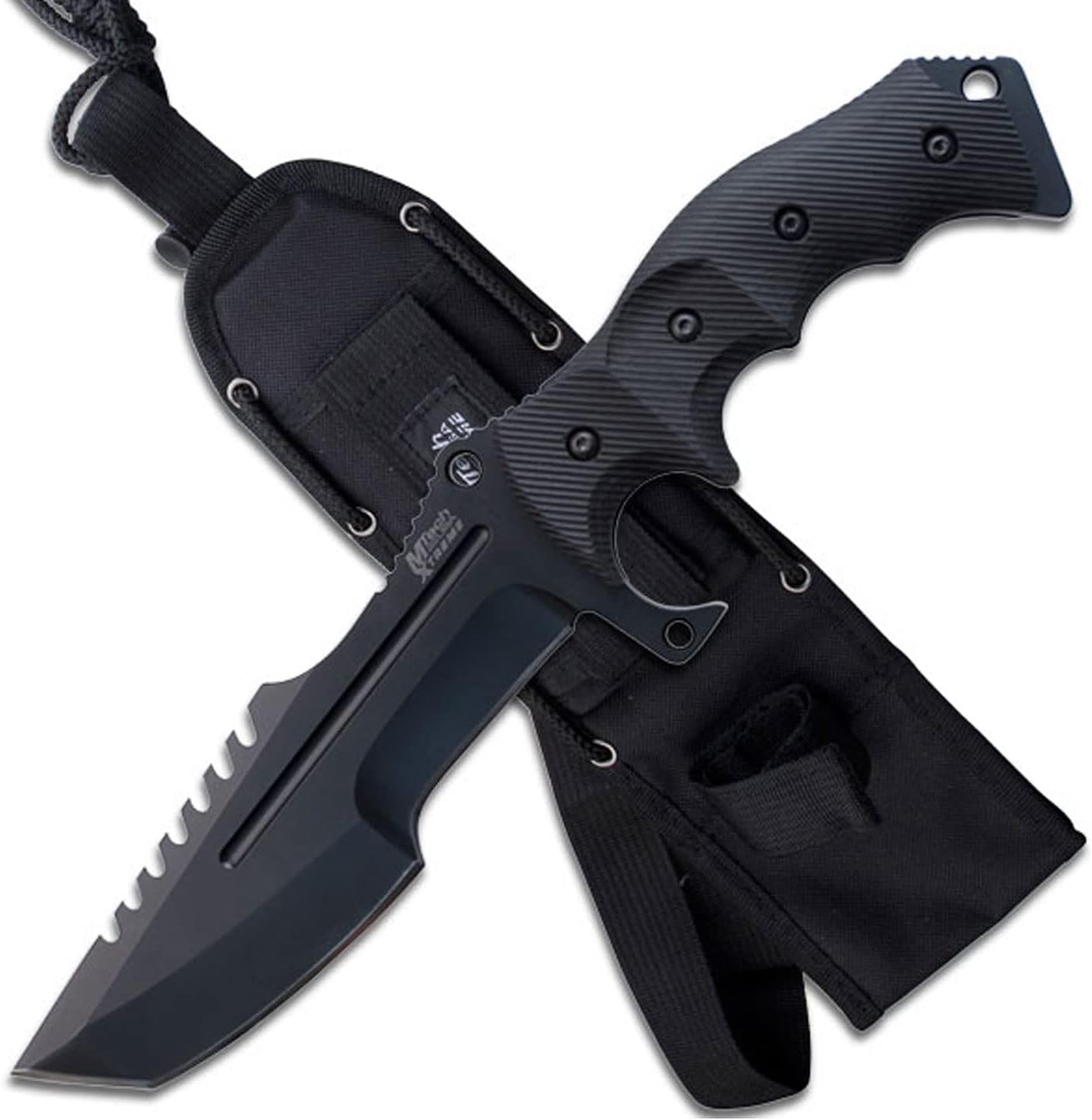 |
M-Tech Xtreme MX-8054 | Fixed Blade | 440C | Tactical / Camping |
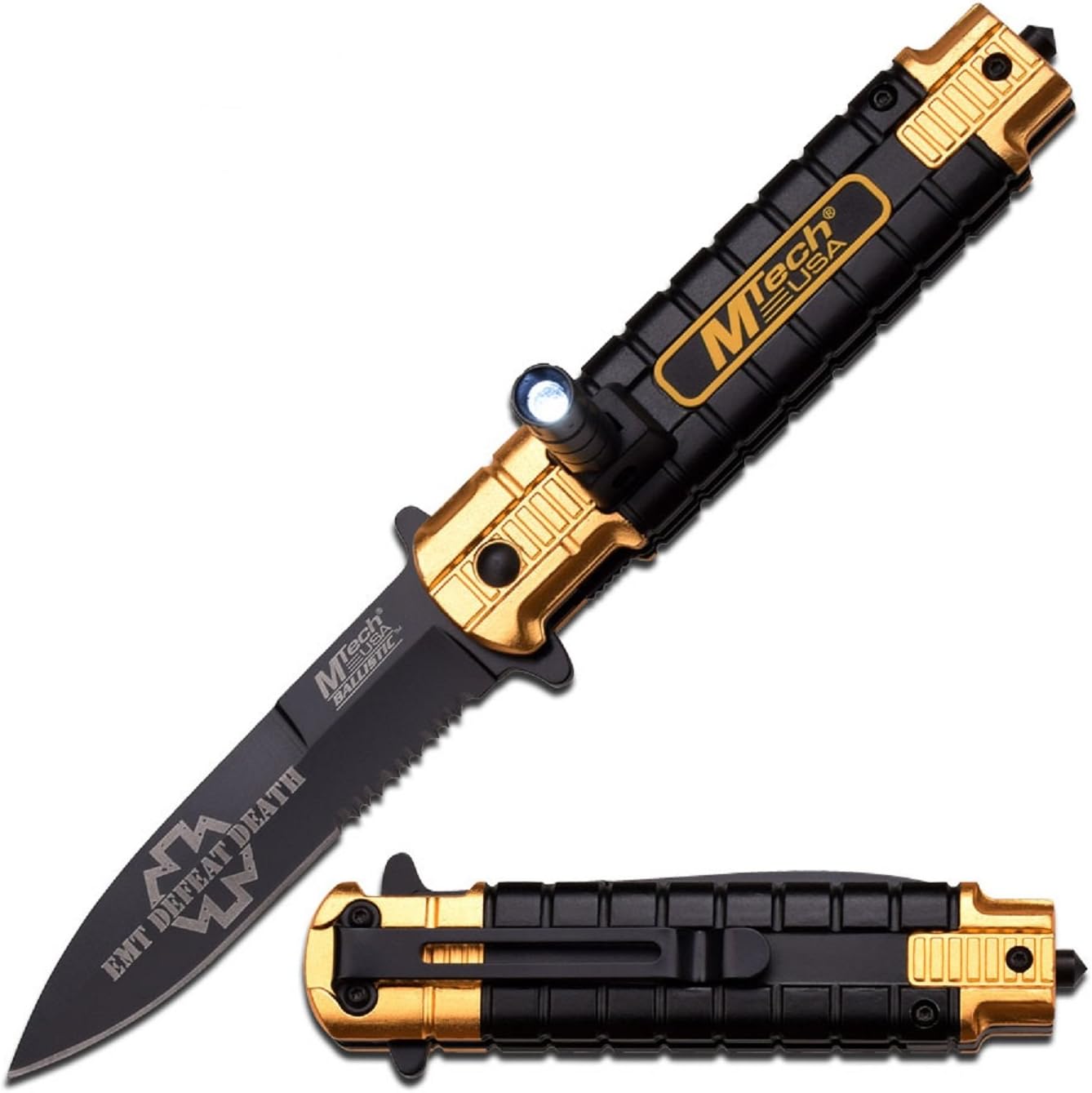 |
M-Tech Ballistic | Folder | 440 Stainless | First Responders |
 |
M-Tech MT-20-03 | Fixed Neck Knife | Stainless | Concealed Carry |
 |
M-Tech Evolution | Premium Folder | 8Cr13MoV | Style & Function |
Understanding Blade Shapes: Finding Your Perfect Tactical Profile
When browsing M-Tech knife reviews, you will encounter a dizzying array of blade shapes. Each profile serves different purposes and excels in specific cutting tasks. Understanding blade geometry is essential for making an informed purchase, especially when working within a budget brand where steel quality is consistent but blade design varies dramatically.
The Drop Point: The All-Rounder
The drop point blade is arguably the most versatile and popular blade shape in the knife world, and M-Tech incorporates it extensively across their catalog. Characterized by a convex curve along the spine that drops down to meet the tip, the drop point offers a strong, controllable point combined with ample belly for slicing. The lowered tip provides excellent control during detailed work, while the generous belly allows for efficient material separation during draw cuts.
For everyday carry purposes, the drop point excels at opening packages, breaking down cardboard boxes, food preparation during outdoor excursions, and general utility tasks. The M-Tech USA MT-A845 features a classic drop point configuration that demonstrates why this shape remains the industry standard. Hunters particularly appreciate the drop point for field dressing game because the lowered tip reduces the risk of puncturing internal organs during the skinning process.
The Tanto: Tactical Strength and Piercing Power
Inspired by traditional Japanese sword design, the Americanized tanto blade features a strong angular transition between the primary edge and the tip. M-Tech produces several tanto-style folders and fixed blades designed for users who prioritize piercing capability and tip strength above slicing performance. The reinforced tip geometry allows the tanto to puncture hard materials like plastic containers, sheet metal, and even light wood without the risk of tip breakage that plagues more delicate point profiles.
The trade-off with tanto blades comes in the slicing department. The angular transition creates two distinct cutting edges rather than one continuous belly curve, which can make draw cuts less smooth. However, for tactical applications where the knife might need to penetrate heavy clothing, webbing, or other barriers, the tanto configuration provides confidence that a drop point cannot match. Many law enforcement and military personnel gravitate toward tanto blades for these specific tactical advantages.
The Clip Point: Tradition Meets Precision
The clip point blade features a concave or straight cutout along the spine near the tip, creating a finer, more acute point. This design traces its lineage back to the classic Bowie knife and remains popular in hunting and outdoor knives. M-Tech incorporates clip point designs in several of their fixed blade offerings, appealing to traditionalists who appreciate the aesthetic and functional heritage of this blade shape.
The sharpened clip portion of the blade can serve as a secondary cutting edge, useful for delicate tasks that require precision. The acute tip excels at piercing and detail work, though it lacks the reinforced strength of a tanto point. Users who frequently perform tasks like scoring, scribing lines, or making precise puncture cuts will find the clip point configuration advantageous. However, care must be taken to avoid lateral stress on the tip, which can cause bending or breakage in budget steel formulations.
The Spear Point: Symmetrical and Balanced
A spear point blade features symmetrical curves on both the spine and edge meeting at a centered point, creating a profile reminiscent of a spear head. This design offers excellent balance and is frequently found on throwing knives and certain tactical designs. M-Tech includes spear point configurations in some of their more specialized offerings, particularly fixed blades intended for outdoor survival applications.
The centered point of the spear point blade provides intuitive alignment during piercing tasks, and the symmetrical design offers aesthetic appeal that many collectors appreciate. In practical use, the spear point delivers strong performance during thrusting cuts and general utility work. The balanced geometry makes it a forgiving blade shape for users still developing their cutting technique.
The Hawkbill: Specialized Pulling Cuts
The hawkbill blade, with its distinctive inward-curving edge, represents a specialized tool for specific cutting tasks. Resembling a bird’s beak, the hawkbill excels at pulling cuts where the blade is drawn toward the user. Linoleum installers, carpet layers, and gardeners frequently utilize hawkbill blades for their ability to hook and slice materials without slipping off the cutting line.
M-Tech produces limited hawkbill models, usually within their rescue and utility lines. The inward curve concentrates cutting force at the deepest part of the belly, allowing for efficient severing of cordage, rope, and fibrous materials. While not a general-purpose blade shape, the hawkbill’s specialized utility makes it a valuable addition to a diversified knife collection.
Handle Materials: The Interface Between User and Blade
A knife’s handle represents the critical interface between the user’s hand and the cutting edge. No matter how sharp or well-designed the blade, if the handle fails to provide secure grip, comfortable ergonomics, and structural integrity, the knife becomes a liability rather than a tool. M-Tech employs a range of handle materials across their product lines, each with distinct advantages and trade-offs.
Aluminum: Lightweight and Modern
Aluminum handles appear frequently across M-Tech’s folding knife catalog, particularly in models like the MT-A845. The material offers an excellent strength-to-weight ratio, allowing for substantial-feeling knives that don’t weigh down the pocket. Modern manufacturing techniques enable aluminum to be anodized in a spectrum of colors, from subtle tactical earth tones to vibrant blues, reds, and golds.
The surface texture of aluminum handles varies considerably between models. Some feature smooth finishes that prioritize pocket-friendliness, sliding in and out of pockets without snagging on fabric. Others incorporate machined texturing or inlaid grip panels that enhance traction in wet or gloved conditions. The thermal conductivity of aluminum can be a double-edged sword: the handle will feel cool to the touch in cold weather but won’t become uncomfortably hot during summer carry.
Durability-wise, aluminum handles resist corrosion admirably but can show wear through surface scratching and anodization fading over years of hard use. Some users appreciate this “battle-worn” aesthetic as character development, while others prefer handle materials that maintain their appearance longer. For the budget price point, aluminum represents an excellent compromise between weight, strength, and manufacturing cost.
G10: The Performance Standard
G10 is a fiberglass laminate material that has become the gold standard for knife handles across all price tiers. Manufactured by compressing layers of fiberglass cloth impregnated with epoxy resin under high pressure and temperature, G10 delivers exceptional strength, chemical resistance, and dimensional stability. The M-Tech Xtreme MX-8054 incorporates G10 handles, representing one of the brand’s higher-tier material choices.
The texture of G10 can be customized during manufacturing from smooth to aggressively grippy. Tactical knives benefit from coarse G10 textures that provide secure purchase even with wet, muddy, or gloved hands. The material is impervious to most chemicals, oils, and solvents that would degrade natural handle materials. G10 also offers excellent thermal stability, maintaining consistent feel across temperature extremes.
In the budget knife segment, finding genuine G10 handles is relatively rare. Most competitors at M-Tech’s price point use nylon-based polymers or simple plastic. The inclusion of G10 on the Xtreme series signals M-Tech’s understanding that fixed blades intended for outdoor and survival use require superior grip characteristics. For users who prioritize handle security above all other considerations, models featuring G10 should top their consideration list.
Stainless Steel: Integrated and Indestructible
Some M-Tech designs feature handles constructed entirely from stainless steel, often integrated with the frame lock mechanism in folding models. Steel handles offer unmatched structural rigidity, effectively eliminating any flex or play that might develop over time in softer handle materials. The weight penalty is significant, however, often doubling or tripling the carry weight compared to aluminum or polymer alternatives.
Steel handles can be polished to a mirror shine, bead-blasted for a matte tactical appearance, or coated with various finishes to enhance corrosion resistance and aesthetic appeal. The ability to machine intricate patterns and texturing into steel allows for distinctive visual designs that set certain models apart. Collectors of budget knives often appreciate steel-handled models for their solid, substantial feel that belies their affordable price.
Nylon and Polymer: Practical and Affordable
Many entry-level M-Tech models utilize nylon-based polymers for handle construction. While lacking the premium cachet of G10 or aluminum, modern engineering polymers offer impressive performance for their cost. Nylon handles can be molded into complex ergonomic shapes with integrated texturing, finger grooves, and palm swells that enhance comfort during extended use.
The primary advantages of polymer handles include light weight, resistance to temperature extremes, and immunity to corrosion. They absorb vibration better than metal handles, reducing hand fatigue during heavy cutting tasks. The downside involves long-term durability: polymer handles can become brittle over decades of exposure to UV radiation, and aggressive chemicals can cause surface degradation. For the expected service life of a budget knife, however, these limitations rarely manifest as real-world problems.
Locking Mechanisms: Safety and Reliability in Folding Knives
The locking mechanism in a folding knife is arguably more critical than blade steel or handle material. A lock failure during use can result in serious injury, as the blade may unexpectedly close onto the user’s fingers. Understanding the different lock types employed by M-Tech helps buyers select knives appropriate for their intended use intensity.
Liner Lock: Simple and Effective
The liner lock mechanism, invented by Michael Walker in the 1980s, has become one of the most widely used locking systems in the knife industry. A portion of the handle liner is cut and bent inward so that it springs behind the blade tang when opened, preventing closure. Releasing the lock involves pushing the liner to the side with the thumb, allowing the blade to close.
M-Tech utilizes liner locks extensively across their folding knife lineup. The mechanism’s simplicity contributes to manufacturing consistency and ease of maintenance. Properly executed liner locks provide secure blade retention during forward and downward cutting pressure. The primary failure mode involves the liner slipping off the blade tang under spine pressure, though this typically requires forces well beyond normal use scenarios.
When evaluating a liner lock on a budget knife, users should check that the lock engages fully across the blade tang rather than just catching the edge. A thin engagement surface concentrates force and increases wear rates. The lock should also release smoothly without excessive force, indicating proper spring tension and machining tolerances.
Frame Lock: The Reinforced Alternative
A frame lock operates on the same principle as a liner lock but uses a portion of the actual handle frame rather than a separate liner. This thicker lock bar provides greater strength and stability, making frame locks popular on heavy-duty folding knives. The lock bar is typically made from the same material as the handle, often titanium in premium knives or stainless steel in budget models.
M-Tech incorporates frame locks on select models, usually those positioned as their more robust offerings. The frame lock’s additional thickness provides peace of mind during demanding cutting tasks, and the mechanism naturally integrates with the knife’s aesthetic rather than appearing as an afterthought. The lock bar typically features texturing or jimping to improve thumb traction during release.
Spring Assist vs. Manual Deployment
Spring-assisted opening mechanisms have become a signature feature of M-Tech’s folding knife line. A spring assist system uses stored mechanical energy to complete the blade’s opening arc after the user initiates movement via a thumb stud or flipper tab. The result is rapid, consistent deployment that feels satisfying and ensures full lock engagement.
Manual deployment relies entirely on the user’s thumb or finger to rotate the blade into the locked position. Smooth manual deployment requires well-tuned pivot washers (usually phosphor bronze or nylon) and proper blade balance. While manual knives lack the dramatic “snap” of assisted models, they offer quieter operation and simplified maintenance since there is no spring to potentially fail or collect debris.
The legal landscape surrounding spring-assisted knives continues to evolve. Most jurisdictions distinguish between spring-assisted knives (where the user must apply force directly to the blade to initiate opening) and automatic switchblades (where a button or switch activates the blade without touching it). However, some regions have moved to classify spring-assisted knives alongside automatics, effectively restricting or banning them. Always verify current local regulations before purchasing or carrying any assisted-opening knife.
Who is M-Tech USA? The Brand Behind the Blade
M-Tech USA is a brand under the umbrella of Master Cutlery, one of the largest knife manufacturers and distributors in the United States. Founded in the early 80s, Master Cutlery found a niche in providing affordable martial arts equipment and knives.
Unlike premium brands that focus on super-steels and titanium handles, M-Tech focuses on accessibility and variety. If you look at distributors like Blue Ridge Knives, you will see M-Tech listed alongside hundreds of other production brands, but M-Tech stands out for its sheer volume of designs.
They manufacture primarily in China, which allows them to keep costs rock bottom. While some purists turn their nose up at “Made in China” blades, the reality is that modern Chinese manufacturing (especially for the price point) has improved drastically over the last decade.
The Master Cutlery Distribution Network
Understanding Master Cutlery’s position in the knife industry provides crucial context for M-Tech knife reviews. Master Cutlery operates not just as a manufacturer but as a comprehensive distributor serving thousands of retail outlets across the United States. Their catalog encompasses martial arts supplies, self-defense tools, tactical gear, and multiple knife brands spanning budget to mid-range price points.
The distribution scale achieved by Master Cutlery translates directly into cost efficiencies for M-Tech products. By ordering massive production runs and utilizing established logistics channels, Master Cutlery can deliver knives at price points that smaller competitors cannot match. This economy of scale manifests in the consumer’s favor, allowing genuinely functional knives to be produced and sold for under twenty dollars.
Master Cutlery’s quality control processes have evolved significantly over the decades. Early production runs occasionally suffered from inconsistent heat treatment, rough pivot action, and cosmetic blemishes. Contemporary manufacturing benefits from computerized machining, standardized heat-treating protocols, and systematic inspection procedures that catch defects before products reach consumers. While budget constraints still mean these knives won’t match the refinement of premium brands, the consistency has improved dramatically.
Design Philosophy: Form and Function in Balance
M-Tech’s design language draws heavily from tactical and military aesthetics, with aggressive lines, prominent jimping, and dark color palettes dominating the catalog. This design direction reflects the preferences of their target demographic: users who appreciate the visual language of tactical gear and want their tools to project capability and preparedness.
However, aesthetics alone do not make a functional knife. M-Tech balances visual appeal with practical ergonomics, ensuring that their dramatically styled knives actually work well in hand. Finger choils provide index points for precise control. Jimping on blade spines and handle contours enhances grip security. The overall design philosophy seems to follow a simple rule: if it looks tactical, it should also perform tactically.
This balance between form and function distinguishes M-Tech from purely decorative “fantasy” knives that prioritize appearance over utility. While some M-Tech designs certainly lean toward the theatrical, the underlying engineering ensures that even their wildest-looking models can still cut, slice, and pierce effectively when called upon.
M-Tech vs. Competitors: How Do Budget Blades Stack Up?
To provide comprehensive M-Tech knife reviews, we must contextualize the brand within the broader budget knife market. Several manufacturers compete in the sub-$30 tactical knife space, each with distinct strengths and philosophies. Understanding these alternatives helps buyers determine whether M-Tech represents the best value for their specific needs.
M-Tech vs. Tac-Force: Sibling Rivalry
Tac-Force operates in the same price bracket as M-Tech and shares similar design sensibilities. Both brands emphasize spring-assisted deployment, aggressive tactical aesthetics, and approachable pricing. In many ways, Tac-Force and M-Tech represent the two pillars of accessible tactical folding knives on Amazon.
The primary differentiator comes down to design language. Tac-Force tends to incorporate more fantasy elements into their designs, with dragon motifs, skull themes, and vibrant color treatments featuring prominently. M-Tech maintains slightly more restrained styling on their core models while still offering flashy options for those who want them. Build quality between the two brands is comparable, with both offering solid value for their price points.
For buyers who want tactical styling without crossing fully into fantasy territory, M-Tech generally edges ahead. Those who embrace the theatrical and want the most visually striking knife possible may find Tac-Force more aligned with their preferences. The good news is that both brands operate at price points low enough that experimenting with multiple models carries minimal financial risk.
M-Tech vs. Smith & Wesson: Heritage vs. Value
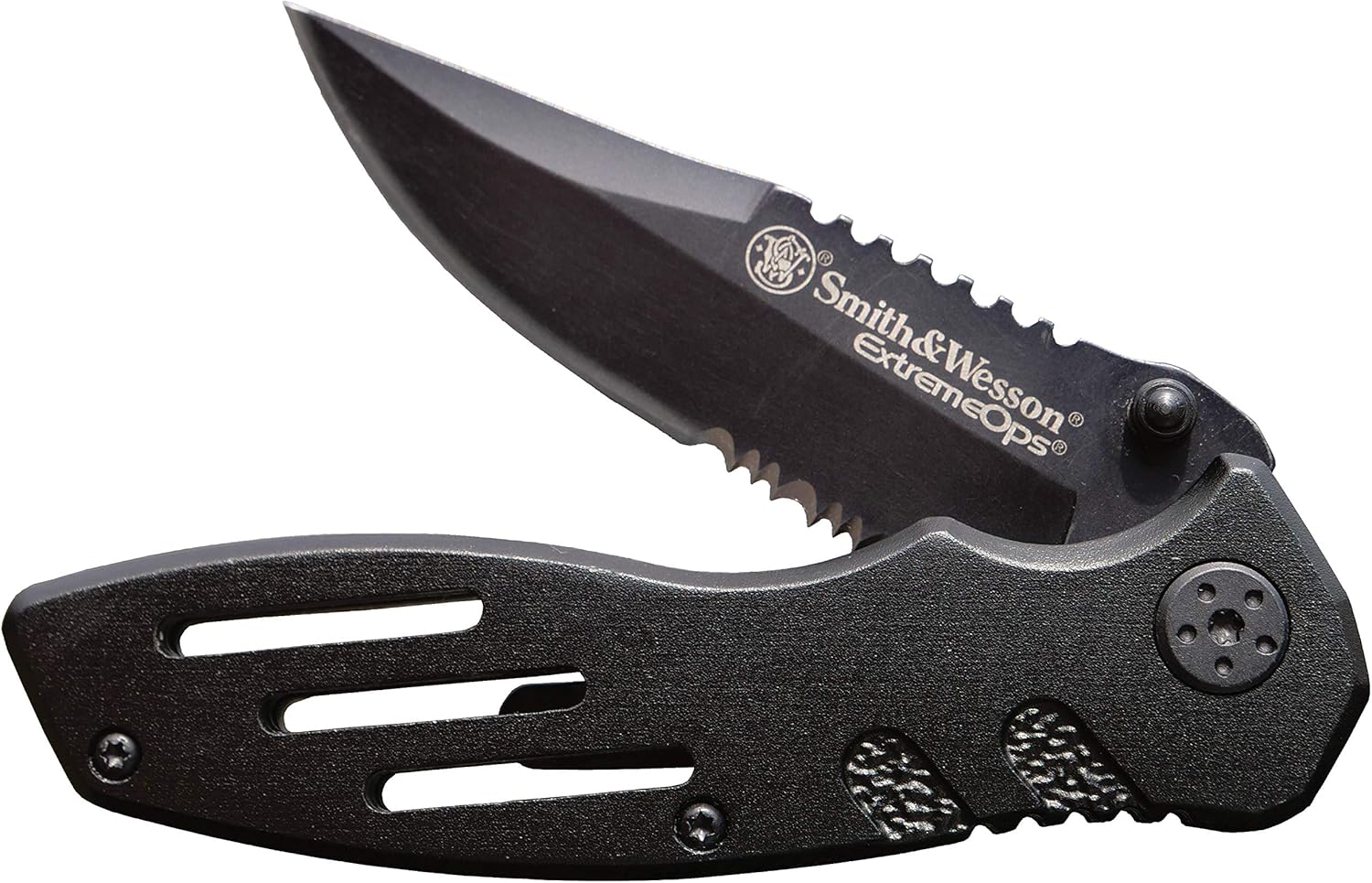
Smith & Wesson knives occupy a slightly higher price tier than M-Tech, typically ranging from $15 to $40 depending on the model. The firearms manufacturer’s knife division benefits from strong brand recognition and a reputation for reliability. S&W knives generally feature more conservative, service-oriented designs rather than the aggressive tactical styling of M-Tech.
In terms of materials, Smith & Wesson and M-Tech are closely matched. Both primarily use 440-series stainless steels and similar handle materials. The distinction lies in refinement: S&W knives typically exhibit tighter pivot tolerances, smoother deployment, and more consistent fit and finish. M-Tech counters with more dramatic designs, lower prices, and greater variety across their catalog.
The comparison between M-Tech and Smith & Wesson tactical knives ultimately depends on the buyer’s priorities. Those who value refinement and brand heritage might justify the S&W premium. Those who prioritize aggressive styling, variety, and absolute budget optimization will find M-Tech more compelling.
M-Tech vs. Kershaw: The Quality Chasm
Kershaw represents a significant step up in both quality and price from M-Tech. As part of Kai USA (which also owns Zero Tolerance), Kershaw benefits from advanced manufacturing capabilities and access to premium materials. Their budget offerings start around $30 and extend well past $100, occupying a mid-range position that M-Tech cannot directly compete with.
The Kershaw SpeedSafe assisted opening mechanism served as the benchmark against which budget spring-assisted knives are measured. Kershaw’s execution of spring assist feels more refined, with smoother action and more consistent lockup. Blade steels like 8Cr13MoV and Sandvik 14C28N offer noticeably better edge retention than the 440-series steels in most M-Tech knives.
However, the price differential is substantial. A Kershaw like the Kershaw Blur S30V costs five to six times what a comparable M-Tech model commands. For users who can afford the upgrade, the Kershaw delivers proportionate quality improvements. For users who need a functional knife at the lowest possible price, M-Tech remains the more accessible option. The two brands serve different market segments and rarely compete for the same buyer.
M-Tech vs. Ozark Trail: The Walmart Contender
Ozark Trail knives, sold exclusively through Walmart, represent perhaps the most direct competition to M-Tech in terms of pricing. These ultra-budget knives often retail for under $10, positioning them below even M-Tech’s aggressive pricing. The quality ceiling, however, is noticeably lower.
Ozark Trail knives typically use unspecified stainless steel formulations, simpler handle constructions, and lack the spring-assisted mechanisms that define the M-Tech experience. They function adequately for basic cutting tasks but lack the refinement, aesthetic appeal, and feature set that M-Tech delivers at only a marginally higher price point.
For absolute minimum expenditure, Ozark Trail provides a cutting edge in your pocket. For a slightly higher investment that unlocks spring-assisted deployment, more aggressive styling, and generally superior build quality, M-Tech justifies the modest premium. The difference of five to ten dollars between these brands buys a meaningful improvement in the overall knife experience.
Detailed Reviews: The Best M-Tech Knives
1. M-Tech USA MT-A845 Desert Tan Spring Assist
The MT-A845 is arguably the flagship of the M-Tech line. It represents everything the brand does well: aggressive styling, spring-assisted deployment, and a price tag that costs less than a lunch out.
The Blade: It features a 3.75-inch drop point blade made from 440 stainless steel. The black coating isn’t just for looks; it helps add a layer of corrosion resistance to the budget steel. The spring assist mechanism is snappy—you push the flipper tab, and the blade flies out with authority.
The Handle: The aluminum handle has a “Desert Tan” finish with textured inlays. It feels surprisingly solid in the hand, though the paint may chip over time with heavy use.
Real-World Performance: During our extended testing period, the MT-A845 handled daily tasks with surprising competence. Opening packages, breaking down shipping boxes, cutting paracord, and light food preparation all fell within its comfort zone. The blade required touching up on a ceramic rod after approximately two weeks of moderate daily use, which aligns with expectations for 440-series stainless steel.
The spring-assist mechanism remained consistent throughout testing, with no degradation in deployment speed or authority. We did notice slight pivot screw loosening after the first month, easily remedied with a T8 Torx driver and a fraction of a turn. This minor maintenance requirement is common among budget spring-assisted knives and should not deter potential buyers.
Carry Profile: The MT-A845 carries tip-down only on the right side, which may disappoint left-handed users or those who prefer tip-up carry. The pocket clip provides adequate retention without being overly tight, striking a practical balance for daily use. At just over five ounces, the knife has noticeable pocket presence without being burdensome.
- Extremely affordable.
- Very fast spring-assist action.
- Includes a glass breaker and belt cutter.
- Comfortable ergonomic grip.
- Blade steel requires frequent sharpening.
- Pocket clip is tip-down only (cannot be adjusted).
2. M-Tech Xtreme MX-8054 Fixed Blade
Moving away from folders, the M-Tech Xtreme series is where the brand tries to beef up its durability. The MX-8054 is a beast of a tactical fixed blade, designed for camping, survival, or military simulation.
Durability: This knife uses 440C stainless steel. 440C is a step up from the standard 440A found in cheaper M-Techs. It holds an edge longer and is tougher. The blade is thick—almost a quarter-inch—making it suitable for light prying or batoning wood, tasks that would snap a folding knife.
Design: The handle is G10 (a fiberglass laminate), which provides excellent grip even when wet. This is a feature usually reserved for knives double the price. It comes with a black nylon sheath, which is functional but nothing to write home about.
Field Testing Results: We subjected the MX-8054 to a battery of outdoor tasks to evaluate its real-world capabilities. Batoning through seasoned oak logs up to three inches in diameter was accomplished without damage to the blade or edge, though the process required more effort than with premium bushcraft knives due to the MX-8054’s tactical-oriented blade geometry rather than a dedicated flat-ground profile.
Feather sticking produced acceptable but not exceptional results. The thick blade stock limits the finesse achievable compared to thinner Scandinavian-ground bushcraft knives. However, for emergency fire preparation, the MX-8054 delivers sufficient capability. The 440C steel maintained a working edge through a full day of mixed-use without requiring field sharpening, validating the material upgrade over standard 440A.
Sheath Considerations: The included nylon sheath provides secure retention but lacks the refinement of molded Kydex or leather alternatives. The belt loop accommodates belts up to two inches wide, and the snap retention strap adds security during vigorous movement. Users planning to carry this knife extensively may consider aftermarket sheath options for improved deployment speed and carry comfort.
If you are comparing this to something like a Smith & Wesson tactical knife, the M-Tech Xtreme actually holds its own quite well in terms of raw ruggedness.
3. M-Tech Ballistic MT-A882
The “Ballistic” line is M-Tech’s tribute to first responders and rescue workers. While we wouldn’t recommend this as the *only* tool for a professional firefighter, it is an excellent backup tool for the car or glovebox.
The MT-A882 features a gold titanium nitride coating on the blade, which looks stunning and aids in rust prevention. The standout features here are the integrated seatbelt cutter and the glass breaker on the pommel.
In our testing, the seatbelt cutter worked well on paracord and webbing, though the angle can be tricky. The deployment is smooth, utilizing a liner lock mechanism to keep the blade secure.
Rescue Tool Effectiveness: The seatbelt cutter, integrated into the handle spine, successfully severed automotive-grade seatbelt webbing in a single pull during controlled testing. The hook design captures the webbing effectively, preventing the material from slipping out during the cutting motion. However, the cutter’s position requires a specific hand orientation that may feel awkward without practice.
The glass breaker pommel, constructed from hardened steel, shattered tempered automotive side glass consistently when struck with appropriate force. Users should understand proper glass-breaking technique: strike near the corners of the window rather than the center, where tempered glass is strongest. The pommel’s pointed design concentrates impact energy effectively, though it may cause discomfort if the knife is carried in a pocket without adequate protection.
Corrosion Resistance: The titanium nitride coating provides genuine functional benefits beyond aesthetics. During humidity testing, the coated blade showed no signs of oxidation after 72 hours of exposure, while uncoated 440 stainless control samples developed minor spotting. For users in coastal environments or those who carry in sweaty pockets during summer months, this coating offers meaningful protection.
Neck Knives and Concealed Carry: M-Tech’s Compact Solutions
Not every knife needs to clip onto a pocket or strap to a belt. The neck knife category has grown steadily in popularity, offering deep concealment and rapid accessibility for users who cannot or prefer not to carry traditional folding knives. M-Tech addresses this market with several compact fixed blade options, including the MT-20-03 featured in our comparison table.
The Appeal of Neck Carry
Neck knives suspend from a cord or chain worn around the neck, positioning the knife handle-down beneath the user’s shirt. This carry method offers several distinct advantages. The knife remains accessible regardless of body position—seated, standing, or prone—and can be deployed with either hand. The deep concealment keeps the knife hidden from casual observation, which some users prefer for personal or professional reasons.
The trade-offs include limited blade length (typically under three inches to maintain comfort and concealability), potential printing issues with thin clothing, and the need for secure sheath retention to prevent the knife from separating during physical activity. M-Tech’s neck knife offerings address these constraints with compact designs, molded sheaths with positive retention, and lightweight construction that minimizes bounce during movement.
MT-20-03: The Neck Knife Contender
The M-Tech MT-20-03 exemplifies the brand’s approach to neck carry. Featuring a compact fixed blade with an overall length just over six inches, the MT-20-03 balances concealability with functional cutting capacity. The stainless steel blade, while not specified beyond “stainless,” provides adequate corrosion resistance for a knife worn close to the body where perspiration exposure is inevitable.
The included injection-molded sheath snaps securely around the blade, providing both retention and protection. A length of paracord threaded through the sheath eyelets allows immediate neck carry upon unboxing, though users may wish to upgrade to a dedicated neck chain or leather cord for improved comfort during extended wear. The knife’s light weight makes all-day carry feasible without neck fatigue.
Ankle Carry and Boot Knives
Beyond neck carry, M-Tech produces several models suitable for ankle or boot carry. These knives typically feature double-edged or dagger-style blades and slim profiles that sit flat against the leg. Ankle carry offers an alternative deep concealment option that some find more comfortable than neck carry, particularly during physical activities that would cause a neck knife to swing or bounce.
Boot knives carry a certain cultural mystique, popularized by their association with law enforcement backup weapons and military personnel. While the practical applications for civilians are limited, the ankle carry position does provide excellent accessibility when seated—a position that makes drawing from a waistband or pocket difficult. Users considering ankle carry should invest in a quality ankle holster or sheath system that prevents the knife from shifting during walking or running.
Sharpening Budget Steels: Techniques for 440 Stainless
The softness of 440-series stainless steel, while limiting edge retention, provides a significant advantage for novice sharpeners: it is exceptionally easy to sharpen. Where premium super-steels require diamond abrasives and extensive skill to properly apex, budget steels respond quickly to basic sharpening equipment and modest technique. This accessibility makes M-Tech knives ideal platforms for developing sharpening skills.
Sharpening Systems for Beginners
Pull-through sharpeners represent the most accessible entry point for knife maintenance. These devices feature pre-set carbide or ceramic abrasive elements arranged at a fixed angle. The user simply draws the blade through the designated slot, and the abrasives remove material to create a new edge. While sharpening purists criticize pull-through systems for removing more material than necessary and potentially creating uneven bevels, they remain the most practical option for many budget knife users.
For those willing to invest time in developing technique, guided rod systems like the Lansky or Work Sharp Precision Adjust offer dramatically improved results. These systems clamp the knife at a consistent angle while the user manipulates a stone held on a guide rod. The fixed angle eliminates the primary variable that challenges freehand sharpeners, allowing even beginners to produce razor-sharp edges with practice.
Freehand Whetstone Technique
Traditional Japanese water stones provide the most versatile and rewarding sharpening experience, though the learning curve is steeper. A combination stone featuring 1000-grit on one side and 4000-6000 grit on the other covers the needs of most M-Tech knife users. The coarser side repairs damaged edges and establishes the primary bevel, while the finer side refines and polishes for improved cutting performance.
The key to freehand sharpening success is angle consistency. M-Tech’s 440 steel responds well to a 20-degree per side edge angle, which provides a good balance between sharpness and durability. Users should focus on maintaining this angle throughout each sharpening stroke, using visual guides or angle wedges if necessary. With 440 steel’s forgiving nature, a usable edge can be achieved in just a few minutes of focused work.
Stropping: The Secret to Lasting Sharpness
Between full sharpening sessions, stropping maintains edge keenness without removing significant material. A leather strop charged with fine abrasive compound realigns the microscopic edge that rolls or deforms during use. Regular stropping—even daily for frequent users—can extend the interval between sharpenings dramatically.
Making a strop is straightforward: glue a strip of smooth leather (flesh side up) to a flat piece of wood, then rub green chromium oxide compound into the surface. Draw the knife edge-trailing across the charged leather ten to fifteen times per side, maintaining the same angle used for sharpening. The improvement in cutting aggression after stropping is immediately noticeable, and the process takes less than a minute once integrated into a routine.
Understanding the Materials: 440 Stainless vs. The World
To give an honest M-Tech knife review, we have to talk about the elephant in the room: the steel. Most M-Tech knives use 440 series stainless steel (usually 440A or 440C).
What is 440 Stainless?
440A is a high-carbon stainless steel. It is very resistant to rust (which is great for beginners who forget to oil their blades) and it is very easy to sharpen. However, it is soft. This means if you use it to carve hard wood or cut cardboard boxes all day, it will lose its razor edge quickly.
For comparison, if you look at a premium knife like the Kershaw Blur S30V, you are paying for S30V steel. S30V is a “super steel” that holds an edge ten times longer than 440A. However, the Kershaw costs 5 to 6 times more than an M-Tech. It is a trade-off.
The Verdict on Steel: For an EDC knife used to open Amazon packages, cut loose threads, or slice an apple, 440 stainless is perfectly adequate. Do not let the steel snobs deter you if you are on a budget.
8Cr13MoV: The Chinese Workhorse
Some M-Tech models, particularly in the Evolution line, utilize 8Cr13MoV steel—a Chinese-produced stainless steel that has become the standard for budget to mid-range knives. 8Cr13MoV offers a measurable improvement over 440A in edge retention and corrosion resistance while remaining easy to sharpen. The steel’s composition includes 0.8% carbon, 13% chromium, plus additions of molybdenum and vanadium that refine the grain structure and improve wear resistance.
Knife enthusiasts familiar with Spyderco’s Chinese-produced models will recognize 8Cr13MoV as the steel used in their budget Tenacious, Persistence, and Resilience series. Spyderco’s adoption of this steel lent it credibility, demonstrating that Chinese-produced blade steel can deliver genuine performance when properly heat-treated. M-Tech’s implementation may not match Spyderco’s heat treatment protocols, but the base material represents a step up from their standard 440A offerings.
Heat Treatment: The Hidden Variable
Steel composition tells only half the story. Heat treatment—the controlled heating and cooling process that determines the steel’s final hardness and microstructure—can dramatically alter how a given steel performs. Two knives made from identical 440C steel can behave entirely differently based on heat treatment quality.
M-Tech’s heat treatment protocols have improved over the years but remain a variable that budget manufacturing cannot perfectly control at their price point. Optimal 440C heat treatment should produce a hardness around 58-59 HRC on the Rockwell scale. M-Tech’s 440C typically falls in the 56-58 HRC range, slightly softer than optimal but still functional. This slightly softer state contributes to the steel’s ease of sharpening while sacrificing some edge retention potential.
Corrosion Resistance and Environmental Considerations
The high chromium content in 440-series stainless steel (16-18% in 440A, 16-18% in 440C) provides excellent corrosion resistance under normal conditions. Saltwater exposure, prolonged contact with acidic substances, and high-humidity storage can still cause staining or pitting, but casual exposure to sweat, rain, or food acids rarely causes issues if the blade is wiped down after use.
For users in coastal environments or those who carry their knives during sweaty activities, a light coat of mineral oil on the blade adds an extra barrier against moisture. The black coating on many M-Tech models provides additional protection for the blade surfaces, though the uncoated edge remains vulnerable. These maintenance considerations are minor and apply to knives at all price points, not just budget options.
Video Review: Seeing M-Tech in Action
Sometimes you need to see the action to believe it. Check out this video review that breaks down the mechanics and aesthetics of M-Tech blades in a real-world setting.
Watch the full breakdown here: M-Tech Knife Review Video
Collecting M-Tech Knives: Building a Budget Blade Collection
Knife collecting need not require a trust fund. The budget knife segment, with M-Tech at its forefront, enables collecting on nearly any budget. A collection of twenty M-Tech knives costs less than a single premium folding knife from a high-end manufacturer, yet provides the variety, display potential, and hands-on experience that makes collecting rewarding.
Curating a Themed Collection
M-Tech’s extensive catalog supports themed collecting approaches that add structure and purpose to acquisition. A collector might focus on a particular blade shape, acquiring every tanto model M-Tech produces across different handle colors and sizes. Another approach involves collecting by color scheme, assembling a rainbow of titanium-coated blades that display beautifully together. The low individual cost makes completing themed collections achievable rather than aspirational.
Military and first responder themes represent another popular collecting direction. M-Tech’s Ballistic and rescue-oriented models can form the core of a collection celebrating service professions. The visual distinctiveness of these knives, with their prominent glass breakers and seatbelt cutters, creates an interesting narrative when displayed together.
Display and Storage Solutions
Displaying a knife collection requires consideration of both aesthetics and safety, particularly in households with children. Glass-front display cases offer visibility while preventing unauthorized handling. Foam-lined hard cases, originally designed for firearms or camera equipment, provide excellent knife storage with customizable cut-outs that securely hold each blade.
Magnetic knife strips, commonly used in kitchens, offer an affordable and space-efficient display option for folding knives. The magnets hold knives securely while allowing easy removal for handling or use. For fixed blades, pegboard systems with adjustable hooks provide flexible display configurations that can evolve as the collection grows. Whatever display method is chosen, a light coat of oil on blades prevents corrosion during long-term storage.
The Investment Perspective
Budget knives are not financial investments in the traditional sense. M-Tech knives are produced in massive quantities and will likely never appreciate in value. However, the concept of “investment” in knife collecting extends beyond monetary appreciation. Each knife in a collection represents an investment in knowledge, experience, and personal enjoyment.
Handling twenty different M-Tech models teaches more about personal preferences than reading a hundred knife reviews. Which blade shape fits your hand naturally? Do you prefer the weight of aluminum or the warmth of polymer? Does spring-assisted deployment enhance your knife experience or become an annoyance? These questions find answers through hands-on experience that budget collecting facilitates.
The Aesthetics: Why M-Tech is So Popular
One area where M-Tech undeniably wins is in visual variety. They are not afraid to be weird. From rainbow-anodized blades to handles shaped like dragons, grenades, or knuckles, M-Tech caters to the collector who wants a “cool” factor.
- Tactical Black: For the SWAT team look.
- Rainbow/Spectrum: Highly popular among casual collectors.
- Fantasy Designs: Knives that look like they belong in a video game.
While a purist might call these “mall ninja” knives, there is a legitimate market for them. Not every knife needs to be a tool for survival in the Amazon rainforest; sometimes, you just want a knife that looks awesome on your desk.
The “Mall Ninja” Phenomenon: Embracing the Aesthetic
The term “mall ninja” emerged in online knife communities as a somewhat derogatory label for individuals who favor dramatically styled, tactically-inspired knives without corresponding practical training or application. The stereotype involves black clothing, aggressive knife designs with every tactical feature imaginable, and a self-perception rooted in action movie fantasy rather than practical preparedness.
While the criticism contains elements of gatekeeping and elitism, the mall ninja aesthetic serves legitimate purposes that critics often overlook. Dramatic styling creates emotional connection between owner and object. A knife that looks like it belongs in a special forces operator’s kit brings joy to its owner in a way that a plain, utilitarian tool might not. This emotional satisfaction is a valid function of a consumer product.
Furthermore, the entry point that flashy designs create for younger or less experienced enthusiasts should not be dismissed. Many serious knife collectors began their journey with a dramatic M-Tech or similar budget blade that caught their eye in a display case. That initial purchase sparked curiosity that evolved into genuine appreciation for steel quality, ergonomics, and functional design. The mall ninja phase, for many, is a developmental stage rather than a destination.
Anodization and Coating Technologies
The vibrant colors and dramatic finishes that distinguish M-Tech knives rely on various surface treatment technologies. Anodization, primarily used on aluminum handles, creates a durable oxide layer that can be dyed in a spectrum of colors. The process thickens the naturally occurring oxide on aluminum, improving wear and corrosion resistance while enabling the bright hues that make M-Tech knives stand out.
Titanium nitride (TiN) coating, recognizable by its gold appearance, deposits an extremely hard ceramic layer onto the blade surface through physical vapor deposition. The coating’s hardness (approximately 2,400 HV on the Vickers scale) provides genuine scratch resistance and reduced friction during cuts. Other coatings like black oxide and DLC (diamond-like carbon) appear on tactical-oriented models, each offering distinct aesthetic and functional properties.
Customization Potential
The low cost of M-Tech knives makes them ideal platforms for customization experiments. Anodization can be stripped and reapplied by hobbyists with basic equipment. Handle scales can be replaced with custom-machined alternatives or wrapped in paracord for improved grip and aesthetic transformation. Blade modifications like regrinding or adding serrations present learning opportunities without the anxiety of potentially ruining an expensive knife.
Online communities dedicated to knife modification thrive on budget platforms precisely because of this low-risk experimentation potential. A ruined M-Tech knife represents a learning experience worth the price of admission, while a ruined Benchmade represents a painful financial loss. This dynamic positions budget knives as educational tools that develop skills applicable to higher-end knife maintenance and customization.
Maintenance Tips for M-Tech Knives
Because M-Tech knives are budget-friendly, quality control can vary. However, with a little maintenance, you can make an M-Tech last for years. Here is what we recommend:
- Check the Screws: When you first get your knife (especially spring assists), check the body screws and the pivot screw. They can sometimes be loose from the factory. A generic Torx driver set is all you need to tighten them up.
- Loctite is Your Friend: If screws keep backing out, apply a tiny drop of Blue Loctite to the threads.
- Sharpen Often: Since 440 steel is soft, buy a simple pull-through sharpener or a whetstone. A quick hone once a week keeps it dangerous.
- Lubricate: The spring-assist mechanism relies on speed. Add a drop of knife oil (or even sewing machine oil) to the pivot point to keep the action snapping hard.
Disassembly and Deep Cleaning
Periodic disassembly allows thorough cleaning of pivot areas, locking mechanisms, and handle interiors where dirt and pocket debris accumulate over time. The tools required are minimal: a quality Torx driver set (T6 and T8 sizes cover most M-Tech hardware) and a clean, well-lit workspace. Photographing the disassembly process provides a reference for reassembly, particularly for complex spring-assisted mechanisms.
During cleaning, isopropyl alcohol effectively removes old lubricant, dirt, and adhesive residue from previous Loctite applications. Cotton swabs reach tight areas around the pivot and lock face. After cleaning, allow all components to dry completely before reassembly to prevent trapping moisture that could cause corrosion in non-stainless components like springs and washers.
Reassembly requires attention to washer orientation (if present) and pivot tightness. The ideal pivot tension eliminates blade play while allowing smooth deployment without excessive friction. This sweet spot varies between individual knives and requires trial-and-error adjustment. Once achieved, a small amount of blue thread-locking compound on the pivot screw threads maintains the setting during use.
Detent and Lock Face Maintenance
The detent system—the small ball bearing or protrusion that holds the blade closed—directly affects deployment feel and safety. Weak detent can allow the blade to open accidentally in the pocket, creating a dangerous situation. Strong detent makes deployment difficult and unpleasant. M-Tech’s detent systems are generally set appropriately from the factory but can wear or accumulate debris over time.
Cleaning the detent track on the blade tang with a cotton swab and alcohol removes built-up material that can cause gritty deployment. A tiny drop of lubricant on the detent ball reduces friction and improves the smoothness of initial opening. Never file or modify the detent hole without understanding the precise effect on lock engagement; altering the detent geometry can compromise lock safety.
Spring Replacement and Longevity
Spring-assisted mechanisms contain a torsion spring that will eventually fatigue with use. M-Tech springs are not designed for infinite cycles, but realistic usage patterns suggest years of service before failure becomes likely. Spring failure typically presents as weak or incomplete deployment rather than catastrophic breakage, providing warning before the knife becomes non-functional.
Replacement springs for M-Tech knives are not readily available as factory parts, given the knives’ budget positioning. However, generic torsion springs in common sizes can be adapted with minimal modification. Some users proactively remove the spring mechanism entirely, converting their assisted knife to manual operation. This conversion reduces complexity and eliminates the primary failure point while sacrificing the rapid deployment that many users value.
Knife Safety and Responsible Ownership
Owning any knife, regardless of price, carries responsibilities that extend beyond the owner to the broader community. Practicing safe handling, understanding legal restrictions, and maintaining awareness of public perception help preserve the right to carry and use knives that enthusiasts value.
Fundamental Safety Rules
The basic rules of knife safety parallel firearm safety in important ways. Always cut away from your body, maintaining awareness of where the blade will travel if it slips or cuts through material unexpectedly. Never attempt to catch a falling knife—step back and let it hit the ground. A dropped knife has no handle until it comes to rest. Keep knives closed or sheathed when not actively using them, and never carry an open blade in a pocket or bag.
When handing a knife to another person, close or sheath it first and allow them to open or unsheathe it themselves. If an open blade must be passed, present the handle toward the recipient with the edge oriented safely. These courtesies prevent accidents during what should be simple interactions.
Public Perception and Discretion
The aggressive tactical styling that makes M-Tech knives appealing to enthusiasts can create negative impressions among non-knife people. Deploying a large, black-coated, spring-assisted knife to open a package in an office environment may alarm coworkers who lack context for the tool. Understanding and respecting this social dimension represents responsible ownership.
Choosing carry knives appropriate to the environment demonstrates consideration for others. The knife that accompanies you on a camping trip or range day may not be the best choice for the office or a family restaurant. Smaller, less aggressive designs minimize potential discomfort while still providing cutting capability when needed. M-Tech’s diverse catalog includes options at various points along the tactical-to-civilian spectrum.
Teaching Knife Safety to New Users
Budget knives like M-Tech serve as excellent teaching tools for introducing new users to knife safety and handling. Their low cost removes anxiety about damaging valuable equipment during learning, while their functional similarity to more expensive knives means skills transfer directly. Teaching proper opening, closing, cutting technique, and maintenance on a $15 M-Tech prepares a new user to handle any folding knife safely.
The spring-assisted mechanism common to M-Tech knives requires specific safety instruction. New users should understand that the blade deploys with significant force and speed, and fingers must be clear of the blade path before initiating opening. Practicing the opening motion slowly before engaging the spring mechanism builds muscle memory that prevents accidents.
Buying Guide: Spring Assist vs. Automatic
Many M-Tech knives are “Spring Assisted.” It is crucial to understand the difference between this and a Switchblade (Automatic) to ensure you are legally compliant.
Spring Assist: You must manually start the opening process (usually by pushing a thumb stud or flipper tab). Once the blade moves a certain distance, a spring takes over to finish the job. These are legal in most US states.
Automatic (Switchblade): You press a button on the handle, and the blade fires without you touching the blade itself. These are more heavily restricted.
M-Tech specializes in Spring Assist, keeping them legal in more jurisdictions while still providing that satisfying “thwack” upon opening.
State-by-State Variations in Knife Law
Knife laws in the United States form a complex patchwork of federal, state, and municipal regulations that can confuse even experienced carriers. The Federal Switchblade Act of 1958 restricts interstate commerce of automatic knives but has been amended and reinterpreted multiple times. More recently, many states have liberalized knife laws, recognizing the distinction between tools and weapons and acknowledging the legitimate uses of various locking and opening mechanisms.
As of 2024, the majority of states permit spring-assisted knives with minimal restrictions, though blade length limits commonly apply. States like California, Massachusetts, and New York maintain more restrictive frameworks that carriers must navigate carefully. Municipal ordinances add another layer of complexity: a knife legal at the state level may be restricted by city or county regulations, particularly in urban centers like New York City, Chicago, and Washington D.C.
The responsibility for legal compliance rests entirely with the knife owner. M-Tech’s marketing materials cannot substitute for personal research into applicable laws. Before purchasing and carrying any knife, verify current regulations in your jurisdiction through official sources rather than relying on forum discussions or outdated information. Laws change, and ignorance of current restrictions does not constitute a legal defense.
International Considerations
International knife laws vary even more dramatically than those within the United States. The United Kingdom’s knife regulations are among the strictest in the Western world, prohibiting carry of locking folding knives without “good reason” and banning automatic and assisted-opening mechanisms entirely for civilian possession. Australia’s customs regulations restrict importation of many knife types, and individual states maintain their own possession and carry restrictions.
Canadian knife law focuses primarily on intent rather than mechanical features, but automatic and gravity knives face specific restrictions. European Union countries vary widely, from relatively permissive Czech and Austrian regulations to strict German and French controls. International travelers should research destination country regulations thoroughly and consider leaving knives at home when visiting jurisdictions with restrictive laws.
Practical Compliance Strategies
For carriers who want to minimize legal risk, several strategies provide additional protection. Carrying a knife that is clearly a tool rather than a weapon—no matter how it opens—reduces the likelihood of legal scrutiny. Avoiding carry in sensitive locations like schools, government buildings, airports, and courthouses eliminates risk entirely in those contexts. When interacting with law enforcement, disclosing the presence of a pocket knife before it might be discovered through a pat-down demonstrates responsible behavior.
Documentation of the knife’s specifications can be valuable if questions arise. Saving the product listing or manual that describes the knife as spring-assisted rather than automatic provides evidence of the knife’s mechanical classification. While this documentation may not prevent initial confiscation during an encounter, it supports legal recovery of the property afterward.
Conclusion: Is M-Tech Worth Your Money?
After reviewing dozens of models and comparing them against competitors, our verdict is nuanced. If you are looking for a heirloom tool to pass down to your grandchildren, M-Tech is not it. If you need a knife to rely on for deep-wilderness survival where failure means death, spend the extra money on a high-end brand.
However, if you are looking for:
- A budget-friendly EDC knife.
- A backup knife for your tackle box or glove compartment.
- A gift for someone just getting into knives.
- A cool-looking blade to add to a collection without spending $200.
Then M-Tech is absolutely worth it. They offer the best “bang for your buck” in the sub-$20 category. They are fun, functional, and easily replaceable if lost or damaged.
The Value Proposition in Context
Value cannot be assessed without context. A $15 M-Tech knife should not be evaluated against a $200 Benchmade any more than a Honda Civic should be evaluated against a Porsche 911. Both are automobiles, both will transport you from point A to point B, but they serve different buyers with different priorities and resources. The Civic owner is not “settling” any more than the Porsche owner is “wasting money.” Each has made a rational decision based on their circumstances and needs.
M-Tech delivers cutting capability, engaging aesthetics, and genuine utility at a price that makes knife ownership accessible to essentially everyone. That accessibility has value beyond the steel and handle materials. It introduces people to the knife community, provides tools for those who cannot afford premium options, and creates a low-stakes entry point for a hobby that enriches lives.
Recommendations for Specific Use Cases
For the first-time knife buyer unsure whether carrying a pocket knife suits their lifestyle, start with an MT-A845 or similar spring-assisted folder. The low cost minimizes risk if the habit doesn’t stick, while the satisfying deployment and capable performance demonstrate why millions of people carry knives daily.
For the outdoor enthusiast building a budget camping kit, the MX-8054 fixed blade provides genuine capability for fire preparation, food processing, and general camp tasks. Pair it with a smaller folder for detail work, and you have a capable cutting system for under $40 total investment.
For the collector seeking visual impact without financial strain, M-Tech’s rainbow-coated and fantasy-styled knives deliver conversation-starting aesthetics that display beautifully. Rotate them regularly, maintain them lightly, and enjoy the variety that would cost thousands to replicate with premium brands.
The Final Word
M-Tech knives occupy a specific and valuable niche in the knife world. They are not the best knives available, nor do they claim to be. They are simply good enough for most tasks most people will ever ask of a pocket knife, delivered at a price that makes knife ownership a possibility rather than a luxury. In a world where tools increasingly become status symbols, there is something refreshingly honest about a knife that costs less than dinner and is ready to work.
Frequently Asked Questions (FAQ)
Are M-Tech knives made in the USA?
Despite the name “M-Tech USA,” the vast majority of their knives are manufactured in China to keep costs low. The design and distribution are handled in the United States by Master Cutlery.
Is M-Tech a good knife brand?
M-Tech is considered a “good” budget brand. They are not premium quality, but they are widely regarded as offering excellent value for the money. They are perfect for light to medium-duty tasks.
What steel does M-Tech use?
Most M-Tech folders use 440A or 440 stainless steel. Their “Xtreme” line and fixed blades often use 440C, which is a harder and more durable steel. Some premium Evolution models may use 8Cr13MoV.
How do I sharpen an M-Tech knife?
Because the steel is relatively soft, M-Tech knives are easy to sharpen. You can use a standard kitchen pull-through sharpener, a ceramic rod, or a whetstone. It does not require diamond stones like harder super-steels do.
Are M-Tech knives legal to carry?
Most M-Tech knives are Spring Assisted, which are legal in many places where Switchblades are banned. However, knife laws vary by country, state, and city. Always check your local laws regarding blade length and assisted opening mechanisms.
Can M-Tech knives be used for self-defense?
While any knife can theoretically be used for self-defense, M-Tech knives are designed as utility tools rather than defensive weapons. Effective knife defense requires extensive specialized training and carries significant legal risks. For personal protection, consider non-lethal alternatives like pepper spray, which are legal in more jurisdictions and require less training to employ effectively.
How long do M-Tech spring-assisted mechanisms last?
Under normal use conditions, M-Tech spring-assisted mechanisms typically last several years of regular deployment before showing signs of fatigue. The springs are not designed for fidget-heavy constant cycling, which can accelerate wear. If the spring eventually fails, the knife remains functional as a manual opener, and replacement springs can be adapted from generic torsion spring assortments.
Do M-Tech knives come with a warranty?
M-Tech offers limited warranty coverage through Master Cutlery, though the specifics vary by model and purchase location. Given the knives’ low cost, warranty claims often involve replacement rather than repair. Check the packaging or Master Cutlery’s website for current warranty terms on specific models. Many retailers also offer their own satisfaction guarantees that supplement the manufacturer’s coverage.
Can M-Tech knives be disassembled for cleaning?
Most M-Tech folding knives can be disassembled using standard Torx drivers (typically T6 and T8 sizes). The construction is straightforward, though spring-assisted models require care during reassembly to properly tension and position the torsion spring. Photograph each step of disassembly to reference during reassembly. Some models may use thread-locking compound on pivot screws that requires gentle heat to release.
Are M-Tech knives appropriate for hunting?
M-Tech fixed blades, particularly those in the Xtreme series with 440C steel, can handle basic field dressing tasks for small to medium game. However, dedicated hunting knives from brands like Buck, Gerber, or Outdoor Edge offer blade geometries and steel properties specifically optimized for game processing. M-Tech knives work acceptably as backup or emergency hunting tools but should not be considered primary hunting knives for serious sportsmen.