The Minimalist’s Edge: Best Knife Drawer Organizers for a Tidy Kitchen
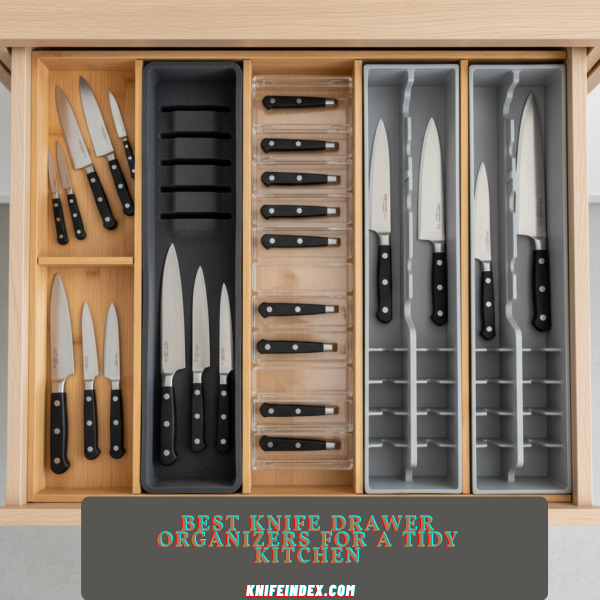
For lovers of clean lines and clutter-free countertops, the traditional knife block can feel like a bulky intruder. You’ve invested in beautiful, sharp knives, but you crave a storage solution that’s discreet, safe, and just as elegant. Enter the in-drawer knife organizer: the ultimate tool for the modern, minimalist kitchen. It’s the secret to transforming a hazardous, jumbled drawer into a perfectly organized, blade-safe arsenal that protects your tools and your fingertips.
Escaping the ‘Blade Pit’: How I Reclaimed My Counter and My Sanity
I confess: I am a countertop minimalist. I despise clutter. For years, this put me at odds with my growing collection of kitchen knives. I refused to own a bulky knife block, so my blades were relegated to what my partner grimly called the “Blade Pit”—a standard utensil drawer where my prized chef’s knife lived in mortal peril next to the potato peeler and a whisk. Every time I reached in, I was terrified of slicing a finger. And I constantly heard the sickening clink-clank of my finely honed edges striking other metal objects.
My knives were always getting dull, and I was always on edge. The solution came when I was helping a friend move. We were unpacking their kitchen, and they opened a drawer to reveal a stunning bamboo insert with every knife nestled perfectly in its own carved slot. It was an epiphany. Safe, organized, hidden, and blade-friendly. I ordered one that night. The peace of mind was immediate. My counters were clear, my knives stayed sharp, and the Blade Pit was officially closed for business. This guide is dedicated to helping you achieve that same kitchen nirvana.
What surprised me most wasn’t just the improvement in safety, though that alone would have justified the purchase. It was how much faster meal prep became once every blade had a fixed, obvious home. I no longer wasted ten seconds fishing through a drawer, feeling around blindly for the handle of my santoku while trying not to graze a blade edge. Cooking has a rhythm, and constant low-grade friction — searching, second-guessing, flinching — breaks that rhythm more than people realize. Once the drawer stopped being a hazard, it stopped being a mental tax too.
Beyond the Box: Our Criteria for Selecting the Best In-Drawer Organizers
An in-drawer organizer is more than just a tray; it’s a precision storage system. To separate the truly great from the merely adequate, we evaluated each product based on a strict set of criteria focused on functionality, safety, and long-term durability in a real American kitchen.
Our Core Philosophy: The best knife drawer organizer must first do no harm—it must protect the blade edge at all costs. Secondly, it must be efficient, making it easy to identify and retrieve the exact knife you need, when you need it.
- Material & Blade Protection: This is paramount. We prioritized organizers made from blade-friendly materials like bamboo, acacia wood, or cork. These materials won’t dull or chip the delicate cutting edge. We looked for designs where the sharp edge doesn’t bear the knife’s weight.
- Capacity & Knife Compatibility: How many knives does it hold, and what sizes? We looked for versatile designs that could accommodate a range of common kitchen knives, from small paring knives to long 10-inch slicing or bread knives.
- Design & Drawer Fit: A great organizer should use drawer space efficiently. We analyzed the footprint, the orientation of the knives (vertical vs. horizontal), and whether the design was expandable or modular. Crucially, we considered the height to ensure it would fit in standard kitchen drawers.
- Stability & Security: Do the knives stay put when you open and close the drawer? We looked for organizers with a non-slip base or those whose snug fit prevents shifting. Securely held knives are safe knives.
- Ease of Cleaning & Maintenance: Drawers collect crumbs and dust. We favored organizers that were easy to wipe down or had removable components for thorough cleaning.
We also weighed a handful of secondary factors that don’t make or break a product on their own but tip close calls one way or the other: how the organizer smells out of the box (cheap composite materials can carry an odd chemical scent for weeks), how it performs after repeated wet-and-dry cycles, whether the finish shows water rings after a few months of normal use, and whether the brand backs the product with any kind of warranty or replacement policy. None of these are dealbreakers individually, but a product that scores well across all of them tends to be the one you’re still happy with two years later.
The Drawer Report: Top 5 Knife Organizers
Need a quick decision? Here are our top five picks that master the art of in-drawer knife storage.
| Organizer | Image | Material | Best For | Check on Amazon |
|---|---|---|---|---|
| Noble Home Bamboo Organizer | 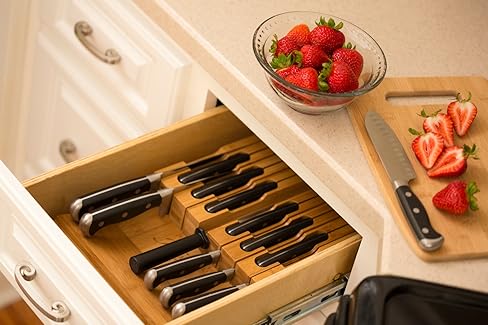 |
Bamboo | Best Overall Capacity | View Price |
| Joseph Joseph DrawerStore |  |
Plastic | Best for Small Drawers | View Price |
| Bambüsi Expandable Tray |  |
Bamboo | Best All-in-One Solution | View Price |
| Wüsthof In-Drawer Tray |  |
Beechwood | Best for Premium Knives | View Price |
| Knifedock Cork Liner |  |
Wood & Cork | Best for Blade Protection | View Price |
The Full Breakdown: In-Depth Reviews of the Best In-Drawer Organizers
We filled our drawers, slammed them shut, and grabbed for knives in a hurry—all to simulate real-world use. Here’s why these five organizers are the best on the market.
1. Noble Home & Chef Bamboo Organizer (Best Overall Capacity)
This is the organizer that solves the problem for the serious cook with a large collection. It’s beautifully made from sustainable bamboo and can hold a staggering 16 knives, plus a sharpening steel. The design is brilliant: it has two tiers, allowing it to hold both long knives (like bread and slicing knives) and shorter knives (like paring and utility knives) without wasting any space. The blades slide into carved slots, so they never touch each other, and the handles are left exposed for easy identification and grabbing.
The construction is solid, and it fits neatly into most standard kitchen drawers. For its sheer capacity and intelligent design, it’s our top pick. It’s the perfect home for a comprehensive set of knives, whether you’ve invested in one of the best chef knife brands or are building a collection piece by piece.
Who is this best for?
The home cook with a large and growing knife collection who needs maximum storage in a single, elegant tray.
- Huge capacity for 16 knives and a steel
- Smart two-tier design saves space
- Made from durable and attractive bamboo
- Protects blades and keeps them secure
- Excellent value for the capacity
Pros
- Requires a fairly wide drawer (at least 9 inches)
- May not fit steak knives with very thick handles
Cons
2. Joseph Joseph DrawerStore Compact Organizer (Best for Small Drawers)
Joseph Joseph is legendary for its space-saving kitchen designs, and this organizer is a work of genius. It uses an innovative two-tier, angled design that stacks up to nine knives of different lengths in a tiny fraction of the space of a traditional tray. It takes up less than half the width of other organizers, leaving plenty of room in the drawer for your other utensils. The slots hold knives securely, and it has a non-slip base to prevent it from sliding around.
This organizer is the perfect solution for apartment dwellers, small kitchens, or anyone with narrow drawers. It proves that you don’t need a massive drawer to have safe, effective knife storage. It’s an ideal way to store the essential knives you might find in the best affordable chef knives collections, keeping them safe and sharp in a tight space.
Who is this best for?
Anyone with narrow drawers or limited kitchen space who needs a clever, ultra-compact storage solution.
- Incredibly space-efficient design
- Fits in very narrow drawers
- Holds up to 9 knives of varying lengths
- Non-slip base adds stability
- Very affordable
Pros
- Made of plastic (though it is high-quality)
- Can be a tight fit for knives with very thick handles or bolsters
Cons
3. Bambüsi Expandable Drawer Organizer (Best All-in-One Solution)
Why dedicate one drawer to knives and another to utensils? This expandable organizer from Bambüsi lets you do it all in one place. It features a central, removable knife block that can hold 6-8 knives, surrounded by multiple compartments for all your flatware and gadgets. The entire unit can expand from 13 to 20 inches wide, allowing you to create a custom fit for your drawer.
This is the ultimate organizational tool for consolidating your kitchen essentials. The bamboo construction is sturdy and looks fantastic, and the dedicated knife block keeps your blades safe and separate from your spoons and spatulas. It’s a complete drawer makeover in a single product, perfect for organizing everything from your best bread knife to your smallest paring knife alongside your everyday cutlery.
Who is this best for?
The hyper-organized cook who wants a single, customizable solution for storing their knives, flatware, and kitchen tools in one drawer.
- Combines knife and utensil storage
- Expandable design for a custom fit
- Removable knife block for easy cleaning
- Made from 100% organic bamboo
- Excellent for total drawer organization
Pros
- Knife block has a smaller capacity than dedicated models
- Requires a wide drawer to fully expand
Cons
4. Wüsthof In-Drawer Knife Tray (Best for Premium Knives)
If you’ve invested in a set of high-end knives, they deserve a home of equal quality. This in-drawer tray from Wüsthof, a titan in the knife world, is a premium storage solution. Made from solid beechwood, it’s designed to hold seven knives—three long and four short—in recessed slots that cradle the blades perfectly. The build quality is exceptional, as you would expect from the brand.
This is a no-frills, high-function piece designed purely to protect your investment. It’s the kind of quality that complements a difficult decision like choosing between a Wüsthof vs. Victorinox. By choosing this tray, you’re opting for the same level of craftsmanship in your storage as you did for your blades. It’s simple, elegant, and built to last a lifetime.
Who is this best for?
The discerning cook who owns premium knives (especially Wüsthof) and wants a storage tray made with the same commitment to quality and craftsmanship.
- Exceptional build quality from a top-tier brand
- Made from beautiful, solid beechwood
- Holds knives securely and protects edges perfectly
- Designed to fit a core set of essential knives
Pros
- Premium price point
- Limited capacity of 7 knives
Cons
5. Knifedock Cork Lined Tray (Best for Blade Protection)
This organizer features a simple but brilliant innovation: the blade dividers are lined with soft, gentle cork. While wood and bamboo are great, cork is even softer, providing the most forgiving surface possible for your finely honed knife edges to rest against. This virtually eliminates any risk of chipping or dulling, even if you place your knives in the drawer carelessly.
The tray is made of solid wood and has 11 slots for a variety of knife sizes. It’s a sturdy, well-designed piece that prioritizes one thing above all else: the health of your blades. For knife aficionados who spend time debating the merits of a Zwilling vs. Henckels blade, this level of protection is highly appealing. It’s a fantastic choice for those who want maximum peace of mind.
Who is this best for?
The knife enthusiast who is most concerned with protecting the delicate edges of their blades and wants the gentlest storage material available.
- Soft cork lining is extremely gentle on blades
- Prevents any chance of chipping or dulling
- Solid wood construction
- Good capacity with 11 slots
Pros
- Cork can potentially absorb moisture if knives are put away wet
- Takes up more space than compact models
Cons
Measuring Your Drawer Correctly: The Step Most People Skip
More returned organizers get sent back for one reason than any other: the buyer never actually measured the drawer. It sounds obvious, but “the drawer looks about the same size as my old one” is not a measurement, and kitchen drawers vary far more than most people expect, even between cabinets in the same kitchen from the same manufacturer.
The Three Measurements That Matter
Before you add anything to your cart, pull the drawer all the way out and record three numbers with a tape measure, not a guess:
- Interior width — measured wall to wall at the narrowest point, since many drawer boxes taper slightly or have hardware protruding on one side.
- Interior length — measured from the back wall to the point where the drawer front begins to curve or angle inward, not to the very front lip.
- Interior height — measured from the drawer floor to the underside of the countertop or the drawer above, including any slide hardware that eats into vertical clearance.
Height is the dimension people forget most often, and it’s the one that causes the most frustrating returns. A tray that’s a perfect footprint match can still fail to close the drawer if it’s a half-inch too tall, especially in drawers with center-mount glides or an overhead drawer stacked directly above.
Accounting for Drawer Slides and Hardware
Side-mounted drawer slides can eat up to an inch of usable width on each side of a drawer box, which matters enormously for organizers designed to be a snug fit. If your kitchen uses older ball-bearing slides mounted low on the drawer sides, measure at the height where the organizer will actually sit, not just at the very top of the drawer opening, since some slide hardware bulges inward partway down.
Leaving Room to Open and Close Comfortably
Don’t measure to the exact millimeter and buy a tray that fills every available inch. Leave at least a quarter inch of clearance on each side so the tray can be lifted out for cleaning without prying, and so seasonal wood expansion in humid months doesn’t jam the fit. A tray that’s technically the right size but installed with zero clearance often ends up more annoying than a slightly loose one.
Material Guide: Bamboo vs. Cork vs. Solid Wood vs. Plastic
Material is the single biggest factor separating a knife organizer that protects your investment from one that quietly damages it. Here’s how the four common materials actually compare in daily use, not just on a spec sheet.
Bamboo
Bamboo is technically a grass, not a wood, and it grows remarkably fast and dense, which makes it both sustainable and hard-wearing. It’s naturally resistant to moisture absorption compared to many hardwoods, and its tight grain means it won’t easily splinter or dent from a knife edge resting against it. The tradeoff is that bamboo can be slightly harder than some woods, so over years of use it may show more visible wear marks where a blade repeatedly slides into the same slot, even though it won’t structurally weaken.
Cork
Cork is the softest common lining material, and that softness is exactly why it’s prized for blade protection. A cork-lined slot conforms slightly to the blade shape and cushions contact in a way that rigid wood simply can’t. The downside is that cork is more porous, so any knife put away even slightly damp can transfer moisture into the lining, and over time that moisture exposure can lead to mold if the drawer doesn’t get good airflow. Cork liners generally need a bit more attentive maintenance than wood or bamboo.
Solid Hardwood (Beech, Acacia, Walnut)
Premium organizers, especially those sold by knife brands themselves, often use solid hardwoods like beech or acacia. These woods are typically kiln-dried and finished with food-safe oil, giving them excellent dimensional stability, meaning they won’t warp or swell as easily with seasonal humidity changes. They tend to carry a higher price tag, but the craftsmanship usually shows in tighter tolerances and a finish that resists staining from acidic foods.
Plastic and Composite
Plastic organizers, like the compact Joseph Joseph style trays, trade a bit of luxury feel for practicality: they’re the easiest to wash (some are even dishwasher-safe), the lightest to lift out, and usually the most affordable option. Quality varies enormously here — cheap, thin plastic can develop stress cracks after repeated flexing, while well-molded ABS or polypropylene trays hold up for years. Plastic is also the most forgiving material if you tend to put knives away while they’re still a little wet, since it won’t absorb moisture the way cork or unsealed wood can.
Quick Rule of Thumb: Choose bamboo or hardwood for everyday durability and looks, cork if blade protection is your single highest priority and your kitchen has good ventilation, and plastic if budget, dishwasher-safety, or minimal upkeep matters most.
Horizontal vs. Vertical Knife Storage in a Drawer
Most in-drawer organizers store knives horizontally, lying flat with the blade resting in a carved or molded slot. A smaller category of products instead stores knives vertically, blade-down, in individual slim pockets similar to a mini knife block laid inside the drawer.
The Case for Horizontal Trays
Horizontal storage is by far the most common approach, and for good reason. It allows a single shallow tray (often under two inches tall) to hold many knives side by side, which fits comfortably in standard drawer depths. Horizontal slots also make it easy to see every knife at a glance, since handles are all facing up and roughly the same direction, and it’s generally easier to grab a knife safely from a horizontal slot because your hand approaches from above the handle rather than reaching down toward a blade tip.
The Case for Vertical Storage
Vertical in-drawer storage takes up less width for a given number of knives, since knives are stacked side by side rather than laid end to end, but it demands significantly more drawer depth. It works best in kitchens with unusually deep drawers, such as some pot-and-pan drawers repurposed for cutlery. The main safety consideration is that a vertical slot must fully sheath or shield the blade edge, otherwise a hand reaching in from above risks contact with an exposed edge on the way down.
For the vast majority of standard American kitchen drawers, which run somewhere between two and four inches deep, horizontal trays remain the more practical and widely available choice.
In-Drawer Trays vs. Countertop Blocks vs. Magnetic Strips vs. In-Drawer Sheaths
Knife drawer organizers are only one of several storage philosophies, and understanding how they stack up against the alternatives helps clarify whether a drawer solution is really the right fit for your kitchen.
Countertop Knife Blocks
The traditional wooden block sitting beside the stove offers the fastest possible access — no drawer to open, no searching, just reach and grab. The tradeoff is permanent counter real estate, a surface that collects dust and grease inside the slots over time, and a fixed number of slots that rarely matches your actual knife collection exactly. Blocks also make it harder to keep knives fully out of reach of curious children, since they’re always visible and accessible at counter height.
Magnetic Knife Strips
Wall-mounted magnetic strips are the space-saving countertop alternative: knives are displayed edge-out on a magnetized bar, taking zero counter or drawer space. They look striking in an open kitchen and make every blade instantly visible. The downsides are real, though — magnetic strips expose blade edges at all times, which is a genuine hazard in households with kids or during a crowded, hurried dinner service, and mounting one requires securing it firmly to a stud or using appropriate wall anchors, which isn’t always practical in rental kitchens.
In-Drawer Knife Sheaths and Edge Guards
A lower-cost alternative to a full tray is a set of individual blade sheaths or edge guards, plastic or felt-lined covers that slide over each blade before the knife goes into a regular utensil drawer. These are inexpensive and portable, and they solve the edge-protection problem without requiring any particular drawer size. However, they don’t solve the organization problem in the same way a tray does — knives still shift around loosely in the drawer, sheaths can slip off during vigorous drawer use, and you lose the at-a-glance visibility a tray provides.
Which One Actually Fits Your Kitchen?
If counter space is precious and you want zero visual clutter, an in-drawer tray wins outright. If speed of access during high-volume cooking matters more than a hidden aesthetic, a countertop block or magnetic strip may serve you better despite the visible footprint. Many serious home cooks actually run a hybrid system: a small countertop block for the two or three knives used daily, and an in-drawer tray for the rest of the collection.
Knife Rolls, Cases, and Bags: Storage for Knives on the Move
Everything discussed so far assumes your knives live in one fixed kitchen. But a meaningful number of cooks — culinary students, private chefs, caterers, and serious home cooks who travel for holiday cooking duty — need a storage solution built for transport rather than a stationary drawer.
Knife Rolls
A knife roll is a flexible fabric case with individual sewn pockets, designed to be rolled up and tied or zipped closed for carrying. Rolls are lightweight, pack flat in a bag, and typically hold anywhere from five to twelve knives depending on size. Because they’re soft-sided, they don’t protect against being crushed under heavier items, so they work best as a dedicated, standalone carry rather than being tossed into a shared duffel bag.
Hard-Sided Knife Cases
For cooks who need serious protection during transport — flying with knives in checked luggage, for instance — a rigid case with foam cutouts or individual locking sheaths offers far more protection than a soft roll. These cases are bulkier and heavier, but they’re the only sensible option if the knives will be tossed around in transit rather than carried carefully by hand.
How This Relates to Drawer Organizers
It’s worth noting that these are not competing products so much as complementary ones. Many cooks who own a nice in-drawer tray at home still keep a basic roll for travel, since a fixed tray obviously can’t come along to a friend’s kitchen for a holiday dinner. If you already know you’ll need portability at least occasionally, factor a roll or case into your total knife-storage budget rather than expecting a single drawer tray to do both jobs.
Universal Trays vs. Brand-Specific Knife Inserts
A distinction worth understanding before you buy is the difference between a universal in-drawer tray, designed to hold a range of knife shapes and sizes from any brand, and a brand-specific insert, designed and sold by a knife manufacturer to fit its own product line precisely.
Universal Trays
Most of the organizers on this list, including the bamboo and cork-lined models, are universal designs. Their slots are cut to accommodate a range of blade widths and handle shapes, which makes them the sensible choice if your knife collection is a mix of brands built up over years, as most home cooks’ collections are. The tradeoff is a slightly less precise fit for any individual knife compared to a purpose-built insert.
Brand-Specific Inserts
Some manufacturers, Wüsthof among them, sell in-drawer trays sized specifically around their own knife geometry — blade width, bolster shape, handle profile. If your entire collection is from a single brand, a brand-matched insert can offer a marginally snugger, more tailored fit. The obvious limitation is that it won’t necessarily accommodate future purchases from other brands as gracefully, and it locks you into that manufacturer’s sizing conventions going forward.
For most households with a mixed collection built up over time — a chef’s knife from one brand, a paring knife from another, hand-me-down steak knives from a set — a well-designed universal tray is almost always the more practical long-term choice.
DIY Knife Drawer Organizers: Is Building Your Own Worth It?
For woodworking hobbyists or anyone with an oddly sized drawer that no off-the-shelf product fits, building a custom in-drawer knife tray is a genuinely reasonable weekend project.
The Basic Build
A simple DIY tray starts with a shallow box cut to your drawer’s exact interior dimensions, typically from a single board of hardwood or plywood. Slots are cut at an angle — most woodworkers use somewhere between 15 and 20 degrees from vertical — using a table saw with the blade tilted, or a router with a straight bit run at that angle through a jig. The angle matters because it lets the knife rest on its spine rather than its cutting edge, the same principle every commercial tray relies on.
Simpler Alternatives to Full Woodworking
If a table saw isn’t in your toolkit, a dense, high-density foam insert cut to fit the drawer is a much lower-effort option. Slits are cut into the foam with a sharp utility knife, sized specifically to each blade’s thickness, so knives slide in snugly. Foam offers less structural blade protection than solid wood over the long term, since repeated insertion gradually widens the slit and knives can start to wobble, but it’s an inexpensive way to solve the immediate safety problem while you plan something more permanent.
When DIY Makes Sense — and When It Doesn’t
Building your own is worth the effort when your drawer’s dimensions genuinely don’t match anything available commercially, when you already have the tools and enjoy the process, or when you want a fully custom layout that mixes knife slots with compartments for other tools. For most people, though, the time and tooling cost of a from-scratch build outweighs the modest savings compared to a well-reviewed commercial tray, especially once angled slot-cutting is factored in.
Cleaning and Long-Term Maintenance
An in-drawer organizer is a low-maintenance product by design, but a few habits meaningfully extend its lifespan and keep it hygienic.
Routine Cleaning
Wipe wood, bamboo, and cork trays with a barely damp cloth rather than soaking them, and dry immediately with a towel rather than air-drying in place, since standing moisture is what eventually causes warping or mold. Plastic trays can typically handle a more thorough wash and, depending on the model, may be dishwasher-safe on a top rack — always check the manufacturer’s specific care instructions rather than assuming.
Refreshing Wood and Bamboo Finishes
Over months of use, wood and bamboo trays can start to look dry or dull, especially near the slots where blades slide in repeatedly. A light coat of food-safe mineral oil, applied every few months and buffed off after it soaks in, restores the finish and helps the wood resist moisture absorption. Avoid vegetable or olive oil for this, since those oils can turn rancid over time; mineral oil or a dedicated food-safe board oil is the standard choice.
Handling Crumbs and Drawer Debris
Because a knife tray sits inside a drawer that also collects everyday debris, it’s worth lifting the tray out every month or two to sweep out crumbs and dust that accumulate underneath and around it. This is also a good moment to check that the tray’s non-slip pads or feet, if it has them, haven’t come loose or worn down.
Drying Knives Before Storage
Regardless of the material, the single best habit for long-term tray health is simply making sure knives are fully dry before they go back into their slots. This one habit does more to prevent both rust on the blade and moisture damage to the tray than any cleaning routine after the fact.
Knife Safety Beyond Storage
A good organizer solves the storage half of knife safety, but it’s worth pairing it with a few broader habits, especially in households with children or frequent guests in the kitchen.
Childproofing Considerations
An in-drawer tray is inherently more child-resistant than a countertop block simply because it’s out of a small child’s line of sight and reach at counter height. For households with curious toddlers, pairing the drawer with a basic child-safety drawer latch adds a meaningful extra layer, since it prevents a drawer from being pulled open at all rather than relying solely on the knives being hard to grab once the drawer is open.
Teaching Safe Retrieval
Even with a well-organized tray, it’s worth building the habit of always grasping a knife by the handle only, lifting it straight up and out of its slot rather than sliding it out sideways, which can drag an edge across an adjacent knife or the tray itself. This is a good habit to model for anyone else in the household who uses the kitchen.
Sharp Knives Are Safer Knives
It’s counterintuitive, but a properly organized, well-protected, consistently sharp knife is safer to use than a dull one, since dull blades require more downward force and are more prone to slipping off whatever’s being cut. A good drawer organizer that prevents edge damage is, in that sense, a genuine safety investment, not just an organizational nicety.
Best Setups by Kitchen Type
Small Apartment Kitchens
Narrow drawers and limited counter space make a compact, space-efficient tray like the Joseph Joseph DrawerStore style organizer the natural fit. Prioritize width over raw capacity — a tray holding six well-organized knives in a four-inch drawer footprint beats one that holds twelve but can’t fit at all.
Large Family Kitchens
Households cooking for several people daily, with a larger knife collection accumulated over years, benefit most from a high-capacity two-tier tray. Look for a design that clearly separates larger chef’s and bread knives from smaller paring and utility knives, since a busy family kitchen sees the most drawer traffic and the clearest organization pays off fastest here.
Rental Kitchens
If you’re renting, a self-contained tray that requires no mounting or modification is the obvious choice over anything like a magnetic wall strip, which typically requires drilling. A tray also travels with you at move-out time far more easily than a wall-mounted fixture.
Shared or Multi-Cook Kitchens
Kitchens used by multiple cooks with different habits benefit from an organizer with clearly labeled or obviously differentiated slot sizes, so knives consistently go back to a predictable spot regardless of who’s doing the dishes. Consistency reduces the odds of a knife being left loose in the drawer by someone unfamiliar with the system.
Knife Types: What You’re Actually Storing
Choosing the right organizer is much easier once you know exactly what shapes and sizes you’re trying to fit. Knife collections look deceptively similar from a distance, but the blade profiles inside a typical set vary more than most people realize, and that variation is exactly what determines whether a tray’s slots will actually work for you.
Chef’s Knife
The workhorse of almost every kitchen, typically between 8 and 10 inches long with a wide, curved blade that tapers to a point. Because it’s usually the longest and widest blade in a collection, it’s the knife most likely to determine the minimum slot length and width an organizer needs.
Santoku
A shorter, straighter-edged alternative to the chef’s knife, generally 6 to 7 inches, often with a flatter profile and sometimes granton (dimpled) sides. Santoku knives usually fit comfortably in slots sized for a chef’s knife, but their flatter spine means they can sometimes sit slightly differently in an angled slot designed around a curved blade.
Paring Knife
Small, usually 3 to 4 inches, used for detail work like peeling and trimming. These are the easiest knives to accommodate in almost any organizer, since nearly every tray includes at least a few narrow, short slots sized for them.
Utility Knife
A mid-sized blade, typically 4 to 7 inches, that splits the difference between a paring knife and a chef’s knife. Utility knives are versatile in the kitchen and also versatile in a tray, usually fitting either the small or medium slot category depending on the specific model.
Bread Knife
Long, usually 8 to 10 inches, with a serrated edge. The serration itself doesn’t need special protection in the way a plain edge does, but the sheer length of a bread knife is often the deciding factor in whether a tray needs an extended slot or a two-tier design to accommodate it alongside shorter knives.
Boning and Fillet Knives
Thin, flexible, narrow blades used for detailed butchery or fish prep. Their slender profile means they can sometimes slide loosely in a slot sized for a standard chef’s knife, so a tray with adjustable or foam-lined slots handles these more securely than one with fixed wood carvings.
Cleaver
Wide, heavy, rectangular-bladed, and the single hardest knife type to fit into a typical in-drawer tray, since most slots are carved around a tapering blade profile rather than a flat rectangular one. If a cleaver is part of your regular rotation, check a tray’s maximum slot width carefully, or consider storing the cleaver separately in a wall-mounted block or a dedicated wide slot.
Steak Knives
Short blades paired with proportionally larger handles, often with bolsters or rounded grips that are noticeably thicker than a standard kitchen knife handle. As mentioned earlier in this guide, handle thickness — not blade length — is usually what determines whether steak knives fit a given tray’s slots.
A Short History of Knife Storage
Understanding how knife storage evolved helps explain why so many different formats exist today, and why the in-drawer organizer is a relatively recent addition to that lineage.
Early Storage: Sheaths and Rolls
For most of culinary history, knives were stored the way traveling cooks and butchers still store them today: wrapped, sheathed, or rolled individually. Professional kitchens for centuries relied on cooks bringing their own personal knife rolls from job to job, a tradition that persists in culinary schools and many restaurant kitchens to this day.
The Rise of the Countertop Block
The slotted wooden countertop block, the format most people picture when they hear “knife storage,” became a fixture of home kitchens in the mid-20th century, alongside the broader trend of dedicated, matched knife sets sold as a package. It solved the sheath problem by giving each knife a fixed, visible home, but it also introduced the counter-space and hygiene tradeoffs discussed earlier in this guide.
Magnetic Strips and the Open-Kitchen Trend
As open-plan and exposed-tool kitchen design grew popular, magnetic wall strips emerged as a way to display knives as design objects in their own right, borrowing an idea long used in professional and industrial settings for organizing metal tools. They reflected a broader shift toward kitchens as visible, almost performative spaces rather than purely functional ones.
The In-Drawer Organizer as a Minimalist Response
The in-drawer tray is, in a sense, a reaction against both the countertop block and the magnetic strip: it keeps the functional benefits of a fixed, protective home for each blade while removing the visual footprint entirely. Its rise tracks closely with the broader minimalist kitchen movement of the past couple of decades, where clear counters became a design priority in their own right rather than just a practical convenience.
Sustainability and Sourcing
Material choice affects more than blade protection and looks — it also affects the environmental footprint of the product you’re bringing into your kitchen, and this is worth a closer look for anyone weighing that factor in a purchase decision.
Why Bamboo Gets Marketed as Sustainable
Bamboo’s reputation as an eco-friendly material comes down to its growth rate: some bamboo species can reach harvestable maturity in three to five years, dramatically faster than hardwood trees, which often take decades. That said, sustainability claims vary a great deal by manufacturer and supply chain, so a “bamboo” label alone doesn’t guarantee responsible sourcing; certifications and transparent sourcing statements from the brand carry more weight than the material name by itself.
Hardwood Sourcing
Solid hardwood organizers, particularly higher-end beech or acacia trays, vary in sustainability depending on whether the wood comes from managed forestry operations or less regulated sources. Shoppers who care about this can look for FSC (Forest Stewardship Council) certification or similar labeling on premium wood products, though not every manufacturer discloses this clearly.
Cork as a Renewable Material
Cork has a genuinely strong sustainability story: it’s harvested from the bark of cork oak trees without felling the tree itself, and the bark regenerates over several years for repeated harvests from the same tree over its lifespan, which can run a century or more. This makes cork-lined trays an appealing choice for buyers specifically prioritizing renewable materials.
Plastic’s Tradeoffs
Plastic organizers carry a different sustainability profile: they’re generally petroleum-derived and don’t biodegrade, but their durability and light weight can offset some of that impact if the product lasts many years rather than being replaced frequently. Some manufacturers now offer trays made from recycled or partially recycled plastic, which is worth checking for buyers who want the practicality of plastic with a somewhat lower environmental cost.
How We Stress-Tested Long-Term Durability
Beyond initial fit and finish, we wanted to understand how these organizers hold up over months of real kitchen use, since a tray that looks great on day one but degrades quickly isn’t actually a good long-term value.
Repeated Wet-Dry Cycling
We simulated the daily reality of knives occasionally going back into the tray slightly damp by repeatedly introducing light moisture to test slots and monitoring for swelling, warping, or lingering odor over several weeks. Solid hardwood and bamboo trays with a sealed finish held up noticeably better than unfinished or thinly finished pieces, and cork-lined slots, as expected, needed the most attentive drying to avoid any hint of mustiness developing.
Repeated Insertion Wear
To approximate months or years of daily use in a condensed timeframe, we repeatedly inserted and removed knives from the same slots many times over, checking for slot widening, splintering, or loosening of the base. Tighter, more precisely cut slots in premium hardwood trays showed the least wear, while some budget composite trays began to show minor fraying at slot edges after extended repetition.
Weight and Load Testing on Bases
We also checked how non-slip bases and feet held up under the weight of a fully loaded tray being repeatedly slid in and out of a drawer, since a base that degrades or peels off defeats the purpose of a stability feature. Rubberized feet generally outlasted adhesive-backed rubber strips, which occasionally began to lift at the edges after months of friction against the drawer bottom.
What This Means for Your Purchase
The takeaway from this testing isn’t that any one material is universally superior, but that finish quality and construction precision matter as much as the raw material choice. A well-finished, precisely cut bamboo or plastic tray will often outlast a poorly finished hardwood one, so it’s worth reading reviews for comments specifically about long-term wear rather than relying on material type alone.
Shopping by Budget Tier
Budget Tier (Under $25)
At this price point, expect molded plastic construction, moderate capacity, and basic but functional slot design. These organizers won’t offer the visual warmth of wood or bamboo, but a well-reviewed budget tray still solves the core safety and organization problem effectively, and it’s a sensible entry point if you’re not yet sure an in-drawer system will suit your kitchen habits.
Mid-Range Tier ($25–$50)
This is where most bamboo and basic solid-wood trays land, including several of the organizers reviewed in this guide. Expect better fit and finish, larger capacity, and often a two-tier or expandable design. For most home cooks, this tier offers the best balance of durability, capacity, and price.
Premium Tier ($50 and Up)
Premium trays, including brand-specific inserts from knife manufacturers and cork-lined specialty trays, focus on craftsmanship, precise fit, and superior blade protection rather than maximizing capacity. This tier makes the most sense for cooks with a smaller collection of genuinely expensive knives, where protecting the investment matters more than storing the largest possible number of blades.
Knife Organizers as Gifts
An in-drawer knife organizer is an unusually practical gift for anyone who cooks regularly, precisely because it’s the kind of purchase people rarely make for themselves until after years of frustration with a cluttered drawer. A few things are worth considering if you’re buying one as a gift rather than for your own kitchen.
Sizing Is the Main Challenge
Since fit depends entirely on the recipient’s specific drawer dimensions, a universal or expandable tray is a safer gift choice than a fixed-size premium insert, unless you happen to know their drawer measurements already. Gift receipts or easy-return policies are worth checking for this reason.
Pairing With Other Kitchen Gifts
An organizer pairs naturally with a new knife or a small knife set as a combined gift, since it solves the “where do I even put this” problem that often comes with receiving new kitchen tools. It also works well as a practical add-on to a housewarming gift for someone moving into their first kitchen with real counter-space constraints.
More Reader Questions, Answered
Will an in-drawer tray work in a drawer with a divider already installed?
It depends on the divider. A fixed, non-removable divider that splits the drawer into unequal sections may prevent a rectangular tray from sitting flat; measure each resulting section separately rather than the drawer’s total width. A removable divider can simply be taken out for the knife tray and reinstalled elsewhere if you still want compartments for other tools.
Can I stack two smaller trays instead of buying one large one?
Some households do exactly this, using one shallow tray for larger knives and a second, thinner tray or insert for smaller ones side by side rather than stacked, since true vertical stacking usually isn’t stable unless the trays are specifically designed to interlock. Check your drawer’s height carefully before assuming two trays will fit comfortably.
Do in-drawer trays work for left-handed cooks?
Yes — since knives sit with the handle exposed and accessible from directly above, orientation isn’t handedness-dependent the way, say, a right-hand-biased kitchen tool might be. The main consideration for left-handed cooks is simply where the tray sits relative to their dominant-hand workspace, which is a kitchen layout question rather than a product design one.
How many slots should I actually buy for future knife purchases?
A reasonable rule of thumb is to buy a tray with two or three more slots than your current collection, since most home cooks’ knife collections grow gradually over years rather than shrinking. Buying exactly to your current count often means an awkward second purchase within a year or two.
Common Myths About Knife Storage
Myth: Any drawer tray protects blades equally well.
Not true — as covered in the material guide above, softer materials like cork provide meaningfully more cushioning than hard wood or bamboo, and cheap, loosely fitted slots can actually allow more blade movement (and therefore more edge contact) than a snug, well-carved slot in a firmer material.
Myth: Wood knife trays need to be treated exactly like cutting boards.
While the food-safe oiling advice is similar, a knife tray doesn’t need nearly the same oiling frequency as an actively used cutting board, since it isn’t being cut on or exposed to the same level of daily contact and moisture. A few times a year is typically sufficient for most trays.
Myth: A bigger tray is always a better tray.
Capacity matters, but only relative to your actual drawer size and knife collection. An oversized tray that barely fits, leaving no clearance and making the drawer hard to open, is a worse everyday experience than a slightly smaller tray with a comfortable margin, even if the larger one technically holds more knives.
Myth: In-drawer storage is less hygienic than a countertop block because it’s hidden.
This one runs backward from reality. Because a drawer tray is fully enclosed and can be lifted out entirely for cleaning, it’s generally easier to keep genuinely clean than a traditional slotted block, whose narrow internal slots are notoriously difficult to reach with a cloth or brush.
Ten Extra Tips From Professional Kitchens
- Group knives by frequency of use within the tray, not just by size, so your most-reached-for blades sit closest to the front of the drawer.
- Label slots temporarily with painter’s tape during the first week after a big kitchen reorganization, so household members build the habit of returning knives to the same spot.
- Keep a small silicone or rubber mat under the tray itself if your drawer bottom is a slick laminate, even if the tray already has a non-slip base, for an extra layer of stability.
- Avoid placing a knife tray directly beside a heat source drawer, such as one above a dishwasher or oven, since repeated heat exposure can accelerate warping in wood and bamboo over time.
- If your collection includes a honing steel, look for a tray with a dedicated slot for it rather than letting it roll loosely among the knives.
- Reassess your tray’s fit any time you replace your entire knife set, since a new set’s blade widths and handle shapes may differ meaningfully from your old one.
- For households with a dishwasher-safe plastic tray, still hand-dry it immediately after a dishwasher cycle rather than letting it air-dry inside a closed drawer, to avoid trapped humidity.
- Keep sharpening tools like whetstones separate from the knife tray itself; the stone can pick up moisture and grit that’s better kept away from stored blades.
- When traveling with knives even occasionally, invest in a basic roll rather than wrapping blades in a towel, which offers essentially no edge protection during transport.
- Revisit your drawer organization about once a year, since knife collections, cooking habits, and household needs all shift gradually, and what fit perfectly two years ago may no longer reflect how you actually cook today.
Common Mistakes to Avoid
- Skipping the height measurement. As covered above, this is the single most common cause of a tray that looks perfect but won’t let the drawer close.
- Buying based on knife count alone. A tray advertised for “12 knives” may only fit 12 identically sized knives; a mixed collection with a large chef’s knife and a long bread knife often needs fewer, larger slots rather than more, smaller ones.
- Putting knives away wet. This damages both the blade and, over time, cork or unfinished wood trays.
- Sliding knives in sideways instead of lifting them straight down into the slot. This is both a safety risk and a common cause of nicks along the slot edges.
- Ignoring drawer slide hardware when measuring width. A tray that fits the drawer opening but not the usable interior width, once slides are accounted for, won’t sit flat.
- Choosing a magnetic strip or open block in a home with small children without considering that exposed blades are a very different risk profile than a covered drawer.
Pre-Purchase Buying Checklist
Before you check out, confirm the following:
- You’ve measured interior width, length, and height of the actual drawer, accounting for slide hardware.
- The tray’s stated capacity matches your real knife sizes, not just a generic count.
- The material fits your priorities: bamboo or hardwood for durability and looks, cork for maximum blade protection, plastic for easy cleaning and budget.
- The tray has some form of non-slip base or snug fit to prevent shifting when the drawer opens and closes.
- You’ve decided whether you need a portable roll or case in addition to a fixed drawer tray, if travel or catering work is part of your routine.
- You’ve checked whether the product is dishwasher-safe or requires hand care, if that matters to your routine.
Your Drawer Dilemmas, Solved
Is it bad to keep knives in a drawer?
It is extremely bad to store knives loose in a drawer. When unsecured, their sharp edges constantly collide with each other and other utensils, leading to nicks, chips, and rapid dulling. It is also a major safety hazard. However, using a dedicated in-drawer organizer is one of the best ways to store knives. It keeps them stationary, separated, and safe, all while freeing up your counter space.
Are knife drawer organizers better than countertop blocks?
They each have their pros and cons. In-drawer organizers are superior for those who value clear, uncluttered countertops. They are also generally more hygienic than traditional slotted blocks, which can be hard to clean. Countertop knife holders or blocks offer quicker, more immediate access to your tools. The “better” option depends entirely on your kitchen’s layout and your personal preference for aesthetics and workflow.
How do I measure my drawer to make sure an organizer will fit?
This is the most crucial step! You need to measure three internal dimensions of your drawer: width (side to side), length (front to back), and height/depth (top to bottom). Pay close attention to the height, as some organizers for large knives can be too tall for shallow drawers. Always compare your three measurements to the product dimensions listed on Amazon before you buy.
Can I store steak knives in a drawer organizer?
Yes, most organizers have smaller slots that are perfect for steak knives or utility knives. However, be mindful of handle thickness. Some steak knives, particularly those with thick, rounded handles, may be too bulky to fit in the narrower slots of some compact organizers. Models like the Noble Home & Chef are generally better for accommodating a full set of steak knives.
How do you organize a deep utensil drawer with a knife tray?
Use a two-tier or stackable in-drawer knife tray so the top layer holds knives and the bottom layer holds smaller utensils. Keep the knife slots along the back or side of the drawer so knives are never underneath heavier tools, and pad any unused slot with a cork or felt insert to prevent rattling.
What is the difference between an in-drawer knife tray and a knife roll?
An in-drawer knife tray is a fixed insert that lives inside a kitchen drawer and is meant for daily use in one location. A knife roll is a portable, soft-sided case with individual pockets designed for carrying knives to a different kitchen, a culinary class, or a catering job. Trays prioritize drawer fit and daily access; rolls prioritize portability and travel protection.
Can you make a DIY knife drawer organizer?
Yes. A basic DIY option is a shallow wooden or bamboo box cut to your drawer’s interior dimensions, with angled slots cut using a table saw or router at roughly a 15 to 20 degree angle so blades rest on their spine rather than their edge. Simpler DIY versions use a dense foam insert with slits cut for each blade, though foam offers less edge protection than solid wood or cork over time.
The Final Verdict: The Best Organizer for Your Drawer
Reclaiming your kitchen drawer is a simple upgrade with a profound impact. It brings safety, organization, and a quiet sense of order to the heart of your home, all while protecting the tools you rely on for every meal.
For the cook who needs maximum capacity and a smart, durable design, the Noble Home & Chef Bamboo Organizer is our top recommendation. It’s a masterclass in efficient, high-density storage.
If you’re fighting for every inch of space in a smaller kitchen, the ingenious Joseph Joseph DrawerStore is a game-changer, proving that even the narrowest of drawers can house a full set of knives safely. And for those who want the absolute gentlest home for their prized blades, the Cooks Standard Cork Lined Tray offers unparalleled edge protection.
Measure your drawer, assess your collection, and choose the organizer that fits your life. It’s a small step that will make your kitchen safer, your knives sharper, and your countertops beautifully, blissfully clear.