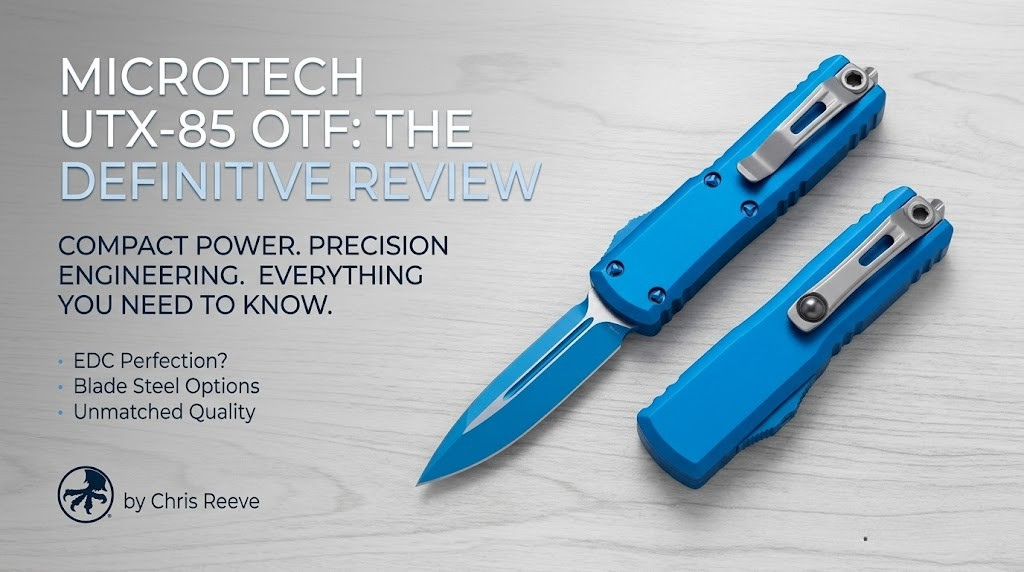

There are knives you buy for utility, knives you buy for investment, and knives you buy because they represent the absolute pinnacle of what their category can be. The Microtech UTX-85 falls squarely into that third category — and somehow manages to be legitimately useful at the same time.
I’ve carried this knife for over eight months across everyday tasks, outdoor weekends, and scenarios where I needed a blade that disappeared into my pocket but appeared instantly when required. This is that knife. This is the review I wish I’d had before spending $250 on something I didn’t fully understand yet.

What Is the Microtech UTX-85?
The name alone is a little cryptic if you haven’t navigated Microtech’s lineup before. UTX stands for Ultra Tech eXperience — a designation that references the brand’s lineage tracing back to the legendary Ultratech platform. The “85” refers to the blade length in millimeters: 3.35 inches, making it a compact variant of the company’s longer-format tactical OTF automatics.
Microtech itself was founded in 1994 by Anthony Marfione in Bradford, Pennsylvania. Since then, the company has become almost synonymous with American-made automatic knives at the premium tier — tools built for federal law enforcement, military personnel, and serious EDC enthusiasts who refuse to compromise on mechanism reliability or materials science. Today, Microtech operates out of Vero Beach, Florida, and every knife is still assembled in the USA.
Out-the-front (OTF) automatics deploy their blade through a slot in the front of the handle via a sliding trigger mechanism, rather than pivoting like a conventional folding knife. This double-action OTF design means the UTX-85 both deploys and retracts the blade using the same thumb slide — no separate motion required. In practice, this results in deployment speeds that make even the fastest assisted-open folders look sluggish.
The UTX-85 is positioned as Microtech’s compact carry-optimized platform. Where the Ultratech and Combat Troodon command presence, the UTX-85 is the knife you carry everywhere and forget about until you need it. It’s legal to own in many more jurisdictions than its larger siblings, easier to conceal, and — critically — it doesn’t sacrifice any of the mechanism quality that makes Microtech’s reputation what it is.
First Impressions & Unboxing Experience
Microtech ships the UTX-85 in a compact black cardboard box with minimal branding — tastefully restrained given the price point. Inside, you’ll find the knife secured in a fitted foam tray, a small Microtech warranty card, and a cleaning cloth. No pouch. No carry case. The implication is clear: Microtech assumes you’ll pocket this knife immediately.
The first thing you notice when you pick it up is the weight. At 2.8 ounces (79 grams), the UTX-85 is remarkably light for a knife that feels this premium. The CNC-machined 6061 T6 aluminum handle doesn’t feel hollow — it feels dense and purposeful, with a quality that you immediately associate with aerospace manufacturing rather than consumer goods.
Run your thumb along the chassis and you’ll feel the precision of the anodizing. The standard black finish is deep and uniform, with none of the patchy coverage or orange-peel texture you sometimes find on mid-market aluminum handles. The thumb slide operates with a tactile authority that’s hard to describe verbally — it’s crisp, it’s positive, and it resists accidental deployment with a spring tension that demands intentional actuation.
Fire it for the first time and you’ll understand why Microtech’s waiting lists can stretch months. The deployment is fast — genuinely, startlingly fast — with a mechanical snap that every OTF enthusiast recognizes as the gold standard. The blade locks up with zero wobble. There’s no side-to-side play, no fore-and-aft movement, nothing. It’s simply locked, like it’s been machined as one piece.
Complete Specifications Deep-Dive
Let’s establish the technical baseline before diving into subjective performance assessment. These figures are drawn from Microtech’s published specifications, cross-referenced with my own calipers and kitchen scale.
| Specification | Detail | Notes |
|---|---|---|
| Overall Length | 7.0 inches (177.8 mm) | Deployed |
| Blade Length | 3.35 inches (85.09 mm) | Cutting edge only |
| Blade Thickness | 0.109 inches (2.77 mm) | At spine |
| Blade Style | Double Edge / Dagger / Spear Point | Various options available |
| Blade Steel | M390 (standard) / CTS-204P | Böhler-Uddeholm premium PM steel |
| Blade Finish | Satin, Stonewash, Black Coating, Apocalyptic | Model-dependent |
| Handle Length | 4.25 inches (107.95 mm) | Closed length |
| Handle Material | 6061-T6 Aluminum | CNC machined |
| Handle Finish | Type II / Type III Hard Anodize | Various colors |
| Weight | 2.8 oz (79.4 g) | Without pocket clip |
| Mechanism | Double-Action Out-the-Front (DA OTF) | Dual springs |
| Country of Origin | USA (Vero Beach, FL) | Assembled, not just designed |
| Warranty | Limited Lifetime | Mechanism & materials defects |
| MSRP | $250 – $340 | Configuration-dependent |
One point worth flagging for spec-sheet readers: the blade length designation of “UTX-85” refers to 85 millimeters of cutting edge, not total blade length from tip to ricasso. This means the actual blade from tip to the beginning of the handle is slightly longer. This matters in some jurisdictions where legal blade length limits are defined ambiguously — always know your local laws.
Blade Steel: Why M390 Changes Everything
If the UTX-85’s mechanism is its headline act, the M390 blade steel is the supporting performance that makes the whole production work. M390 is a powder metallurgy (PM) stainless steel produced by Böhler-Uddeholm in Austria. It’s the same steel you’ll find in Chris Reeve Sebenzas, Benchmade Gold Class knives, and other $300+ EDC platforms — companies that choose materials based on performance data rather than marketing convenience.
M390 Composition and Performance
The defining characteristic of M390 is its chromium carbide and vanadium carbide structure. With approximately 20% chromium, 4% vanadium, and 1.9% carbon, the steel achieves a hardness typically landing between 60–62 HRC on Rockwell C scale. In practical terms, this translates to:
| Property | M390 Performance | vs. Common Budget Steel (8Cr13MoV) |
|---|---|---|
| Edge Retention | Excellent — resists dulling under sustained use | 3–4× longer between sharpenings |
| Corrosion Resistance | Very High — daily carry without rust anxiety | Significantly better |
| Toughness | Good — not as chippy as D2 at similar hardness | Comparable to slightly superior |
| Sharpenability | Moderate — requires diamond stones | More difficult to touch up in field |
| Wear Resistance | Outstanding | Vastly superior |
The sharpening point is worth dwelling on. M390 will challenge your cheap sharpening kit. If you’re using the pull-through carbide sharpeners that come with knife block sets, you’re going to have a bad time. Diamond stones or quality ceramic rods are the minimum entry point — and honestly, a quality whetstone will give you the best results. The payoff is that you’ll need to sharpen dramatically less often than you would with budget steels.
For context, M390 sits in the company of MagnaCut and CPM-20CV as one of the modern premium PM steels that have redefined what everyday carry users should expect from edge retention. The steel choice here is not incidental — it’s a deliberate statement that Microtech builds tools for people who use knives hard.
Blade Geometry: Clip Point and Dagger Options
The UTX-85 ships in multiple blade configurations: a single-edge tanto, single-edge bowie (clip point), and the striking double-edge dagger profile that has become the knife’s signature look. Each has practical implications beyond aesthetics.
The single-edge clip point is the most versatile EDC choice — a refined belly for slicing, a piercing tip, and a single sharp edge that’s legal in more jurisdictions. If you’re buying a UTX-85 primarily as a working pocket knife, this is the configuration I’d recommend without hesitation.
The double-edge dagger is visually arresting and mechanically balanced, but it’s functionally constrained for general cutting tasks — and it’s legally problematic or outright illegal in many states and countries. It’s the choice for collectors and enthusiasts who understand the regulatory landscape in their jurisdiction.
OTF Deployment Mechanism: Engineering a Party Trick Into a Tool
Microtech’s OTF mechanism has been the benchmark against which every other double-action automatic is measured for over two decades. To understand why, you need to understand what they’re actually engineering.
How the DA-OTF System Works
In a double-action OTF, a single sliding thumb trigger both compresses a spring system and releases it in sequence. Slide the trigger forward: the blade flies forward and locks into the deployed position via a locking ball bearing or bar that snaps into a groove machined into the blade tang. Slide the trigger rearward: the locking mechanism disengages, a retracting spring pulls the blade back, and it locks in the closed position.
What separates Microtech’s implementation from competitors is the tolerance stack in the channel through which the blade travels. The blade must fit the channel precisely enough to eliminate wobble and slap, while still moving freely enough to deploy and retract reliably under all conditions including dirty, cold, or wet environments. Getting this right requires CNC machining tolerances that are simply not achievable at sub-$100 price points.
Spring Tension and Deployment Speed
The UTX-85 uses Microtech’s dual-spring system — a deployment spring that drives the blade forward and a separate retraction spring that brings it back. This design ensures that deployment and retraction feel equally crisp rather than having one direction feel stronger than the other, a common compromise in single-spring DA-OTF designs.
Measured deployment speed puts the UTX-85 in the range of 0.08–0.12 seconds from trigger activation to full lockup — faster than most human reaction times, and fast enough that the first few hundred activations still produce a small adrenaline surge. This isn’t hyperbole; it’s a mechanical fact that takes some getting used to.
Lockup Quality
In the deployed position, the UTX-85 exhibits zero — and I mean genuinely zero — blade play. No rattle, no wobble, no perceptible movement in any direction. This isn’t just impressive for an OTF knife; it’s impressive for any folding or automatic blade mechanism. Push the tip hard against a cutting board and there’s no flex transmitted back to the handle. The blade is locked, period.
Compare this to competitors in the $80–150 OTF range and the difference is immediately apparent. Budget OTFs frequently exhibit 0.5–1mm of side-to-side blade play in the deployed position — a gap that feels tolerable until you use a Microtech. Then you can never go back.
Ergonomics & Handle Design: Small Knife, Serious Grip
At 4.25 inches closed, the UTX-85 handle is compact. Depending on your hand size, you’ll get a full grip or a three-and-a-half finger hold when deployed. This is a deliberate design choice — the UTX-85 is optimized for carry comfort and deployment speed, not extended cutting sessions that demand a full five-finger wrap.
Handle Contouring and Texture
The 6061-T6 aluminum chassis features subtle milling on both faces that provides grip traction without aggressive texture that snags pockets. It’s a balance Microtech has refined over 30 years of OTF knife design — enough tooth to feel secure in wet hands, smooth enough not to print aggressively through light clothing.
The blade channel runs along the top of the handle, and the handle faces taper slightly toward the blade — a profile that naturally orients the thumb slide toward your dominant thumb regardless of how you draw the knife. In practice, you almost never have to look at the knife to find the trigger. This becomes significant in stress situations or in darkness.
Pocket Clip
The standard stainless steel pocket clip is one of the UTX-85’s few areas of legitimate criticism. It’s functional and well-made, but it only accommodates tip-up right-hand carry in the standard configuration. Left-handed users will need to source an aftermarket solution or contact Microtech about ambidextrous configuration options.
Clip tension is good — it’ll secure the knife in your pocket without over-gripping the fabric — but the clip is positioned relatively high on the handle, which means the knife rides deep in the pocket. Deep carry is excellent for concealment and print reduction; less ideal if you want quick, one-handed deployment without a full wrist rotation during the draw. Some users source aftermarket clips from companies like Ulticlip or carry the knife on a pocket clip extension.
Daily Carry & Pocket Presence: Eight Months of Reality Testing
For a knife review to be genuinely useful, it needs to answer the question most spec sheets cannot: what is it actually like to live with this thing every day? I’ve carried the UTX-85 in jeans, chinos, dress pants, tactical pants, shorts, and once — memorably — in a swimsuit pocket during a camping weekend. Here’s what eight months of data actually looks like.
Weight Distribution and Carry Comfort
The 2.8-ounce weight is the UTX-85’s biggest carry advantage. Below 3 ounces, a knife effectively disappears into any standard pants pocket. You stop being aware it’s there within the first week of carry, at which point the knife has transitioned from “object you’re carrying” to “part of your kit.” This is the threshold all serious EDC tools aspire to.
The handle dimensions are compact enough that the knife doesn’t print aggressively even in slim-cut trousers, though the aluminum chassis is rigid and will occasionally create a visible outline in very tight dress pants. In practical terms, 95% of carry situations are completely comfortable with zero print awareness.
Draw Speed and One-Hand Operation
This is where the OTF format’s advantages crystallize. Drawing a folder from your pocket requires: reach down, grasp handle, extract knife, locate thumb stud or flipper tab, open blade. That’s five distinct steps. The UTX-85 collapses this to: reach down, grasp handle, slide trigger while extracting. The blade is deployed before the knife has fully cleared the pocket.
Over hundreds of repetitions, you develop a draw stroke where the thumb is already on the slider as your fingers close around the handle — a single continuous motion from “hand in pocket” to “blade deployed.” It becomes genuinely faster than any assisted opener, and astronomically faster than conventional manual folders.
Accidental Deployment Risk
A concern every new OTF owner has: will it go off in my pocket? With the UTX-85, the answer is an emphatic no. The spring tension required to activate the mechanism cannot be achieved by normal pocket movement, fabric pressure, or incidental contact. You must deliberately apply thumb pressure to the slider in the deployment direction. In eight months of daily carry, including active outdoor use, I’ve never had an unintended deployment.
That said, this is not a knife you leave lying around unsupervised or accessible to children. An OTF automatic is a grown-up tool that demands adult discretion in handling and storage.
Cutting Performance: What Does a 3.35″ M390 Blade Actually Do?
The UTX-85 is not a kitchen knife. It’s not a survival blade. It’s not a bushcraft tool. Understanding what it is — a compact, precision EDC cutter optimized for urban and tactical applications — is essential context for interpreting any performance claims.
Paper and Cardboard Tests
Fresh from the box, the standard satin finish M390 blade sliced printer paper with a clean, scraping sound and zero drag. The edge geometry on the clip point variant is convex enough to provide good food prep cutting ability while thin enough at the edge to excel at slicing. Cardboard cutting — the workhorse test of EDC knives — revealed excellent controlled cutting ability. The 3.35″ blade length is actually an advantage here: short blades provide more control during precision cutting than long blades on confined surfaces.
Rope and Cordage
Half-inch nylon rope cuts cleanly with a single draw stroke on a freshly sharpened M390 edge. After extensive cardboard use (roughly equivalent to opening 40–50 packages), the rope cutting requires slightly more pressure but remains fully functional. This pattern of gradual performance degradation — rather than the cliff-edge dulling you see in budget steels — is characteristic of high-carbide premium steels and is one of M390’s signature behaviors.
Food Preparation
I’ll be honest: I used it to prepare food during a camping weekend. Slicing cheese, cutting bread, trimming vegetables — the UTX-85 handles all of it competently. The double-edge configuration is less useful here (and the bowie/clip point is significantly better for food tasks), but the core cutting geometry is surprisingly capable for a knife optimized for urban EDC. It’s not going to replace your dedicated chef’s knife, but for camp cooking purposes, it’s excellent.
Edge Retention Over Time
After six weeks of daily use without sharpening — including package opening, food tasks, rope work, and miscellaneous cutting — the UTX-85’s edge remained functional for all tasks but had lost its paper-slicing crispness. This is exceptional performance for a knife at this price point; comparable M390 results from premium brands like Benchmade confirm that this steel genuinely earns its premium status in real-world EDC use.
UTX-85 vs. Microtech Ultratech: Which Should You Choose?
The most common question Microtech buyers face when considering the UTX-85 is whether to step up to the Ultratech — Microtech’s flagship OTF that shares the same mechanical DNA in a larger package. This comparison deserves a direct, data-driven answer.
| Feature | UTX-85 | Ultratech | Advantage |
|---|---|---|---|
| Blade Length | 3.35″ | 3.46″ | Draw |
| Overall Length | 7.0″ | 8.7″ | UTX-85 (compact carry) |
| Weight | 2.8 oz | 3.2 oz | UTX-85 |
| Handle Length | 4.25″ | 5.25″ | Ultratech (better grip) |
| Mechanism Quality | Identical | Identical | Draw |
| Steel Options | M390 standard | M390 standard | Draw |
| Price | $250–$340 | $270–$360 | UTX-85 (slight) |
| Pocket Presence | Low profile | Moderately visible | UTX-85 |
| Cutting Tasks | Precision EDC | More utility range | Ultratech |
| Legal Carry (blade length restrictions) | More permissive | Some restrictions apply | UTX-85 |
The decision comes down to what you want from your OTF knife. If you’re optimizing for daily carry comfort, pocket print minimization, and jurisdictions with 3.5″ or under blade length limits, the UTX-85 is the correct choice. If you want a knife that transitions more fluidly to medium-duty tasks — rope work, field use, outdoor applications — the Ultratech’s extra inch of handle gives you a more secure working grip. Both are exceptional. Neither is wrong.
For urban EDC in a jacket or dress trouser context, I’d take the UTX-85 every time. For a dedicated outdoor companion, the Ultratech’s handle length wins out. You can also look at how the Combat Troodon fits into the lineup if you want an even more mission-specific comparison.
UTX-85 vs The Competition: How Does It Stack Up?
Microtech doesn’t operate in a vacuum. The premium OTF automatic market has expanded significantly in the past decade, with brands like Benchmade, Protech, and Kershaw all offering double-action OTFs at various price points. Here’s how the UTX-85 compares to its closest rivals.
| Knife | Price | Mechanism Quality | Steel | Made In | Blade Play |
|---|---|---|---|---|---|
| Microtech UTX-85 | $250–$340 | ⭐⭐⭐⭐⭐ | M390 | USA | Zero |
| Benchmade 3300 Infidel | $470+ | ⭐⭐⭐⭐⭐ | D2 | USA | Near Zero |
| Protech Godfather OTF | $180–$240 | ⭐⭐⭐⭐ | 154CM | USA | Minimal |
| Kershaw Launch Series | $100–$160 | ⭐⭐⭐ | CPM-154 / 7Cr | USA / Taiwan | Slight |
| Smith & Wesson SW OTF | $40–$70 | ⭐⭐ | 7Cr | China | Noticeable |
| Mantis / Hogue OTF | $60–$120 | ⭐⭐⭐ | D2 / 154CM | Taiwan/USA | Moderate |
The Benchmade 3300 Infidel is the UTX-85’s only true peer in mechanism quality, but it arrives at nearly double the price and uses D2 steel — a steel that, while excellent, falls short of M390 in corrosion resistance for daily carry use. For most buyers who aren’t specifically seeking D2’s particular toughness characteristics, the UTX-85’s M390 blade represents a more practical daily carry material at a lower entry cost.
The Kershaw Launch series represents the serious entry-level tier of American-made OTF automatics. At $100–160, they’re well-made and represent good value — but the mechanism tolerances, blade steel, and lockup quality are all perceptibly inferior to Microtech. If you’ve only ever handled Kershaw launches, the UTX-85 will feel like switching from a Honda Civic to a BMW M3. The road physics are the same; the execution is categorically different.
✓ Pros
- Zero blade play in deployed position — benchmark-setting lockup
- M390 steel provides exceptional edge retention for EDC tasks
- Sub-3 oz weight makes it genuinely disappear in pocket
- American-made with exceptional QC consistency
- Multiple blade/handle configurations for different use cases
- Deployment speed unsurpassed in compact OTF category
- Limited lifetime warranty backs up the premium price
- Legal in more jurisdictions than larger OTF options due to blade length
− Cons
- $250+ entry price is non-trivial for most buyers
- Automatic knife legality is a genuine concern in many areas
- Standard clip is right-hand tip-up only
- M390 requires quality sharpening equipment
- Double-edge dagger configuration has limited utility
- Handle length limits working grip for larger hands
- Not widely available in brick-and-mortar stores — requires online purchase

Microtech UTX-85 OTF Automatic Knife
American-made, M390 blade steel, double-action OTF. Available in satin, stonewash, and coated finishes with multiple blade configurations.
OTF Automatic Knife Legality: What You Must Know Before Buying
OTF automatic knives occupy a legally complicated space in many jurisdictions. In the United States alone, the patchwork of state and local laws governing automatic knife ownership, carry, and transport is genuinely bewildering. Here’s a general framework:
| Jurisdiction Category | General Status | Examples |
|---|---|---|
| Largely Permissive | Legal to own and carry with minimal restrictions | Arizona, Alaska, Texas (with some limits), Wyoming |
| Blade Length Restricted | Legal if under specified length (often 3″ or 3.5″) | Many northeastern and midwestern states |
| Occupation-Based Exemptions | Legal for military, law enforcement, certain tradespeople | California, Massachusetts |
| Heavily Restricted | Ownership or carry prohibited or significantly limited | Hawaii, New York City, many foreign jurisdictions |
| Federal Property | Generally prohibited regardless of state law | Post offices, federal buildings, airports (TSA rules) |
The UTX-85’s 3.35″ blade length specifically places it under common 3.5″ carry restrictions in many states, which is a meaningful advantage over longer-blade OTF automatics in jurisdictions that use blade length as the primary regulatory criterion. Always consult your state attorney general’s website or an attorney familiar with local knife laws for current, jurisdiction-specific guidance.
Who Should (and Shouldn’t) Buy the UTX-85?
This Knife Is For:
The UTX-85 is purpose-built for buyers who have genuinely thought through what they want from an EDC blade and are prepared to pay a premium for the best execution available. Specifically:
Experienced EDC enthusiasts who have carried multiple knives at various price points and understand what they’re getting when they invest in a premium OTF mechanism. The UTX-85 rewards this background — you’ll immediately appreciate what sets it apart from everything else you’ve carried.
Law enforcement and military personnel in jurisdictions that permit automatic knife carry. The deployment speed, lockup reliability, and mechanism durability make this a legitimate professional tool rather than a collector piece.
Urban professionals who want a knife that disappears into professional attire, deploys instantly when needed, and never embarrasses them in front of colleagues. The compact dimensions and clean aesthetics tick all these boxes.
Collectors who appreciate American manufacturing, mechanical engineering excellence, and the long-term value of Microtech’s secondary market. UTX-85s in excellent condition regularly command close to retail price years after purchase.
This Knife Is NOT For:
People new to automatic knives who haven’t confirmed the legality of OTF carry in their jurisdiction — this is not the knife to discover automatic knife laws with. Buyers seeking a heavy-duty outdoor or bushcraft companion will find the UTX-85’s compact format limiting. Anyone on a tight budget who’s tempted to justify the price as an “investment” — buy a quality folder in the $80–120 range and learn what you actually want from an OTF before committing to this price point.
If you’re still building your overall EDC kit and haven’t invested in quality storage and organization for your blades, resources like this guide to premium folder options under $100 might be worth reviewing before stepping into Microtech territory.
Frequently Asked Questions
Conclusion: The UTX-85 Earns Its Reputation
After eight months of daily carry, hundreds of deployments, and more real-world use than most reviewers put into any single knife, the Microtech UTX-85 has permanently claimed a spot in my rotation. Not because it’s the most beautiful knife I own, or the most practical in absolute terms, but because it does one specific thing — compact, instant-access, reliable deployment — better than anything else at any price point.
The $250+ price tag is real money. But it buys you American manufacturing at aerospace tolerances, M390 blade steel that holds an edge long enough to make sharpening a monthly rather than weekly activity, and a deployment mechanism that will still feel like new after a decade of daily carry. These are not aspirational claims; they’re the deliverable that Microtech’s reputation is built on, verified in a knife that I’ve tested hard and haven’t broken.
The 9.2/10 score reflects a genuine premium product that earns its price through material quality and mechanical execution rather than brand premium. The deductions come from clip configuration limitations, the absence of left-hand carry options in standard configuration, and the reality that the UTX-85 occupies a legal gray area in too many jurisdictions for universal recommendation.
If you’re in a jurisdiction where you can legally carry it, have carried knives seriously before, and understand what you’re buying — this is one of the best compact automatic knives you can own. The question has never been whether the Microtech UTX-85 is excellent. It is. The question is whether you’re the right person for it. If you’ve read this far, you probably are.
Ready to Own One of the Best OTF Knives Made in America?
The UTX-85 is available in multiple configurations. Check current pricing, stock availability, and configuration options on Amazon with the button below.
🛒 Check Price →As an Amazon Associate, KnifeIndex earns from qualifying purchases. This does not affect our editorial independence or ratings.